The Future of Payments: How Tokenization is Empowering Small Businesses in 2026
In today’s world, digital transactions have become the heartbeat of commerce.
Nowadays, small businesses are constantly looking for ways to stay secure and efficient.
It is important to note that tokenization has emerged as a game-changer for these entrepreneurs.
By protecting customer data, this technology is reshaping how local shops and online boutiques operate.
What is Tokenization?
To begin with, let’s define what tokenization actually is.
In simple terms, it is a security technique that replaces sensitive information—like your 16-digit credit card number—with a unique, random string of characters called a “token.”
For instance, when you pay for a coffee using a digital wallet like Apple Pay or Google Pay, the merchant never sees your actual card number.
Instead, they receive a meaningless token.
Even if a hacker were to steal that token, it would be useless to them because it is not your real card data.
It acts as a digital substitute that protects your account while keeping the checkout process fast and simple.
Learn More About:-
Understanding Tokenization and Wholesale Digital Assets in 2026
The Impact of Tokenization: Global Insights
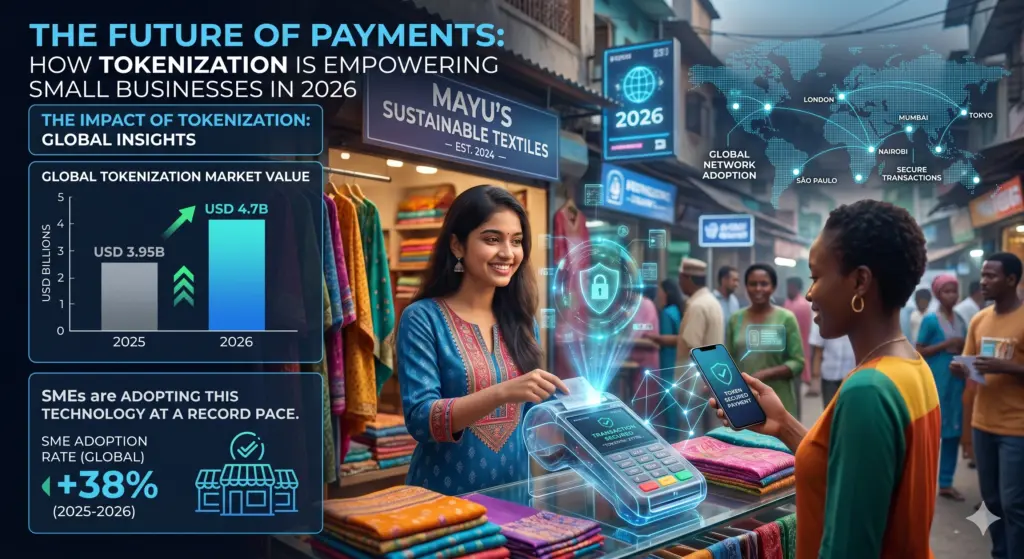
The global tokenization market is growing rapidly.
It was valued at approximately USD 3.95 billion in 2025 and is projected to reach USD 4.7 billion in 2026.
Furthermore, Small and Medium Enterprises (SMEs) are adopting this technology at a record pace.
Some significant impacts include:
- Enhanced Authorization: Data shows that tokenized transactions have a higher success rate because banks trust them more than traditional card data.
- Reduced Fraud: Merchants using network tokens have reported significant reductions in fraud-related chargebacks.
- Simplified Compliance: Because businesses no longer store raw card numbers, the burden of security regulations (like PCI DSS) is much lower.
Why is This Happening?
Initially, tokenization was only available to large corporations.
However, due to the rise in sophisticated cyber-attacks, security has become a necessity for everyone.
Consequently, payment providers have made these tools accessible to small business owners.
Moreover, Consumers are using digital wallets and “card-on-file” payments more and more.
Therefore, businesses have to upgrade their systems.
This helps them stay competitive.
The Need for Tokenization
Why does this need to occur?
Primarily, it is because trust is the currency of the digital age.
If a small business suffers a data breach, it can lose customers forever.
Thus, tokenization is no longer just an “extra” feature.
It is a critical defensive layer.
It helps businesses avoid the high costs of data leaks.
And it also ensures that customers feel safe every time they click “buy.”
Explore It:-
A beginners guide to cryptocurrency and blockchain technology
Benefits for Businesses Worldwide
There are many reasons why companies are embracing this change:
- Seamless Experience: It enables “one-click” checkouts, which makes shopping easier for customers.
2. Higher Revenue: Because tokenized payments are more reliable, businesses see fewer failed transactions.
3. Global Growth: It allows small businesses to sell internationally without worrying about complex, local security regulations.
4. Operational Efficiency: It saves time on manual data management, letting owners focus on growing their business instead of worrying about IT security.
The Future of Tokenization
Looking ahead, 2026 marks a turning point where tokenization is becoming “invisible.”
In the future, we will see the rise of Agentic Commerce, where AI agents shop on our behalf using secure, pre-authorized tokens.
Furthermore, tokenization will likely integrate deeper with digital identity wallets.
This means you will soon be able to verify your identity and make a payment in one single, secure movement.
Conclusion
In conclusion, tokenization has evolved from a complex technical concept into an essential tool for small business success.
Overall, it provides the security, trust, and speed that modern customers demand.
As we move through 2026, those who adopt these “token-first” strategies will undoubtedly have a significant advantage in the global marketplace.
Indeed, the future of small business is not just digital—it is secure, seamless, and smarter than ever before.
Are you a small business owner looking to implement tokenization, and what is your biggest concern regarding your current payment security?
Disclaimer
The information provided in this blog post is for educational and informational purposes only. While we strive to provide accurate and up-to-date content, technology and security standards evolve rapidly. Therefore, we do not guarantee the completeness or reliability of the information presented.
Small business owners should consult with a professional payment processor or a qualified cybersecurity advisor before making changes to their payment infrastructure. We are not responsible for any financial losses or data issues that may arise from the implementation of these technologies. Ultimately, you are responsible for the security decisions you make for your business.

Pingback: The Complete Ethereum Wealth Strategy: Build Long-Term Digital Wealth