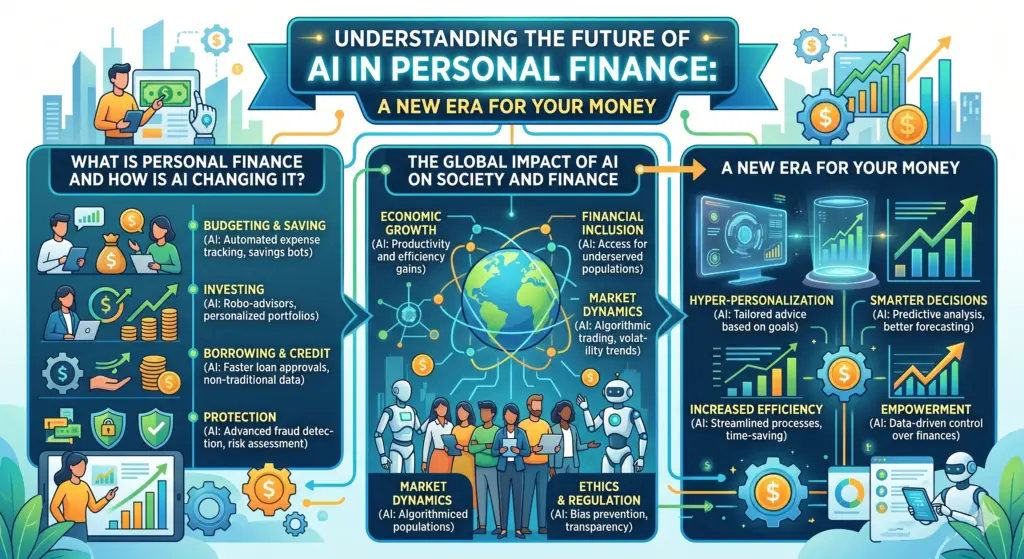
Understanding the Future of AI in Personal Finance
A New Era for Your Money
Firstly, I want to express my deepest gratitude to you for being here. Thank you for taking the time to read this post.
In today’s world, managing money is very important.
Nowadays, technology is moving incredibly fast.
Let’s start with a warm welcome as we explore this exciting topic together.
It is important to note that artificial intelligence is changing everything.
For example, in 2026, we have highly advanced AI versions like GPT-5.5, Gemini 3.1 Pro, and Llama 4.
Indeed, the global AI in finance market reached $51.8 billion in 2025.
In 2026, the global AI market size has already climbed to approximately $600 billion.
Significantly, it is expected to grow to over $1,000 billion by 2035.
At the same time, the specialized AI-powered personal finance market has reached a substantial $1.77 billion this year.
Due to this massive growth, we must understand how it affects our wallets.
Artificial Intelligence is completely stepping into our daily lives, and it is here to change how we handle our wealth.
Recent data highlights that young generations are leading this change.
In fact, around 67% of Gen Z and 62% of Millennials have already used AI to assist with their personal finances.
Consequently, this technology is no longer a distant dream. It is a real, everyday tool that is reshaping our global society.
What is AI?
To begin with, let’s clarify what we mean by AI.
Artificial Intelligence, or AI, refers to the use of computer systems to copy human intelligence processes.
This includes things like learning from data, recognizing patterns, and making decisions.
Nowadays, we see “Generative AI“—models that can create content and solve complex problems. It has become a standard part of our digital toolkit.
In essence, it acts like a tireless assistant that processes information much faster than any human could.
These smart systems are trained on massive amounts of data.
As a result, they can perform complex tasks that usually require human brainpower.
AI is made up of several important technical components:
- Machine Learning (ML): This allows computers to learn from past data and improve over time without direct programming.
- Natural Language Processing (NLP): This helps machines understand, read, and respond to human language naturally.
- Predictive Analytics: This uses historical data to forecast future trends and behaviors.
Learn more about
The Global Impact of AI on Society and Finance
Nowadays, AI is leaving a massive footprint on society worldwide.
It is transforming major global sectors such as healthcare, education, and transportation.
For example, AI algorithms are now assisting doctors in diagnosing diseases with incredible accuracy.
Furthermore, it optimizes global supply chains to reduce corporate waste and lower carbon footprints.
Because of its broad success, AI is now creating deep ripples in personal finance.
In the past, people had to rely solely on human advisors or confusing spreadsheets.
Now, intelligent algorithms can look at your unique spending habits in real time.
Therefore, AI bridges the gap between complex financial data and ordinary citizens, making wealth management accessible to everyone.
What is Personal Finance and How is AI Changing It?
To understand the future, we must look at what personal finance means to us.
Personal finance is the management of money and financial decisions for an individual or a family.
It includes how you handle your income, saving, budgeting, investing, and insurance.
In our daily lives, we calculate personal finance through core pillars:
Personal Finance = Income - (Spending + Savings + Investing + Debt Payments)
Historically, we calculated these numbers manually.
We wrote down expenses in paper diaries or typed them into Excel sheets.
Yet, this traditional process is often slow and prone to human error.
This is exactly where AI changes the game.
Instead of you calculating your remaining monthly budget, AI tracks your bank accounts automatically.
It categorizes your food, rent, and entertainment bills instantly.
In the same way, it looks at your cash flow history and warns you if you are about to overspend before it actually happens.
Understanding the Future of AI in Personal Finance
When we look deep into the future, we see that AI will become an autonomous financial co-pilot.
We are moving away from simple budgeting apps and entering the age of Generative AI and Agentic AI.
Initially, apps only told you how much money you spent last month.
In contrast, the future of AI in personal finance is entirely forward-looking and proactive.
Imagine a conversational AI assistant that lives on your phone.
You can speak to it just like a human expert.
You can ask, “Can I afford to buy a new car next year?”
The AI will instantly calculate your inflation rates, current savings, investment growth, and future income.
Subsequently, it will give you a clear, personalized roadmap to achieve that goal safely.
AI Wealth Trajectory Simulator
Final Value: $0
Explore It
Benefits of AI in Personal Finance
The integration of AI into your wallet brings several significant advantages:
- Hyper-Personalization: AI does not offer generic advice. It creates custom financial plans based entirely on your unique lifestyle and goals.
- Automated Savings: Smart apps can analyze your checking account. They can automatically move small, safe amounts of money into your savings or investment accounts without you noticing.
- 24/7 Availability: You do not need to wait for a bank appointment. Your AI financial advisor is available to answer urgent questions at any hour of the day.
- Fraud Detection: AI tracks your transaction patterns continuously. Consequently, it can detect and block weird or fraudulent charges instantly.
There are many amazing benefits.
- Firstly, it saves you a lot of time.
- Secondly, it spots fraud instantly.
- In addition, it provides financial advice 24 hours a day.
- Furthermore, it removes human emotion from investing.
- Overall, it helps you reach your financial goals much faster.
Disadvantages of AI in Personal Finance
Although the technology is highly beneficial, we must remain realistic about its downsides.
- Lack of Human Empathy: Money is deeply tied to human emotions, such as fear, ambition, and family stress. An AI operates on cold logic, so it cannot comfort you during an economic crisis.
- Data Privacy Risks: AI requires access to your private bank statements and personal identity details to work well. This makes users vulnerable if a fintech platform suffers a data breach.
- Algorithmic Biases: If the historical data used to train the AI contains biased lending practices, the AI might continue to unfairly deny credit scores to certain groups of people.
Disadvantages:-
- First, privacy is a major concern. AI needs access to all your sensitive data to work.
- Next, AI models can sometimes “hallucinate” or make errors.
- Even so, many people might rely on it too much.
- Therefore, blind trust can lead to bad investments.
Crucial Precautions for Users
To protect your hard-earned wealth, you must take important precautions when using AI financial tools:
- Verify Important Advice: Never let an AI make massive, life-changing investment decisions without double-checking the facts yourself or consulting a certified human professional.
- Use Strong Security: Always activate two-factor authentication (2FA) on any app connected to your bank accounts.
- Check App Credibility: Only use AI financial tools created by trusted, regulated financial institutions. Avoid downloading unknown apps that promise unrealistic overnight riches.
Conclusion: The Best Path Forward
In conclusion, the future of AI in personal finance is incredibly bright, and it is reshaping our relationship with money right now.
To sum up, this technology is not here to replace your judgment. Instead, it is here to empower you.
The best way to navigate this modern shift is to combine human wisdom with machine efficiency.
By embracing AI tools mindfully while keeping your data secure, you can eliminate financial stress and build a stable, prosperous future.
The future of wealth management is already in your hands—let AI help you master it.

Leave a Reply