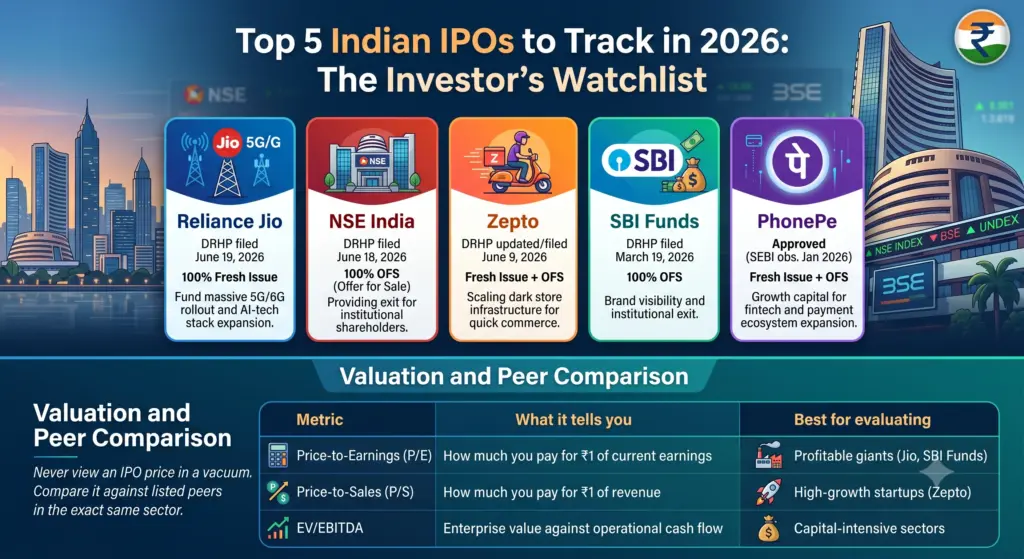
Top 5 Indian IPOs to Track in 2026: The Investor’s Watchlist
Are you looking to capture high-growth opportunities as the Indian stock market reaches new heights in 2026?
Investing in an Initial Public Offering (IPO) is a unique opportunity.
It allows you to secure ownership in emerging market leaders.
You can do this before they hit mainstream public trading.
Generally speaking, as domestic capital markets mature, several massive enterprises are preparing to list.
Therefore, it is essential for smart investors to build a research-backed watchlist.
The 2026 Indian IPO landscape is characterized by high-liquidity digital giants and established financial infrastructure firms. Key anticipated listings include Reliance Jio Platforms, the National Stock Exchange (NSE), and Zepto, each signaling major shifts in their respective sectors. To navigate these offerings, investors must prioritize analyzing the Red Herring Prospectus (RHP), monitoring Grey Market Premium (GMP) trends, and assessing long-term valuation metrics to mitigate the risks associated with immediate post-listing market volatility.
Why Should You Prioritize the 2026 IPO Pipeline?
It is important to understand why these companies are going public now.
This provides a window into broader market health.
You gain valuable insight by watching these moves.
When a company decides to launch an IPO, it is often a sign of maturity.
Sometimes, it shows a need for capital to fuel massive expansion.
In other cases, it is a strategy to provide exit liquidity to early venture capital backers.
Participating in these early stages is a smart move.
It helps you position your portfolio for growth.
You can benefit from the trajectory of these companies.
These entities have already secured dominant market positions.
Top 5 Most Anticipated IPOs to Track This Year
Tracking the right companies requires understanding their competitive moat and sector influence.
Below are the five most-watched entities based on current market sentiment and valuation scale.
| Company Name | Primary Sector | Strategic Significance |
| Reliance Jio | Telecom & Digital | Massive data user base and digital ecosystem dominance. |
| NSE India | Financial Exchange | The foundational backbone of Indian equity trading. |
| Zepto | Quick-Commerce | Disrupting traditional retail through high-speed logistics. |
| SBI Funds | Asset Management | Leveraging massive brand trust in financial services. |
| PhonePe | Fintech | A leader in the digital payments and UPI landscape. |
Status & Structure of Anticipated IPOs
| Company Name | IPO Status (as of June 20, 2026) | Structure | Key Strategic Objective |
| Reliance Jio | DRHP filed June 19, 2026. | 100% Fresh Issue. | Fund massive 5G/6G rollout and AI-tech stack expansion. |
| NSE India | DRHP filed June 18, 2026. | 100% OFS (Offer for Sale). | Providing exit for institutional shareholders. |
| Zepto | DRHP updated/filed June 9, 2026. | Fresh Issue + OFS. | Scaling dark store infrastructure for quick commerce. |
| SBI Funds | DRHP filed March 19, 2026. | 100% OFS. | Brand visibility and institutional exit. |
| PhonePe | Approved (SEBI obs. Jan 2026). | Fresh Issue + OFS. | Growth capital for fintech and payment ecosystem expansi |
Valuation and Peer Comparison
Never view an IPO price in a vacuum. Compare it against listed peers in the exact same sector.
| Metric | What it tells you | Best for evaluating |
| Price-to-Earnings (P/E) | How much you pay for ₹1 of current earnings | Profitable giants (Jio, SBI Funds) |
| Price-to-Sales (P/S) | How much you pay for ₹1 of revenue | High-growth startups (Zepto) |
| EV/EBITDA | Enterprise value against operational cash flow | Capital-intensive sectors |
How Does the IPO Application Process Work for Retail Investors?
To begin with, successfully applying for an IPO requires a structured approach to ensure your bid is processed correctly by your broker.
You must first have an active Demat account and a verified Unified Payments Interface (UPI) ID to manage the mandatory application blocking process.
Then, once the company officially announces its Price Band, you submit your bid through your brokerage portal.
Consequently, you must ensure your account holds enough funds to cover the application amount until the allotment process concludes. 🚀
What Key Risks Should You Consider Before Investing?
Assessing the risks is just as important as identifying potential gains when you look at new market entrants.
New listings are notoriously prone to extreme price fluctuations in their first few weeks of trading due to speculative demand and profit-taking.
Even the most established brands can face challenges. Their market valuation might dip unexpectedly.
This happens if broader market conditions turn negative. Sector-specific regulatory changes can also hurt sentiment.
All these factors often dampen investor confidence.
As a result, you should never deploy capital that you may need for urgent short-term liquidity. 📉
Are SME IPOs a Better Option for Smaller Investors?
Many retail participants wonder: Is the SME (Small and Medium Enterprise) segment a smarter play than mainboard listings?
SME IPOs often offer a chance for significant capital appreciation. However, they come with lower trading liquidity.
They also carry higher risk compared to established blue-chip listings.
In contrast, mainboard IPOs offer higher transparency and secondary market stability.
Because these SME offerings usually mandate a larger minimum lot size for investment. They may not be suitable for every retail portfolio. 💡
How Can You Stay Updated with Latest IPO News?
Maintaining a disciplined information flow is the only way to stay ahead of sudden schedule changes or regulatory updates.
You should regularly visit the official SEBI website.
There, you can review DRHP filings.
These documents contain critical financial disclosures.
You need to verify this information before investing.
You should also track the Grey Market Premium, or GMP.
This provides a helpful snapshot of market demand.
Note that it remains an unofficial indicator.
It acts as a secondary sign of potential performance.
You can use it to gauge how the listing might behave on its debut day.. 📈
Final Thoughts on Your Long-Term Investment Strategy
To wrap up, your success in the primary market depends on one thing.
You must be able to separate marketing hype from fundamental financial strength.
This skill is critical for any investor.
Mastering it will help you make better decisions.
Focus on firms with clear paths to profitability.
Look for companies with sustainable business models.
Prioritize those with significant market share.
This strategy helps you build a strong portfolio.
Your investments will thrive well beyond the initial listing date.
Above all, conduct your own due diligence.
Always consult with financial advisors if you feel it is necessary.
Finally, remember that patience is a vital tool.
It is the most valuable asset you have in wealth creation. 🏦
Disclaimer
Investment Disclaimer: The content provided in this post is for educational and informational purposes only and should not be construed as financial, investment, legal, or tax advice. We are not SEBI-registered investment advisors or research analysts.
Market Risk Warning: Investments in the securities market are subject to market risks. The value of investments can fluctuate, and you may lose some or all of your original capital. Past performance is not indicative of future results.
Due Diligence: Before making any investment decisions, you should conduct your own thorough research, read all official scheme-related documents (such as the DRHP/RHP) carefully, and consult with a qualified, SEBI-registered financial advisor to ensure any investment aligns with your specific financial goals and risk tolerance. We do not provide buy/sell recommendations, and any stocks or companies mentioned are for illustrative purposes only.

Leave a Reply