How Is Money Created?
The Complete Guide to Modern Money Creation
📌 Key Takeaways
- Most modern money is created by commercial banks when they issue loans—not by printing cash.
- Central banks manage the monetary system, but they do not create every dollar, rupee, or euro in circulation.
- Physical cash represents only a small portion of today’s total money supply.
- When loans are repaid, much of the bank-created money effectively disappears from circulation.
- The money creation process supports economic growth but must be carefully regulated to prevent inflation and financial instability.
⚡ ZenvestAI Quick Read
Many people believe governments simply print money whenever they need more. In reality, the modern monetary system is much more sophisticated. Most of the money you use today exists only as digital balances inside banks. Commercial banks create new money primarily by issuing loans, while central banks influence this process through interest rates, reserve policies, and financial regulations. Understanding how money is created explains why inflation happens, why interest rates change, and why banking crises can affect the entire economy.
🤖 ZenvestAI Explains: How is money created today?
In modern economies, most money is created electronically by commercial banks when they issue loans. When a bank approves a loan, it credits the borrower’s account with a new deposit, increasing the money supply. Central banks support this system by issuing physical currency, managing reserves, setting policy interest rates, and regulating financial institutions. Together, commercial banks and central banks form the foundation of the modern monetary system.
🎯 What You’ll Learn
Do Governments Print All the Money?
Short Answer: No.
This is one of the biggest misconceptions in economics. Many people imagine that governments constantly print stacks of currency to finance the economy. The reality is very different.
In most modern economies:
- Physical cash makes up only a small share of the total money supply.
- Most money exists as digital bank deposits.
- Commercial banks create a significant portion of this money through lending.
- Central banks oversee and influence the process rather than creating every unit directly.
Where Does Money Come From?
Money enters the economy through several channels:
- Central bank-issued currency: Physical notes and coins.
- Commercial bank lending: The primary driver of the broad money supply.
- Government spending: Financed through borrowing or taxation.
- Foreign capital inflows: Money moving across borders.
- Central bank asset purchases: Quantitative easing (QE) during specific monetary operations.
However, the largest source of broad money in many modern economies is commercial bank lending.
Who Creates Money?
There are two main institutions involved. Think of the central bank as the architect of the monetary system and commercial banks as the builders who expand money through everyday financial activity.
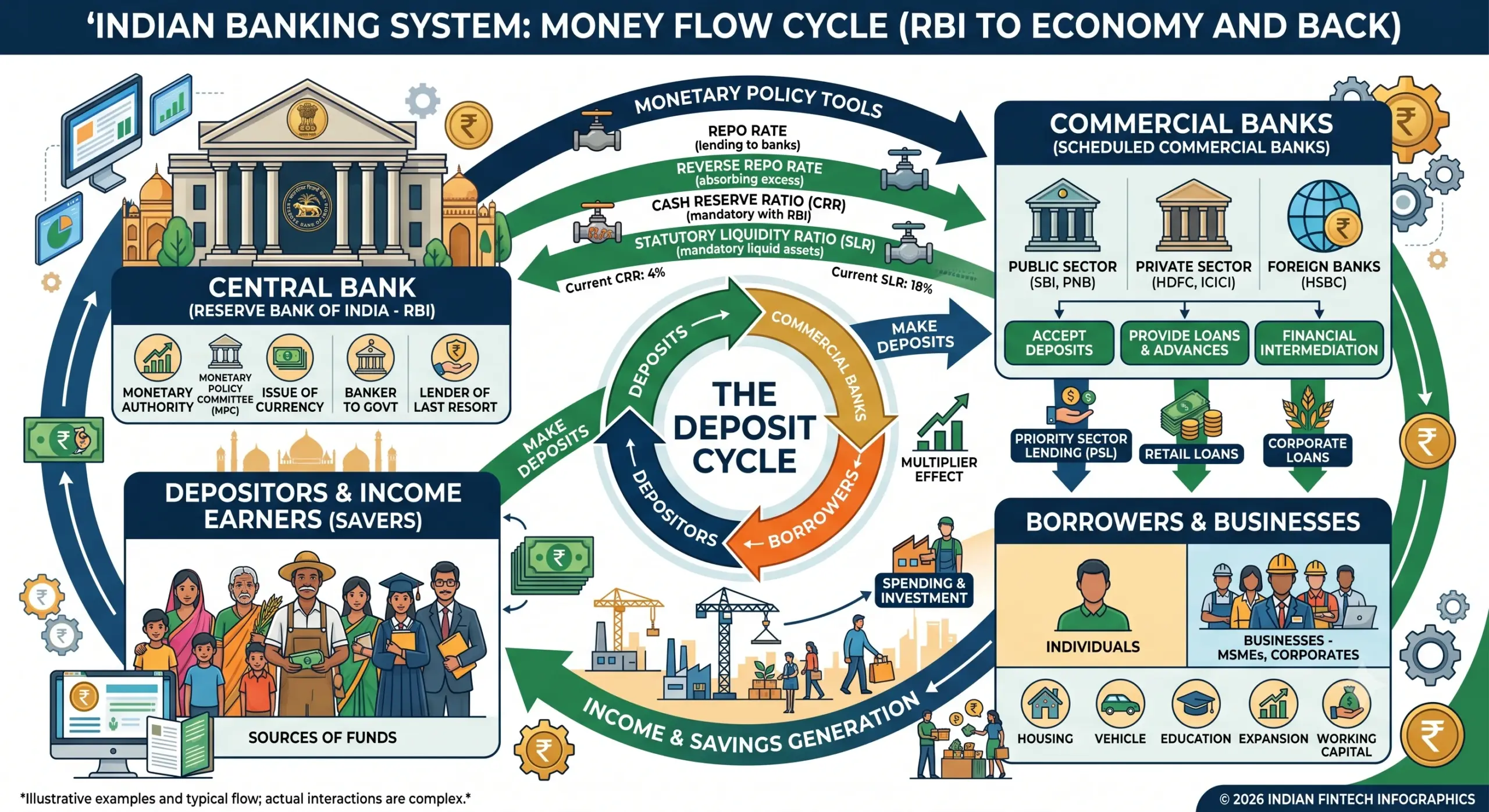
| 🏛️ Central Bank | 🏦 Commercial Banks |
|---|---|
| Issues currency | Creates bank deposits through lending |
| Sets monetary policy | Accepts deposits |
| Regulates banking system | Provides loans |
| Controls policy interest rates | Supports households and businesses |
| Maintains financial stability | Facilitates payments |
What Is a Central Bank?
A central bank is the nation’s primary monetary authority responsible for maintaining monetary and financial stability.
Examples include the Federal Reserve (US), European Central Bank, Bank of England, Bank of Japan, and the Reserve Bank of India (RBI).
Central banks do not operate like ordinary retail banks. Instead, they issue currency, regulate banks, manage inflation, support employment, maintain financial stability, and act as a lender of last resort.
What Do Commercial Banks Do?
Commercial banks interact directly with individuals and businesses.
Examples include opening savings accounts, processing payments, providing mortgages, issuing business loans, offering credit cards, and financing investments.
Every time a bank makes a qualifying loan, it generally creates a matching deposit in the borrower’s account. This is how new money enters the banking system.
How Does Bank Lending Create Money?
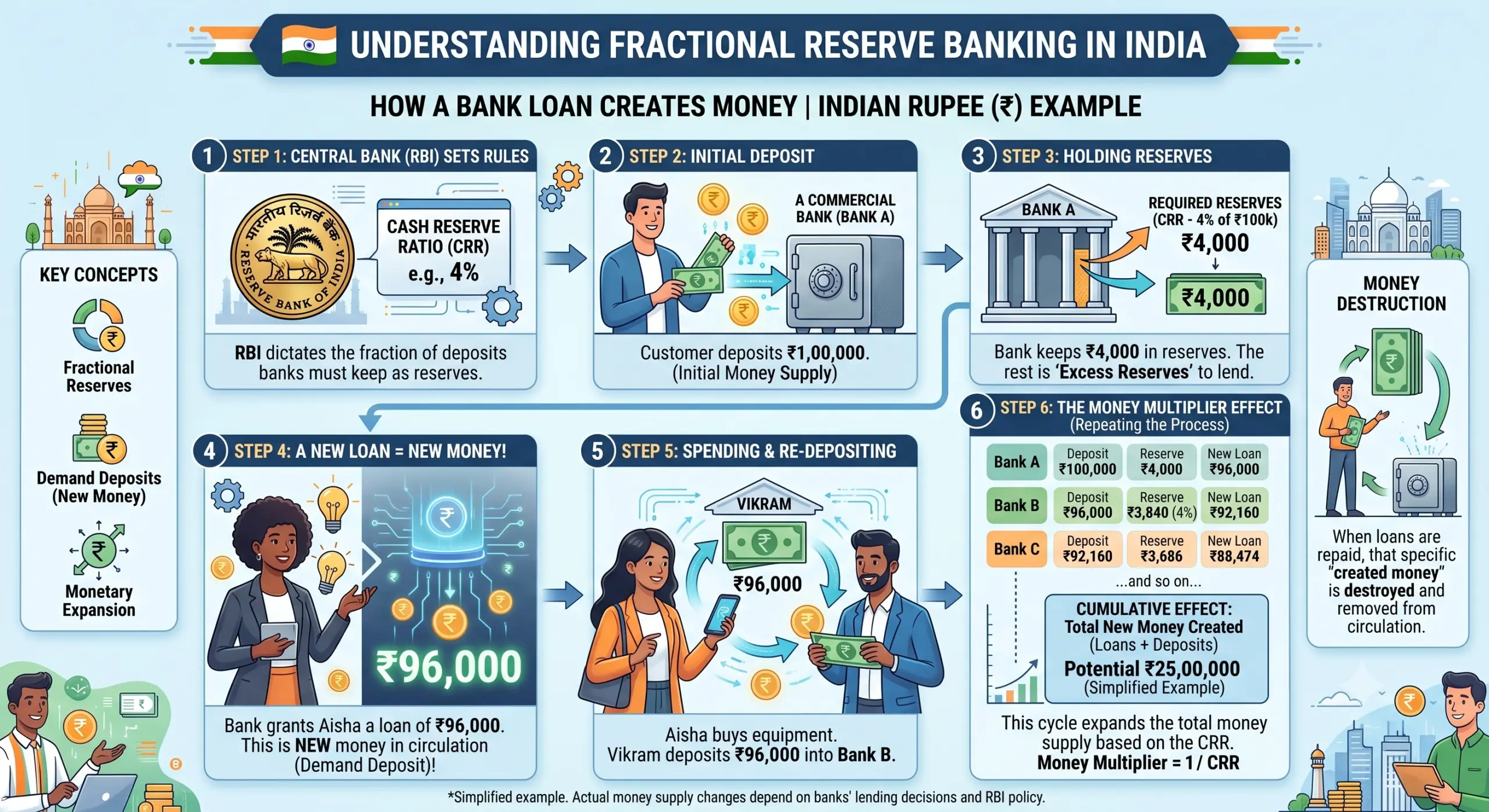
Imagine this simplified example:
Step 1: The Loan
Sarah receives a $10,000 business loan. The bank approves it. Instead of handing over a suitcase of cash, the bank credits $10,000 to Sarah’s account. Sarah can now spend it. A new bank deposit has been created.
Step 2: The Spend
Sarah pays a construction company. The construction company deposits the payment into its own bank account. The banking system now contains new deposits created through lending.
Step 3: The Repayment
Over time, when Sarah repays the loan, the outstanding loan balance declines, and the corresponding bank-created money is reduced.
This simplified example illustrates how lending expands and repayment contracts the money supply.
Fractional Reserve Banking
What Is Fractional Reserve Banking?
Fractional reserve banking is a system in which banks keep only a portion of customer deposits as reserves while lending much of the remainder.
This allows banks to support more economic activity than would be possible if every deposited dollar had to remain idle. However, banks today are also constrained by capital requirements, liquidity rules, risk management, and borrower demand—not just reserve requirements.
How Does the Money Multiplier Work?
The textbook money multiplier explains how one initial deposit can support multiple rounds of lending and redepositing. The formula is represented as:
Where ‘m’ is the money multiplier and ‘r’ is the reserve ratio.
🔄 Case Study: The ₹1,00,000 Money Creation Cycle
Here is a step-by-step breakdown of how a single deposit expands the money supply:
The Multiplier Effect Table
| Bank | Deposit | Reserve (10%) | New Loan |
|---|---|---|---|
| Bank A | ₹1,00,000 | ₹10,000 | ₹90,000 |
| Bank B | ₹90,000 | ₹9,000 | ₹81,000 |
| Bank C | ₹81,000 | ₹8,100 | ₹72,900 |
| Bank D | ₹72,900 | ₹7,290 | ₹65,610 |
Final Result: The total money circulating in bank accounts becomes much larger than the original ₹1,00,000. This is known as the Money Multiplier Effect.
The Economic Impact of Bank Loans
More loans (such as home loans, vehicle loans, business loans, and education loans) lead directly to more spending and investment. This translates into business expansion, more employment, and overall economic growth. However, there is a risk: if lending grows too fast, inflation can rise.
Why Don’t Banks Create Unlimited Money?
Banks cannot lend without limits.
They face several constraints:
- ⚖️ Regulatory capital requirements
- 💧 Liquidity requirements
- 🛡️ Risk management standards
- 🧑💼 Creditworthy borrowers
- 🏛️ Central bank policy
- 📈 Market confidence
If banks issued too many risky loans, they could suffer losses and threaten financial stability.
What Is the Money Supply?
Economists classify money into different measures based on liquidity.
| Measure | Includes |
|---|---|
| M0 | Physical notes and coins plus central bank reserves |
| M1 | M0 plus highly liquid checking/current account deposits |
| M2 | M1 plus many savings deposits and certain time deposits or money market balances (definitions vary by country) |
Each country may define these measures slightly differently, but they help economists track the amount of money circulating in the economy.
What Happens When Loans Are Repaid?
This is an important concept. When a borrower repays the principal on a bank loan:
- The loan asset on the bank’s balance sheet decreases.
- The corresponding deposit used to repay it is reduced.
In simplified terms, that bank-created money is removed from circulation. Interest payments, however, become income for the bank and are treated differently from principal repayment.
🤔 Top Questions
Can banks create money from nothing?
Quick Insight: Banks do not create unlimited wealth from nothing. They create bank deposits when they make loans, but this process operates within a framework of regulation, capital requirements, liquidity constraints, and borrower demand. Lending always creates both an asset (the loan) and a liability (the deposit) on the bank’s balance sheet.
Why doesn’t printing more money make everyone rich?
Quick Insight: Simply increasing the money supply without increasing the production of goods and services usually causes inflation. When more money chases the same amount of goods, prices tend to rise, reducing the purchasing power of each unit of currency.
⚠️ Common Myths
- ❌ Myth: Banks only lend existing deposits.
Reality: Modern banks typically create new deposits when they extend loans, subject to regulatory and economic constraints. - ❌ Myth: The central bank prints all money.
Reality: Central banks issue currency and manage monetary policy, but commercial banks create much of the broad money supply through lending. - ❌ Myth: More money always means more prosperity.
Reality: Sustainable prosperity depends on productivity, innovation, investment, and efficient use of resources—not merely on increasing the quantity of money.
Real-World Example
Imagine a growing city where businesses need financing to build factories, restaurants, and technology companies. Banks evaluate these businesses and provide loans. The borrowed funds are used to:
- Hire workers
- Purchase equipment
- Build infrastructure
- Produce goods and services
When lending supports productive investment, it can contribute to economic growth. However, excessive or poorly managed lending can also increase financial risks, which is why regulation and prudent banking practices are essential.
The Bottom Line
Money creation is one of the most important—and often misunderstood—parts of modern economics. While central banks provide the framework and issue currency, commercial banks expand the money supply through lending. This system enables investment, entrepreneurship, and economic growth, but it also requires careful regulation to keep inflation and financial risks under control.
Frequently Asked Questions
A: Commercial banks create much of the broad money supply by issuing loans, while central banks issue physical currency and guide monetary policy.
A: No. Banks are limited by regulations, capital, liquidity, risk management, and the availability of qualified borrowers.
A: Electronic money is faster, more convenient, and better suited to today’s financial system than relying solely on physical cash.
A: In simplified terms, yes. Repaying the principal of a bank-created loan reduces the associated deposit, contracting that portion of the money supply.
A: It helps explain inflation, interest rates, credit cycles, banking stability, and the broader functioning of the economy.

Leave a Reply