
Solana is entering a critical governance moment as validators and delegators vote on a proposal that could dramatically accelerate the reduction of new SOL issuance.
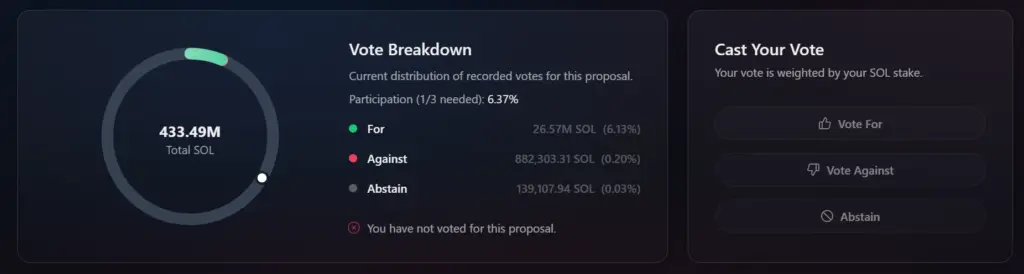
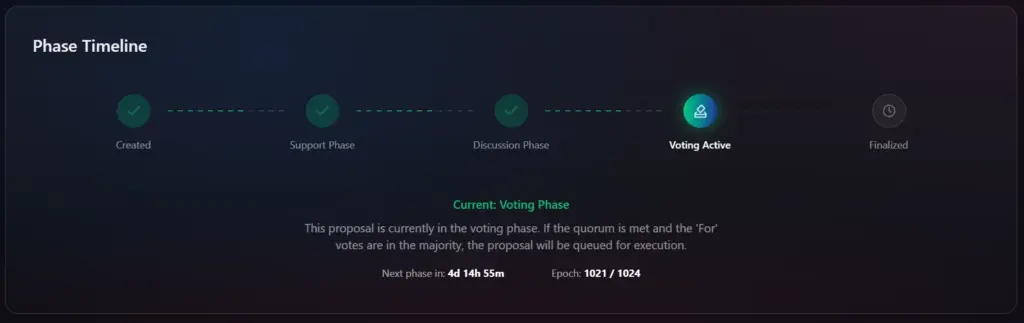
The proposal, SGP-0002 (linked to SIMD-0550), would increase Solana’s annual disinflation rate from 15% to 30% while keeping the network’s long-term inflation floor at 1.5%. The live governance vote is currently open and moving through Epoch 1023.
🔥 WHY THIS VOTE MATTERS
If approved, Solana could reach its 1.5% terminal inflation rate in roughly 2.8 years (H1 2029), compared with approximately 5.7 years (H1 2032) under the existing schedule.
That means the network would move much faster toward a lower-emission monetary model.
📉 The Proposed Change
| Metric | Current Schedule | Proposed Schedule |
| Annual Disinflation | 15% | 30% |
| Terminal Inflation | 1.5% | 1.5% |
| Time to Terminal Rate | ~5.7 years (2032) | ~2.8 years (2029) |
| Estimated 6-Year Emission Reduction | Baseline | ~18.9M SOL |
The proposal estimates that approximately 18.9 million fewer SOL could be emitted over six years under the accelerated schedule.
💰 WHAT IT COULD MEAN FOR SOL
The proposal does not simply remove SOL from circulation overnight. Instead, it changes the rate at which new SOL enters the economy.
The Core Mechanics: Slower new issuance $\rightarrow$ Less dilution $\rightarrow$ Faster decline in inflation $\rightarrow$ Greater scarcity pressure.
However, that does not automatically mean SOL’s price will rise. Market demand, network activity, staking participation, liquidity, and broader macro crypto conditions will continue to determine actual market outcomes.
⚠️ THE BIG TRADE-OFF: STAKERS & VALIDATORS
Lower issuance means fewer newly created SOL are available as inflation-funded staking rewards.
Official modeling indicates nominal staking yields could shift significantly:
- Year 1: ~4.34% (down from ~5.84%)
- Year 2: ~3.00%
- Year 3: ~2.25%
This creates a heavy economic debate: Lower dilution for general SOL holders vs. lower inflation-funded rewards for stakers and validators.
🏛️ SOLANA GOVERNANCE UNDER THE SPOTLIGHT
The vote is a major stress test for Solana’s evolving on-chain governance. The current vote requires a two-thirds supermajority and a minimum participation quorum to pass.
Ecosystem alignment is currently split. For instance, major market participants like Solana Company have publicly stated they plan to vote against the faster-disinflation proposal, arguing that reopening a pre-established issuance schedule could inject unnecessary policy uncertainty for institutional participants and staking economics.
🚨 WHAT THE MARKET IS WATCHING NOW
The key question facing the network is no longer simply: “Will Solana reduce inflation?”
It is: How aggressively should Solana reduce new SOL issuance without weakening the economic incentives that secure the network?
- If the proposal passes: Solana rapidly accelerates toward its 1.5% terminal supply ceiling.
- If the proposal fails: The original -15% disinflation track remains intact.
🔎 ZENVESTAI TAKE
This is bigger than a standard network update. Solana is actively rewriting the balance between token scarcity, validator profitability, and long-term security.
Keep your eyes on the live vote tallies, staking yield shifts, and whether this supply contraction coincides with sustained on-chain demand.
#Solana #SOL #SolanaGovernance #CryptoNews #CryptoBreaking #Tokenomics #DeFi #Blockchain #SGP0002 #SIMD0550
Disclaimer: This overview discusses an active governance proposal and its modeled economic effects. It does not constitute financial advice
Cast Your Vote on Solana Governance Proposal SGP-0002