The Ultimate Guide to DeFi Oracle Risk
DeFi protocols can automate lending, borrowing, trading, derivatives, stablecoins, and liquidations without relying on a traditional bank or broker.
But there is a fundamental problem:
Smart contracts cannot naturally know the real-world price of an asset.
A lending protocol may know how many tokens are deposited in a wallet. A decentralized exchange may know the price implied by its liquidity pools. But a smart contract cannot independently know whether Bitcoin is trading at $100,000 on the broader market, whether ETH has suddenly crashed, or whether a token’s market price is being manipulated.
That information has to come from somewhere.
This is where price oracles enter DeFi.
An oracle acts as a bridge between blockchain-based applications and external information. In financial applications, the oracle may provide asset prices that determine how much a user can borrow, whether a position should be liquidated, how a derivative should settle, or whether a stablecoin remains properly collateralized.
That makes the oracle one of the most important—and potentially most dangerous—components in a DeFi protocol.
If an oracle reports the wrong price, a perfectly written smart contract can execute the wrong action automatically.
A manipulated price can therefore turn into:
Bad data → incorrect valuation → incorrect protocol decision → financial loss.
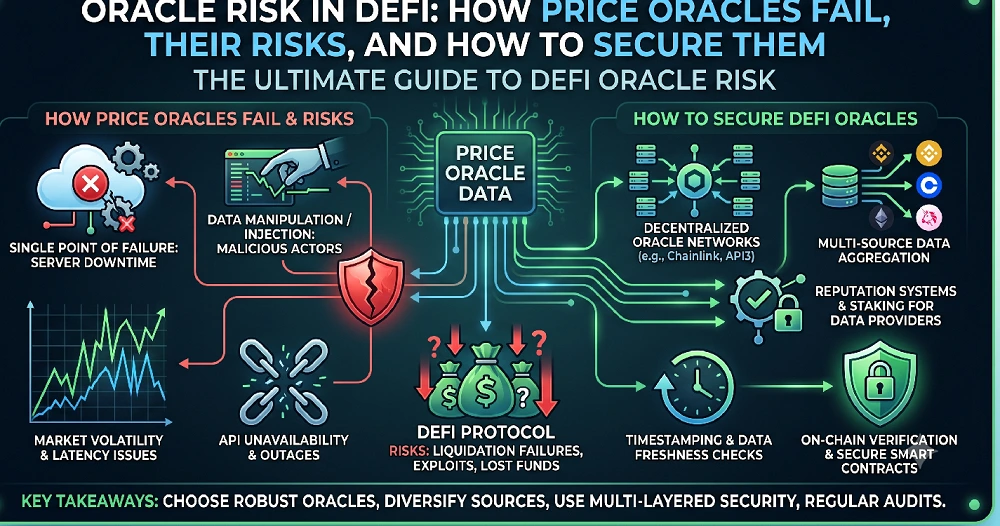
This guide explains how DeFi price oracles work, why they fail, how attackers manipulate them, which oracle architectures are safer, how protocols can defend themselves, and how users can evaluate oracle risk before interacting with a DeFi application.
Key Takeaways
- Price oracles connect blockchain applications with external price information.
- Smart contracts generally cannot directly access arbitrary off-chain market data.
- Oracle failure can cause incorrect borrowing limits, liquidations, settlements, collateral valuations, and trading decisions.
- Oracle manipulation is one of the major attack surfaces in DeFi.
- A decentralized exchange’s spot price is not automatically a safe oracle.
- Low-liquidity assets are particularly vulnerable to price manipulation.
- Flash loans can provide attackers with temporary capital that makes some manipulation attacks much easier.
- Time-weighted prices can make short-term manipulation more expensive.
- Multiple independent data sources can reduce dependence on one market.
- Circuit breakers, deviation limits, heartbeat checks, and liquidity thresholds can limit damage.
- Oracle security must be evaluated together with the economic design of the protocol.
- Decentralization alone does not guarantee accurate data.
- An oracle can be technically decentralized while still being economically fragile.
- Protocols should design for oracle failure, not assume that oracle failure is impossible.
ZenvestAI Explains
A DeFi oracle is a mechanism that supplies external information to a blockchain application, such as an asset price, so that a smart contract can make decisions based on that information.
A price oracle specifically provides price information.
For example:
ETH = $4,000
A lending protocol might use that information to determine whether $10,000 worth of ETH collateral can support a $6,000 loan.
If the oracle suddenly reports:
ETH = $8,000
the protocol may believe the user has much more collateral than they actually do.
An attacker may then borrow more than the collateral should support.
The opposite can also happen.
If ETH is genuinely worth $4,000 but an oracle reports $2,000, healthy positions could be incorrectly liquidated.
So oracle security is not simply about obtaining a price.
It is about obtaining a price that is:
- accurate,
- timely,
- manipulation-resistant,
- sufficiently decentralized,
- economically reliable,
- available when required,
- and appropriate for the protocol’s specific use case.
The key principle is simple:
A DeFi protocol is only as reliable as the assumptions it makes about the data entering its smart contracts.
At a Glance
| Area | What It Means |
|---|---|
| Oracle | System that supplies external information to smart contracts |
| Price Oracle | Oracle specifically providing asset prices |
| Data Feed | Stream or collection of data supplied to a protocol |
| Spot Price | Current market price |
| TWAP | Time-weighted average price |
| VWAP | Volume-weighted average price |
| Manipulation | Deliberately influencing the reported price |
| Stale Price | Data that is too old to safely use |
| Deviation | Difference between reported and reference prices |
| Liquidity | Amount of available market liquidity |
| Heartbeat | Maximum expected time between oracle updates |
| Fallback Oracle | Alternative source used when the primary source fails |
| Circuit Breaker | Mechanism that pauses or limits actions after abnormal data |
| Liveness | Ability of an oracle to continue providing usable data |
| Integrity | Reliability and correctness of the supplied data |
What Is a DeFi Oracle?
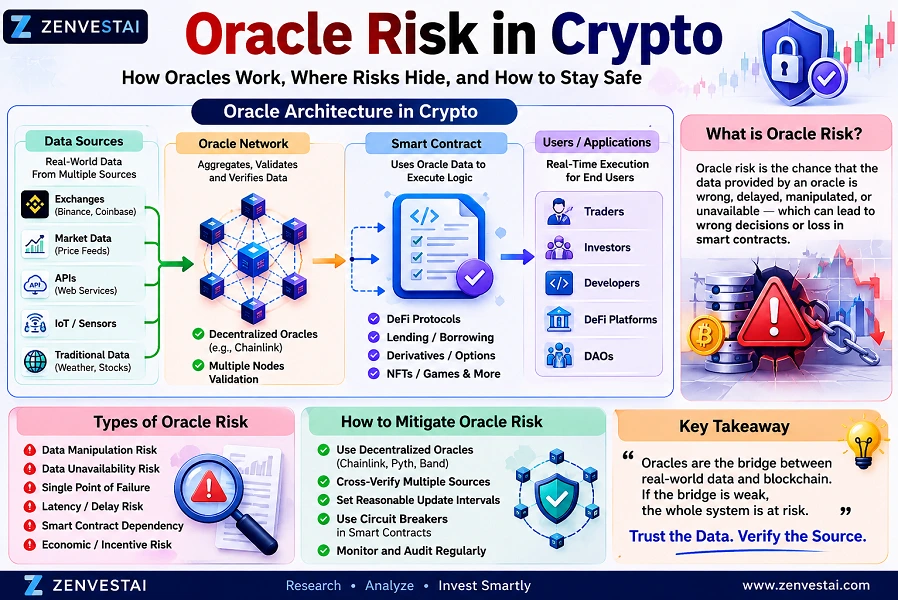
A DeFi oracle is an infrastructure component that provides information to smart contracts that the blockchain cannot reliably obtain on its own.
This information can include:
- cryptocurrency prices,
- exchange rates,
- interest rates,
- volatility,
- commodity prices,
- stock prices,
- weather information,
- sports results,
- cross-chain information,
- proof-of-reserves information,
- and other external data.
For financial DeFi applications, price feeds are particularly important.
Consider a lending protocol.
A user deposits:
2 ETH
The smart contract knows the quantity:
2 ETH
But it needs to know the value.
If ETH = $4,000:
2 ETH = $8,000
If ETH = $2,000:
2 ETH = $4,000
The smart contract therefore needs a trustworthy price source.
The oracle provides that information.
Why Do Smart Contracts Need Oracles?
Blockchains are intentionally deterministic.
Every validating node needs to reach the same result when executing the same transaction.
If a smart contract could freely query random websites or centralized APIs during execution, different nodes might receive different information.
For example:
Node A:
BTC = $100,000
Node B:
BTC = $100,500
Node C:
BTC = $99,800
The network could not safely execute the same transaction based on those inconsistent results.
Instead, oracle systems create a controlled mechanism for bringing external information into blockchain applications.
This creates a critical security boundary:
Blockchain consensus protects what happens on-chain.
Oracle infrastructure helps determine what external information is accepted as input.
That distinction is extremely important.
History of Blockchain Oracles
The oracle problem is not unique to DeFi.
It is a broader problem in blockchain system design.
Early blockchain applications primarily operated on information already contained within the blockchain.
As decentralized applications became more sophisticated, developers wanted smart contracts to react to external events.
Examples included:
- exchange rates,
- financial market prices,
- sports results,
- weather data,
- insurance events,
- real-world assets.
This created the oracle problem:
How can a decentralized system securely consume information that originates outside the blockchain?
As DeFi grew, price oracles became increasingly important.
Lending markets, derivatives platforms, synthetic assets, stablecoins, automated vaults, and liquidation systems all began depending on reliable price information.
This also created a new class of attacks.
Instead of attacking the smart contract directly, an attacker could sometimes attack the information that the smart contract trusted.
That is the essence of oracle risk.
How DeFi Price Oracles Work
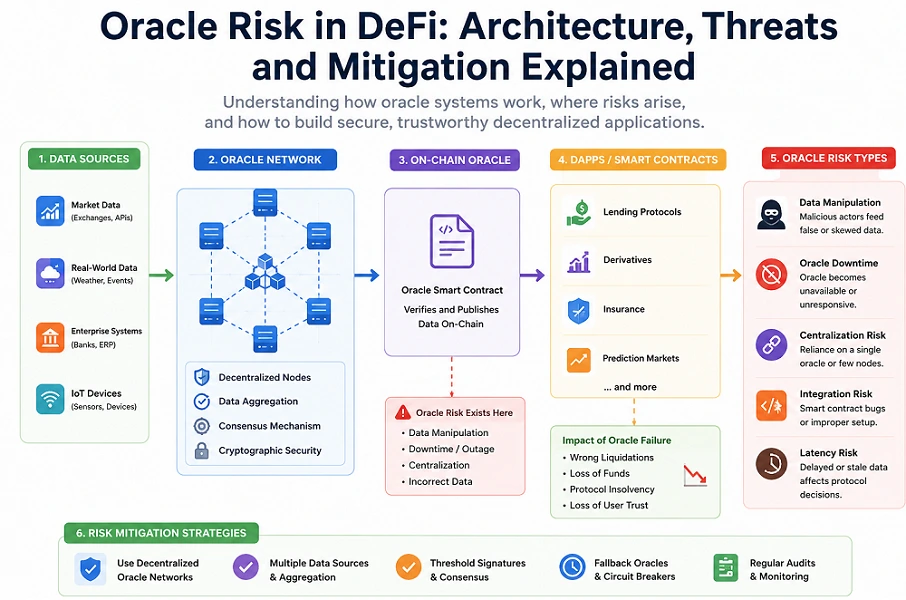
A simplified oracle architecture looks like this:
External Markets
      ↓
Data Sources
      ↓
Data Collection
      ↓
Aggregation / Validation
      ↓
Oracle Network
      ↓
On-Chain Price Feed
      ↓
DeFi Smart Contract
      ↓
Protocol Decision
      ↓
Borrow / Liquidate / Trade / Settle
Suppose a lending protocol needs the price of ETH.
The oracle infrastructure may collect prices from multiple markets.
For example:
Exchange A → $4,010
Exchange B → $4,005
Exchange C → $4,020
Exchange D → $4,008
The oracle system can aggregate the information.
It might produce a reference value around:
$4,008–$4,010
The final value is then delivered on-chain.
The lending protocol reads that value.
It can then calculate:
- collateral value,
- borrowing capacity,
- health factor,
- liquidation threshold,
- liquidation price.
Core Components of a Price Oracle System
A robust oracle system generally contains several layers.
1. Data Sources
These are the original sources from which market information is obtained.
Examples include:
- centralized exchanges,
- decentralized exchanges,
- market makers,
- institutional data providers,
- blockchain-native markets.
The quality of these sources matters enormously.
2. Data Providers
Data providers collect market information and submit it to the oracle infrastructure.
The provider may monitor:
- prices,
- trading volume,
- liquidity,
- market depth,
- timestamps,
- market status.
3. Aggregation
Multiple observations may be combined into one reference value.
Aggregation reduces dependence on one individual source.
Possible approaches include:
- median,
- weighted median,
- trimmed mean,
- volume-weighted calculation,
- time-weighted calculation.
4. Validation
Oracle systems may apply checks before accepting a value.
Examples:
- maximum deviation,
- minimum liquidity,
- timestamp validation,
- source availability,
- outlier detection,
- confidence thresholds.
5. Oracle Network
A decentralized oracle network can have multiple independent nodes or reporters.
Instead of trusting:
one reporter
the protocol can depend on:
many reporters + aggregation rules.
This can reduce single-point-of-failure risk.
6. On-Chain Feed
The resulting information is published to the blockchain.
Smart contracts can then query the feed.
7. Consumer Protocol
Finally, a DeFi application consumes the price.
Examples:
- lending protocol,
- perpetual futures protocol,
- options protocol,
- stablecoin,
- synthetic asset platform,
- vault,
- insurance application.
Important Types of DeFi Oracles
There is no single oracle architecture that is best for every application.
Different designs have different strengths and weaknesses.
1. Centralized Oracles
A centralized oracle obtains data from one organization or trusted provider.
Advantages
- simple,
- inexpensive,
- fast,
- easy to operate.
Risks
The oracle operator becomes a major trust assumption.
Potential problems include:
- malicious updates,
- compromised infrastructure,
- downtime,
- censorship,
- incorrect data,
- governance failure.
For high-value permissionless DeFi applications, excessive dependence on one oracle operator can create significant systemic risk.
2. Decentralized Oracle Networks
Multiple independent participants contribute data.
Instead of:
One Provider
     ↓
Price
     ↓
DeFi Protocol
the architecture becomes:
Provider A ─┐
Provider B ─┤
Provider C ─┼→ Aggregation → On-Chain Feed
Provider D ─┤
Provider E ─┘
Advantages
- reduces single-provider dependence,
- improves resilience,
- can make manipulation more difficult,
- distributes trust.
Risks
Decentralization introduces its own complexity.
Possible issues include:
- correlated data sources,
- insufficient node diversity,
- governance attacks,
- poor incentive design,
- delayed updates,
- infrastructure failures.
3. DEX-Based Oracles
A protocol may use prices derived directly from decentralized exchange liquidity pools.
This can be useful because the data is blockchain-native.
However, it creates an important risk:
The same market being used as an oracle may be manipulated.
If an attacker can temporarily move the price in a low-liquidity pool, a protocol that immediately trusts that spot price may consume the manipulated value.
4. CEX-Based Oracles
Centralized exchange prices can provide deep liquidity and highly active markets.
But they introduce centralized dependencies.
Potential risks include:
- exchange outages,
- API failures,
- market manipulation,
- withdrawal restrictions,
- exchange-specific price anomalies,
- centralized infrastructure failure.
5. TWAP Oracles
TWAP = Time-Weighted Average Price.
Instead of using one instantaneous price, the oracle calculates an average over a period.
For example:
10:00 → $4,000
10:05 → $4,020
10:10 → $4,010
10:15 → $4,030
The system can calculate an average rather than trusting a single moment.
Why TWAP Helps
An attacker attempting to manipulate the price must generally sustain the manipulated price for longer.
That can significantly increase the attack cost.
Limitation
TWAP is not a magic shield.
If:
- the observation window is too short,
- the market is extremely illiquid,
- the attacker controls substantial liquidity,
manipulation may still be possible.
6. Median-Based Oracles
Suppose several independent sources report:
$4,000
$4,010
$4,005
$4,500
$4,008
A median-based system can reduce the influence of the extreme value.
This is particularly useful when one source becomes an outlier.
7. Hybrid Oracles
Some protocols combine multiple approaches.
For example:
CEX Data
     +
DEX Data
     +
Independent Providers
     ↓
Aggregation
     ↓
Validation
     ↓
On-Chain Feed
Hybrid systems can provide stronger resilience than relying on one source.
8. Cross-Chain Oracles
Many DeFi applications operate across multiple blockchains.
The oracle must therefore deliver information across networks.
This creates another security layer:
cross-chain messaging.
Now the system must protect against:
- bridge failures,
- message delays,
- replay attacks,
- inconsistent state,
- chain reorganizations,
- cross-chain infrastructure failures.
Oracle Use Cases in DeFi
Oracle infrastructure supports a large portion of decentralized finance.
Lending and Borrowing
Lending protocols need asset prices to determine:
- collateral value,
- borrowing capacity,
- health factor,
- liquidation thresholds.
Liquidations
When collateral falls below a required level, the protocol may liquidate a position.
The oracle therefore directly influences liquidation decisions.
An incorrect oracle price can trigger:
false liquidation
or allow:
under-collateralized borrowing.
Perpetual Futures
Perpetual futures protocols use price references to determine:
- mark prices,
- funding,
- liquidation,
- unrealized profit and loss,
- bankruptcy conditions.
Options
Options protocols may require price information for:
- settlement,
- intrinsic value,
- collateral,
- risk calculations.
Stablecoins
Collateralized stablecoins can use oracle prices to determine whether backing assets remain sufficient.
Synthetic Assets
Synthetic assets attempt to track the value of another asset.
They therefore require reliable reference prices.
Automated Vaults
Yield strategies may depend on asset valuations when:
- rebalancing,
- calculating collateral,
- determining exposure.
Prediction Markets
Oracle systems may determine the outcome of real-world events.
Benefits of Good Oracle Infrastructure
A robust oracle can provide:
Reliable Price Discovery
The protocol gets a standardized reference value.
Automation
Smart contracts can make financial decisions without manual intervention.
Transparency
On-chain oracle data can often be inspected publicly.
Composability
Multiple DeFi applications can use the same infrastructure.
Reduced Centralization
Decentralized oracle networks can distribute data provision.
Better Capital Efficiency
Accurate prices allow protocols to set collateral and borrowing parameters more efficiently.
Oracle Risks in DeFi
This is the most important section of the guide.
Oracle risk is not one single vulnerability.
It is a collection of risks.
1. Price Manipulation
An attacker attempts to influence the market price observed by the oracle.
A simplified attack looks like:
Attacker
   ↓
Buys/Sells Large Amount
   ↓
DEX Price Moves
   ↓
Oracle Reads Price
   ↓
DeFi Protocol Trusts Price
   ↓
Attacker Exploits Protocol
This becomes especially dangerous when the protocol relies on a thinly traded market.
2. Flash-Loan-Assisted Oracle Manipulation
Flash loans allow users to borrow large amounts of capital without traditional collateral, provided the transaction is repaid within the same transaction.
An attacker may use temporary capital to manipulate a low-liquidity market.
For example:
Flash Loan
     ↓
Large Trade
     ↓
DEX Price Moves
     ↓
Oracle Reads Manipulated Price
     ↓
Borrow / Mint / Liquidate
     ↓
Reverse Trade
     ↓
Repay Flash Loan
     ↓
Keep Profit
The attacker does not necessarily need millions of dollars of personal capital.
The vulnerability lies in the protocol’s reliance on a manipulable price.
3. Low-Liquidity Risk
Liquidity is one of the most important variables in oracle security.
A market with deep liquidity generally requires more capital to move its price substantially.
A thin market may be moved with comparatively little capital.
Consider:
Market A
$500 million liquidity
versus:
Market B
$500,000 liquidity.
Using Market B as a primary price source for a high-value lending protocol creates obvious risks.
4. Stale Price Risk
A price can be accurate but still unsafe because it is old.
Suppose:
ETH = $4,000The market suddenly crashes to:
ETH = $3,000But the protocol continues using the $4,000 oracle price because the feed has not updated.
The data is now stale.
Stale data can create:
- excessive borrowing,
- delayed liquidations,
- incorrect collateral valuation.
5. Oracle Downtime
An oracle may stop updating.
Possible causes include:
- infrastructure failure,
- network congestion,
- node failure,
- software bugs,
- API outage,
- blockchain issues.
A protocol needs to decide what happens when the oracle becomes unavailable.
6. Data Source Failure
If an oracle depends on one exchange or provider, that source can become unavailable or produce abnormal data.
This creates concentration risk.
7. Outlier Data
Suppose four providers report:
$4,000
$4,005
$4,010
$5,000
The $5,000 value is suspicious.
A strong aggregation system should prevent one abnormal source from disproportionately affecting the final result.
8. Data Correlation Risk
Having ten data providers does not automatically mean having ten independent sources.
If all ten obtain prices from the same underlying market, they may fail together.
This is called correlated failure.
True resilience requires diversity in:
- providers,
- infrastructure,
- markets,
- geographic distribution,
- software,
- data sources.
9. Oracle Update Manipulation
Attackers may attempt to exploit how and when oracle updates occur.
Important parameters include:
- update frequency,
- minimum update interval,
- heartbeat,
- deviation threshold.
Poorly designed update rules can create exploitable windows.
10. Front-Running and MEV
Oracle updates can interact with transaction ordering.
If market participants can predict an upcoming oracle update, they may attempt to position transactions around it.
This can create:
- arbitrage,
- liquidation front-running,
- sandwich opportunities,
- price-update exploitation.
11. Governance Risk
Oracle systems may depend on governance.
Governance participants might control:
- approved data sources,
- oracle parameters,
- emergency actions,
- fallback systems.
A compromised governance mechanism can therefore become an oracle attack vector.
12. Admin-Key Risk
If a small group controls the ability to change oracle configuration, that authority becomes a centralization risk.
Questions to ask:
- Who can change the oracle?
- Who can pause it?
- Who can replace data providers?
- Is there a timelock?
- Is there multisig protection?
13. Wrong Asset Mapping
An oracle can technically function correctly while reporting the wrong asset.
For example:
Token Amay accidentally be mapped to:
Token BThis can produce catastrophic valuation errors.
14. Decimal Errors
Different assets may use different decimal conventions.
A smart contract incorrectly handling decimals can interpret:
1.00as:
100or:
0.01Such errors can create severe financial consequences.
15. Unit and Quote-Currency Errors
A price feed may represent:
ETH/USD
while a protocol incorrectly interprets it as:
ETH/USDC
or another denomination.
Even small assumptions around units can become dangerous when multiplied across large positions.
16. Cross-Chain Staleness
A price may be current on one blockchain but delayed on another.
For example:
Source Chain
   ↓
Oracle Update
   ↓
Bridge / Messaging
   ↓
Destination Chain
   ↓
DeFi Protocol
Every additional layer can introduce latency and failure risk.
17. Negative or Invalid Data
Protocols should not blindly accept any numerical output.
They should validate:
- price > 0,
- timestamp is valid,
- data is within acceptable deviation,
- feed has sufficient confidence,
- source is active.
18. Liquidity Mirage
A token can appear valuable because a small amount trades at a high price.
Example:
A token has:
- $100,000,000 nominal market capitalization,
- but only $50,000 available liquidity.
Using market capitalization as evidence of reliable liquidation value would be dangerous.
Market value is not the same as realizable liquidity.
19. Stablecoin Depeg Risk
A protocol may assume:
1 USDC = $1
But stablecoins can trade away from their intended peg.
If the oracle assumes a permanent $1 value, the protocol may miscalculate collateral.
20. Long-Tail Asset Risk
Highly established assets generally have deeper markets.
Small tokens may have:
- limited liquidity,
- few exchanges,
- concentrated ownership,
- volatile prices,
- shallow order books.
Oracle design must therefore consider the asset itself.
How Oracle Attacks Actually Become Profitable
An important misconception is:
“The attacker only needs to manipulate the price.”
Not necessarily.
The attacker needs to manipulate the price and then find a protocol action that converts the incorrect valuation into economic value.
A simplified attack equation is:
Profit = Protocol Benefit − Manipulation Cost − Fees − Slippage − Gas
An attack becomes attractive when:
Expected Profit > Expected Attack Cost
This is why oracle security is fundamentally an economic security problem, not merely a coding problem.
Example: Oracle Manipulation Against a Lending Protocol
Imagine:
- ETH market price = $4,000
- User collateral = 100 ETH
- True collateral value = $400,000
Suppose the protocol allows borrowing up to 70%.
Maximum legitimate borrowing:
$400,000 × 70% = $280,000
Now imagine an attacker manipulates the oracle to:
ETH = $5,000
The protocol believes collateral is:
100 × $5,000 = $500,000
Maximum borrowing becomes:
$500,000 × 70% = $350,000
The attacker has potentially created:
$70,000 of artificial borrowing capacity.
The exact economics depend on the protocol, liquidity, oracle mechanism, collateral, and ability to unwind the manipulation.
The lesson is more important than the numbers:
An incorrect oracle price can manufacture artificial financial capacity.
How To Get Started With Oracle Risk Analysis
If you are a DeFi user, developer, researcher, or investor, start with these questions.
Step 1: Identify the Oracle
Find out which oracle or price mechanism the protocol uses.
Step 2: Identify the Data Sources
Ask:
- Which markets supply the data?
- How many sources exist?
- Are they independent?
Step 3: Examine Liquidity
Check whether the underlying asset has sufficient liquidity.
Step 4: Understand the Update Mechanism
Determine:
- heartbeat,
- deviation threshold,
- update frequency,
- timestamp behavior.
Step 5: Identify Failure Handling
Ask:
What happens if the oracle stops updating?
Step 6: Examine Fallbacks
Does the protocol have another trusted source?
Step 7: Check Protocol Parameters
Look at:
- loan-to-value,
- liquidation threshold,
- liquidation bonus,
- maximum exposure,
- caps.
Step 8: Look for Emergency Controls
Determine whether the protocol can:
- pause borrowing,
- freeze a market,
- disable an asset,
- switch feeds.
Oracle Security Architecture
A robust DeFi application should avoid relying on one simplistic price input.
A stronger architecture can look like:
              ┌───────────────┐
              │ CEX Sources   │
              └───────┬───────┘
                      │
              ┌───────▼───────┐
              │ DEX Sources   │
              └───────┬───────┘
                      │
              ┌───────▼───────┐
              │ Data Providers│
              └───────┬───────┘
                      │
              ┌───────▼───────┐
              │ Aggregation   │
              └───────┬───────┘
                      │
             ┌────────▼────────┐
             │ Validation Layer│
             │ • Deviation     │
             │ • Timestamp     │
             │ • Liquidity     │
             │ • Outliers      │
             └────────┬────────┘
                      │
              ┌───────▼───────┐
              │ Oracle Network │
              └───────┬───────┘
                      │
              ┌───────▼───────┐
              │ On-Chain Feed  │
              └───────┬───────┘
                      │
        ┌─────────────▼─────────────┐
        │       DeFi Protocol       │
        └─────────────┬─────────────┘
                      │
             ┌────────▼────────┐
             │ Risk Controls   │
             │ • Caps          │
             │ • Pauses        │
             │ • Liquidations  │
             └─────────────────┘
The important concept is that oracle security should exist as a layered system.
How To Secure DeFi Price Oracles
1. Use Multiple Independent Sources
Do not depend unnecessarily on a single market.
2. Use Robust Aggregation
Median or other robust aggregation techniques can reduce the impact of outliers.
3. Use Time-Weighted Prices
TWAP can increase the cost of short-lived manipulation.
4. Set Deviation Limits
A protocol can reject or flag prices that move beyond reasonable limits.
For example:
Previous price = $4,000
New price = $5,000
Deviation = +25%
A protocol may treat such a move as abnormal and require additional validation.
Importantly, legitimate crashes can also be large.
Therefore, deviation limits should not simply reject every major move.
5. Add Staleness Checks
A protocol should know when a feed was last updated.
Conceptually:
Current Time − Oracle TimestampIf the result exceeds the acceptable threshold, the protocol should enter a safe mode.
6. Add Liquidity Filters
Do not treat every market as equally trustworthy.
The protocol should consider:
- trading volume,
- liquidity depth,
- market concentration,
- available exit liquidity.
7. Use Circuit Breakers
Circuit breakers can limit damage during abnormal conditions.
Examples:
- pause borrowing,
- restrict minting,
- cap new positions,
- freeze a collateral asset,
- require governance intervention.
8. Use Exposure Caps
Even if an oracle fails, an exposure cap can limit the maximum possible loss.
For example:
Maximum collateral exposure = $10 millionrather than allowing unlimited protocol exposure.
9. Use Conservative Collateral Parameters
Oracle uncertainty should influence:
- collateral factors,
- loan-to-value ratios,
- liquidation thresholds.
A highly volatile or thinly traded asset should generally not receive the same risk parameters as a deep, liquid asset.
10. Separate Pricing From Liquidation Logic
Protocols can use additional safeguards around liquidations.
For example:
Oracle Price
      ↓
Risk Validation
      ↓
Position Health
      ↓
Liquidation Decision
This reduces the chance that one anomalous price immediately triggers a catastrophic action.
11. Have Fallback Oracles
A fallback mechanism can provide an alternative source if the primary feed becomes unavailable.
But fallback design itself must be audited.
A fallback that is also manipulable does not solve the problem.
12. Monitor Oracle Health
Protocols should continuously monitor:
- price deviation,
- update frequency,
- stale data,
- source availability,
- liquidity,
- unusual price movements.
13. Audit Oracle Integration
A protocol can use a highly reputable oracle network and still implement it incorrectly.
Audits should examine:
- decimals,
- timestamps,
- price scaling,
- feed addresses,
- asset mapping,
- fallback logic,
- stale-data behavior,
- access control.
14. Test Economic Attacks
Traditional unit tests are not enough.
Protocols should simulate:
- flash-loan manipulation,
- low-liquidity attacks,
- sudden market crashes,
- oracle downtime,
- stale prices,
- abnormal updates,
- cross-chain delays.
15. Use Formal Verification Where Appropriate
Critical financial logic may benefit from formal methods that prove certain properties under specified assumptions.
This is especially valuable for:
- liquidation logic,
- collateral calculations,
- price bounds,
- emergency mechanisms.
Oracle Security Is Also Protocol Security
A common mistake is treating the oracle as an isolated component.
It is not.
The real security equation is:
Oracle Security × Protocol Design × Economic Incentives × Market Liquidity
A strong oracle cannot completely save a badly designed protocol.
For example, even a reliable oracle can become dangerous when a protocol has:
- excessive leverage,
- unlimited borrowing,
- no exposure caps,
- poor liquidation design,
- highly volatile collateral.
Costs of Oracle Infrastructure
Oracle systems have economic and technical costs.
Data Costs
Obtaining high-quality external data can require infrastructure and provider relationships.
On-Chain Costs
Updating feeds may consume blockchain transaction resources.
Operational Costs
Decentralized infrastructure requires:
- monitoring,
- servers,
- security,
- redundancy,
- maintenance.
Integration Costs
Protocols must correctly integrate oracle contracts.
Security Costs
High-value protocols may require:
- audits,
- monitoring,
- formal verification,
- incident response,
- bug bounties.
The cheapest oracle is not necessarily the safest oracle.
Regulation and Oracle Risk
Oracle infrastructure sits at an interesting intersection of blockchain technology and financial markets.
Regulatory considerations can vary depending on:
- jurisdiction,
- protocol structure,
- asset type,
- data source,
- derivatives functionality,
- operator involvement,
- custody arrangements.
An oracle itself is generally a technical mechanism, but the application using the oracle may operate in a regulated financial environment.
For example, a protocol dealing with tokenized securities or financial derivatives can face very different regulatory questions from a basic decentralized application.
Therefore:
Oracle security and regulatory compliance should be evaluated separately.
A technically decentralized oracle does not automatically make the application legally compliant.
Regulatory frameworks also change over time, so protocols should obtain jurisdiction-specific legal advice rather than relying on an evergreen technical article for legal conclusions.
Advanced Concepts
The Oracle Trilemma
Oracle design often involves balancing three broad objectives:
- Accuracy
- Decentralization
- Timeliness
Improving one dimension can create trade-offs elsewhere.
For example:
A highly decentralized system may require more time to aggregate information.
A very fast feed may have fewer validation layers.
A highly robust aggregation system may increase infrastructure complexity.
The objective is not necessarily to maximize one property.
It is to find the appropriate balance for the application.
Oracle Extractable Value
Oracle updates can create opportunities for economically motivated actors.
When a new price is about to enter the blockchain, traders may anticipate how protocol positions will change.
This can create opportunities around:
- liquidations,
- arbitrage,
- derivatives settlement,
- collateral valuation.
Oracle design should therefore consider not only correctness but also how information changes can be exploited economically.
Oracle Latency
No oracle is infinitely fast.
There is usually a delay between:
Market Event
      ↓
Data Observation
      ↓
Aggregation
      ↓
Oracle Update
      ↓
Blockchain Confirmation
      ↓
Protocol Consumption
During volatile markets, that latency can become important.
A protocol should therefore determine how much delay it can safely tolerate.
Price Discovery vs Reference Pricing
These concepts are related but different.
Price Discovery
The market determines where buyers and sellers are willing to trade.
Reference Pricing
An oracle provides a value that a protocol uses for a specific purpose.
An oracle does not necessarily need to reproduce every individual market transaction.
It needs to provide a sufficiently reliable reference for the protocol’s risk model.
Spot Price vs TWAP
| Feature | Spot Price | TWAP |
|---|---|---|
| Speed | Very fast | Slower |
| Manipulation resistance | Lower | Generally higher |
| Reacts to crashes | Quickly | More gradually |
| Capital required for sustained manipulation | Potentially lower | Generally higher |
| Complexity | Lower | Higher |
Neither is universally superior.
The appropriate choice depends on the protocol.
Oracle Security for Different DeFi Applications
Lending
Priority:
Accurate collateral valuation
Important controls:
- stale checks,
- deviation checks,
- liquidity assessment,
- exposure caps,
- conservative collateral factors.
Perpetuals
Priority:
Reliable mark/reference pricing
Important controls:
- manipulation-resistant aggregation,
- volatility handling,
- liquidation safeguards,
- latency management.
Stablecoins
Priority:
Accurate collateral and peg information
Important controls:
- diversified feeds,
- depeg detection,
- emergency mechanisms,
- collateral-specific risk parameters.
Derivatives
Priority:
Correct settlement
Important controls:
- clearly defined settlement methodology,
- timestamp rules,
- dispute mechanisms,
- robust source selection.
Common Mistakes
Mistake 1: Assuming Decentralized Means Safe
Decentralization reduces certain risks.
It does not automatically guarantee accurate data.
Mistake 2: Using a Low-Liquidity DEX as the Only Price Source
This can create a manipulable market.
Mistake 3: Ignoring Stale Data
An old price can be just as dangerous as a manipulated price.
Mistake 4: Ignoring Flash Loans
Flash loans can dramatically change the economics of market manipulation.
Mistake 5: Assuming Multiple Providers Are Independent
Ten providers using the same underlying source may behave like one source.
Mistake 6: Ignoring Token Decimals
Incorrect decimal handling can produce extreme valuation errors.
Mistake 7: Hardcoding Feed Addresses Without Verification
The wrong feed can return the wrong asset.
Mistake 8: No Emergency Mechanism
Protocols should plan for oracle failure.
Mistake 9: Treating Market Capitalization as Liquidity
A high market capitalization does not mean an asset can be sold at that value.
Mistake 10: Testing Only Normal Conditions
Oracle systems should also be tested during:
- crashes,
- extreme volatility,
- network congestion,
- liquidity shortages,
- feed outages.
Related Concepts
Understanding oracle risk becomes easier when you understand the surrounding DeFi concepts.
Flash Loans
Uncollateralized, transaction-based borrowing that can provide temporary capital for complex strategies.
MEV
Value extracted from transaction ordering and blockchain block construction.
Slippage
The difference between an expected execution price and the actual execution price.
Liquidity
The ability to buy or sell an asset without significantly changing its price.
Impermanent Loss
Potential loss experienced by liquidity providers compared with simply holding the assets.
Liquidation
Forced closing of an under-collateralized position.
Collateral Factor
The percentage of an asset’s value that can generally support borrowing.
Health Factor
A metric used by lending systems to estimate whether a position remains adequately collateralized.
Stablecoin Depeg
A situation in which a stablecoin moves materially away from its intended reference value.
Smart Contract Risk
The possibility that a contract contains vulnerabilities, logic errors, or exploitable assumptions.
Oracle Risk Assessment Framework
ZenvestAI can frame oracle risk using five major dimensions:
1. Data Quality
Is the underlying market data reliable?
2. Manipulation Resistance
How expensive is it to manipulate the reported value?
3. Decentralization
How many independent participants and sources are involved?
4. Liveness
Will the oracle continue providing current information during stressful conditions?
5. Protocol Dependence
How much money can be lost if the oracle becomes incorrect?
This final category is often overlooked.
A minor oracle error in a low-value application may be manageable.
The same error in a $1 billion lending market could become catastrophic.
A Practical Oracle Risk Scorecard
When analyzing a DeFi protocol, consider scoring:
| Factor | Low Risk | Medium Risk | High Risk |
|---|---|---|---|
| Data Sources | Diverse | Moderate | Single |
| Liquidity | Deep | Moderate | Thin |
| Aggregation | Robust | Basic | None |
| Update Frequency | Reliable | Variable | Stale |
| Deviation Protection | Strong | Limited | None |
| Fallback | Multiple | Basic | None |
| Exposure Caps | Yes | Partial | None |
| Circuit Breaker | Yes | Limited | None |
| Governance | Distributed | Moderate | Concentrated |
| Monitoring | Continuous | Partial | None |
This framework can be adapted to different protocols.
Glossary
Oracle: A system that supplies external information to blockchain applications.
Price Oracle: An oracle that provides asset price information.
Oracle Manipulation: Deliberately influencing information consumed by an oracle.
TWAP: Time-Weighted Average Price.
VWAP: Volume-Weighted Average Price.
Spot Price: The current market price at a particular moment.
Stale Price: A price that has not been updated within an acceptable period.
Heartbeat: A mechanism or parameter defining how frequently an oracle should update under normal conditions.
Deviation Threshold: The amount a price must change before an update is triggered.
Data Provider: Entity or infrastructure supplying market information.
Data Aggregation: Combining multiple observations into a reference value.
Outlier: A value that differs substantially from other observations.
Liquidity: The depth available for buying or selling an asset.
Flash Loan: A loan that is borrowed and repaid within the same blockchain transaction under the applicable protocol rules.
MEV: Maximal Extractable Value, referring broadly to value obtained through transaction ordering and block construction.
Circuit Breaker: An emergency mechanism that restricts protocol activity under abnormal conditions.
Fallback Oracle: A secondary oracle mechanism used when the primary source is unavailable or unreliable.
Oracle Liveness: The ability of an oracle to continue delivering timely data.
Oracle Integrity: The reliability and correctness of the data being supplied.
Cross-Chain Oracle: Oracle infrastructure that delivers information between blockchain networks.
Liquidation: Forced closing of a position when specified collateral or risk conditions are breached.
Collateral: Assets deposited to secure a loan or financial position.
Bottom Line
Oracle risk is one of the most important security considerations in DeFi because smart contracts can only make reliable decisions when the information they receive is reliable.
A protocol may have:
- audited smart contracts,
- decentralized governance,
- deep liquidity,
- strong cryptography,
and still suffer a major loss if it trusts the wrong price.
The central lesson is:
Don’t ask only, “Where does this protocol get its price?” Ask, “How difficult would it be to make this protocol believe the wrong price?”
A strong oracle architecture combines multiple defenses:
Reliable Data Sources
↓
Independent Providers
↓
Robust Aggregation
↓
Manipulation Resistance
↓
Freshness & Deviation Checks
↓
Liquidity Awareness
↓
Fallback Mechanisms
↓
Circuit Breakers
↓
Exposure Limits
↓
Continuous Monitoring
The most secure DeFi protocols do not assume that their oracle will always be correct.
They design the protocol so that even when the oracle is delayed, manipulated, unavailable, or wrong, the potential damage remains limited.
That is the deeper principle of oracle security:
Don’t build DeFi systems that require perfect information. Build systems that remain resilient when information becomes imperfect.
Explore Related Pillar Content & Tags
Pillar Topics: DeFi | DeFi Security | Crypto Market | Risk Watch | Market Structure
Further Reading:
- How Distributed Ledgers Are Radically Rewriting the Rules of Modern Finance
- Smart Contracts: How Blockchain Programs Work
- What Is DEX Routing? The Ultimate to Best Crypto Swap Execution
- What Is Blockchain?
- The Future of Crypto Regulations
