Key Takeaways:–
- Distributed Trust: Blockchain is a shared digital ledger maintained across a network of independent computers (nodes) rather than a central entity.
- Cryptographic Security: Data is grouped into blocks and chained chronologically using cryptographic hashes, making records tamper-evident.
- Decentralized Consensus: Network rules like Proof of Work (PoW) or Proof of Stake (PoS) ensure everyone agrees on valid transactions without middlemen.
- Blockchain ≠ Bitcoin: Bitcoin is a digital currency, whereas blockchain is the foundational architecture powering it and broader decentralized applications.
At a Glance: Fast Facts
| Feature | Traditional Centralized Ledger | Blockchain Distributed Ledger |
| Data Control | Single central authority (e.g., a bank) | Distributed among independent nodes |
| Record Editing | Can be altered/deleted by the database admin | Tamper-evident and immutable history |
| Trust Model | Requires trust in the intermediary | Math, cryptography, and consensus rules |
| Single Point of Failure | High risk if the central server fails | High resilience across multiple devices |
What This Guide Covers
- Understanding the Core Problem with Traditional Databases
- What Is Blockchain in Simple Terms?
- Step-by-Step: How a Blockchain Operates
- Why Blocks Are Cryptographically Linked
- Blockchain vs. Bitcoin: The Key Differences
- Technical Foundations: What Makes Blockchain Unique?
- Practical Terminology Glossary
What Is Blockchain? The Ultimate Beginner’s Guide to Distributed Ledgers 🌐
Have you ever wondered why you must place complete faith in a single bank or company every time you transfer money or verify digital records? It is completely natural to feel concerned about hidden fees, server outages, or arbitrary record alterations when one central entity holds all the cards. Blockchain technology fundamentally transforms this dynamic, handing verification and security back to an open, mathematical network where you can verify information directly.
ZenvestAi Explains
A blockchain is a decentralized, distributed digital ledger that securely records transactions across an interconnected network of computers (nodes). Instead of relying on a central database administrator, it organizes transaction data into timestamped blocks linked by cryptography. This ensures all historical entries remain verifiable, transparent, and highly resistant to unauthorized tampering.
Why Do Traditional Systems Need a Blockchain Alternative?
Conventional record-keeping systems rely entirely on a central organization to maintain, update, and protect critical data.
For instance, when funds move between two accounts, a traditional bank maintains the official ledger entry. However, this structure introduces specific vulnerabilities:
- Single Points of Failure: If the central database is compromised, the entire system can go down.
- Opaque Record Custody: Users cannot independently verify whether internal data was modified or handled fairly without comprehensive security audits.
- Intermediary Costs and Delays: Central authorities add settlement layers, slowing transactions and charging management fees.
The Decentralized Solution: Blockchain in Simple Terms 💡
Blockchain provides a direct, distributed alternative to centralized record keeping.
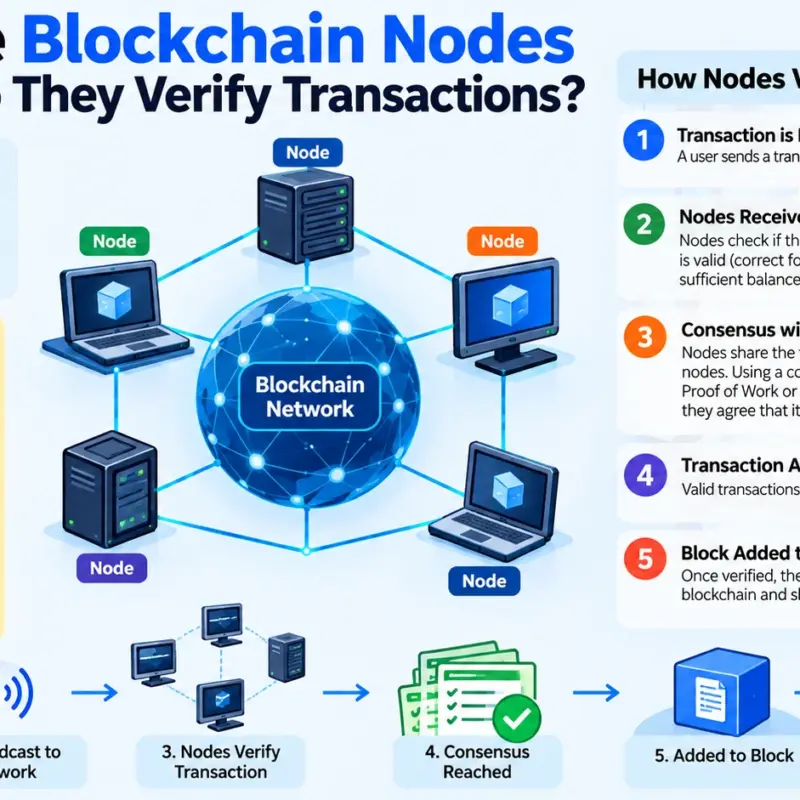
Instead of placing all data inside one central silo, a blockchain network distributes exact copies of its ledger across participating computers, commonly called nodes. These nodes continuously follow strict mathematical rules to verify new entries and keep records synchronized.
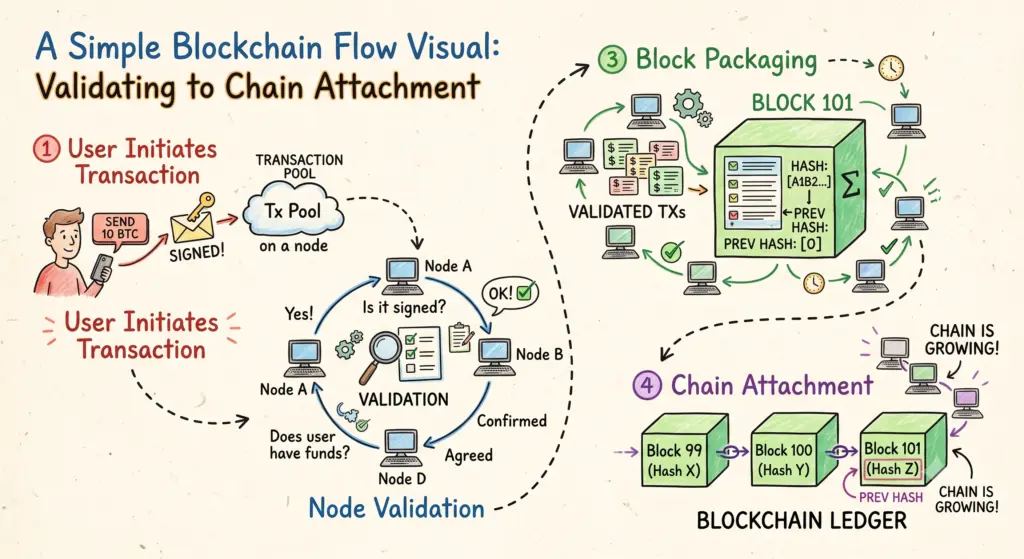
[User Initiates Transaction]
           │
           ▼
[Network Nodes Validate Data via Consensus]
           │
           ▼
[Transactions Packaged into Cryptographic Block]
           │
           ▼
[Block Appended to Existing Chain (Permanent Ledger)]
This design does not mean every system operates identically:
- Public Blockchains: Open networks where anyone can read, send transactions, and participate in consensus.
- Private / Permissioned Blockchains: Restricted networks where access is limited to approved organizations (enterprise-level setups).
Therefore, blockchain is an architectural design, not a single product, network, or cryptocurrency.
Zenvestai Quick Insight
Think of blockchain as a shared spreadsheet where every participant has an identical, auto-updating copy. Because every computer must validate changes using consensus rules, no single party can alter past records without the entire network instantly rejecting the change.
How Does a Blockchain Work? Step-by-Step Breakdown ⚙️
The entire blockchain process operates through a continuous cycle of verification, packaging, and permanent ledger distribution.
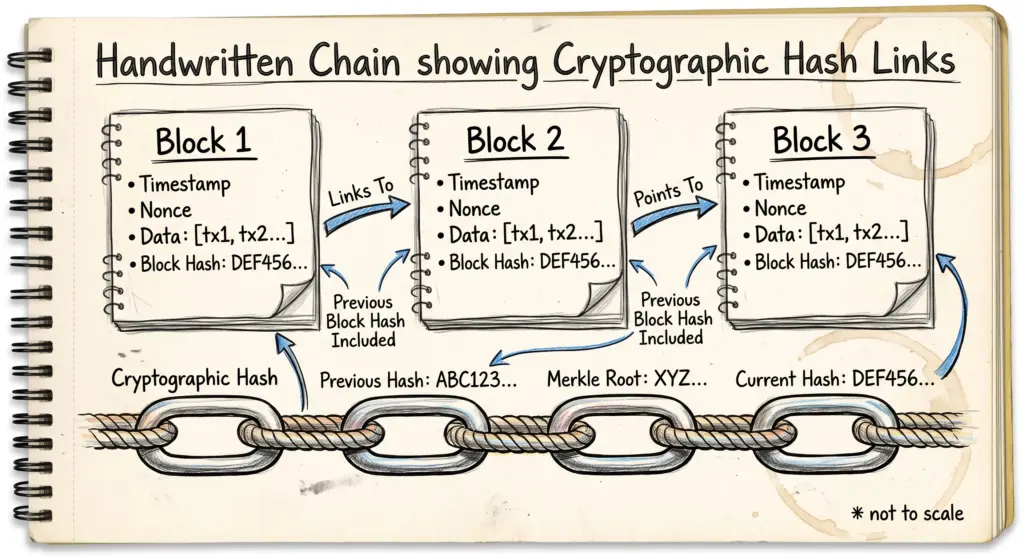
+---------------+     +---------------+     +---------------+
|    Block 1    |     |    Block 2    |     |    Block 3    |
| Prev Hash: 0  |<--- | Prev Hash: A1 |<--- | Prev Hash: B2 |
| Data: Tx Data |     | Data: Tx Data |     | Data: Tx Data |
| Hash: A1      |     | Hash: B2      |     | Hash: C3      |
+---------------+     +---------------+     +---------------+
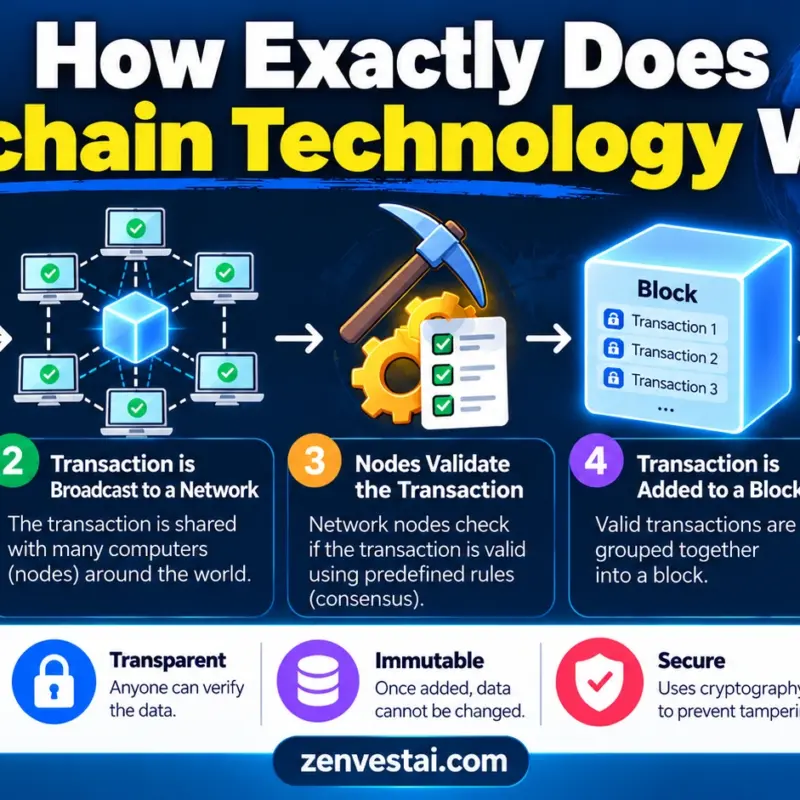
- Transaction Creation: A user initiates a transfer or submits digital data via secure crypto wallets. The entry is digitally signed using a private cryptographic key, proving authentic ownership without exposing secret data.
- Node Verification: Participating computers (nodes) verify whether the transaction follows the network’s rules, confirming signatures, available balances, and parameters.
- Block Assembly: Verified transactions are bundled into a block, containing the payload and a cryptographic reference to the preceding block.
- Consensus Validation: The network applies a consensus mechanism (such as Proof of Work or Proof of Stake) to ensure all participants agree that this block is valid.
- Chain Integration: Once accepted, the new block is permanently added to the chain, and all nodes synchronize their copies simultaneously.
The final result is not just an ordinary ledger, but a continuously growing, chronologically structured chain of cryptographically linked records.
Why Are Blocks Linked Cryptographically? 🔗
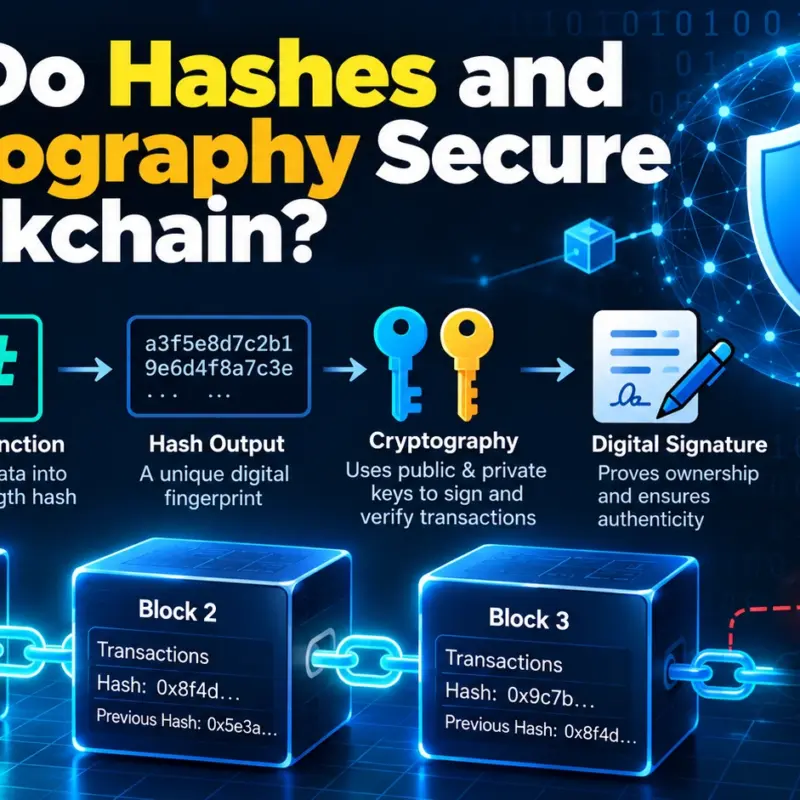
The cryptographic link between blocks is what makes historical records tamper-evident.
Every block generates a unique digital fingerprint called a cryptographic hash. Each subsequent block embeds the previous block’s hash within its own header.
- Alteration Detection: If someone attempts to rewrite data in an earlier block, its resulting hash changes completely.
- Broken Links: That modification immediately breaks the connection with every following block in the chain, causing honest nodes to reject the fraudulent ledger.
Consequently, blockchain is best described as tamper-evident and tamper-resistant rather than magically invincible. It exposes illicit alterations instantly, though overall network safety still depends on sound governance, evolving crypto regulations, and software implementation.
Blockchain vs. Bitcoin: What Is the Difference? 🔍
Blockchain is the foundational technology, whereas Bitcoin is a specific real-world application of it.
- Bitcoin (BTC): A decentralized digital currency and peer-to-peer payment network created to transfer value without central banks. Exploring a focused Bitcoin wealth strategy illustrates how this asset operates.
- Blockchain: The underlying distributed ledger technology (DLT) that records and protects Bitcoin’s transaction history.
- Programmable Blockchains (e.g., Ethereum): Platforms extending blockchain design to support automated smart contracts, decentralized finance (DeFi), and tokenized physical assets, powered by ecosystems like Ethereum.
What Makes Blockchain Different?
Blockchain combines multiple mature computer science disciplines into a unified record-keeping system:
- Distributed Records: Transaction histories are mirrored across a global network rather than stored on a central server.
- Public-Key Cryptography: Ensures secure identity verification, signing, and data transmission.
- Consensus Mechanisms: Formulates mathematical rules (like Proof of Stake) to achieve global agreement across untrusted computers.
- Immutability via Hash Chaining: Makes past events verifiable, traceable, and permanent across the entire market structure.
Key Blockchain Terminology Glossary
- Node: Any computer connected to a blockchain network that stores, shares, and validates ledger data.
- Block: A discrete batch of verified transaction data with a timestamp and previous hash.
- Cryptographic Hash: A fixed-length mathematical string representing a specific set of digital data.
- Consensus Mechanism: The protocol algorithm (PoW, PoS) used by nodes to agree on a single shared truth.
- Smart Contract: Self-executing code stored on a blockchain that runs automatically when predetermined conditions are met, expanding into practical tokenization systems.
The Bottom Line
Blockchain provides the foundational trust layer for the modern digital asset economy. By combining distributed networking, cryptographic security, and decentralized consensus, it allows participants worldwide to interact with complete confidence in their shared records. As you begin exploring cryptocurrency, decentralized applications, and future digital asset trends, understanding this core ledger model makes navigating financial technology clear and intuitive.
What specific use case for blockchain technology are you most excited to explore further? Share your thoughts and questions in the comments below!
Explore Related Topics & Guides
Start Here • Crypto Basics • Learn Crypto • Market Basics • Crypto Market • Trending News • Crypto News • Bitcoin News • Ethereum News • Trading Hub • Spot Trading • Futures Trading • Futures Guide • Low Capital Futures • Margin Trading • Portfolio Margin • Margin Financing • Options Trading • Options Guide • Options Basics • How Options Work • Why Options • Calls & Puts • Risk/Reward Ratio • Take Profit Strategy • Grid Bot Trading • AI Trading • Arbitrage • Spatial Arbitrage • SME Tokenization • Staking Hub • Yield • Liquidity Pools • Stablecoins • Crypto Wallets • Wallet Security • Binance Security • Binance Card Guide • Ethereum Upgrade • DeFi Security • Crypto Scams • Risk Watch • Regulation Hub • Crypto Research • Crypto in 60s • Breaking Stories