A crypto wallet → can look like a simple app on your phone or computer. But behind that simple screen is an important system of keys, addresses, signatures, and blockchain records →.
A decentralized crypto wallet is a type of wallet → that lets you control your crypto without giving a central company direct custody of your assets. In most cases, this means the wallet is self-custodial: you control the private keys or recovery credentials that give access to your crypto.
The most important thing to understand is this:
Your crypto is not physically stored inside the wallet app. It remains recorded on the blockchain. The wallet manages the keys that allow you to control those assets. Bitcoin.org makes the same basic distinction: a wallet manages private keys, while bitcoins → themselves exist as records on the blockchain.
This guide explains what a decentralized crypto wallet is, how it works, what it stores, how transactions happen, how wallets connect to dApps, and what you need to know about security →.
ZenvestAI Answer: What Is a Decentralized Crypto Wallet?
A decentralized crypto wallet is a crypto wallet designed to give the user direct control over the credentials needed to access and manage crypto assets on a blockchain, rather than placing those assets under the control of a central custodian.
In simple words:
A decentralized wallet gives you the keys instead of asking a company to hold them for you.
Many wallets described as decentralized are more precisely called self-custodial or non-custodial wallets →.
With a self-custodial wallet:
- You control the wallet credentials.
- You can create and manage blockchain accounts.
- You can send and receive supported crypto.
- You can connect to decentralized applications →.
- You are responsible for protecting your recovery phrase and private keys.
- There may be no central company that can simply reset your wallet for you.
This last point is very important.
More control also means more responsibility.
For example, MetaMask explains that its self-custodial model does not use a normal centralized account-recovery system. If a user loses the Secret Recovery Phrase or another supported recovery method, the provider may not be able to recover the funds for them.
Key Takeaways
A decentralized crypto wallet can be understood through a few simple ideas:
- It gives the user direct control over wallet credentials.
- Many decentralized wallets are more precisely described as self-custodial wallets.
- The wallet does not physically store crypto.
- The blockchain records the crypto and transaction history.
- Private keys authorize transactions.
- Public addresses can be used to receive crypto.
- Recovery phrases can help restore wallet access.
- Wallets can connect users to dApps and blockchain networks →.
- Self-custody provides greater control but also greater responsibility.
- Losing or exposing recovery credentials can lead to loss of funds.
- A decentralized wallet is not automatically anonymous or completely safe.
The easiest way to remember the whole concept is:
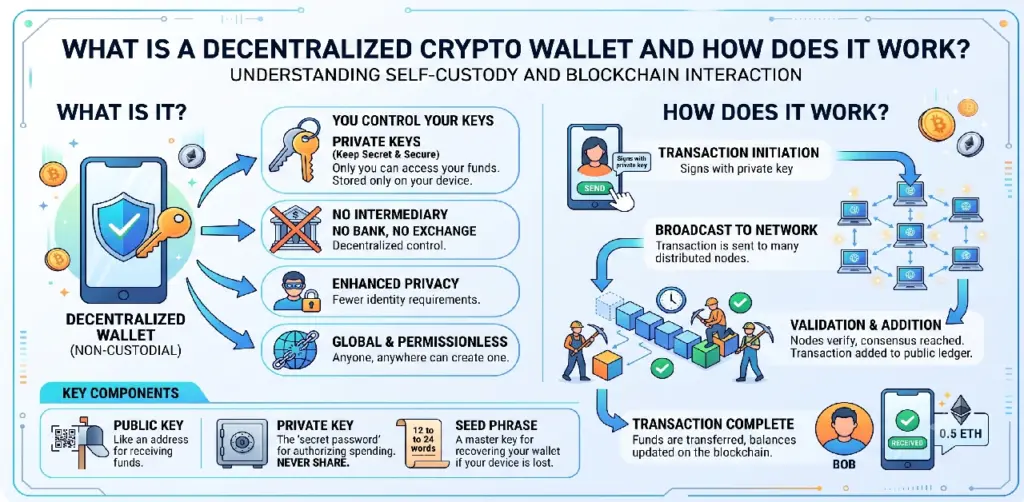
The blockchain records your crypto. The wallet manages the keys. The private key authorizes transactions. The public address lets others send crypto to you.
Once you understand these four ideas, the rest of crypto wallets becomes much easier to understand.
What Is a Decentralized Crypto Wallet?
Think about a normal bank account.
You have an account number and a way to prove that you are allowed to use the account. The bank keeps the official records and controls access to the banking system.
A crypto wallet works differently.
The blockchain keeps the transaction records. Your wallet provides the tools and cryptographic credentials needed to interact with those records.
For example, suppose you have 0.1 BTC.
You do not have a small digital coin sitting inside your phone.
Instead, the Bitcoin blockchain → contains the record of the relevant bitcoin and its current control. Your wallet holds or manages the private key that allows you to authorize a transaction involving those funds.
That is why losing your phone does not automatically mean losing your crypto.
If you still have the correct recovery information, you may be able to restore the wallet on another compatible device.
But if you lose the credentials needed to control the wallet, the situation can be very different.
How Does a Decentralized Crypto Wallet Work?
A decentralized crypto wallet works through several connected parts.
The basic process looks like this:
Wallet creation → Recovery phrase → Private keys → Public address → Blockchain → Transaction signing
Let’s understand each part step by step.
1. You Create the Wallet
When you create a self-custodial wallet, the wallet software generates the cryptographic information needed to create and control blockchain accounts.
You may see a screen asking you to create or protect a recovery phrase.
At this point, the wallet is creating the foundation for your future transactions.
The exact process differs between wallet types and blockchains, but the main idea is the same:
The wallet creates credentials that can be used to control blockchain accounts.
2. The Wallet Gives You a Recovery Phrase
Many self-custodial wallets use a recovery phrase, sometimes called a seed phrase or Secret Recovery Phrase.
It is usually a series of words.
For example, a wallet might show a phrase made up of 12 or 24 words, depending on the wallet and setup.
These words are extremely important.
They can be used to restore the wallet and the accounts derived from it.
Think of the recovery phrase as the master backup for the wallet.
It should never be treated like an ordinary password.
Never share your recovery phrase with:
- A stranger
- A website claiming to provide support
- A person claiming to be from a wallet company
- A random social media account
- An unknown dApp
- Anyone asking you to “verify” your wallet
MetaMask describes the Secret Recovery Phrase as the foundation of the wallet and warns that losing it can mean losing access to the wallet.
3. The Wallet Uses Private Keys
A private key is a secret piece of cryptographic information that allows you to authorize actions from a blockchain account.
You should think of it as a highly sensitive digital key.
If someone gets control of the relevant private key, they may be able to control the associated assets.
This is why private keys should never be posted online or sent to another person.
The relationship can be simplified like this:
Private key → controls account
Public address → identifies where crypto can be sent
The private key is secret.
The public address is designed to be shared.
4. The Wallet Creates a Public Address
Your wallet also gives you one or more public addresses.
You can normally give a public address to someone who wants to send you crypto.
For example:
Deep wants to send ETH → to Shankar.
Shankar gives Deep his Ethereum address.
Deep enters that address in her wallet and sends the ETH.
Shankar does not need to give Deep his private key.
The public address is meant to be shared.
The private key is not.
5. The Blockchain Records the Activity
The wallet does not become the blockchain.
It connects to a blockchain network → and helps you interact with it.
When you send crypto, the transaction is broadcast to the relevant network.
The network processes the transaction according to its rules.
After confirmation, the blockchain records the result.
This is why a wallet can be described as an interface to blockchain accounts and assets rather than a physical storage box for coins.
6. The Wallet Signs Transactions
When you want to send crypto, the wallet needs to prove that you are authorized to make the transaction.
This is where the private key is used.
The wallet uses the private key to create a digital signature.
The signature helps the blockchain network verify that the transaction was authorized by the holder of the required key.
The private key itself does not need to be publicly revealed.
In simple terms:
You approve → wallet signs → network receives → network verifies → blockchain records
That is one of the most important ideas behind crypto wallets.
What Does a Decentralized Wallet Store?
This question causes a lot of confusion.
A wallet normally does not store your cryptocurrency in the same way that a physical wallet stores cash.
Instead, it manages important information and credentials.
| Wallet element | What it does |
|---|---|
| Public address | Lets others send crypto to you |
| Private key | Authorizes transactions |
| Recovery phrase | Helps restore the wallet |
| Wallet software | Gives you an interface to manage accounts |
| Blockchain | Records transactions and asset ownership/control |
The exact design differs between wallets and blockchain networks.
Some wallets may also manage additional information, such as token balances, network settings, transaction history, connected applications, and account names.
But the central idea remains:
The blockchain records the assets. The wallet manages the credentials and tools used to control them.
Bitcoin.org states this directly for Bitcoin wallets: bitcoins exist as records on the blockchain, while the wallet manages the private keys that allow them to be spent.
Where Is Your Crypto Actually Stored?
Your crypto is recorded on the blockchain.
This is one of the first ideas every new crypto user should understand.
Imagine that you own 1 ETH.
It is tempting to think:
“My 1 ETH is inside my wallet.”
A better way to think about it is:
“The blockchain records my account’s ETH balance, and my wallet controls the credentials needed to use that account.”
Your phone can be lost.
Your computer can break.
Your wallet app can be deleted.
The blockchain itself does not disappear because your wallet app is gone.
What matters is whether you can securely recover the credentials needed to control your account.
This is also why backup is so important.
How Does a Wallet Send Crypto?
Let’s use a simple example.
Suppose Alice wants to send 0.05 ETH to Bob.
Step 1: Alice enters Bob’s address
Alice opens her wallet and enters Bob’s public address.
Step 2: Alice enters the amount
She enters:
0.05 ETH
Step 3: The wallet prepares the transaction
The wallet creates the transaction using information such as the destination address and amount.
Network-specific details and fees are also included.
Step 4: Alice approves the transaction
The wallet asks Alice to confirm.
Step 5: The transaction is signed
The wallet uses the required private key to create a digital signature.
Step 6: The transaction is broadcast
The transaction is sent to the blockchain network.
Step 7: The network processes it
The network checks the transaction according to its rules.
Step 8: The blockchain records the result
After the required confirmation process, the transfer becomes part of the blockchain’s recorded history.
The simplified flow is:
You → Wallet → Sign → Blockchain network → Confirmation → Recipient
This is why sending crypto is different from sending a normal message.
A blockchain transaction is an action that changes the state recorded by a blockchain.
How Does a Wallet Receive Crypto?
Receiving crypto is usually simpler.
Suppose Jacky wants to receive ETH.
Jacky opens his wallet and copies his Ethereum address.
He gives that public address to Aryan.
Aryan sends ETH to the address.
The blockchain records the transaction.
Jacky’s wallet can then read the blockchain and display the updated balance.
The basic process is:
Sender → Recipient address → Blockchain → Recipient wallet displays balance
Jacky does not need to approve the incoming transaction in the same way he would approve an outgoing transaction.
But he must still make sure that the sender is using the correct address and compatible network.
A wrong address or wrong network can create serious problems.
How Does a Wallet Connect to dApps?
A decentralized wallet can do more than send and receive crypto.
It can also connect to dApps, or decentralized applications →.
A dApp is an application that uses blockchain technology for some part of its operation.
For example, a dApp may allow users to:
- Swap tokens
- Use a DeFi service →
- Trade digital assets
- Stake supported assets →
- Interact with smart contracts →
- Participate in blockchain-based applications
When you visit a dApp, you may see a button such as:
Connect Wallet
If you choose to connect, the dApp may ask your wallet to approve the connection.
The basic flow is:
You → dApp → Wallet → Connection request → You approve
But there is an important difference between connecting a wallet and approving a transaction.
Connecting a wallet does not automatically mean that you have sent crypto.
A later action may ask you to approve a transaction or sign a message.
Always read what the wallet is asking you to approve.
Decentralized Wallet vs Custodial Wallet
The biggest difference is who controls the keys or account access.
| Feature | Self-custodial wallet → | Custodial wallet |
|---|---|---|
| Key control | User controls the relevant credentials | Custodian controls the keys |
| Access | User manages wallet access | Provider manages account access |
| Recovery | User is often responsible for backup | Provider may provide account recovery |
| Responsibility | Higher user responsibility | More responsibility sits with the provider |
| dApp access | Often direct | Depends on the platform |
| Main concern | Losing or exposing credentials → | Custodian or platform risk |
A custodial service can be convenient because the provider may offer familiar account recovery and other services.
But you are trusting that provider to hold and manage the crypto or keys correctly.
With self-custody →, you get more direct control.
But if you lose your recovery credentials, there may be no central company that can simply reset access.
Bitcoin.org similarly warns that when a third party controls your keys, you depend on that third party’s security → and reliability.
What Are the Advantages of a Decentralized Crypto Wallet?
You control your credentials
A self-custodial wallet can give you direct control over the keys or recovery credentials used to manage your blockchain accounts.
You can interact directly with blockchains
You do not always need to move assets to a centralized exchange before interacting with a blockchain application →.
You can connect to dApps
Supported wallets can act as a bridge between you and many blockchain applications →.
You can manage multiple assets
Depending on the wallet, you may be able to manage assets across one or several supported blockchain networks.
You have greater control
You are not simply asking a company to perform every blockchain action for you.
This is one of the main reasons people choose self-custody.
But control comes with responsibility.
What Are the Risks of a Decentralized Crypto Wallet?
A decentralized or self-custodial wallet is not automatically safe just because it gives you control.
The main risks include:
Losing your recovery phrase
If you lose the credentials required to restore your wallet, you may lose access to your assets.
Sharing your private key
If another person gets your private key, they may be able to control the associated assets.
Sharing your recovery phrase
A recovery phrase should be treated as extremely sensitive.
Anyone who obtains it may be able to restore the wallet.
Phishing
A fake website → may try to trick you into entering your recovery phrase or signing a harmful transaction.
Fake wallet apps
Criminals can create apps or websites that look similar to legitimate wallets.
Malicious dApps
A dApp → can ask you to approve an action that you do not fully understand.
Wrong addresses
Sending crypto to the wrong address can be difficult or impossible to reverse.
Wrong networks
Sending an asset through an incompatible network can create problems.
Malware
A compromised phone or computer may expose sensitive information or interfere with transactions.
Bitcoin.org notes that user error is a major practical wallet risk and recommends careful security practices →, backups, and appropriate wallet choices.
Is a Decentralized Crypto Wallet Safe?
The best answer is:
It can be safe, but safety depends on both the wallet design and the user’s behavior.
There is no wallet that can protect a user from every possible mistake.
Think about it this way:
A self-custodial wallet gives you the keys to your house.
That is useful because you control access.
But if you give the keys to a stranger, the security benefit disappears.
For better wallet security →:
- Keep your recovery phrase private.
- Never share your private key.
- Download wallet software from trusted sources.
- Keep wallet software updated.
- Check addresses before confirming transactions.
- Check the blockchain network before sending.
- Be careful with unknown dApps.
- Read transaction requests before approving them.
- Consider a hardware wallet → for larger or long-term holdings.
- Keep only the amount you need for everyday use in a hot wallet.
Bitcoin.org recommends considering hardware wallets for stronger protection and keeping only smaller amounts in wallets used for everyday transactions.
What Happens If You Lose Your Phone?
Losing your phone does not necessarily mean losing your crypto.
Your crypto is recorded on the blockchain →, not inside the physical phone.
If you have the correct recovery information, you may be able to restore your wallet on another compatible device.
For example:
Old phone lost → Install compatible wallet → Restore using recovery credentials → Regain access
However, this does not mean that recovery is guaranteed in every situation.
If your recovery phrase is lost, or if it was exposed to someone else, the situation can be much more serious.
MetaMask states that it cannot recover a user’s Secret Recovery Phrase for them and that losing the required recovery credentials can result in unrecoverable funds.
Types of Decentralized Crypto Wallets
Decentralized or self-custodial wallets come in different forms.
The main difference is usually where and how the wallet’s credentials are protected.
Mobile Wallets
A mobile wallet runs on a smartphone.
It is convenient for everyday use and can make QR-code transactions easy.
The downside is that your phone is a connected device and can be exposed to malware, theft, loss, or other security problems.
Desktop Wallets
A desktop wallet runs on a computer.
It may provide more features and can sometimes connect to hardware wallets or other tools.
But the security of the computer itself becomes important.
Browser Wallets
A browser wallet usually works as a browser extension.
It can make it easy to connect to Web3 applications.
This convenience also means users need to be careful about which websites and dApps they interact with.
Hardware Wallets
A hardware wallet → is a physical device designed to keep sensitive wallet credentials in a more protected environment.
Hardware wallets are often considered for larger holdings or long-term storage.
Bitcoin.org describes hardware wallets as one of the more secure wallet options and notes that they are particularly useful for storing larger amounts.
Smart Contract Wallets
Some modern wallets use smart contracts → as part of the account design.
They can support features that are difficult or impossible with a basic account model, depending on the blockchain.
These can include additional recovery methods, spending rules, multiple approvals, or other account features.
The exact features depend on the blockchain and wallet system.
How to Choose a Decentralized Crypto Wallet
There is no single wallet that is best for everyone.
Your choice should depend on what you want to do.
Before choosing a wallet, consider these points.
1. Which blockchain do you use?
A Bitcoin wallet → and an Ethereum wallet → do not necessarily work in the same way.
Some wallets support several networks.
Others focus on one ecosystem.
2. Is it self-custodial?
Check who controls the private keys or recovery credentials.
Do not rely only on the word “decentralized” in marketing.
Understand the actual custody model.
3. How does recovery work?
Understand what happens if your phone, computer, or hardware device is lost.
4. Does it support the applications you need?
If you plan to use DeFi → or other dApps, check whether the wallet supports the networks and applications you need.
5. How does it handle security?
Look for features such as transaction warnings, secure key storage, hardware-wallet support, and other appropriate security controls.
6. Is the software maintained?
A wallet is software.
Regular maintenance and security updates matter.
7. Does it fit your level of experience?
A wallet with many advanced features may not be the easiest option for a complete beginner.
Bitcoin.org’s wallet guide compares wallets using factors such as control, validation, transparency, privacy, environment, and fees.
A Simple Example of How a Decentralized Wallet Works
Let’s put everything together.
Imagine that Ravi wants to send 100 USDT → to Priya.
Step 1: Priya opens her wallet
She finds her receiving address.
Step 2: Priya sends the address to Ravi
The address is public information.
Step 3: Ravi enters the address
He opens his wallet and enters Priya’s address.
Step 4: Ravi enters 100 USDT
The wallet prepares the transaction.
Step 5: Ravi checks the details
He checks the address, amount, network, and expected fee.
Step 6: Ravi approves
The wallet asks him to confirm.
Step 7: The transaction is signed
The wallet uses the required private key to authorize the transaction.
Step 8: The transaction reaches the blockchain network
The network processes it according to its rules.
Step 9: The blockchain records the transaction
After the relevant confirmation process, the transfer is reflected on the blockchain.
Step 10: Priya sees the updated balance
Her wallet reads the blockchain data → and displays the balance.
The important point is that the wallet did not physically move a coin from Ravi’s phone to Priya’s phone.
Instead, the blockchain record changed to reflect the transaction.
Decentralized Wallet vs Blockchain: What Is the Difference?
These two terms are often confused.
A blockchain → is the underlying network and shared record system.
A wallet → is a tool used to manage blockchain accounts and interact with the network.
Think of it this way:
Blockchain = record system
Wallet = tool for interacting with that system
The wallet does not replace the blockchain.
It works with it.
Decentralized Wallet vs Crypto Exchange
A crypto exchange → can provide an account where you see a crypto balance.
A self-custodial wallet works differently.
With an exchange account, the exchange may control the keys for the assets held in its custody.
With a self-custodial wallet →, you control the relevant credentials.
This creates an important trade-off:
Exchange custody → easier account recovery, but greater dependence on the platform
Self-custody → greater control, but greater personal responsibility
Neither model is simply “good” or “bad.”
The right choice depends on the user’s goals, knowledge, risk tolerance, and security practices.
What Does “Not Your Keys, Not Your Crypto” Mean?
You may hear the phrase:
“Not your keys, not your crypto.”
This phrase refers to custody.
If another company controls the private keys associated with assets held for you, you are relying on that company to provide access to those assets.
If you control the keys yourself, you have more direct control.
But this does not mean self-custody removes all risk.
You can still lose your keys, fall for phishing →, approve a harmful transaction, or make a transfer mistake.
So the better lesson is:
Self-custody gives you control, but control comes with responsibility.
Are Decentralized Wallets Anonymous?
Not necessarily.
A crypto wallet address is generally a public blockchain identifier.
Depending on the blockchain, transactions and balances may be visible publicly.
A wallet address does not always display your real name directly, but that does not automatically make your activity anonymous.
A person’s identity may become linked to an address through exchanges, transactions, public information, blockchain analysis, or other sources.
So:
Decentralized wallet ≠ automatically anonymous
Public blockchain ≠ automatically private
Privacy depends on the blockchain, wallet, applications, transaction patterns, and other factors.
Can a Decentralized Wallet Be Hacked?
The wallet itself can have software vulnerabilities, but many real-world losses happen because an attacker obtains the user’s credentials or tricks the user into approving an unsafe action.
Common attack paths include:
- Phishing websites →
- Fake wallet applications
- Malware
- Stolen recovery phrases
- Stolen private keys
- Malicious browser extensions
- Fake customer support
- Harmful smart-contract approvals →
- Social engineering
This is why wallet security → is not only about the wallet software.
It is also about how you use it.
What Is the Difference Between a Wallet Password and a Recovery Phrase?
These two things are not always the same.
A wallet password may protect access to the wallet application on a particular device.
A recovery phrase can be the underlying backup used to restore the wallet and its accounts.
For this reason, losing a device password may be very different from losing the recovery phrase.
The exact recovery system depends on the wallet.
Users should understand their wallet’s recovery model before depositing significant funds.
Can You Have More Than One Crypto Wallet?
Yes.
There is no rule saying that you must use only one wallet.
Someone might use:
- One wallet for everyday transactions
- One hardware wallet → for long-term holdings
- Another wallet for testing dApps →
- A separate wallet for a specific blockchain ecosystem
Using separate wallets can help separate different activities and risks.
But it also means managing more recovery information and security responsibilities.
More wallets do not automatically mean more security.
Good security practices matter more.
What Happens When You Connect Your Wallet to a dApp?
Connecting your wallet can allow a dApp to identify an address and request certain actions.
The exact permissions depend on the application and blockchain.
A connection is not the same as giving someone your private key.
A legitimate wallet should not require you to give your private key or recovery phrase to a dApp.
However, you may be asked to:
- Sign a message
- Approve a token allowance →
- Confirm a transaction
- Interact with a smart contract →
Always understand what you are approving.
If something looks unusual, stop and investigate before confirming.
What Are the Most Important Wallet Security Rules?
For beginners, keep these rules simple.
Rule 1: Never share your recovery phrase
Not with friends.
Not with strangers.
Not with “support.”
Not with a website.
Not with an AI bot.
Rule 2: Never share your private key
Treat it as secret information.
Rule 3: Check every transaction
Before clicking confirm, check:
- Address
- Amount
- Network
- Fee
- Transaction details
Rule 4: Be careful with links
Do not blindly click wallet or dApp links sent through social media, email, or messages.
Rule 5: Keep backups secure
A backup should be protected from theft, damage, and unauthorized access.
Rule 6: Do not keep everything in one hot wallet
For significant holdings, consider whether a hardware wallet → or another safer setup is appropriate.
Rule 7: Learn before you approve
If you do not understand a transaction, do not rush.
Bottom Line
A decentralized crypto wallet gives you direct control over your crypto through the keys that control your blockchain accounts. Your crypto is not stored inside the wallet app; it remains recorded on the blockchain, while the wallet helps you manage your keys, send and receive assets, and connect with dApps.
The biggest benefit is control. The biggest responsibility is security →. If you choose self-custody, protecting your recovery phrase and private keys becomes your responsibility.
In simple terms: your wallet gives you the keys, the blockchain keeps the records, and you control the access.
Explore Related Pillar Hubs
- Blockchain Architecture & Foundations →
- Cryptocurrency Basics & Starter Essentials →
- Crypto Wallets & Custody Solutions →
- Decentralized Finance (DeFi) →
- Wallet Security & Key Management →
- Cryptoeconomic Security & Asset Protection →
- Crypto Scams & Fraud Prevention →
- Global & Regional Crypto Regulation →
Related Guides & Recommended Reading
- A Beginner’s Guide to Cryptocurrency and Blockchain Technology →
- What Is Cryptoeconomic Security? Complete Guide →
- What Is Crypto Staking and How Does It Work? →
- How Layer 2 Scaling Works on Blockchains →
- What Is a Stablecoin and How Do Stablecoins Work? →
- How Distributed Ledgers Are Radically Rewriting Modern Finance →
- The Future of Crypto Regulations →
- Understanding Tokenization and Wholesale Digital Assets in 2026 →
