⚡ Bitcoin Fast Facts
| Parameter | Key Detail |
| Creator | Satoshi Nakamoto (Pseudonymous Individual or Group) |
| Whitepaper Release Date | October 31, 2008 |
| Genesis Block Mined | January 3, 2009 |
| Network Type | Decentralized, Peer-to-Peer [P2P] |
| Consensus Mechanism | Proof-of-Work [PoW] (SHA-256) |
| Maximum Supply Cap | 21,000,000 BTC (Mathematically Fixed) |
| Smallest Unit | 1 Satoshi (0.00000001 BTC) |
| Primary Core Utility | Censorship-Resistant Store of Value & Digital Cash |
💡 Key Takeaways:
- Bitcoin is the world’s first decentralized digital currency, functioning without banks, central governments, or intermediaries.
- It was created in direct response to the 2008 global financial crisis to protect everyday people against unchecked currency debasement and systemic institutional failures.
- The fundamental breakthrough of Bitcoin is solving the double-spending problem through a distributed cryptographic ledger known as the blockchain.
- Supply is strictly capped at 21 million units, making it mathematically scarce and immune to political inflation.
- You maintain absolute mathematical ownership of your funds through private cryptographic keys, truly allowing you to be your own bank.
📌 What This Post Covers
- What is Bitcoin?
- The Origination: Why Did Satoshi Create Bitcoin?
- The Breakthrough: How Bitcoin Solved the Double-Spending Problem
- Who Invented Bitcoin and When Did It Launch?
- How Does Bitcoin Works?
- Mining and Proof-of-Work
- History and Early Adoption Of Bitcoin
- Goals and Inventor
- Bitcoin vs. Traditional Fiat Currency
- Criticisms and Limitations
- What is the Ultimate Mission and Goal of Bitcoin?
- Bitcoin Glossary for Beginners
What is Bitcoin? The Ultimate Beginner’s Guide to How It Works, Who Created It, and Why It Matters
Have you ever stopped to wonder what gives the paper money in your wallet its actual value? You work tirelessly for your income, yet every year, inflation quietly chips away at your purchasing power while banks control when, where, and how you access your own hard-earned savings.
In today’s interconnected world, traditional financial institutions act as gatekeepers to your economic freedom. Whenever you make a wire transfer, pay an international fee, or watch central banks print trillions of new currency units, you feel the friction of an outdated monetary system.
Initially, the idea of completely separating money from centralized institutions sounded like science fiction. However, in late 2008, a quiet technological revolution began that permanently redefined our relationship with trust, technology, and wealth.
🧠 ZenvestAi Explains Bitcoin As
Permissionless Accessibility: Anyone with an internet connection can download a wallet and participate without undergoing credit checks or background approvals.
Decentralized Architecture: No central headquarters, CEO, board of directors, or single point of failure.
Peer-to-Peer
[P2P]Settlement: Direct wallet-to-wallet transactions occur without intermediary clearing houses.Mathematical Scarcity: There will only ever exist 21,000,000 Bitcoins, permanently safeguarding it from arbitrary inflation.
Complete Transparency: Every transaction ever settled is permanently recorded on a publicly viewable distributed ledger.
What is Bitcoin?
Bitcoin is a decentralized digital currency introduced in 2008 by the pseudonymous inventor Satoshi Nakamoto.
It was designed as a peer-to-peer electronic cash system, meaning people can send payments directly to each other without banks or other trusted intermediaries.
Bitcoin transactions are recorded on a public ledger called the blockchain, which anyone can view but cannot easily change after confirmation.
New bitcoins are created through a process called mining, where computers compete to solve cryptographic puzzles and secure the network. Bitcoin has a maximum supply of 21 million coins.
The main idea behind Bitcoin was to remove the need for a central authority, such as a bank, while solving the double-spending problem.
The network uses cryptography and consensus among participants to verify transactions.
In late 2008, Satoshi Nakamoto published the Bitcoin whitepaper, explaining how the system could work. In 2009, the first Bitcoin software was released and the network went live.
Bitcoin’s early history began with the creation of the genesis block in January 2009.
Soon after, Satoshi Nakamoto sent 10 BTC to developer Hal Finney, marking one of the earliest known Bitcoin transactions between users.
In 2010, Bitcoin made history when 10,000 BTC were used to buy two pizzas. This event is widely remembered as one of the first real-world purchases made with Bitcoin.
Furthermore, Bitcoin is not a physical coin tucked away in a vault. It is an unchangeable digital ledger entry secured by global mathematics and cryptography.
Because the software is completely decentralized, no single corporation, prime minister, or billionaire controls its rules.
Top News: Stay informed with the absolute latest developments and headline updates across the global crypto landscape. Read Top News
Market Structure: Analyze the underlying frameworks, macroeconomic forces, and systemic trading patterns driving digital asset markets. Explore Market Structure
Risk Watch: Monitor security vulnerabilities, macro threats, and volatility alerts to protect your capital. Check Risk Watch
StableCoins: Track pegged digital assets, regulatory shifts, and liquidity flows within the stablecoin ecosystem. View StableCoins
Market Today: Get a comprehensive daily snapshot of asset performance, volume changes, and key price movements. See Market Today
Crypto Staking: Discover how to lock your tokens, secure networks, and earn sustainable passive rewards safely. Learn Crypto Staking
Yield: Maximize capital efficiency across decentralized finance protocols with optimized yield-generation strategies. Explore Yield
Liquidity Pools: Understand automated market makers (AMMs) and the mechanics of decentralized liquidity provision. Discover Liquidity Pools
Breaking Crypto Story: Catch real-time, in-depth coverage of major market-shifting events as they unfold. Read Breaking Crypto Story
Crypto in 60 Seconds: Quick-fire, bite-sized summaries designed to keep you updated on everything happening in the fast-paced crypto world. Check Crypto in 60 Seconds
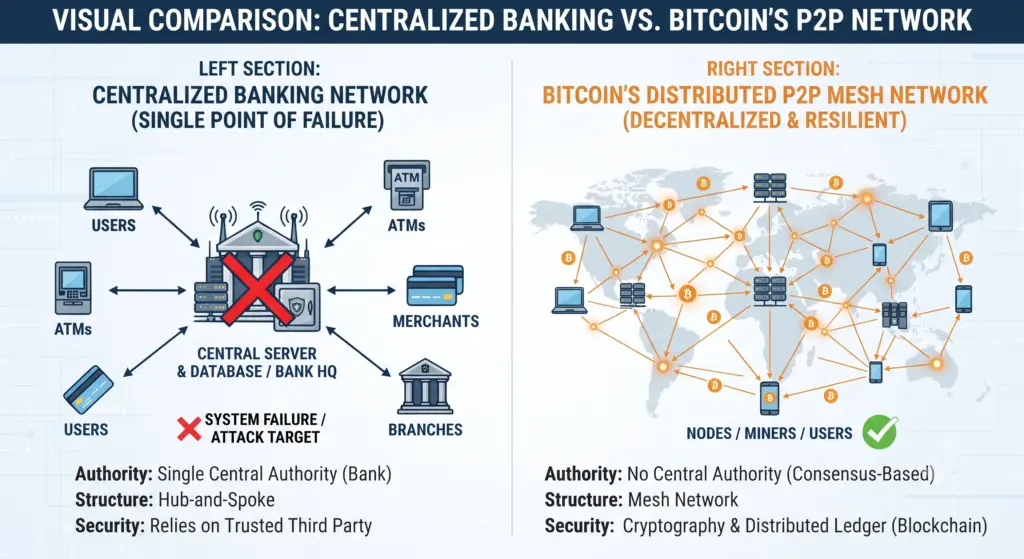
The Origination: Why Did the Concept of Bitcoin Emerge?
Bitcoin was created in response to limitations of traditional financial systems.
Satoshi Nakamoto published the “Bitcoin: A Peer-to-Peer Electronic Cash System” whitepaper in October 2008.
It explained the main idea behind Bitcoin: people should be able to send money directly to each other without using a bank or financial institution.
Satoshi highlighted that existing online payment systems relied on trust in banks or payment services, which can cause delays, fees, reversals, and vulnerabilities (e.g. fraud or failure of a central server).
In contrast, Bitcoin uses cryptographic proof to secure transactions so that no trusted third party is needed.
The concept was influenced by earlier ideas in the “cypherpunk” community. In 2004, computer scientist Hal Finney proposed Reusable Proof-of-Work (RPoW) as a digital cash concept.
Wei Dai described “b-money” (a theoretical distributed currency), and Nick Szabo described “bit gold” – ideas that combined cryptography and time-stamping.
Nakamoto combined these ideas with proof-of-work. It recorded transactions in a public ledger. This helped solve the double-spending problem.
In simple words, the same Bitcoin cannot be spent twice. Bitcoin could work without a central authority or central mint.
Nakamoto began quietly communicating with cypherpunks.
On October 31, 2008, Satoshi announced on a cryptography mailing list: “I’ve been working on a new electronic cash system that’s fully peer-to-peer, with no trusted third party.”
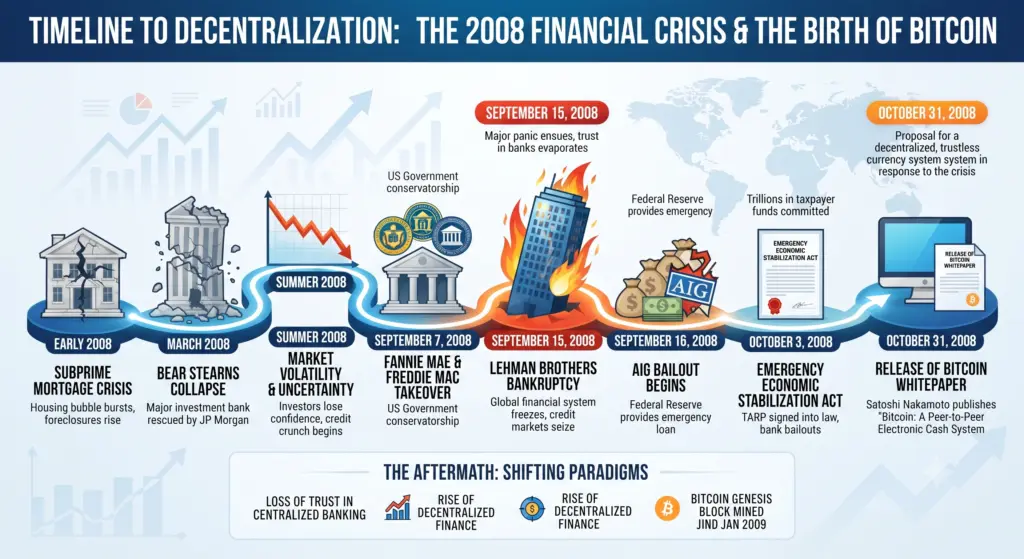
The timing coincided with the 2008 financial crisis, and Satoshi later embedded a political message in the first block: “The Times 03/Jan/2009 Chancellor on brink of second bailout for banks,” suggesting a critique of central banking.
The overarching goal was to create money not subject to arbitrary creation or control, but governed by transparent code and cryptographic math, making it cannot be changed and censorship-resistant.
The Great Breakthrough: What Was the Big Idea Behind It?
Bitcoin’s true genius lies in solving computer science’s most notorious puzzle: the “Double-Spending Problem.”
When you send a digital file (like a PDF or JPEG image) to a friend, you are merely sending a duplicate copy while keeping the original on your device.
Clearly, money cannot work like a copy-paste JPEG, because everyone would simply duplicate wealth out of thin air.
Traditional systems solved this by using trusted third parties (banks) to maintain a private database balance for everyone.
Satoshi Nakamoto realized that humanity could replace institutional trust with cryptographic proof.
By combining peer-to-peer file sharing, asymmetric encryption, and a proof-of-work incentive mechanism, Satoshi created a self-policing, uncheatable digital ledger.
🚀 Who Invented Bitcoin and When Did It Launch?
Bitcoin was introduced to the world on October 31, 2008, by a pseudonymous developer (or group) named Satoshi Nakamoto.
On that day, Satoshi published a concise 9-page whitepaper titled “Bitcoin: A Peer-to-Peer Electronic Cash System” to a specialized cryptography mailing list.
Shortly thereafter, on January 3, 2009, Satoshi brought the network to life by mining the very first block of transactions, known as the Genesis Block (Block 0).
Significantly, Satoshi permanently embedded a secret headline inside the Genesis Block:
“The Times 03/Jan/2009 Chancellor on brink of second bailout for banks”
This message serves as an eternal timestamp and an undeniable philosophical statement highlighting why decentralized money had to be built.
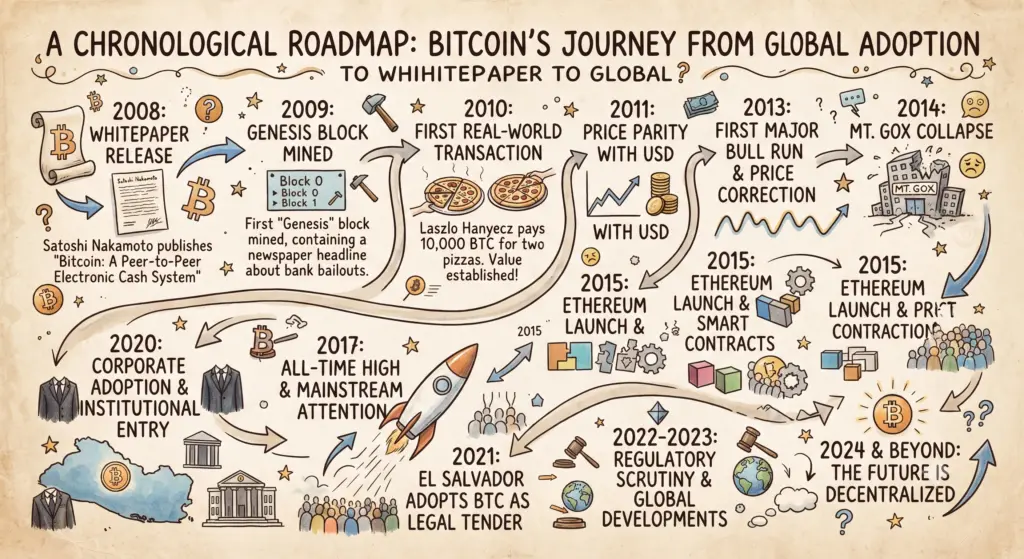
Milestone Timeline of Bitcoin’s Genesis
- October 31, 2008: Satoshi Nakamoto publishes the official Bitcoin whitepaper.
- January 3, 2009: The Genesis Block is mined, yielding the initial 50 BTC block reward.
- January 12, 2009: Satoshi executes the first-ever Bitcoin transaction, sending 10 BTC to computer scientist Hal Finney.
- May 22, 2010 (Bitcoin Pizza Day): Laszlo Hanyecz completes the first commercial transaction, buying two pizzas for 10,000 BTC.
- April 2011: Satoshi Nakamoto sends a final email stating they have “moved on to other things,” handing project development entirely to the open-source community.
⚙️ How Does Bitcoin Work?
At its core, Bitcoin uses a blockchain: an append-only, time-stamped ledger of all transactions. Each block contains a batch of transactions and a special cryptographic hash of the previous block, chaining them together.
The chain structure means that changing any transaction in a past block would require redoing the proof-of-work for that block and all blocks that follow it. This is computationally infeasible if honest nodes control the majority of processing power.
In practical terms, once a transaction is buried under several blocks, it is considered final and very unlikely to be reversed.
Bitcoin defines a “coin” (or satoshi, its smallest unit) as a chain of digital signatures. When Alice pays Bob 1 BTC, she signs the transaction with her private key. The transaction references a previous transaction output and specifies Bob’s public key as the new owner.
Anyone can verify the chain of signatures to ensure the coins were legitimately hers and not already spent.
Because all transactions are public, nodes can check that no double-spend occurred by ensuring each coin output is only spent once.
The network participants must agree on a single sequence of transactions (global order) to prevent conflicts. This is achieved through a consensus rule where the longest valid chain wins.
The Step-by-Step Transaction Journey:
- Step 1: Signing the TransactionYou enter the recipient’s public address and the amount in your wallet app, authorizing the transfer using your confidential private key.
- Step 2: Mempool BroadcastYour transaction is broadcast to the peer-to-peer network and waits in a temporary holding area called the Mempool
[waiting room for transactions]. - Step 3: Proof-of-Work MiningSpecialized computers called miners bundle thousands of pending transactions into a candidate block and compete to solve a complex mathematical puzzle (SHA-256 algorithm).
- Step 4: Block Validation and Ledger AppendOnce a miner discovers the valid cryptographic solution, the block is broadcast to all nodes, verified as authentic, and permanently added to the blockchain ledger.
Mining and Proof-of-Work
Mining is the process that adds blocks to the blockchain and issues new bitcoins.
Miners gather unconfirmed transactions into a candidate block and perform Proof-of-Work.
They repeatedly compute hashes with different “nonce” values until the block hash has a certain number of leading zeros.
This requires substantial computing power and electricity. The first miner to find a valid proof-of-work broadcasts the new block to the network. Other nodes verify the transactions and accept the block, then begin working on the next block.
This process provides security and consensus. Because producing blocks requires real computing power and electricity, it is extremely costly for an attacker to change past blockchain history.
Honest miners controlling most of the mining power will keep building the longest (most-work) chain. Satoshi described this as “one-CPU-one-vote.”
Bitcoin automatically adjusts its mining difficulty to keep block creation at about one block every 10 minutes.
In the early days, the difficulty was very low, so anyone could mine with a personal computer. As more miners joined, the difficulty increased automatically.
The block reward started at 50 BTC and is programmed to halve roughly every 4 years (every 210,000 blocks).
This process limits the total supply to 21 million bitcoins.
Eventually, when all bitcoins have been mined, miners will be rewarded mainly through transaction fees.
Keys, Addresses and Wallets
Users interact with Bitcoin through wallets, which manage cryptographic keys. A private key is a large random number that must be kept secret. From it, a public key and then a Bitcoin address are derived.
When sending Bitcoin, the owner signs the transaction with their private key. This proves ownership of the bitcoins being spent and helps ensure the transaction cannot be altered after signing.
Everyone can see Bitcoin transactions and balances on the public blockchain. Bitcoin addresses are pseudonymous, meaning they are not automatically connected to a real-world identity. Therefore, Bitcoin provides some privacy but not complete anonymity.
To spend Bitcoin, the owner must have the corresponding private key. Without the private key, the bitcoins cannot be spent. Losing a private key can mean losing access to the bitcoins permanently.
In Simple Terms
Bitcoin’s technical design combines:
- Blockchain — a public chain of hashed blocks containing transactions.
- Proof-of-Work mining — uses computing power to secure the network.
- Longest valid chain — represents the chain with the most accumulated work.
- Digital signatures — use private keys to prove ownership.
- 21 million maximum supply — creates a fixed limit on Bitcoin supply.
- No central authority — allows Bitcoin to operate as a decentralized and tamper-resistant ledger.
The Complete Bitcoin Wealth Strategy: Discover long-term accumulation plans, portfolio allocation tactics, and wealth-building strategies centered around Bitcoin. Read Bitcoin Strategy
The Complete Ethereum Wealth Strategy: Learn advanced portfolio frameworks and valuation models for building enduring digital wealth with Ethereum. Explore Ethereum Strategy
What Is Crypto Staking? The Complete Guide to Earning Rewards Safely: Master how to lock your crypto assets in proof-of-stake networks to generate secure passive income. Learn Crypto Staking
Why Does Staking Exist? The Ultimate Guide to Cryptoeconomic Security: Explore the fundamental economics and validation mechanics powering decentralized blockchain consensus. Discover Staking Security
What Is Crypto Futures Trading? A Complete Beginner’s Guide: Get a step-by-step introduction to derivatives markets, leverage, and contract trading basics. Read Futures Guide
The Ultimate Risk-to-Reward Ratio Guide: Master Crypto Risk and Protect Your Capital: Learn how to calculate and apply optimal risk-to-reward ratios to safeguard your portfolio from heavy drawdowns. Master Risk Management
What Is Take Profit (TP)? The Ultimate Step-by-Step Guide to Locking in Crypto Trading Profits with Discipline: Understand how to strategically set Take Profit targets to secure gains without emotional bias. Learn Take Profit Strategies
History and Early Adoption Of Bitcoin
Bitcoin was unveiled publicly on October 31, 2008, when Satoshi Nakamoto posted the whitepaper to a cryptography mailing list. The domain bitcoin.org had already been registered in August 2008 by Satoshi and Martti Malmi, an early developer, laying groundwork for the project.
In January 2009, Satoshi mined the genesis block (Block 0) – the very first block in the Bitcoin blockchain – which included a hidden message: “The Times 03/Jan/2009 Chancellor on brink of second bailout for banks”. This timestamped message served as proof of the date and a commentary on traditional banking, hinting at Bitcoin’s goal to bypass traditional financial systems. The genesis block granted Satoshi 50 BTC, although these coins are not spendable due to a quirk in the software.
Shortly after, on January 8, 2009, Satoshi announced and released Bitcoin v0.1, the first Bitcoin software, to the public, describing it as “completely decentralized with no server or central authority.”
Early adoption was slow. On January 12, 2009, just three days after the first software release, Satoshi sent 10 BTC to Hal Finney as a test. This marked the world’s first Bitcoin transaction. Finney, a veteran cypherpunk, had received early copies of the software and helped refine Bitcoin’s ideas.
According to Guinness World Records, the first Bitcoin transaction took place on January 12, 2009, when Satoshi Nakamoto transferred 10 bitcoins to Hal Finney. For nearly a year, the network remained largely experimental, with very limited activity.
The first real-world purchase using Bitcoin happened on May 22, 2010, when programmer Laszlo Hanyecz paid 10,000 BTC for two pizzas. This event, now celebrated as “Bitcoin Pizza Day,” demonstrated Bitcoin’s ability to function as a real-world payment method. At the time, the 10,000 BTC were worth about $41.
By 2010, a small community of Bitcoin enthusiasts and developers began to form. Bitcointalk.org, founded by Satoshi in late 2009, became an important discussion forum. Early infrastructure also emerged, including Mt. Gox, which launched in 2010 and allowed users to trade Bitcoin for fiat currency. Mining pools also appeared as solo mining became more difficult.
Over the following years, Bitcoin’s price and adoption increased. Bitcoin reached US$1 in early 2011, later surged to around $30, and then experienced a major price decline. Satoshi continued guiding the project until approximately late 2010, after which he handed leadership to others, notably Gavin Andresen, and disappeared from public involvement.
Key Early Bitcoin Timeline
| Date | Event |
|---|---|
| Oct 31, 2008 | Bitcoin whitepaper published by Satoshi Nakamoto |
| Jan 3, 2009 | Genesis block (Block 0) mined by Nakamoto |
| Jan 8, 2009 | Bitcoin v0.1 released — first Bitcoin software |
| Jan 12, 2009 | First Bitcoin transaction: 10 BTC sent from Satoshi to Hal Finney |
| May 22, 2010 | First commercial Bitcoin purchase: 10,000 BTC for two pizzas |
Goals and Inventor
Bitcoin’s goals and motivations were laid out by Nakamoto and early documentation. In the whitepaper, Satoshi states the aim is a system where “transactions are computationally impractical to reverse” and where “trust” is replaced by “cryptographic proof”, allowing “any two willing parties to transact directly.”
The main goal was digital cash that is irreversible once confirmed, so sellers are protected from fraud without needing costly intermediaries.
The vision also included micropayments, allowing very small-value transactions without the high overhead of traditional payment systems.
Satoshi Nakamoto is the name used by Bitcoin’s creator, but it is a pseudonym. The true identity of the person or group remains unknown.
The Bitcoin.org domain was registered by Satoshi and Martti Malmi in 2008. Nakamoto communicated with early contributors such as Hal Finney, Wei Dai, Adam Back, and Nick Szabo.
By 2010–2011, Satoshi stepped away from Bitcoin development and handed control to other developers. Nakamoto’s estimated ~1 million BTC holdings have never been spent, adding to the mystery surrounding the creator.
Key Contributions
- October 31, 2008 — Whitepaper: Satoshi Nakamoto published “Bitcoin: A Peer-to-Peer Electronic Cash System.”
- January 3, 2009 — Genesis Block: Satoshi mined Bitcoin’s first block, Block 0.
- January 9, 2009 — Software Release: Bitcoin v0.1 was released as open-source software.
- January 12, 2009 — First Bitcoin Transaction: Satoshi sent 10 BTC to Hal Finney.
- 2008 — Bitcoin.org: The domain was registered by Satoshi and Martti Malmi.
Bitcoin’s motivation was to create a currency independent of governments and banks. Its system is decentralized, open, transparent, and based on cryptography rather than a central authority.
Bitcoin vs Traditional Money
| Attribute | Bitcoin | Traditional Fiat Currency |
|---|---|---|
| Issuer | No central issuer; controlled by protocol rules | Central bank/government |
| Supply Limit | Fixed at 21 million BTC | Generally inflationary |
| Ledger | Public blockchain | Private bank/payment ledgers |
| Consensus | Proof-of-Work | Central authorities and regulations |
| Transactions | Peer-to-peer | Through banks/payment networks |
| Privacy | Pseudonymous addresses | Usually linked to identified accounts |
| Value | Based on scarcity and network security | Supported by government/legal-tender system and economy |
| Divisibility | 1 BTC = 100 million satoshis | 1 dollar = 100 cents |
Main Difference
Bitcoin removes the need for a central intermediary, while traditional money depends heavily on banks, governments, and payment networks.
Bitcoin offers censorship resistance and a transparent supply schedule, but traditional systems generally provide faster and more familiar payments.
Criticisms and Limitations
The main criticisms of Bitcoin include:
- Volatility: Bitcoin’s price can rise and fall sharply, making it difficult to use as a stable form of payment.
- Limited Transaction Capacity: Bitcoin has limited on-chain transaction capacity and roughly 10-minute block intervals.
- Scaling Challenges: Large-scale everyday payments can be difficult, which led to solutions such as the Lightning Network.
- High Energy Use: Proof-of-Work mining consumes significant electricity.
- Privacy Limitations: Bitcoin is pseudonymous, not completely anonymous, because transactions are publicly visible.
- Transaction Fees: Fees can become expensive when network demand is high.
- Micropayment Challenges: Very small payments can still be difficult to make efficiently on the main Bitcoin network.
Despite these limitations, Bitcoin has changed the global discussion about digital money, ownership, trust, and financial systems.
Lasting Impacts
Bitcoin’s creation had several major impacts:
- Created the first successful decentralized cryptocurrency.
- Inspired thousands of other cryptocurrencies and blockchain projects.
- Popularized the idea of a decentralized public ledger.
- Changed how people think about digital ownership and financial freedom.
- Created new industries such as crypto exchanges and digital wallets.
- Encouraged research into blockchain technology and decentralized finance.
- Started a global debate about money, inflation, privacy, and monetary policy.
- Demonstrated that peer-to-peer digital money can operate without traditional banks.
- Bitcoin was adopted as legal tender in El Salvador in 2021.
- Bitcoin continues to coexist with traditional fiat currencies rather than completely replacing them.
Simplified Bitcoin Transaction Flow

Payer → Bitcoin Network → Miners → Blockchain
Payer broadcasts the transaction → Network relays it → Miners verify and include it in a block → Block becomes part of the blockchain.
🛡️ What is the Ultimate Goal and Mission of Bitcoin?
The overarching goal of Bitcoin is to establish an honest, unmanipulable monetary foundation for the digital age. Just as the printing press democratized knowledge and the internet democratized information, Bitcoin democratizes value.
Furthermore, it provides a safe financial haven for billions of unbanked or underbanked people living under hyperinflationary regimes and currency controls. Above all, it serves as “Digital Gold”—a scarce, durable, and highly liquid store of value designed to endure across generations.
💬 Zenvestai Quick Insight
Bitcoin’s foundational goal is providing a sovereign, censorship-resistant monetary network that protects individual purchasing power against arbitrary inflation. By establishing an unchangeable 21-million hard cap, it functions as borderless, transparent “digital gold” that empowers individuals with absolute mathematical ownership over their hard-earned wealth.
How to Start Crypto Futures Trading with Low Capital?: Learn practical risk management techniques and how to leverage small amounts effectively in crypto futures markets. Read Futures Low Capital Guide
Why the Binance Virtual Card is the Smartest Way to Spend Crypto in Asia (2026 Guide): Discover how to seamlessly spend your digital assets across Asia using the Binance virtual card solution. View Binance Card Guide
How Distributed Ledgers Are Radically Rewriting the Rules of Modern Finance: Explore the systemic impact of distributed ledger technology on institutional frameworks and modern banking. Explore Distributed Ledgers
How AI Is Transforming Cryptocurrency Trading in 2026: Understand the integration of artificial intelligence tools, algorithmic execution, and smart trading bots in the current market. Read AI Trading Guide
What Is Cryptocurrency? The Ultimate Beginner’s Guide: Build a rock-solid understanding of digital currencies, blockchain fundamentals, and token mechanics from the ground up. Read Beginner’s Guide
Essential Bitcoin Glossary for Beginners
- Blockchain: A distributed, linear digital ledger consisting of cryptographically linked blocks containing verified transaction records.
- Satoshi (Sat): The smallest sub-unit of a Bitcoin. 1 Bitcoin equals 100,000,000 Satoshis.
- Public Key (Address): Your digital banking account number equivalent that you can safely share with anyone to receive funds.
- Private Key: Your secret digital signature key that grants exclusive spending authority over your coins. Never share this with anyone!
- Halving: A programmed event occurring every 210,000 blocks (roughly every 4 years) that slashes the miner reward by 50%, enforcing long-term disinflation.
- Proof-of-Work
[PoW]: The consensus mechanism that requires computational energy to validate transactions and secure the network against bad actors.
The Bottom Line
In summary, Bitcoin represents a generational shift from institutional trust to mathematical truth. It was created to address real-world vulnerabilities in centralized finance by providing a borderless, scarce, and self-sovereign monetary alternative.
Whether you view it as modern digital cash, a hedge against persistent inflation, or the foundation of a new financial era, understanding how Bitcoin works empowers you to navigate the future of global wealth with clarity and confidence.
💬 Join the Conversation
What was your biggest surprise when learning how Bitcoin works? Are you looking at Bitcoin primarily as a daily payment method or as a long-term store of value? Share your thoughts and questions in the comments below—we read and reply to every single one!