Pi vs Bitcoin is not simply a comparison between two cryptocurrencies. At the architectural level, they make very different choices about consensus, participation, security, transaction processing, distribution and the role of users in the network.
Bitcoin was designed around permissionless participation and Proof of Work. Pi Network was designed around a mobile-first ecosystem using a consensus approach adapted from the Stellar Consensus Protocol, with a trust graph and desktop nodes playing important roles.
That difference matters more than the token price when deciding what each network is actually built to do.
Bitcoin may be better suited to users who prioritize:
- Proven network security
- Permissionless participation
- Decentralization through Proof of Work
- Long-term monetary scarcity
- Deep global liquidity
- A highly established crypto ecosystem
Pi may be better suited to users who prioritize:
- Mobile-first accessibility
- Low-friction participation
- A community-oriented ecosystem
- Everyday payments and applications
- A consensus model that does not rely on energy-intensive Proof of Work
- Integration between users, applications and the Pi ecosystem
The important point: Pi and Bitcoin are not architecturally interchangeable. Pi’s design attempts to solve accessibility and adoption differently from Bitcoin’s permissionless, energy-intensive Proof-of-Work model.
Pi vs Bitcoin
| Feature | Pi Network | Bitcoin |
|---|---|---|
| Main purpose | Mobile-first cryptocurrency and utility ecosystem | Decentralized digital money and monetary network |
| Blockchain type | Layer-1 blockchain | Layer-1 blockchain |
| Consensus | SCP/FBA-based consensus adaptation | Proof of Work |
| Network participation | Mobile users, contributors and computer nodes | Full nodes, miners and users |
| Transaction model | Account-based design | UTXO-based |
| Mining approach | Contribution-based participation rather than PoW hashing | Competitive computational mining |
| Energy requirement for consensus | Much lower than PoW | High because of PoW mining |
| Block/ledger confirmation approach | Federated-consensus model | PoW chain selection |
| Maximum supply | 100 billion PI | 21 million BTC |
| Primary strength | Accessibility and ecosystem participation | Security, decentralization and monetary credibility |
| Liquidity | Smaller and less mature than Bitcoin | Extremely deep global market |
| Main risk | Adoption, ecosystem maturity and network governance/decentralization questions | Scalability, fees during congestion and energy-intensive mining |
| Best suited to | Users interested in Pi’s ecosystem and utility | Users seeking the most established decentralized crypto network |
Pi’s own documentation describes its consensus as being adapted from SCP and FBA, while Bitcoin’s developer documentation describes its blockchain as a PoW-secured public ledger using UTXOs.
What Is Pi Network?
Pi Network is a blockchain project designed around the idea of making cryptocurrency participation accessible through mobile devices.
Its architecture is different from traditional Proof-of-Work cryptocurrencies.
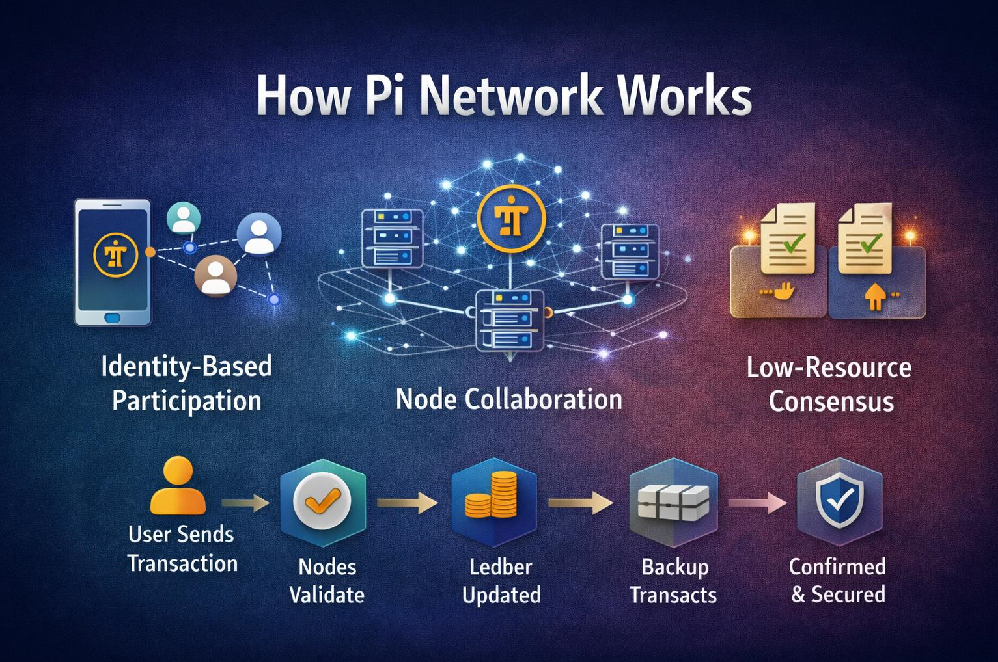
Pi uses a consensus mechanism adapted from the Stellar Consensus Protocol (SCP) and Federated Byzantine Agreement (FBA). Instead of asking miners to continuously perform enormous numbers of hash calculations, Pi’s model relies on nodes forming trusted relationships and reaching agreement through quorum structures.
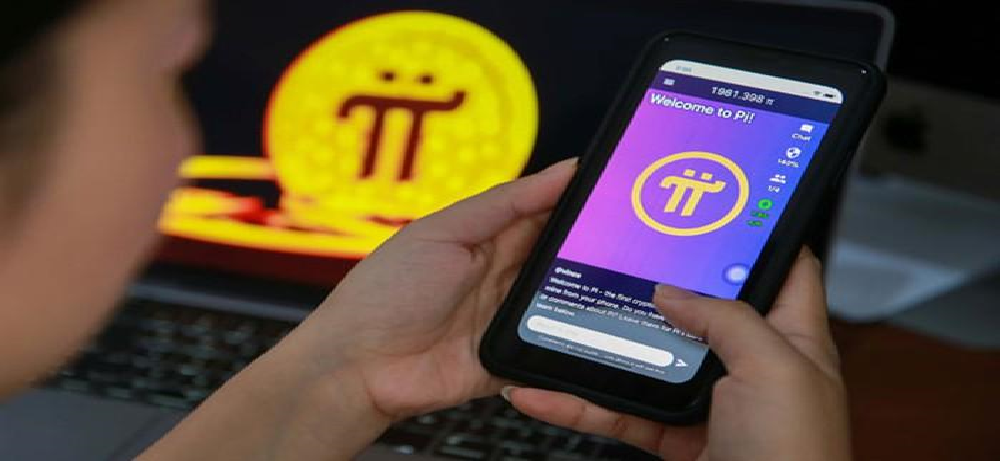
Pi also separates different roles within its ecosystem. Its documentation describes roles including Pioneers, Contributors, Ambassadors and Nodes, with computer-based Nodes performing the heavier consensus-related work.
Pi’s Open Network launched on February 20, 2025, removing the previous external-connectivity restrictions and allowing the Pi blockchain to interact with external networks and organizations.
What Is Bitcoin?
Bitcoin is the original decentralized cryptocurrency introduced through Satoshi Nakamoto’s 2008 white paper.
Bitcoin’s architecture is deliberately simple compared with many newer blockchain ecosystems.
Transactions are broadcast across a peer-to-peer network, validated by nodes and eventually included in blocks produced through Proof of Work.
Bitcoin’s blockchain links blocks through cryptographic hashes. Each block contains a reference to the previous block, making historical modification increasingly difficult as additional blocks are added.
Bitcoin also uses the UTXO model. Rather than maintaining a simple account balance in the traditional banking sense, Bitcoin transactions consume previously created unspent transaction outputs and create new outputs.
Pi vs Bitcoin: Architecture
This is where the comparison becomes most interesting.
1. Consensus Architecture
Pi: SCP/FBA-based approach
Pi’s consensus architecture is derived from the Stellar Consensus Protocol.
The basic idea is that nodes do not compete to solve an enormous computational puzzle. Instead, nodes establish relationships with other trusted nodes and use quorum slices to reach agreement.
In simple terms:
Trust relationships
↓
Quorum slices
↓
Quorums
↓
Agreement between nodes
↓
Ledger update
Pi’s model therefore attempts to replace computational competition with network-level agreement.
Bitcoin: Proof of Work
Bitcoin takes a fundamentally different approach.
Transactions are collected into blocks, and miners compete to produce a valid Proof-of-Work solution.
The simplified process is:
Transactions
↓
Candidate block
↓
Mining / hashing
↓
Proof of Work
↓
Valid block
↓
Network validation
↓
Blockchain confirmation
Bitcoin’s difficulty automatically adjusts so that the average block-production interval remains around 10 minutes.
The key architectural difference
Pi asks:
Which trusted network of nodes can agree on the ledger?
Bitcoin asks:
Which valid chain has accumulated the most Proof of Work?
That distinction is fundamental.
2. Node Architecture
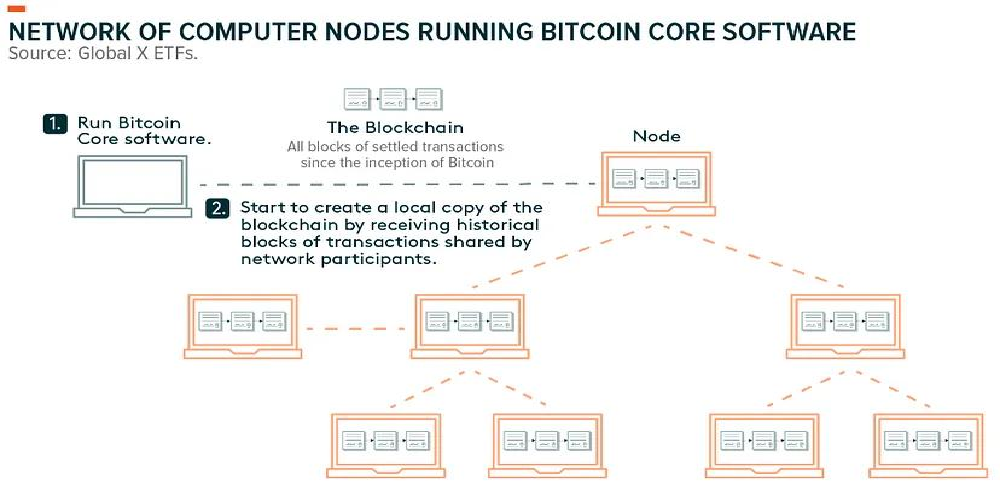
Bitcoin nodes independently validate blocks and transactions according to Bitcoin’s consensus rules.
A full Bitcoin node can therefore reject a block even if a miner produced it when that block violates the network’s rules.
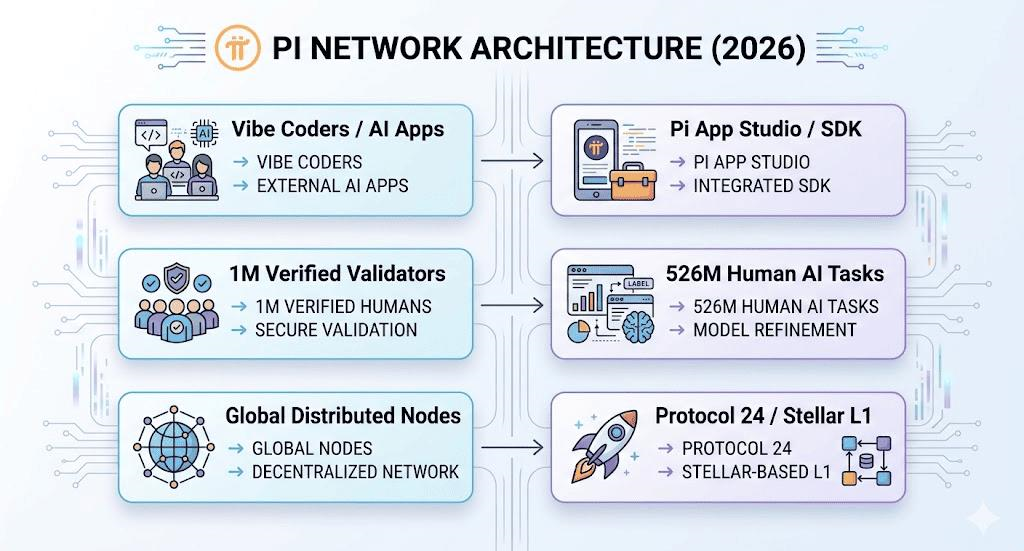
Pi uses computer-based Nodes for blockchain validation and consensus, while its mobile ecosystem contributes to the trust graph through security relationships.
Pi’s documentation says Nodes run on laptops and desktops rather than ordinary mobile phones and are responsible for validating transactions and participating in consensus.
So:
| Node characteristic | Pi | Bitcoin |
|---|---|---|
| Mobile participation | Important to ecosystem | Not required |
| Desktop nodes | Important | Important |
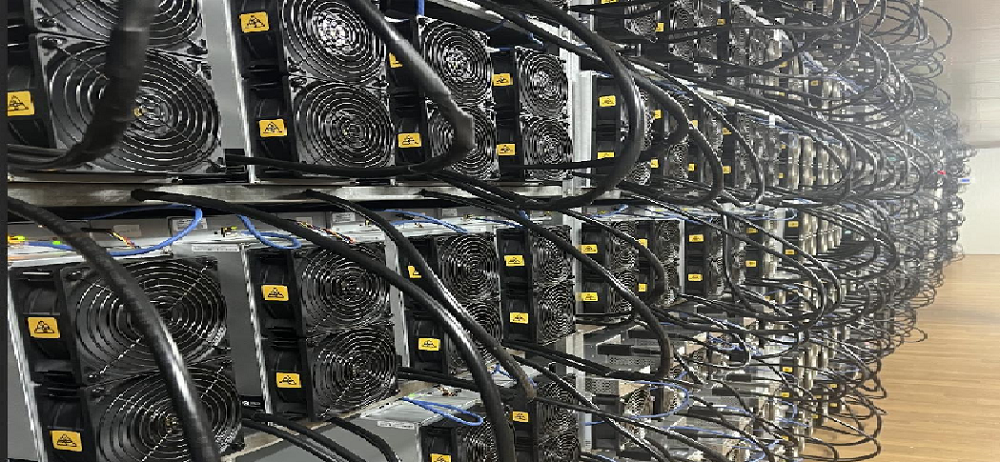
| Mining hardware | Not PoW mining | ASIC mining |
| Consensus contribution | Trust/quorum-based | Computational work |
| Energy-intensive hashing | No | Yes |
3. Transaction Architecture
Bitcoin uses a UTXO architecture.
Suppose Alice receives:
0.5 BTC
That amount becomes an unspent transaction output.
If she later sends 0.2 BTC, the transaction can consume the 0.5 BTC UTXO and create:
0.2 BTC → Bob
0.299 BTC → Alice’s change address
0.001 BTC → transaction fee
This is fundamentally different from the account-balance model people are familiar with from banks.
Bitcoin’s developer documentation confirms that transactions consume previously created UTXOs and create new outputs.
Pi uses a different ledger architecture and is not simply a Bitcoin-style UTXO clone.
4. Security Architecture
Bitcoin
Bitcoin’s security comes primarily from:
- Proof of Work
- Mining competition
- Full-node validation
- Cryptographic signatures
- Economic incentives
- Distributed peer-to-peer infrastructure
- Increasing cost of rewriting historical blocks
Changing an old Bitcoin transaction requires overcoming the accumulated Proof of Work behind that transaction and subsequent blocks.
This is one reason Bitcoin’s architecture places such a strong emphasis on computational security.
Pi
Pi’s security model instead depends on its consensus architecture and trust relationships.
The network uses security circles and a broader trust graph to help Nodes form quorum slices.
This creates a very different security assumption.
Important distinction
It would be inaccurate to simply say:
“Bitcoin is secure and Pi is not.”
A better statement is:
Bitcoin and Pi derive network security from different mechanisms, so their security assumptions and trade-offs are different.
Pi vs Bitcoin: Fees
Transaction fees are another area where users often make overly simple comparisons.
Bitcoin fees
Bitcoin transaction fees are primarily market-driven.
Users compete for limited block space by offering fee rates. During periods of heavy demand, users may need to pay higher fees to obtain faster confirmation.
At the time of checking, Bitcoin’s public mempool data showed fee rates around the low single-digit sat/vB range, but this changes continuously with network demand.
Therefore:
Bitcoin fee ≠ fixed permanent amount
It depends on:
- Transaction size
- Network congestion
- Fee rate
- User’s desired confirmation priority
Pi fees
Pi uses network transaction fees denominated in PI.
Pi documentation has historically described a minimum transaction fee of 0.01 Pi in its wallet/testing documentation, while specific applications and operations can have their own fee requirements.
Therefore, don’t write:
“Pi transactions always cost exactly 0.01 Pi.”
That is too absolute.
A better statement is:
Pi generally uses a much simpler, Pi-denominated fee structure, although the applicable fee can depend on the transaction or blockchain operation.
Pi vs Bitcoin: Speed
Speed requires some caution because transaction broadcast speed, block inclusion and final settlement are not the same thing.
Bitcoin
Bitcoin’s average block interval is approximately 10 minutes.
That does not mean every Bitcoin payment takes exactly 10 minutes.
A transaction can:
- Enter the mempool
- Be included in a block
- Receive additional confirmations
The more confirmations a user waits for, the stronger the practical settlement assurance becomes.
Pi
Pi’s consensus architecture is designed for faster agreement than Bitcoin’s PoW block-production model.
However, simply saying:
“Pi is X seconds and Bitcoin is 10 minutes”
oversimplifies blockchain settlement.
A better comparison is:
| Factor | Pi | Bitcoin |
|---|---|---|
| Consensus mechanism | SCP/FBA-derived | Proof of Work |
| Typical block/ledger progression | Designed for faster consensus | ~10-minute average blocks |
| Confirmation model | Consensus agreement | PoW confirmations |
| Finality experience | Different consensus assumptions | Probabilistic settlement |
| Main trade-off | Trust/quorum architecture | Computational security |
Pi vs Bitcoin: Energy Use
This is one of the clearest architectural differences.
Bitcoin’s Proof of Work requires miners to perform large numbers of cryptographic hash calculations. That creates significant electricity demand.
Pi deliberately chose a different consensus architecture because its design goal included mobile accessibility and avoiding the energy-intensive mining model associated with Proof of Work.
In simple terms:
Bitcoin
Electricity → hashing → Proof of Work → network security
Pi
Trust relationships → quorum-based consensus → network agreement
That does not mean Pi has zero infrastructure or operating costs. It means its consensus mechanism does not depend on Bitcoin-style energy-intensive competitive hashing.

Pi vs Bitcoin: Supply Architecture
This is an important difference for anyone studying token economics.
Bitcoin
Bitcoin has a maximum supply of:
21 million BTC
New BTC enters circulation through the mining reward mechanism, with issuance decreasing through Bitcoin’s halving process.
Pi
Pi has a much larger maximum supply structure, with the Pi Network white paper defining a 100 billion PI maximum supply.
This does not automatically make one asset “better.”
Supply quantity by itself tells you very little.
For example:
1 BTC = expensive
does not mean:
1 PI = cheap
because price depends on:
Market capitalization ÷ circulating supply
This is why comparing the price of one coin directly with another can be misleading.
Pi vs Bitcoin: Use Cases
Bitcoin’s major use cases
Bitcoin is commonly used for:
- Long-term holding
- Digital monetary exposure
- Peer-to-peer payments
- Cross-border value transfer
- Institutional investment
- Portfolio diversification
- Collateral in some financial applications
- Lightning Network payments
Bitcoin’s architecture is particularly strong when the user’s priority is credible scarcity and decentralized monetary settlement.
Pi’s intended use cases
Pi’s ecosystem focuses more heavily on:
- Peer-to-peer payments
- Merchant transactions
- Applications
- Digital services
- Community commerce
- Web3 applications
- Pi-based ecosystem utilities
Pi describes its Open Network as enabling external connectivity and integration with broader blockchain systems and businesses.
Pi vs Bitcoin: Liquidity
This is one category where Bitcoin has a substantial practical advantage.
Bitcoin has:
- Global exchange support
- Deep trading markets
- Large institutional participation
- Extensive derivatives markets
- Mature custody infrastructure
- Large OTC markets
- Extensive payment infrastructure
Current market data places Bitcoin far ahead of Pi in overall market depth and liquidity.
For traders, this matters because liquidity affects:
- Bid-ask spreads
- Slippage
- Order execution
- Large-position trading
- Derivatives availability
- Market efficiency
Pi’s ecosystem has developed significantly since Open Network launched, but it remains much less mature than Bitcoin’s global financial infrastructure.
Pi vs Bitcoin: Beginner Friendly
Pi may feel easier for beginners because:
- Mobile-first participation
- Simple onboarding concept
- Community-oriented ecosystem
- Less technical emphasis on mining hardware
- Accessible user experience
Bitcoin may be better for beginners who want to learn:
- Blockchain fundamentals
- Self-custody
- UTXOs
- Proof of Work
- Mining
- Monetary policy
- Decentralized networks
- Layer-2 scaling
So beginner friendliness depends on what the beginner wants to learn.
Pi Advantages
1. Mobile-first design
Pi was explicitly designed around accessibility and participation through everyday devices.
2. Lower-energy consensus
Its consensus architecture does not depend on Bitcoin-style competitive PoW hashing.
3. Large community orientation
Pi’s architecture places substantial emphasis on its user trust graph and ecosystem participation.
4. Utility-focused ecosystem
The network has positioned itself around applications, payments and real-world utility rather than only monetary holding.
5. Different scalability philosophy
Pi attempts to achieve consensus without requiring the same energy expenditure as Proof of Work.
Pi Disadvantages
1. Less mature than Bitcoin
Bitcoin has operated continuously since 2009 and has developed an enormous ecosystem.
Pi is considerably newer.
2. Different decentralization assumptions
Pi’s quorum-based trust architecture creates different questions around validator selection, trust relationships and network governance than Bitcoin’s permissionless PoW model.
3. Smaller liquidity
Pi’s market infrastructure is nowhere near Bitcoin’s depth.
4. Ecosystem execution matters
Pi’s long-term success depends heavily on whether applications and real-world commerce actually create sustained demand for PI.
5. User security risks
Pi users still need to protect wallets, passphrases and accounts from scams and impersonation. Pi itself warns users about fraudulent websites, applications and communications pretending to be official.
Bitcoin Advantages
1. Proven track record
Bitcoin has the longest operating history among major cryptocurrencies.
2. Strong security model
Proof of Work creates a large economic and computational cost for attempting to rewrite established history.
3. Deep liquidity
Bitcoin is the dominant cryptocurrency by market capitalization and trading infrastructure.
4. Strong monetary narrative
The 21-million maximum supply is one of Bitcoin’s defining characteristics.
5. Extensive ecosystem
Bitcoin has developed:
- Exchanges
- ETFs and institutional products
- Custody
- Mining infrastructure
- Lightning
- Wallets
- Payment systems
- Developer tooling
- Derivatives
Bitcoin Disadvantages
1. Energy-intensive consensus
Proof of Work requires substantial computational energy.
2. Base-layer throughput limitations
Bitcoin intentionally prioritizes security and decentralization over extremely high base-layer transaction throughput.
3. Fee variability
Fees can increase when demand for block space rises.
4. More technical self-custody
Safely managing Bitcoin private keys and UTXOs can be intimidating for beginners.
5. Confirmation time
Bitcoin’s approximately 10-minute average block interval means its base layer is not designed like an instant-payment network.
Who Should Choose Pi?
Pi may be worth exploring if you:
- Like mobile-first cryptocurrency ecosystems
- Want to explore Pi applications
- Are interested in community-driven crypto adoption
- Prefer a non-PoW consensus model
- Want to experiment with Pi payments and applications
- Understand that ecosystem development is still an important part of the long-term story
But participation should not automatically be treated as an investment thesis.
Who Should Choose Bitcoin?
Bitcoin may be more appropriate if your priority is:
- The longest established cryptocurrency network
- Deep liquidity
- Proven Proof-of-Work security
- Monetary scarcity
- Self-custody
- Institutional adoption
- A mature crypto infrastructure
- Long-term decentralized monetary use
Which Is Better for Payments?
It depends on the payment environment.
Pi may have an attractive proposition for ecosystem-based payments where users and merchants already participate in the Pi economy.
Bitcoin has a much broader global infrastructure and can also use Layer-2 systems such as Lightning for faster payments.
Verdict:
For established global monetary infrastructure → Bitcoin has the advantage.
For Pi-native ecosystem payments → Pi may be more convenient within that ecosystem.
Which Is Better for Long-Term Monetary Use?
Bitcoin has the stronger case.
The reason is not simply its price.
It comes from its combination of:
- Fixed maximum supply
- Long operating history
- Permissionless validation
- Proof of Work
- Large mining network
- Deep liquidity
- Global recognition
Bitcoin’s architecture was specifically built around maintaining a decentralized monetary ledger without a central issuing authority.
Which Is Better for Everyday Users?
This is more nuanced.
Pi’s mobile-first philosophy can make participation feel more accessible.
Bitcoin, however, has a much more mature ecosystem for buying, selling, holding, transferring and integrating cryptocurrency into financial products.
Therefore:
Ease of initial participation → Pi may have an advantage
Mature financial infrastructure → Bitcoin has a major advantage
Common Mistakes When Comparing Pi and Bitcoin
Mistake 1: Comparing only coin prices
A ₹1 coin is not automatically cheaper than a ₹1 lakh coin.
Compare:
Market capitalization
Circulating supply
Liquidity
Utility
Token economics
instead.
Mistake 2: Assuming faster means better
A blockchain that reaches consensus faster isn’t automatically superior.
You must also consider:
- Security assumptions
- Decentralization
- Validator structure
- Network resilience
- Liquidity
- Adoption
Mistake 3: Calling Pi “mobile Bitcoin”
Pi is not simply Bitcoin with mobile mining.
The two networks use fundamentally different consensus and transaction architectures.
Mistake 4: Assuming Bitcoin’s energy use makes it insecure
Energy consumption is part of Bitcoin’s security mechanism.
Bitcoin deliberately converts electricity and computational work into an economic barrier against rewriting the blockchain.
Mistake 5: Assuming Pi’s low-energy model automatically makes it better
Lower energy use is an advantage in one dimension.
But network design involves trade-offs.
You must also examine:
decentralization + security + participation + governance + liquidity + adoption + utility.
Advanced View: The Real Architectural Trade-Off
The most useful way to understand Pi vs Bitcoin is not:
Which blockchain is faster?
It is:
What problem is each blockchain trying to solve, and what trade-offs does its architecture make?
Bitcoin’s philosophy
Permissionless participation
↓
Proof of Work
↓
Economic cost
↓
Strong resistance to rewriting history
↓
Decentralized monetary network
Pi’s philosophy
Accessible participation
↓
Trust graph
↓
Quorum-based consensus
↓
Low-energy network agreement
↓
Mobile-first ecosystem
These are fundamentally different design philosophies.
Current Context
Pi’s architectural story also needs to be viewed in light of its transition to Open Network.
Pi launched Open Network on February 20, 2025, enabling external connectivity after its earlier Enclosed Mainnet period.
That means the important question is no longer simply:
“Can Pi create a blockchain?”
The more important long-term question is:
Can Pi convert its large community and blockchain infrastructure into sustainable real-world utility, liquidity and application usage?
That is where Pi’s future differentiation will increasingly be tested.
Bitcoin faces a different question:
Can Bitcoin continue serving as a highly secure decentralized monetary network while scaling its broader payment and application ecosystem through additional layers?
ZenvestAI View
Pi vs Bitcoin is ultimately a trade-off between two different blockchain philosophies.
Bitcoin has the stronger position when the priority is monetary scarcity, established security, decentralization, liquidity and mature global infrastructure.
Pi has a different proposition: mobile accessibility, community participation, lower-energy consensus and an ecosystem designed around real-world utility.
Neither conclusion should be reduced to:
“Bitcoin is better.”
or:
“Pi is better.”
A more useful conclusion is:
Bitcoin may be better for users who value established decentralized monetary infrastructure, while Pi may be more relevant to users who value mobile accessibility and Pi-native ecosystem utility.
The important distinction is that Pi still has to demonstrate sustained ecosystem adoption and economic utility at a scale comparable with its ambitions, whereas Bitcoin has already established a much deeper global monetary and financial network.
Pi vs Bitcoin: Final Scorecard
| Category | Better positioned | Why |
|---|---|---|
| Decentralized monetary network | Bitcoin | Proven PoW architecture and long operating history |
| Maximum scarcity | Bitcoin | 21 million maximum supply |
| Liquidity | Bitcoin | Much deeper global markets |
| Institutional infrastructure | Bitcoin | Far more mature |
| Mobile accessibility | Pi | Designed around mobile participation |
| Energy efficiency of consensus | Pi | Does not rely on PoW hashing |
| Ecosystem experimentation | Pi | Strong focus on applications and community utility |
| Network maturity | Bitcoin | Much longer operating history |
| Beginner accessibility | Pi | Mobile-first participation model |
| Monetary credibility | Bitcoin | Established scarcity and network history |
| Pi-native utility | Pi | Designed specifically around its own ecosystem |
| Overall maturity | Bitcoin | Considerably more established |
The Bottom Line
Pi and Bitcoin should not be judged using the same single metric.
Bitcoin’s greatest strength is its security-focused, permissionless and scarcity-oriented architecture.
Pi’s greatest differentiator is its mobile-first, community-oriented and lower-energy consensus architecture.
If your question is:
“Which has the more established blockchain and monetary infrastructure?”
→ Bitcoin.
If your question is:
“Which is designed around accessible mobile participation and a Pi-native ecosystem?”
→ Pi.
If your question is:
“Which one will perform better as an investment?”
→ Architecture alone cannot answer that. Price depends on adoption, supply, liquidity, market conditions, regulation, demand and execution.
ZenvestAI’s core takeaway
Don’t choose between Pi and Bitcoin because one coin sounds cheaper, faster or newer. Compare the architecture, security assumptions, liquidity, utility, adoption and risks—and then decide which network better matches your objective.
ZenvestAI Verdict
Bitcoin currently has the stronger overall position in security maturity, liquidity, monetary credibility and global financial infrastructure.
Pi’s opportunity is different: turning its accessibility, identity-verified community and ecosystem into durable real-world utility.
So the most accurate answer is:
Bitcoin may be better for established decentralized monetary use.
Pi may be better for users attracted to its mobile-first ecosystem model.
And that is exactly why Pi vs Bitcoin should be analyzed as an architectural and utility comparison—not simply a price comparison.
Data-sensitive items such as price, liquidity, fees and network conditions should be refreshed when this article is updated. Bitcoin’s current fee environment, for example, changes continuously with mempool demand.