A UTXO stands for Unspent Transaction Output. In the simplest terms, a UTXO is an indivisible chunk of bitcoin that was created by a previous transaction and remains unspent, ready to be used as an input for a future payment.
If you open your banking app today, you see a single ledger total representing your balance. If you transfer $10 to a friend, your balance drops by $10 and their balance increases by $10 on a central database.
Bitcoin does not work this way. Bitcoin does not record account balances, digital account sheets, or centralized totals.
Instead, the Bitcoin network exclusively records and tracks unspent transaction outputs (UTXOs). Every single unit of spendable bitcoin across the world exists solely as an individual UTXO anchored to a specific cryptographic script.
Understanding UTXOs is essential for any Bitcoin user.
If you have ever wondered why a small transaction triggered high network fees, why your wallet generated a mystery “change address,” or why privacy tools warn against combining past transactions, you were experiencing the mechanics of the UTXO model firsthand.
ZenvestAI Explain:- Breaking the Balance Illusion
Many newcomers assume Bitcoin manages money like a digital checking account. In reality, Bitcoin acts like a digital billfold containing paper bills of varying denominations. When you spend a paper bill, you cannot tear off a corner; you hand over the whole bill and wait for the cashier to return the change.
In this comprehensive guide, we will unpack how Bitcoin builds spendable money from individual outputs, why this architecture protects the network from fraud, and how managing your UTXOs properly can save you hundreds of dollars in network fees.
Why Does Understanding UTXOs Matter Right Now?
On-chain transaction fees fluctuate drastically during periods of high network activity.
When demand for Bitcoin block space surges—driven by institutional adoption, Ordinals, and tokenized protocols—users with fragmented wallets holding dozens of small UTXOs suddenly face disproportionately high fees just to send routine transactions.
Furthermore, global regulatory scrutiny under frameworks like the European Union’s MiCA and US Treasury compliance standards places an increasing emphasis on transaction provenance.
Because every UTXO carries a transparent, permanent lineage tracing back to the block where it was minted, understanding how outputs are spent and combined is critical for maintaining financial privacy and operational security.
Key Takeaways
- Zero account balances: Bitcoin does not store a balance number; your wallet calculates what you own by scanning the blockchain and summing the values of all UTXOs your private keys can spend.
- Indivisible chunks: A UTXO cannot be partially spent. A 1.0 BTC output must be consumed completely in a transaction, generating a payment output to the recipient and a change output back to the sender.
- Consumptive lifecycle: Spending a UTXO permanently destroys it as an unspent entity and creates one or more brand-new UTXOs in the transaction’s outputs.
- Deterministic security: The UTXO model allows full nodes to validate transactions independently and in parallel without checking a central account database.
Table of Contents
- What Is a UTXO in Bitcoin?
- UTXO Definition at a Glance
- How Does a UTXO Work in Bitcoin?
- UTXO Example: Sending Bitcoin
- What Is the Difference Between a UTXO and a Bitcoin Balance?
- What Is the UTXO Set?
- What Is the Difference Between a UTXO, a Transaction Input, and a Transaction Output?
- What Happens to a UTXO When You Spend Bitcoin?
- Why Does Bitcoin Use UTXOs?
- What Is a Bitcoin Change UTXO?
- Can One Bitcoin Wallet Have Multiple UTXOs?
- How Does UTXO Selection Affect Bitcoin Transactions?
- What Is UTXO Consolidation?
- Is Anything New Happening With Bitcoin UTXOs?
- Common Mistakes to Avoid with Bitcoin UTXOs
- Comprehensive Bitcoin UTXO Glossary
- Frequently Asked Questions About Bitcoin UTXOs
- ZenvestAI View
- Related Bitcoin Intelligence
- Author & Editorial Information
- Regulatory Disclosure & Educational Disclaimer
- Reference Sources & Verified Documentation
What Is a UTXO in Bitcoin?
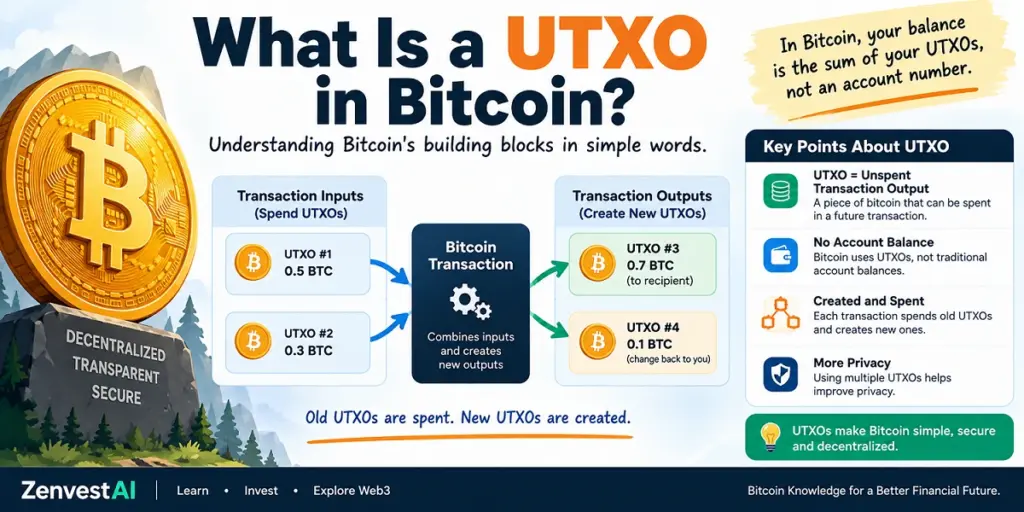
To grasp how your wallet constructs payments, we must first examine the formal definition and fundamental properties that govern every unspent output on the network.
UTXO Definition at a Glance
A UTXO represents a verified amount of satoshis (the smallest unit of bitcoin, where 1 BTC = 100,000,000 satoshis) that has been locked to a specific public key script. Until a valid cryptographic signature unlocks and spends that amount in a subsequent transaction, the output remains unspent.
Core UTXO Properties
- Atomic unit: Satoshis locked inside an unspent output.
- Primary state: Either completely unspent or permanently spent.
- Tracking body: The global UTXO Set maintained in fast-access memory by full nodes.
- Spending mechanism: Referenced as a Transaction Input and unlocked by a cryptographic witness or digital signature.
Now that you know what a UTXO is, let us follow the journey of an output from the moment it is born to the moment it is consumed.
How Does a UTXO Work in Bitcoin?
The operation of Bitcoin relies on a continuous chain of transactions where each transaction consumes existing outputs and creates new ones. Every Bitcoin transaction functions as an exchange of old UTXOs for new UTXOs.
The lifecycle moves through six predictable stages:
- Transaction Output Creation: A sender constructs a transaction that specifies an output value and locks it with a script (such as a public key hash or Taproot script).
- Block Confirmation: Miners include the transaction in a block, confirmed on the blockchain.
- UTXO Set Inclusion: Every full node on the network adds this new unspent output to its local UTXO set.
- Input Selection: When the owner decides to spend these funds, their wallet software selects the UTXO to serve as an input for a new transaction.
- Cryptographic Unlocking: The owner signs the transaction, providing the digital proof required by the locking script.
- Destruction & Replacement: When the new transaction is confirmed, full nodes remove the consumed UTXO from the UTXO set and register the newly created outputs.
Bitcoin does not create money out of thin air. Except for the special coinbase transaction (which creates fresh bitcoin as a subsidy for miners in each block), the total satoshi value of all inputs must equal the total satoshi value of all outputs plus the transaction fee claimed by the miner.
Abstract mechanics can feel complex until you see the exact math behind a everyday transaction. Let us look at a simple numerical scenario.
UTXO Example: Sending Bitcoin
Imagine Alice holds a single UTXO worth 1.000 BTC in her wallet and wants to send 0.600 BTC to Bob.
Because a UTXO is completely indivisible, Alice cannot slice 0.600 BTC off her 1.000 BTC output and leave 0.400 BTC behind.
Instead, Alice’s wallet must spend the entire 1.000 BTC output as an input. Assuming a current network miner fee of 0.001 BTC, her wallet automatically constructs a transaction with two distinct outputs:
- Output 1 (To Bob): 0.600 BTC
- Output 2 (Change to Alice): 0.399 BTC
- Miner Fee (Implicit Difference): 0.001 BTC (Calculated as: 1.000 BTC Input − [0.600 + 0.399 BTC Outputs])
Once the transaction confirms in a block, three critical events take place on the ledger:
- Alice’s original 1.000 BTC UTXO is consumed and permanently erased from the network’s active UTXO set.
- Bob receives a brand-new 0.600 BTC UTXO, which only his private keys can unlock.
- Alice receives a brand-new 0.399 BTC change UTXO, returned to a new address generated by her wallet.
1.000 BTC UTXO
Alice’s Input
│
▼
Bitcoin Transaction
│
├── 0.600 BTC → Bob
│
├── 0.399 BTC → Alice’s Change
│
└── 0.001 BTC → Miner Fee
The Physical Cash Analogy
The clearest way to picture this process is with paper currency. If you walk into a grocery store with a single $20 bill in your wallet to buy a $12 carton of milk, you do not hand the clerk three-fifths of the paper bill.
You give the cashier the entire $20 bill. The cashier drops the $20 bill into the register and hands you back an $8 change bill.
In Bitcoin terms:
- Your $20 bill is the input UTXO.
- The $12 payment is the recipient’s output UTXO.
- The $8 change is your change output UTXO.
- The original bill has left your hands forever, and you now control an entirely new denomination.
This cash-like behavior surprises many people who expect cryptocurrencies to function like modern banking apps. To understand why Bitcoin chose this design, we must compare it directly to the account-based model.
What Is the Difference Between a UTXO and a Bitcoin Balance?
Your Bitcoin balance is an abstract software calculation, not a static number written on the blockchain. When your wallet displays a balance of 1.0 BTC, the blockchain does not contain an entry stating “Alice = 1.0 BTC.”
Instead, your wallet acts as a specialized search tool. It reads your private keys, generates the corresponding public addresses, scans the global UTXO set, and totals every unspent output assigned to you.
Alice’s 1.0 BTC balance might actually consist of three independent chunks:
- One UTXO of 0.400 BTC (received from an exchange)
- One UTXO of 0.300 BTC (received for freelance work)
- One UTXO of 0.300 BTC (received as change from an earlier purchase)
Total Spendable Balance: 1.000 BTC
UTXO Model vs. Account/Balance Model
Most traditional financial institutions and smart-contract networks like Ethereum utilize the Account/Balance model.
In an account model, the network maintains a global state table of addresses and their corresponding account balances, similar to a bank database.
The following table summarizes the structural differences between both architectures:
| Architectural Feature | Bitcoin UTXO Model | Ethereum / Traditional Account Model |
| State Storage | Tracks individual unspent outputs | Tracks global account balances and nonces |
| Transaction Processing | Consumes past outputs, creates new ones | Adjusts debit and credit balances directly |
| Parallel Verification | High: Transactions touching different UTXOs can process concurrently | Lower: Sequential execution required to prevent balance race conditions |
| Privacy Footprint | Encourages using fresh addresses for every change output | Reuses single accounts across hundreds of transactions |
| Double-Spend Defense | Checks whether referenced output exists in the UTXO set | Checks account balance and increments an account nonce |
| Fee Calculation | Based on transaction byte size (number of inputs and outputs) | Based on computational complexity (gas units consumed) |
If Bitcoin does not track balances, how do thousands of decentralized computers verify payments in seconds without reading the entire transaction history from 2009? They rely on a high-speed database called the UTXO Set.
What Is the UTXO Set?
The UTXO set is the complete collection of all unspent transaction outputs that exist across the Bitcoin network at any given moment.
While the blockchain is a massive, append-only history of every transaction since the Genesis Block (exceeding 600 gigabytes), the UTXO set represents only the currently spendable surface of that history.
Full nodes maintain the UTXO set in high-speed random-access memory (RAM) and local storage (commonly implemented via LevelDB in Bitcoin Core).
When a node receives a new transaction, it does not comb through hundreds of gigabytes of historical blocks.
It simply checks its local UTXO set:
- Do the inputs listed in this transaction exist in the active UTXO set?
- Do the cryptographic signatures satisfy the unlocking conditions of those outputs?
- Is the sum of inputs greater than or equal to the sum of outputs?
If all three conditions are met, the transaction is valid.
The node executes the state change in memory: the spent outputs are deleted from the UTXO set, and the newly generated outputs are inserted.
Why the UTXO Set Determines Bitcoin’s Decentralization
The size of the UTXO set is a crucial metric for Bitcoin’s decentralization. Because every validating full node must store and query the UTXO set to verify incoming transactions, keeping this database lightweight ensures regular users can run full nodes on standard consumer hardware.
According to on-chain tracking from Mempool Research, the UTXO set has expanded to over 170 million individual UTXOs, requiring roughly 11 to 14 gigabytes of memory and indexed storage.
If the UTXO set grows too large—a problem known as “UTXO bloat”—running a node becomes more hardware-intensive, centralizing validation into industrial data centers.
Bitcoin Blockchain History
│
▼
600+ GB of historical transactions
│
▼
UTXO Set
│
├── 170+ Million active UTXOs
├── Enables fast transaction lookup
└── Independently verified by full nodes
To prevent common errors when reviewing transaction receipts or block explorers, we must clearly define how outputs become inputs.
What Is the Difference Between a UTXO, a Transaction Input, and a Transaction Output?
Beginners often confuse inputs, outputs, and UTXOs because these terms describe the same satoshis at different points in time.
Here is how these terms interact across the transaction lifecycle:
- Transaction Output: A destination defined inside a transaction. It specifies a satoshi value and the cryptographic conditions required to spend it.
- UTXO: A transaction output that has been confirmed on the blockchain and has not yet been spent. It is an output waiting for an owner to claim it.
- Transaction Input: A pointer inside a new transaction that references a specific past UTXO (identifying it by the previous transaction hash and output index) and supplies the unlocking signature.
- Spent Output: A transaction output whose value has already been referenced and consumed by a confirmed input. Once spent, it is removed from the UTXO set forever.
Transaction A
│
▼
Creates an Output
│
▼
If the Output is not spent
│
▼
It becomes a UTXO
│
▼
A later Transaction Input
references this UTXO
│
▼
Transaction B spends it
Terminology Breakdown
| Term | Technical Role | State on Blockchain |
| UTXO | Unspent output holding spendable value | Active member of the node’s UTXO set |
| Transaction Output (TxOut) | Result of a transaction specifying value and lock script | Created upon transaction execution |
| Transaction Input (TxIn) | Reference to an existing UTXO plus unlocking witness | Consumes an active UTXO |
| Spent Output | An output that has fulfilled its lifecycle | Archived in historical blocks; absent from UTXO set |
Now that the vocabulary is precise, let us walk through the exact steps that occur under the hood when you hit “Send” in your Bitcoin wallet.
What Happens to a UTXO When You Spend Bitcoin?
Spending bitcoin is a deterministic cryptographic process. When you broadcast a payment, your wallet and the network carry out eight sequential steps:
- Target Identification: You enter a recipient address and an amount in your wallet.
- Coin Selection: The wallet’s internal algorithm searches its available UTXOs to assemble an input amount sufficient to cover both the payment and the network fee.
- Drafting Inputs: The wallet references each selected UTXO using an Outpoint—a pair consisting of the previous Transaction ID (TxID) and the specific output index (Vout).
- Drafting Outputs: The wallet creates the recipient’s output and, if the input total exceeds the required payment plus fee, creates a change output assigned to a new address under your control.
- Signing: The wallet applies your private key to sign the transaction data, fulfilling the locking script of each input.
- Mempool Propagation: The transaction is broadcast to peer nodes. Nodes verify the inputs against their UTXO set and hold the valid transaction in their memory pool (mempool).
- Block Inclusion: A miner includes your transaction in a valid block.
- State Transition: When full nodes process the block, they delete the referenced input UTXOs from their UTXO sets and insert the newly generated recipient and change UTXOs.
Why did Satoshi Nakamoto choose this rigorous input-and-output model over a straightforward account balance?
The answer lies in security, verification speed, and privacy.
Why Does Bitcoin Use UTXOs?
The UTXO model was intentionally designed to solve several of the hardest problems in distributed computing.
1. Robust Double-Spending Prevention
In a decentralized network without a central authority, preventing a user from spending the same money twice is paramount. In the UTXO model, double-spending prevention is mathematically simple: an output can only be spent once.
Full nodes do not need to calculate dynamic balances or account balances across historical branches; they simply check if the exact referenced output exists in their UTXO set.
If a transaction attempts to spend an output that is not in the set, the node rejects it instantly.
2. High-Performance Parallel Verification
In an account-based system, transactions touching the same account must be processed sequentially to ensure the balance does not drop below zero.
Because every UTXO is completely independent, transactions spending separate UTXOs can be verified simultaneously across multiple processor cores.
This parallelism allows Bitcoin full nodes to validate thousands of transactions quickly during block propagation.
3. Native Privacy and Address Rotation
The UTXO architecture encourages users to generate a brand-new address for every incoming payment and change output.
Because funds are stored in discrete outputs rather than tied to an account identity, outside observers cannot easily deduce your total wealth by looking at a single public address on an explorer.
4. Mathematical Auditability
Because every transaction references specific previous outputs, anyone can audit the entire circulating supply of Bitcoin from the Genesis Block to the present day.
You simply sum the satoshi values of all outputs currently residing in the UTXO set. This transparent accounting provides absolute mathematical proof that no unauthorized coins have been minted outside the predetermined issuance schedule.
One of the most critical elements of this system is the mechanism that returns your remaining funds back to your possession: the change UTXO.
What Is a Bitcoin Change UTXO?
A change UTXO is an output generated in a transaction that returns leftover satoshis back to the sender’s wallet.
Because inputs must be consumed in their entirety, transactions rarely match the exact amount you wish to send.
If you hold a 0.500 BTC UTXO and want to purchase an item costing 0.150 BTC, your wallet cannot submit a transaction with 0.150 BTC of inputs. It must use the whole 0.500 BTC output.
To prevent the remaining 0.350 BTC from being captured by the miner as an accidental fee, your wallet automatically constructs a second output pointing back to your own keys.
0.500 BTC
Total Input
│
├── 0.150 BTC → Recipient
├── 0.001 BTC → Miner Fee
└── 0.349 BTC → Change UTXO
(Back to your wallet)
Why Change Addresses Must Never Be Reused
Modern BIP 32/39/44 compliant Hierarchical Deterministic (HD) wallets automatically generate a brand-new, unused change address for every outgoing payment.
Reusing an old address for change severely damages your financial privacy. When change is sent back to an address you previously used, blockchain analytics firms can easily correlate your past transactions, de-anonymize your identity, and determine the exact size of your remaining holdings.
Fresh change outputs help keep your discrete UTXOs unlinkable to outside observers.
Understanding change reveals that a single wallet rarely holds just one coin. Let us look at why wallets accumulate dozens of individual outputs.
Can One Bitcoin Wallet Have Multiple UTXOs?
Yes. In fact, almost every active Bitcoin wallet manages dozens or even hundreds of distinct UTXOs simultaneously.
Every time you receive a deposit from an exchange, accept a payment from a client, or receive change from an outgoing transfer, a new UTXO is added to your wallet’s collection.
Consider a typical self-custody wallet holding a total balance of 0.900 BTC:
- UTXO 1: 0.100 BTC (Monthly DCA buy from an exchange)
- UTXO 2: 0.250 BTC (Payment for consulting work)
- UTXO 3: 0.400 BTC (Change from a hardware purchase)
- UTXO 4: 0.150 BTC (P2P transaction from a friend)
Total Displayed Wallet Balance: 0.900 BTC
Your Bitcoin Wallet
│
▼
Total Balance: 0.900 BTC
│
▼
0.100 BTC → UTXO 1
0.250 BTC → UTXO 2
0.400 BTC → UTXO 3
0.150 BTC → UTXO 4
The Problem of UTXO Fragmentation
While holding multiple UTXOs is standard, accumulating too many small outputs leads to UTXO fragmentation.
If you receive fifty micro-deposits of $10 worth of bitcoin over a year, your wallet holds fifty fragmented UTXOs.
When you later try to send $400 in a single transaction, your wallet must combine all fifty outputs as inputs.
Because transaction fees on Bitcoin are determined by the data size of the transaction in virtual bytes (vBytes)—not the dollar amount transferred—a transaction with fifty inputs consumes massive block space.
During fee spikes, the cost to spend those fragmented outputs can exceed the value of the coins themselves, rendering them temporarily uneconomical to spend.
This brings us to one of the most critical operational skills in self-custody: coin selection.
How Does UTXO Selection Affect Bitcoin Transactions?
When you initiate a payment, your wallet runs a coin selection algorithm to choose which specific UTXOs to spend. The combination of outputs your wallet picks directly dictates your transaction fees, confirmation speed, and privacy.
1. Data Size and Network Fees
Bitcoin miners charge fees based on the data footprint of your transaction measured in virtual bytes (vBytes), billed at a rate of satoshis per virtual byte (sat/vB).
Adding an input adds significant data weight because each input requires its own cryptographic signature and public key script. Conversely, sending a large dollar value using a single input requires very little data.
- Transaction A: Sends $10,000 using 1 large UTXO (1 input, 2 outputs) = ~140 vBytes. At 50 sat/vB, fee = 7,000 sats (~$4.50).
- Transaction B: Sends $500 using 20 small UTXOs (20 inputs, 2 outputs) = ~1,420 vBytes. At 50 sat/vB, fee = 71,000 sats (~$46.00).
Notice the counterintuitive reality of Bitcoin: Transaction B transferred 20 times less value than Transaction A, but paid 10 times more in network fees because it consumed more fragmented UTXOs.
2. Privacy and Output Linking (Common Input Ownership Heuristic)
Blockchain analysis tools track transactions using the Common Input Ownership Heuristic. This rule assumes that when multiple UTXOs are spent together as inputs in a single transaction, all those outputs belong to the same entity.
If you combine a UTXO purchased on an exchange with full identity verification (KYC) with a UTXO earned anonymously, you permanently link both funds on the public ledger.
Advanced wallets allow users to perform manual Coin Control, choosing exactly which UTXOs to spend to keep separate financial activities isolated.
How can you clean up fragmented wallets and protect yourself from exorbitant fees? The standard industry solution is UTXO consolidation.
What Is UTXO Consolidation?
UTXO consolidation is the proactive process of combining multiple small UTXOs into a single, larger UTXO during periods of low network congestion.
Do not wait for a high-fee bull market to realize your fragmented coins are expensive to spend. Instead, take action when network activity is quiet. Send all your small UTXOs to a single new address in your own wallet. Timing this during low-fee periods—like weekends when rates drop to 5–10 sat/vB—keeps the consolidation cheap.
Fragmented Wallet
│
├── 0.010 BTC UTXO
├── 0.020 BTC UTXO
├── 0.015 BTC UTXO
└── 0.005 BTC UTXO
│
▼
Consolidation Transaction
8 sat/vB
│
▼
0.050 BTC UTXO
Consolidated Wallet
Lower future fees
When Should You Consolidate?
- Mempool conditions are quiet: Monitor mempool trackers like Mempool.space to spot periods where base fees drop to low single digits.
- Before major market cycles: Consolidate during quiet market phases so you can make fast, cheap transfers when volatility and network fees spike.
- Managing mining or DCA payouts: If you receive frequent small payouts from a mining pool or automated recurring buys, consolidate those outputs periodically.
Privacy Warning During Consolidation
Consolidation combines multiple UTXOs into a single output, permanently linking their transaction histories. If you prioritize privacy, never consolidate KYC-linked exchange withdrawals with non-KYC peer-to-peer coins. Consolidate distinct pools of funds separately to maintain financial boundaries.
The UTXO model is not a frozen relic; it is an active area of ongoing research and protocol optimization within the Bitcoin developer community.
Is Anything New Happening With Bitcoin UTXOs?
While Bitcoin’s foundational UTXO architecture remains unchanged, engineers and protocol designers continue to refine how outputs are created, spent, and cleaned up.
1. The Dust Problem and Uneconomical Outputs
An output is considered dust when its value is lower than the fee required to spend it at prevailing network rates. For example, if an output holds 600 satoshis, but constructing an input to spend it requires 800 satoshis in miner fees, that UTXO is financially dead weight.
Dust outputs clog node memory because nodes must preserve every unspent output in the UTXO set indefinitely. The developer tracking hub Bitcoin Optech regularly documents research into uneconomical outputs and dust pruning mechanisms.
2. BIP 451: Dust UTXO Disposal Protocol
To resolve the challenge of unspendable and toxic dust, developers introduced BIP 451: Dust UTXO Disposal Protocol.
BIP 451 outlines a standardized method for wallets to safely purge dust UTXOs by burning or spending them directly into an OP_RETURN script or designated clean-up transactions.
This protocol provides wallet creators with a safe path to clear spam dust and unspendable fragments without leaking privacy or contaminating clean outputs.
3. The Impact of Ordinals and Runes on the UTXO Set
The rise of Bitcoin Inscriptions (Ordinals) and token protocols (Runes) has accelerated the expansion of the UTXO set.
These protocols embed non-currency digital data directly into individual satoshis and mint millions of tiny, persistent outputs.
As a result, the global UTXO set expanded dramatically between 2023 and 2026, driving renewed debates within the Core development community regarding long-term node RAM requirements and potential UTXO storage fee incentives.
4. Taproot Script Path Efficiencies
The activation of Taproot (BIP 341/342) introduced significant efficiencies for complex UTXO spending.
By leveraging Schnorr signatures and Merkelized Alternative Script Trees (MAST), Taproot allows complex multi-signature or timelocked UTXOs to appear identical to standard single-signature outputs on-chain.
This reduces the virtual byte size of inputs upon spending, lowering fees and obscuring spending logic from blockchain trackers.
Now that we have covered protocol theory and optimization strategies, let us address the practical traps that trip up users in self-custody.
Common Mistakes to Avoid with Bitcoin UTXOs
Navigating UTXOs without proper knowledge can lead to lost privacy and unnecessary expenses.
Here are the most frequent pitfalls and how to avoid them:
1. Blind Auto-Consolidation
Many users discover UTXO consolidation and immediately merge every output in their wallet into one address. This wipes out transaction privacy by clustering every source of funds under a single public identifier. Always practice selective coin control.
2. Spending Unsolicited “Dust” Deposits
If you notice a random, tiny deposit of a few hundred satoshis appearing in your wallet from an unknown source, you may be the target of a dusting attack.
Attackers often send tiny amounts of bitcoin to thousands of random addresses. They hope your wallet will automatically bundle this dust input into your next payment.
If that happens, blockchain trackers can link your addresses together and map your entire wallet. Fortunately, advanced wallets like Sparrow, Electrum, or Coldcard protect against this. They let you freeze or lock specific UTXOs so they never get spent.
3. Leaving Small Balances on Exchanges
Withdrawing $20 worth of bitcoin every week creates a separate micro-UTXO with each withdrawal. Instead of making dozens of tiny on-chain withdrawals, accumulate your purchases on the platform (or use the Lightning Network) until you reach a substantial amount (such as 0.02 to 0.05 BTC) before executing an on-chain withdrawal.
4. Ignoring Fee Rates When Setting Up Transactions
Many wallet users select default fee recommendations during mempool congestion, paying tens of thousands of satoshis to spend multi-input transactions. Check real-time block congestion on mempool explorers before broadcasting non-urgent transactions.
To help you navigate wallet settings and technical documentation with confidence, review this quick reference glossary.
Comprehensive Bitcoin UTXO Glossary
- Coinbase Transaction: The first transaction in every Bitcoin block. It creates new bitcoin out of thin air as the block subsidy and collects all transaction fees from that block. It has no input UTXOs.
- Coin Control: A wallet feature that enables the user to manually select which specific UTXOs are spent as inputs for an outgoing transaction.
- Dust: An output whose satoshi value is smaller than the cost in fees required to spend it.
- Locking Script (scriptPubKey): A cryptographic script placed on a transaction output that defines the exact conditions that must be fulfilled to spend the satoshis.
- Mempool: The waiting room in a full node’s memory where unconfirmed transactions reside before miners bundle them into a block.
- Outpoint: The technical reference identifier for a specific UTXO, comprising the Transaction Hash (TxID) and the Output Index number (Vout).
- Sat/vB: Satoshis per virtual byte. The standard unit of measurement for Bitcoin transaction fee rates.
- Unlocking Script (scriptSig / Witness): The cryptographic proof (such as a digital signature) provided in an input to satisfy the locking script of the UTXO being spent.
- UTXO Set: The global database containing every unspent transaction output that exists on the Bitcoin network, actively maintained by every validating node.
- Vout: The 0-indexed integer identifying the exact position of an output within a transaction.
Let us address the most common, high-intent questions users ask when exploring the UTXO model.
Frequently Asked Questions About Bitcoin UTXOs
What does UTXO stand for in Bitcoin?
UTXO stands for Unspent Transaction Output. It represents an amount of spendable bitcoin generated by a past transaction that has not yet been consumed as an input.
Is a UTXO the same as a Bitcoin?
No. A UTXO is the container or accounting unit in which satoshis reside, while Bitcoin (BTC) is the asset. Just as a $20 bill is not “a dollar” but rather a paper note containing twenty units of currency, a UTXO is a digital output containing a specific quantity of satoshis.
Can you spend half of a UTXO?
No. UTXOs are strictly indivisible. If you have a 0.5 BTC UTXO and want to spend 0.2 BTC, you must consume the entire 0.5 BTC output. Your transaction will send 0.2 BTC to the recipient and return the remaining satoshis (minus miner fees) back to your wallet as a new change UTXO.
What is the Bitcoin UTXO set?
The UTXO set is the active database of all unspent outputs across the entire Bitcoin network. Maintained in fast-access RAM and local storage by every full node, it allows nodes to verify whether a transaction is valid without scanning the entire 600+ GB blockchain history.
What happens to a UTXO after it is spent?
Once an output is referenced as an input in a confirmed block, it is spent. Full nodes immediately delete it from their active UTXO set. The record of that output remains permanently preserved in historical blockchain data, but it can never be spent again.
Why do some Bitcoin transactions have high fees even for small amounts?
Because transaction fees depend on the data weight of the transaction in virtual bytes, not the monetary value sent. A payment that combines ten small, fragmented UTXOs requires substantial signature data, resulting in a large virtual byte size and much higher fees than a transaction spending a single large output.
How do I consolidate my UTXOs?
To consolidate your UTXOs, generate a fresh address in your wallet during a period of low mempool activity (when fees are at 5–10 sat/vB). Then send all or several of your fragmented UTXOs to that new address in a single transaction. This merges multiple small outputs into one clean, larger UTXO for future spending.
What is a change address?
A change address is a new Bitcoin address generated by your wallet to receive the leftover balance from an outgoing payment. Modern HD wallets automatically generate an unused change address for every transaction to protect your financial privacy.
Can a wallet hold multiple UTXOs?
Yes. Almost all wallets hold multiple UTXOs resulting from different deposits, purchases, or change outputs. Your displayed wallet balance is simply the calculated sum of all the individual UTXOs your private keys can unlock.
What is a dusting attack?
A dusting attack occurs when an unknown party sends trace amounts of bitcoin (dust) to your address. The sender monitors the blockchain hoping you will combine that dust output with your other UTXOs in a future transaction, allowing them to link your separate addresses together and compromise your privacy.
ZenvestAI View
At ZenvestAI, we view the UTXO model not merely as a technical accounting mechanism, but as the bedrock of decentralized monetary sovereignty.
While Ethereum’s Account/Balance architecture was optimized for stateful smart contracts and complex application loops, it introduced systemic trade-offs: account state bottlenecks, MEV (Maximal Extractable Value) exploitation, and centralized validation hurdles.
In contrast, Satoshi Nakamoto’s UTXO design prioritizes radical transparency, auditability, and parallel verification. Every satoshi has an immutable cryptographic lineage.
By mastering how UTXOs function, you take control of your financial security: you learn to minimize fee leakage to miners, preserve your on-chain privacy against surveillance heuristics, and actively protect your personal wealth. In a financial system built on transparency, understanding the anatomy of an output is the ultimate form of self-custody literacy.
The Bottom Line on What Is a UTXO in Bitcoin?
In Bitcoin, you do not have an account balance—you hold a collection of individual unspent cryptographic outputs (UTXOs) that must be consumed whole and replaced whenever you transact.
Related Bitcoin Intelligence
Deepen your on-chain knowledge with our related technical guides:
- What Is Bitcoin? An Analytical Primer
- How Do Bitcoin Transactions Work Under the Hood?
- What Is the Bitcoin UTXO Set and Why Does It Matter for Nodes?
- How Are Bitcoin Transaction Fees Calculated in sat/vB?
- How Does Bitcoin Coin Selection Affect Privacy and Cost?
- Understanding Bitcoin Change Addresses and HD Wallets
- The Ultimate Guide to Safe UTXO Consolidation
- Bitcoin Dusting Attacks: How to Protect Your On-Chain Anonymity
Author & Editorial Information
- Written by: Deepak Kumar, Founder & Lead Editor, ZenvestAI
- Research: ZenvestAI Technical Research Desk
- Technical Review: ZenvestAI Technical Review Desk
- Published by: ZenvestAI
- Research Scope: Bitcoin Transaction Architecture, UTXO Accounting, Transaction Inputs & Outputs, Fees, and Wallet Management
Editorial Standards: See the ZenvestAI Editorial Policy.
Regulatory Disclosure & Educational Disclaimer
This publication is produced strictly for general educational and informational purposes in accordance with global regulatory guidance for digital asset informational platforms, including standards established by the International Organization of Securities Commissions (IOSCO), the U.S. Securities and Exchange Commission (SEC), and the European Union’s Markets in Crypto-Assets (MiCA) regulation.
Nothing contained in this article constitutes financial, investment, legal, tax, or trading advice. Cryptographic assets, including Bitcoin, exhibit extreme price volatility and carry inherent operational and market risks. Managing private keys, self-custody wallets, and UTXO transactions requires technical care; improper execution can result in irreversible loss of capital. Always conduct independent due diligence and consult a licensed financial advisor or tax specialist before executing cryptocurrency transactions or custody reorganizations. ZenvestAI does not endorse, solicit, or offer custody, brokerage, or exchange services.
Reference Sources & Verified Documentation
- Bitcoin Developer Documentation — Transactions and UTXO Architecture
- BIP 451: Dust UTXO Disposal Protocol — Bitcoin Improvement Proposals
- Mempool Research — UTXO Set Growth and Historical Analysis
- Bitcoin Optech — Newsletter and Technical Topics: Uneconomical Outputs
- BIP 341: Taproot Segregated Witness Spending Rules
- Mempool.space — Real-Time Bitcoin Blockchain and Mempool Explorer
