For three decades, everyday internet users accepted an unspoken bargain: free digital services in exchange for personal data, privacy, and sovereignty. You generated the value, built the networks, and created the content, while a handful of centralized platforms owned your accounts, collected your identity, and monetized your digital footprint.
Web3 represents the foundational challenge to that one-sided bargain. It is an architectural shift moving the web away from corporate gatekeepers and toward an open environment where you retain verifiable ownership of your data, assets, and identity.
Web3 is a vision for a decentralized, user-owned internet where blockchain networks, cryptographic protocols, and digital wallets allow people to control their own identity, data, money, and online interactions without relying entirely on centralized intermediaries.In simple terms:
Web3 = Decentralization + User Ownership + Cryptographic Verification + Sovereign Digital Assets
ZenvestAI Quick Insight
Web3 is not merely an upgrade to website software or a rebranding of cryptocurrency speculation. It is a fundamental redesign of digital property rights. By replacing platform-governed user databases with mathematically verified, distributed ledgers, Web3 turns passive internet consumers into sovereign participants who hold the private keys to their digital existence.
Key Takeaways
- From corporate monopolies to user control: Web1 let users read static pages; Web2 let users read and publish social content while platforms kept the data; Web3 lets users read, write, and verifiably own their assets.
- Deterministic code replaces middlemen: Smart contracts execute digital transactions automatically under transparent mathematical rules rather than behind the closed doors of banks or tech platforms.
- Sovereign identity: Digital wallets and verifiable credentials give individuals portable digital profiles that no single corporation can arbitrarily suspend, censor, or monetize.
- Substantial institutional growth: The global Web3 market is projected to expand from roughly $6.75 billion–$12.61 billion today to between $116.55 billion and $176.32 billion by 2034–2035, driven by institutional real-world asset tokenization and enterprise tooling.
- Pragmatic realism over hype: True decentralization remains an evolving spectrum, requiring balanced navigation of private-key custody risks, smart contract vulnerabilities, and international regulatory frameworks.
At a Glance
- Core Paradigm: Sovereign digital ownership via cryptography.
- Primary Technologies: Blockchains, smart contracts, digital wallets, decentralized storage (IPFS), zero-knowledge proofs (ZKPs).
- Primary Currency Standard: Denominated in USD for global accounting and cross-border settlement parity.
- Governance: Community-led Decentralized Autonomous Organizations (DAOs) and deterministic code.
- Current Stage: Transitioning from technical experimentation to regulated, production-grade utility.
What Is Web3? A Complete Guide to the Decentralized Internet
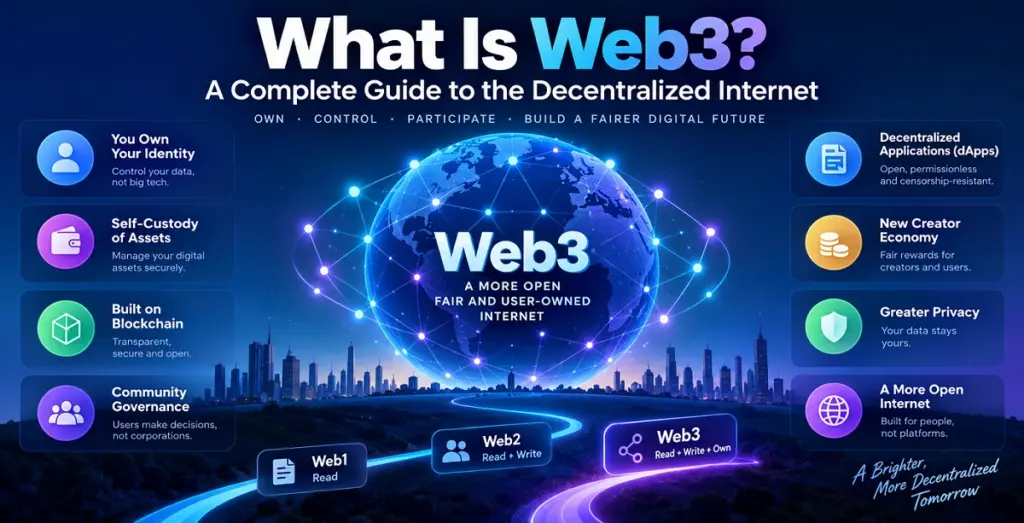
Table of Contents
- What Is Web3? The Foundation of a Decentralized Internet
- The Evolution: Web1 vs. Web2 vs. Web3
- Why Is Web3 Different from Today’s Web?
- What Are the Core Principles of Web3?
- How Does Web3 Work? The Step-by-Step Technical Engine
- What Technologies Power the Web3 Ecosystem?
- What Is Web3 Identity? Owning Your Digital Self
- How Does Web3 Give Users True Ownership?
- Web3 Applications and Real-World Use Cases
- Groundbreaking Technological Shifts Shaping Web3
- Economic Scale, Market Projections, and Global Institutional Adoption
- What Are the Real Benefits of Web3?
- Risks, Vulnerabilities, and Technical Limitations
- Is Web3 Really Decentralized?
- Web3 vs. Blockchain: Clarifying the Misconception
- Is Web3 the Future of the Internet?
- Frequently Asked Questions About Web3
- ZenvestAI View
- The Bottom Line
- Related Intelligence
- Author and Editorial Information
- Global Regulatory Disclosures
- Data Sources and Research Citations
What Is Web3? The Foundation of a Decentralized Internet
Web3 is an emerging paradigm for an internet built on decentralized infrastructure rather than centralized corporate servers. Instead of storing user data inside closed private databases managed by a few global technology conglomerates, Web3 uses open peer-to-peer networks to coordinate information, value, and access.
To understand the concept clearly, it helps to distinguish Web3 from the older academic term Web 3.0. In the late 1990s, World Wide Web creator Tim Berners-Lee envisioned the “Semantic Web,” often dubbed Web 3.0, where machine-readable metadata would help computers understand and interconnect website information automatically.
While that vision aimed for universal information sharing, it did not solve the fundamental problem of centralized platform monopolies. In 2014, computer scientist and Ethereum co-founder Gavin Wood coined the term Web3 in its modern context, framing it as an alternative system where human trust in centralized institutions is replaced by open cryptographic protocols.
Decentralization matters because the modern internet has accumulated single points of failure. A small group of cloud service providers, advertising platforms, and social networks control what people can say, how commerce is conducted, and how personal records are stored. When a centralized platform alters its terms of service, de-platforms a creator, or suffers a catastrophic data breach, everyday users bear the entire cost.
Web3 addresses this systemic imbalance by shifting control from corporate terms of service to open-source mathematical rules. It is not a single downloadable software program or a single cryptocurrency; it is an interconnected ecosystem of open networks, communication standards, and digital asset layers working together.
To understand how we arrived at this decentralized vision, we must first look at the architectural journey of the internet over the past thirty years.
The Evolution: Web1 vs. Web2 vs. Web3
The history of the internet is best understood as a progression from static consumption to interactive centralized publishing, and finally to sovereign digital ownership. This historical progression explains why the phrase “Read, Write, Own” has become the standard framework for describing the internet’s evolution.
The first generation, Web 1.0 (the “Read” era, spanning the 1990s to the early 2000s), was built on decentralized open protocols such as HTTP, SMTP, and TCP/IP. Anyone could build a personal website or run an independent email server, but the web was primarily read-only.
Most users acted as passive consumers reading static information published by media companies, educational institutions, and directories. Interactivity was minimal, and financial commerce was in its infancy.
The second generation, Web 2.0 (the “Read-Write” era, from the mid-2000s to the present), introduced dynamic databases, social networks, and user-generated content. Web2 democratized creative publishing through platforms like YouTube, Instagram, and Reddit, allowing anyone with an internet connection to reach a global audience. However, this convenience came with severe structural trade-offs.
The infrastructure consolidated around a tiny cohort of tech monopolies. These platforms offered free services in exchange for tracking human behavior, capturing data, and selling user attention to advertisers. In Web2, you may create the content, but the platform owns the account, the distribution algorithm, and the monetization.
The current generation, Web3 (the “Read-Write-Own” era), integrates the rich interactivity of Web2 with the open, decentralized infrastructure of Web1. Instead of renting accounts from corporations, users participate as sovereign peers who control digital assets and identities through cryptography.
| Internet Generation | Dominant Era | Core Architecture | User Role | Data & Asset Ownership | Underlying Infrastructure |
| Web 1.0 | 1990s–Early 2000s | Open, static, decentralized protocols | Consumer (“Read”) | Publisher-controlled static files | Open protocols (HTTP, FTP, SMTP), personal web servers |
| Web 2.0 | Mid-2000s–Present | Centralized client-server cloud databases | Creator & Consumer (“Read + Write”) | Platform-owned; corporate walled gardens | Centralized cloud hyperscalers (AWS, Azure, Google Cloud) |
| Web 3.0 (Web3) | Present Onward | Distributed ledgers, smart contracts, cryptography | Sovereign Participant (“Read + Write + Own”) | User-owned via self-custody cryptographic keys | Peer-to-peer blockchain nodes, decentralized storage (IPFS) |
Having charted the generational timeline, we can now examine the structural mechanisms that make Web3 fundamentally different from the web you use today.
Why Is Web3 Different from Today’s Web?
Web3 replaces corporate intermediation with direct protocol-level interactions. In traditional web architectures, every online action requires a trusted middleman to manage identity, verify transactions, and store private data.
Consider how a standard interaction works in the Centralized Web:
Platform → User Account → Centralized Database → Corporate Permission → Transaction Settlement
In this Web2 workflow, the platform acts as an absolute authority. If you post a photo, transfer money, or message a friend, your request passes through proprietary corporate servers. The platform has the technical ability to freeze your balance, censor your speech, monetize your browsing history, or shut down entirely. You do not own your account; you merely lease access to a line entry inside someone else’s private database.
Now contrast this with the Web3 Model:
User → Cryptographic Wallet/Identity → Open Protocol → Blockchain Network → Sovereign Asset/State Change
In the Web3 workflow, no intermediary sits between you and the network. You authenticate your identity using a private cryptographic key stored on your own device. When you initiate an action—such as transferring funds, playing a game, or publishing a piece of writing—you sign the transaction directly. A distributed network of independent computers verifies your signature using open mathematical algorithms, updating a public ledger that no single company owns or alters.
This fundamental difference introduces three critical capabilities:
- True self-custody: Your funds and data are controlled by your private cryptographic keys, eliminating bank runs or arbitrary account freezes.
- Seamless asset portability: A digital asset, credential, or reputation earned in one application can move across entirely different platforms without asking a developer for permission.
- Censorship resistance: Because the transaction rules are hardcoded into public protocols, valid transactions cannot be selectively blocked by corporate whim.
These architectural differences are powered by a distinct set of operational rules, known as the foundational principles of Web3.
What Are the Core Principles of Web3?
The Web3 ecosystem operates on seven core principles that collectively guarantee user freedom, transparency, and system resilience. These principles ensure that decentralized systems remain durable, open, and resistant to central manipulation.
1. Decentralization
Decentralization eliminates reliance on a single controlling authority by distributing computing tasks across thousands of independent global computers.
In a traditional server environment, taking down one central facility can paralyze an entire service. In a decentralized blockchain network, thousands of independent nodes run identical copies of the software simultaneously, ensuring the network continues operating even if dozens of servers fail.
2. User Ownership
User ownership means that digital property is held directly by individuals rather than registered as an entry on a private corporate ledger. In Web2, if you buy an in-game item or digital book, your access lasts only as long as that platform remains in business.
In Web3, your digital items are recorded directly to an open blockchain under your public address, giving you genuine legal and technical property rights over digital assets.
3. Self-Custody
Self-custody ensures that only the individual holder possesses the cryptographic keys needed to authorize transactions. A common misconception is that the blockchain stores your passwords or private keys.
In reality, the blockchain holds the public ledger of balances, while your private key lives securely in your custody on your local device or hardware wallet. Without that private key, no outside party—neither government, corporation, nor hacker—can transfer your assets.
4. Permissionless Participation
Permissionless access means anyone with an internet connection can interact with a decentralized network without undergoing subjective corporate approval. Traditional finance and enterprise platforms require extensive identity checks, credit scores, geographic proximity, and bureaucratic approvals.
In Web3, the protocol treats every valid cryptographic signature equally, regardless of nationality, location, or socioeconomic background.
5. Cryptographic Verification
Web3 replaces human trust with mathematical proof through digital signatures and public-key cryptography. In a centralized system, you must trust that an institution will honor its promises and protect your data. In Web3, every transaction follows a strict verification sequence:
Private Key Signature → Public Mathematical Verification → Network Consensus Inclusion
The system guarantees that an action occurred because the mathematics proves it, not because an administrator signed off.
6. Native Digital Assets
Native digital assets provide the economic fuel and property deeds necessary to align incentives across global decentralized communities. Blockchains use fungible tokens to reward network operators for validating data and to pay for computational processing power (“gas fees”).
Concurrently, Non-fungible tokens (NFTs) serve as unique, verifiable digital deeds for digital art, domain names, physical asset titles, and intellectual property.
7. Programmable Rules
Programmable rules allow automated agreements to execute reliably without legal departments, escrow agents, or human managers. Through smart contracts, developers can build complex financial instruments, voting systems, and multi-signature treasuries that operate strictly according to their open-source code.
Understanding these principles naturally sparks a practical question: How do all of these moving parts work together when an everyday user clicks a button?
How Does Web3 Work? The Step-by-Step Technical Engine
Web3 operates through an integrated software stack where user-initiated signatures trigger automated smart contracts across distributed blockchain nodes. The interaction does not require passwords or usernames; instead, it relies on cryptographic handshakes.
The standard Web3 transaction lifecycle follows a continuous, seven-step path:
To see how this works in practice, let us examine a real-world scenario:
- Step 1: Connecting your identity: Instead of typing a username and password, you open a decentralized lending application and click “Connect Wallet.” Your browser-based wallet software supplies your public address to establish a secure, private session.
- Step 2: Initiating an action: You decide to deposit $500 in tokenized US Treasury bills to earn yield. You enter the amount and click “Supply.”
- Step 3: The dApp prepares the payload: The decentralized application translates your click into a specific instruction for its underlying smart contract.
- Step 4: Cryptographic signing: A prompt appears in your wallet software displaying the exact contract details, permissions, and estimated network transaction fee. You confirm the transaction using your private key, which generates an unforgeable digital signature.
- Step 5: Broadcast to the network: The wallet broadcasts this signed package to a global mempool of pending transactions.
- Step 6: Network consensus & execution: Independent validator nodes pick up the transaction, confirm that your cryptographic signature is mathematically valid, ensure you have sufficient funds, and execute the smart contract logic.
- Step 7: Permanent state settlement: The smart contract records your deposit on the immutable ledger and issues interest-bearing yield tokens directly into your wallet. The entire transaction settles in seconds without a bank, credit officer, or centralized custodian.
Now that we have traced the transaction flow, let us inspect the individual technologies that make this engine run.
What Technologies Power the Web3 Ecosystem?
The Web3 ecosystem relies on a multi-layered infrastructure stack that coordinates compute, storage, logic, and user interfaces. Each component specializes in solving a distinct architectural challenge.
Blockchains and Distributed Ledgers
Blockchains provide the tamper-proof foundation layer where the history of all transactions is permanently recorded. A blockchain is a continuous chain of cryptographically linked data blocks maintained across thousands of peer-to-peer computers. Because every node holds a synchronized copy, altering historical records would require overwhelming the consensus of the entire global network, making the ledger virtually immune to unilateral tampering.
Smart Contracts
Smart contracts are immutable software programs deployed on blockchains that run exactly as written without human intervention. First popularized on a wide scale by Ethereum, smart contracts hold assets and execute financial agreements when predefined conditions are satisfied. They eliminate counterparty risk because the rules cannot be rewritten once deployed to the network.
Crypto Wallets and Key Management
Crypto wallets serve as personal management tools for your cryptographic keys rather than storage containers for physical currency. Your wallet does not hold tokens inside its software; rather, it securely stores your private key and uses it to sign transactions on the blockchain. Wallets come in diverse form factors, including mobile applications, browser extensions, and specialized offline hardware devices designed to keep private keys isolated from internet-connected threats.
Cryptographic Protocols
Cryptography provides the mathematical foundation for privacy, security, and digital signatures across Web3. Public-key cryptography ensures that anyone can verify a transaction was authorized by your public address without ever seeing your secret private key. Advanced cryptographic primitives, such as zero-knowledge proofs, allow systems to verify identity and compliance without revealing confidential data.
Fungible Tokens
Fungible tokens are uniform digital units of value that power decentralized network economies. These tokens serve as the native currency used to pay network fees (such as ETH on Ethereum or Solana on its native chain) or as governance tokens that grant voting rights in decentralized protocols. Because each unit is interchangeable with any other of equal value, they function like native digital money.
Non-Fungible Tokens (NFTs)
Non-fungible tokens represent distinct, non-interchangeable digital deeds of ownership registered on a public ledger. Unlike standard cryptocurrencies, each NFT has a unique identifier and metadata tag. This makes them ideal for recording ownership of digital art, music catalogs, gaming items, university credentials, and tokenized real-world property deeds.
Decentralized Applications (dApps)
Decentralized applications are user-facing platforms whose back-end code runs on blockchain smart contracts rather than centralized corporate servers. While a dApp may use standard front-end code (HTML, CSS, JavaScript) to deliver a clean browser experience, its critical business logic, financial ledgers, and database entries are anchored to public blockchains.
Decentralized Storage Systems
Decentralized storage networks distribute file fragments across global peer networks to prevent single-server censorship or data loss. Storing large media files, videos, or full website directories directly on high-performance blockchains is cost-prohibitive. Decentralized storage protocols like the InterPlanetary File System (IPFS) and Arweave break data into cryptographic pieces, store them across independent nodes, and retrieve them using content identifiers rather than central web addresses.
With the technical stack established, we must address how this infrastructure transforms one of the most critical elements of the digital experience: personal identity.
What Is Web3 Identity? Owning Your Digital Self
Web3 identity replaces corporate-managed user profiles with sovereign, portable credentials controlled entirely by the individual. In the current internet landscape, your digital identity is fragmented across hundreds of corporate databases.
In Web2:
Platform Creates Account → Platform Stores Personal Data → Platform Retains Absolute Access Control
Under this legacy framework, you log into websites using centralized identity providers (“Log in with Google” or “Sign in with Apple”). While convenient, this setup creates massive security liabilities. If a provider locks your profile, you lose access to third-party services, personal contacts, and linked accounts. Furthermore, your identity data is routinely harvested, packaged, and monetized without your explicit granular consent.
In Web3:
User Generates Cryptographic Pair → User Holds Decentralized Identifier (DID) → Applications Mathematically Verify Credentials
Web3 identity relies on Decentralized Identifiers (DIDs) and Verifiable Credentials (VCs). Instead of handing over your passport number, home address, and financial records to access a service, your wallet holds cryptographic proofs issued by trusted authorities (such as a university or government agency).
When an application asks to confirm your credentials, you use selective disclosure to prove eligibility without exposing unnecessary private details. For example, you can mathematically prove you are over 21 years old or hold an accredited investor status without revealing your exact birthdate, full name, or residential address. If an application chooses to ban your wallet, your cryptographic identity remains intact, ready to connect to any competing service instantly.
This identity transformation leads directly into the broader economic question: In what tangible ways does Web3 hand real ownership back to the user?
How Does Web3 Give Users True Ownership?
Web3 provides true ownership by giving individuals exclusive cryptographic control over their assets, identity, data, and organizational governance. Ownership is no longer a contractual promise written in an unread terms-of-service document; it is an enforced mathematical reality.
This sovereign ownership extends across four interconnected digital domains:
- Sovereign digital assets: When you hold cryptocurrency, stablecoins, or NFTs in a non-custodial wallet, no bank, payment processor, or government can freeze your account with a keystroke. You can execute digital currency transfers across borders twenty-four hours a day, 365 days a year, settling transactions directly in USD-denominated stablecoins or native tokens.
- Portable digital identity: In Web2, leaving a social media platform means abandoning your follower graph, messaging history, and established reputation. Web3 protocols decouple your audience from the hosting platform. If you build a following on a decentralized social network, you can port your social graph to a completely different application interface without starting from scratch.
- Granular data sovereignty: Web3 architectures let individuals decide who accesses their personal data, for how long, and under what financial terms. Instead of tech giants capturing all advertising profits from your browsing habits, decentralized data exchanges allow users to monetize their own anonymized attention directly.
- Democratic governance participation: In traditional corporate structures, decisions are made by executive boards and major institutional shareholders. Web3 projects frequently distribute governance tokens to active community members, giving users a direct vote on protocol upgrades, fee allocations, and treasury spending.
Having established how ownership works conceptually, let us look at where these capabilities are actively being deployed in the global economy today.
Web3 Applications and Real-World Use Cases
Web3 applications span finance, corporate governance, creative media, enterprise supply chains, and artificial intelligence. The industry has expanded far beyond simple digital currency transfers into complex, multi-industry ecosystems.
Decentralized Finance (DeFi)
Decentralized Finance (DeFi) rebuilds legacy banking services into open, programmable protocols that run without human intermediaries. Users worldwide can lend, borrow, trade, and earn yield on their capital through automated liquidity pools.
Protocols like Uniswap and Aave facilitate billions of dollars in daily transaction volume without relying on traditional brokerage clearinghouses or custodian banks.
Real-World Asset (RWA) Tokenization
Real-World Asset (RWA) tokenization bridges off-chain physical and financial assets onto public blockchains as liquid, fractional digital tokens. Traditional finance institutions are moving rapidly to tokenize government bonds, commercial real estate, private debt, and commodities.
Major global banking giants like Goldman Sachs and Fidelity are actively building on-chain settlement infrastructure, while financial service provider Broadridge processes billions in tokenized repo transactions.
In emerging markets, regulatory bodies such as the Securities and Exchange Board of India (SEBI) have tested initiatives like the Demat 2.0 framework to explore tokenized corporate and sovereign bonds. Global analysts project the total market capitalization of tokenized RWAs will reach between $10 trillion and $16 trillion by 2030.
Decentralized Autonomous Organizations (DAOs)
Decentralized Autonomous Organizations provide an internet-native corporate architecture governed by code and community consensus. Instead of centralized hierarchical management, a DAO writes its foundational rules, treasury management, and voting systems into smart contracts.
Community members submit proposals and vote using governance tokens. Once a proposal meets threshold approval, the smart contract releases funds automatically, eliminating executive embezzlement and backroom decisions.
Web3 Gaming and Digital Economies
Web3 gaming turns in-game items from leased entertainment assets into tradable, player-owned digital property. In conventional online video games, players spend thousands of hours and dollars accumulating digital skins, characters, and weapons, only to lose everything if the publisher shuts down the game servers.
Web3 games mint items as NFTs on high-performance blockchains, enabling players to trade, sell, or utilize their gear across open secondary marketplaces.
Decentralized Social Networks (DeSoc)
Decentralized social networks decouple content creation and personal networks from corporate hosting algorithms. Protocols such as Farcaster and Lens allow creators to own their follower relationships on-chain. If an interface policy changes or an account is penalized by one client app, the creator’s social graph remains completely unaffected and accessible via other compatible applications.
The Convergence of Web3 and Artificial Intelligence (AI)
The intersection of Web3 and Artificial Intelligence (AI) solves critical bottlenecks around corporate AI monopolies, data provenance, and automated machine-to-machine commerce.
- Autonomous agent commerce: As autonomous AI agents conduct tasks across the web, they cannot open legacy bank accounts or hold credit cards. Blockchains provide AI agents with permissionless crypto wallets, allowing them to pay each other micro-cents for cloud compute, data storage, and API access via smart contracts.
- Cryptographic provenance and deepfake prevention: The explosion of synthetic generative media makes authenticating human creation difficult. Blockchains allow creators to cryptographically sign digital content at the moment of creation, leaving a permanent public watermark that proves provenance and guarantees training royalties.
These diverse use cases are accelerating rapidly thanks to a wave of breakthrough technological solutions that directly address early Web3 limitations.
Groundbreaking Technological Shifts Shaping Web3
Recent engineering breakthroughs have transformed Web3 from an intimidating, high-cost environment into an accessible, enterprise-ready infrastructure. Four technological leaps stand out as foundational catalysts for mass adoption.
Account Abstraction (ERC-4337) and the UX Renaissance
Account Abstraction converts cumbersome cryptographic wallets into intelligent, user-friendly programmable smart accounts. Early crypto adoption suffered from severe usability issues: users were forced to write down 12-word seed phrases on paper, manually calculate transaction fees in volatile tokens, and risk losing their life savings if they made a single typing error.
With Account Abstraction (standardized on Ethereum via ERC-4337):
- Users log in using standard biometric authentication, such as Apple FaceID or Android fingerprint sensors.
- Account recovery is handled via “social recovery” or trusted contacts, eliminating catastrophic seed phrase losses.
- Transaction fees can be sponsored by applications or paid directly in standard USD stablecoins rather than native volatile tokens.
- Multiple distinct transactions (such as approving and trading an asset) are batched into a single click, delivering a Web2-level consumer experience backed by Web3 security.
Zero-Knowledge Proofs (ZKPs) and zkRollups
Zero-Knowledge technology enables mathematically verified computation without revealing the underlying private data. ZKPs allow one party to prove to another that a statement is true without disclosing any confidential inputs.
This solves two massive structural hurdles simultaneously:
- High throughput and ultra-low fees: Layer-2 scaling networks known as zkRollups bundle thousands of transactions off-chain, compute their validity, and post a tiny, compressed mathematical proof back to the main blockchain. This slashes network transaction fees to fractions of a cent while maintaining the full underlying security of the base chain.
- Institutional data privacy: Financial institutions and healthcare providers cannot conduct business on fully transparent public ledgers where trade secrets or patient data are visible to everyone. Zero-knowledge cryptographic proofs allow enterprise systems to verify regulatory compliance, asset solvency, and identity without exposing sensitive internal data.
As these usability and scaling technologies mature, institutional capital is flowing into the ecosystem at an unprecedented rate.
Economic Scale, Market Projections, and Global Institutional Adoption
The Web3 market is shifting away from retail speculation toward industrial enterprise software, tokenized debt, and global payments. Research institutions, sovereign wealth funds, and market intelligence firms now track Web3 as a critical frontier of financial technology.
Independent analytical projections highlight the rapid commercial expansion of the decentralized web over the coming decade:
| Economic Metric / Market Attribute | Baseline Estimate (Current Era) | Long-Term Projection (2034–2035) | Compound Annual Growth Rate (CAGR) | Strategic Growth Driver |
| Global Web3 Market Size | $6.75 Billion – $12.61 Billion | $116.55 Billion – $176.32 Billion | 38.10% – 49.84% | Enterprise software integration, institutional digital asset custody |
| Tokenized Real-World Assets (RWAs) | ~$35 Billion – $50 Billion | $10.0 Trillion – $16.0 Trillion (by 2030) | >55.0% | On-chain sovereign debt, commercial real estate, private credit |
| Geographic Market Leadership | North America (Highest global revenue share; institutional capital) | Asia-Pacific (Fastest projected regional CAGR worldwide) | Regional divergence | Cross-border retail payments, supportive Asian digital frameworks |
Institutional adoption is no longer theoretical. Sovereign governments and regulated banking networks across the European Union, the United Kingdom, Singapore, the UAE, and the United States are deploying real-time settlement platforms that use decentralized ledger rails to eliminate cross-border settlement friction for global payments.
With institutional numbers validating the technology’s scale, let us synthesize the primary advantages Web3 offers over legacy platforms.
What Are the Real Benefits of Web3?
Web3 delivers tangible systemic advantages across operational security, market efficiency, and individual digital sovereignty. Rather than relying on sweeping promises, the benefits correspond directly to specific cryptographic principles.
| Web3 Architectural Principle | Concrete Practical Benefit | Real-World Advantage |
| Decentralization | Eliminates single points of technical and corporate failure | 24/7 network uptime; immunity to corporate platform shutdown or unilateral de-platforming |
| Self-Custody | Direct personal control of funds and records | Protection against custodial insolvency, bank runs, or unauthorized balance confiscation |
| Cryptographic Verification | Tamper-proof, mathematically verified transactions | Absolute fraud reduction; transparent audit trails without paying expensive accounting auditors |
| Permissionless Access | Open worldwide participation | Instant banking and financial services access for the unbanked global population |
| Smart Contract Automation | Code-based deterministic transaction settlement | Eliminates escrow intermediaries, administrative delays, and expensive legal arbitration |
| Asset Portability & Interoperability | Seamless movement of assets across platforms | Universal digital identity; in-game assets and credentials work across competing applications |
| Tokenized Incentive Alignment | Shared network value creation | Early community participants, creators, and developers earn direct equity in the platform’s growth |
A balanced, professional analysis cannot highlight these benefits without equally scrutinizing the severe structural challenges and risks Web3 currently faces.
Risks, Vulnerabilities, and Technical Limitations
Web3 is an evolving, high-risk technological frontier that introduces novel security, economic, and operational hazards. Understanding these vulnerabilities is vital for any professional or beginner exploring the ecosystem.
- Irrevocable private-key loss: Self-custody is a double-edged sword. If an individual fails to secure their credentials or falls victim to social engineering, there is no centralized “forgot password” button or customer service department to restore access. Lost keys mean permanently lost assets.
- Smart contract vulnerabilities and economic exploits: Blockchain networks are cryptographically robust, but the application code deployed on top of them is written by humans. Software bugs, logic flaws, and smart contract vulnerabilities in protocols have led to billions of dollars in irreversible capital losses. Because transactions are immutable, stolen funds cannot be arbitrarily refunded.
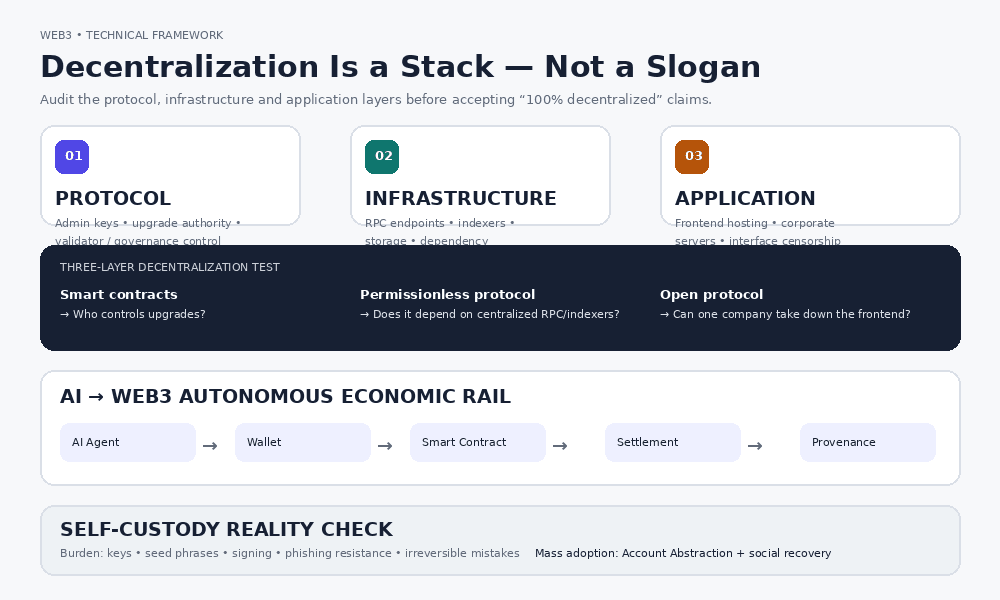
- Centralization chokepoints and RPC reliance: While base blockchains are decentralized, many end-user applications rely on centralized infrastructure. Most decentralized applications connect to blockchains through centralized Remote Procedure Call (RPC) node providers like Infura or Alchemy, and host their browser interfaces on centralized cloud servers like AWS. If these centralized services experience outages, everyday users find themselves temporarily unable to access their “decentralized” applications.
- Cross-chain bridge exploits: Because individual blockchains (such as Bitcoin, Ethereum, and Solana) cannot communicate natively, developers build multi-chain software bridges to transfer tokens between networks. These bridges pool vast amounts of capital in smart contracts, making them the single most targeted chokepoint for sophisticated cross-chain bridge exploits.
- International regulatory uncertainty and compliance burdens: Regulatory frameworks governing digital assets remain fragmented globally. Market authorities—including the US Securities and Exchange Commission (SEC), the European Union under its Markets in Crypto-Assets (MiCA) regulation, and the International Organization of Securities Commissions (IOSCO)—continue to balance consumer protection and financial stability against digital innovation. Shifting legal interpretations regarding securities definitions and tax reporting requirements create persistent operational challenges for development teams.
The presence of these central chokepoints and technical risks raises a crucial, frequently debated question: Is Web3 truly decentralized, or is that label an exaggeration?
Is Web3 Really Decentralized?
Web3 is not an absolute, binary state; it exists on a spectrum of decentralization where projects balance security, performance, and user convenience. Claiming that all Web3 platforms are completely decentralized is factually inaccurate.
To evaluate decentralization accurately, an analyst must look across three distinct system layers:
- Protocol-layer decentralization: This measures how many independent validator nodes secure the underlying blockchain, how geographically dispersed they are, and how much computational power or staked capital is required to compromise the network. While networks like Bitcoin and Ethereum exhibit exceptional node diversity, many newer, high-speed blockchains rely on a small validator set, sacrificing decentralization to achieve higher transaction throughput.
- Application-layer decentralization: Even if a smart contract is deployed on a decentralized network, the developers may retain “admin keys” that allow them to pause trading, blacklist specific wallet addresses, or upgrade contract code unilaterally. Truly decentralized applications renounce these administrative keys or lock them behind multi-signature community voting timelocks.
- Infrastructure-layer decentralization: A project is only as decentralized as its weakest operational dependency. If a decentralized finance protocol relies on a single centralized price oracle to fetch asset values, or if its front-end website runs entirely on a single corporate cloud server, it remains vulnerable to centralized failure points.
Decentralization is therefore an ongoing architectural pursuit rather than a guaranteed, pre-existing reality. The most mature Web3 systems actively work toward “progressive decentralization,” gradually transferring operational power from founding developer teams to automated, distributed community governance over time.
This nuanced reality leads to another common point of confusion: the conflation of Web3 with blockchain technology itself.
Web3 vs. Blockchain: Clarifying the Misconception
Blockchain is a specific foundational technology; Web3 is the overarching internet vision and socioeconomic ecosystem built on top of that technology. Using the terms interchangeably is a fundamental conceptual error.
A helpful analogy is the relationship between the database and the modern internet. A database is a structured method for storing and querying information.
The modern internet is the vast, multidimensional network of web applications, media companies, e-commerce platforms, and communication channels that utilizes databases as a silent infrastructure component.
In this architectural hierarchy:
- Blockchain acts as the decentralized, tamper-proof database and settlement layer.
- Smart Contracts provide the programmable business logic and automated agreements.
- Crypto Wallets deliver the identity management and signing interfaces.
- Tokens and NFTs serve as the digital assets, economic incentives, and property records.
- Decentralized Applications (dApps) deliver the consumer-facing user experience.
- Web3 is the complete paradigm that unites all these layers into a user-owned internet.
Blockchain → Foundational Infrastructure
Smart Contracts → Programmable Logic
Crypto Wallets → User Interface and Key Custody
Tokens & NFTs → Native Value and Ownership Primitives
Web3 → The Comprehensive Decentralized Internet Paradigm
Having separated the infrastructure from the broader vision, we can now address the ultimate question: Will Web3 actually replace the internet as we know it?
Is Web3 the Future of the Internet?
Web3 will not suddenly erase and replace the existing internet; rather, it is evolving into an indispensable, foundational layer that integrates into traditional web infrastructure. The future is not a binary choice between Web2 and Web3, but a hybrid model where decentralized ownership layers enhance legacy web services.
In the coming decade, we will see blockchain infrastructure become invisible to the end user. Just as billions of people send emails every day using the SMTP protocol without needing to understand packet routing, future web users will interact with tokenized assets, verifiable identity credentials, and decentralized storage networks effortlessly.
You will log into a game, authenticate your identity, or transfer money internationally without necessarily knowing—or caring—which underlying blockchain processed the signature.
Web3 is already proving its practical value wherever human coordination suffers from trust deficits, predatory middlemen, or restrictive financial borders.
While speculative hype will continue to rise and fall in market cycles, the fundamental demand for digital ownership, cryptographic transparency, and sovereign data control will permanently influence the future of global computing.
To reinforce these complex concepts, here are direct, authoritative answers to the most critical questions everyday readers ask about Web3.
Frequently Asked Questions About Web3
What is Web3 in simple words?
Web3 is an internet where you own your digital stuff instead of renting it from corporations. In Web3, you use a personal Web3 wallet to control your identity, money, data, and digital property directly, without needing permission from big tech platforms or traditional banks.
What is the main purpose of Web3?
The main purpose of Web3 is to return digital ownership, privacy, and economic control to internet users. It accomplishes this by replacing centralized platform gatekeepers with open, decentralized blockchain networks governed by transparent mathematical code rather than corporate policies.
How is Web3 different from Web2?
Web2 is built around centralized platforms that store your data, while Web3 is built around decentralized networks where you keep self-custody of your assets. In Web2, platforms own your accounts and monetize your data. In Web3, you hold the cryptographic keys to your own identity, content, and value.
Is Web3 the same as cryptocurrency?
No, Web3 is not the same as cryptocurrency, though it relies on cryptocurrencies to function. Cryptocurrency provides the economic fuel, incentive mechanism, and native payment layer for Web3, but Web3 itself encompasses decentralized identity, computing, file storage, gaming, and governance.
Does Web3 always use blockchain?
Yes, Web3 relies fundamentally on blockchains and distributed ledgers as its immutable recording layer. While Web3 also uses decentralized file storage networks like IPFS and off-chain zero-knowledge systems, blockchains serve as the primary source of truth for transaction verification, balances, and smart contract execution.
What is a Web3 wallet?
A Web3 wallet is a personal digital tool that stores your private cryptographic keys and lets you interact with decentralized applications. It does not hold physical money inside its software; rather, it acts as a digital passport and signing device that proves your ownership of assets recorded on the blockchain.
What is a Web3 dApp?
A Web3 dApp is a decentralized application whose core business logic runs on public blockchain smart contracts rather than corporate cloud servers. DApps run continuously without single points of failure, allow users to connect directly using digital wallets, and execute transactions transparently.
What is Web3 identity?
Web3 identity is a sovereign digital profile controlled entirely by you through cryptography rather than by a tech company. Using Decentralized Identifiers (DIDs) and Verifiable Credentials, you can authenticate your identity and share verified information across different services without exposing your private personal data.
Who owns user data in Web3?
In Web3, data ownership belongs to the individual who controls the cryptographic private keys associated with that data. Instead of platforms collecting and selling your browsing history, Web3 architectures allow you to store data privately and choose exactly who can view or monetize it.
Is Web3 completely decentralized?
No, Web3 is not entirely decentralized today; it operates on a spectrum of decentralization. Many applications still rely on centralized cloud hosts for website front-ends or centralized node providers, though developers are actively working toward full progressive decentralization across all layers.
What are some real-world examples of Web3?
Real-world examples include decentralized finance protocols like Uniswap, digital identity credentials, tokenized US Treasury bonds, and player-owned gaming items. Everyday examples also include decentralized storage networks like IPFS and community-governed organizations known as DAOs.
What are the main disadvantages of Web3?
The primary disadvantages of Web3 are high user complexity, irreversible transaction errors, smart contract vulnerabilities, and regulatory uncertainty. If you lose your private keys or fall for a fraudulent signature request, there is no centralized customer support service to reverse the transaction or recover your funds.
ZenvestAI View
At ZenvestAI, our editorial analysis cuts through the industry’s promotional extremes. Web3 is neither an immediate utopian revolution that will dismantle all existing institutions overnight, nor is it a passing speculative bubble. It is a profound, generational re-engineering of the global internet’s balance sheet.
The greatest error market observers make is evaluating Web3 exclusively through the lens of liquid token trading. The true long-term value lies in programmatic trust: the ability for two strangers, businesses, or autonomous AI agents across the globe to engage in instant economic collaboration with mathematical certainty and zero intermediary rent.
As Account Abstraction and Zero-Knowledge cryptography mature, Web3 will quietly become the standard settlement backbone for digital global commerce.
The Bottom Line On What Is Web3? A Complete Guide to the Decentralized Internet
The single most important takeaway: Web3 shifts the internet from a system of corporate platform tenancy into an open environment of sovereign, cryptographic property rights. In Web3, you no longer rent your digital life from corporate databases—you own it through your own private keys.
Related Intelligence
- Decentralized Finance (DeFi) Architecture: A deep dive into automated market makers, liquidity pools, and smart-contract lending protocols.
- Tokenized Real-World Assets (RWAs): How traditional institutions, private credit markets, and sovereign bonds are migrating to public blockchain rails.
- Zero-Knowledge Proofs Explained: The cryptographic breakthrough enabling private enterprise computation and sub-cent transaction scaling.
- Smart Contract Security Best Practices: A technical guide to understanding reentrancy, multi-signature governance, and smart contract auditing.
Author and Editorial Information
Published by the ZenvestAI Team
ZenvestAI is an independent, global educational and research platform committed to deconstructing advanced blockchain architectures, emerging financial technologies, and decentralized systems into clear, precise, and practical knowledge for beginners and institutional professionals alike.
Global Regulatory Disclosures
This comprehensive educational guide is produced strictly for informational and research purposes and does not constitute financial, investment, legal, accounting, or tax advice. The digital asset ecosystem, blockchain protocols, and Web3 technologies involve substantial market risk, operational complexity, and technological volatility.
Under global regulatory frameworks—including guidelines established by the International Organization of Securities Commissions (IOSCO), the United States Securities and Exchange Commission (US SEC), and the European Union’s Markets in Crypto-Assets (MiCA) regulation—educational research must remain distinct from individual investment solicitation or regulated financial advisory services. ZenvestAI does not endorse, sponsor, or recommend any specific digital asset, cryptocurrency, blockchain protocol, or commercial software mentioned herein. Readers must conduct independent technical due diligence and consult qualified legal and financial professionals before committing capital to self-custody wallets, smart contract interactions, or decentralized financial applications.
Data Sources and Research Citations
- Ethereum Foundation Documentation: Standards for decentralized architecture, consensus mechanisms, and Web3 principles (Ethereum.org).
- National Institute of Standards and Technology (NIST): Research publications on blockchain security considerations and user-centric decentralized paradigms (NIST.gov).
- World Economic Forum (WEF): Global council reports on decentralized autonomous organizations, digital identity frameworks, and blockchain governance (WEForum.org).
- Boston Consulting Group (BCG) & ADDX Research: Global market size projections for the tokenization of real-world illiquid assets by 2030 ($16 trillion forecast).
- Grand View Research & Precedence Research: Industry intelligence projections on global Web3 market size, compounding growth rates (CAGR), and regional institutional adoption trends through 2034–2035.
- Securities and Exchange Board of India (SEBI): Working group consultation papers on Demat 2.0 and public distributed ledger pilots for sovereign and corporate debt instruments.
- ERC-4337 Official Specification: Core architecture and standard definitions for Account Abstraction and smart contract wallets on the Ethereum Virtual Machine.