Imagine a financial system that does not close at 5 PM.
There is no bank counter. No branch manager. No central exchange matching every order. No person sitting in the middle approving every transaction.
Instead, you connect a crypto wallet to a blockchain application, choose what you want to do, sign a transaction, and software executes the rules.
That is the basic idea behind decentralized finance, or DeFi.
But DeFi is much more than swapping one cryptocurrency for another.
It can include decentralized exchanges, crypto lending and borrowing, stablecoins, staking, liquid staking, yield-generating vaults, derivatives, insurance-like applications, asset management, and decentralized governance.
The interesting part is what sits underneath all of this.
Code becomes part of the financial infrastructure.
Smart contracts hold assets and enforce rules. Blockchain networks record transactions. Oracles bring outside information such as asset prices onto the blockchain. Liquidity pools help people trade without a traditional order book. Lending protocols calculate interest and liquidate unsafe loans automatically.
This creates a new way to build financial services.
It also creates a new type of risk.
When a bank makes a mistake, there may be a customer-support team, legal process, insurance arrangement, or regulator involved.
When a DeFi smart contract has a serious bug, the code may simply do exactly what it was programmed to do—even if that result is disastrous.
That is why understanding how DeFi works is more important than simply knowing the names of popular DeFi platforms.
This complete guide explains DeFi from the ground up, including smart contracts, blockchain networks, tokens, liquidity pools, automated market makers, lending protocols, oracles, staking, governance, yield, gas fees, MEV, impermanent loss, liquidation, security risks, regulation, and the future of decentralized finance.
What Is DeFi?
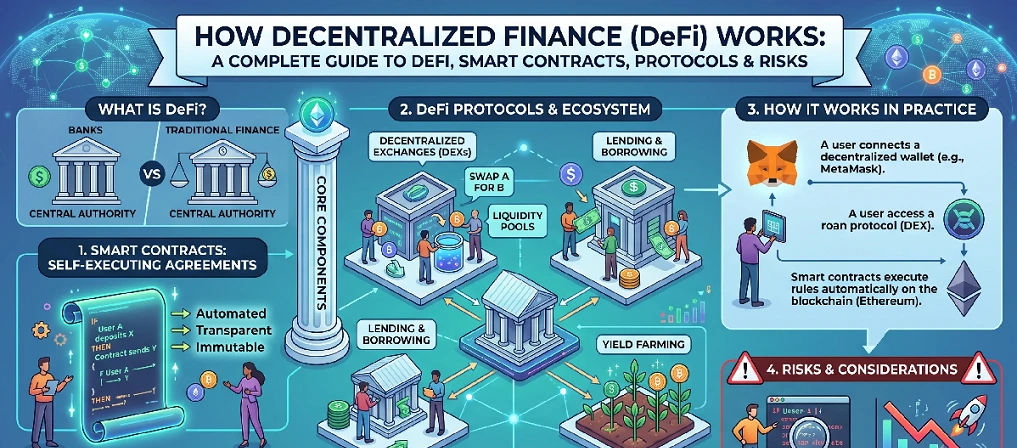
DeFi stands for Decentralized Finance.
It is a broad term for financial services built with blockchain networks and smart contracts instead of depending entirely on traditional financial intermediaries.
Traditional finance normally uses institutions such as:
- Banks
- Stock exchanges
- Brokerages
- Clearing houses
- Payment companies
- Custodians
- Asset managers
- Centralized lending institutions
DeFi attempts to move some of these functions into software running on public blockchain networks.
For example:
A traditional bank may manage deposits and loans using private databases and internal systems.
A DeFi lending protocol can use smart contracts to hold collateral, calculate borrowing costs, record debt, and trigger liquidations.
A traditional exchange uses an order-matching system.
A decentralized exchange can use liquidity pools and mathematical pricing formulas.
A traditional financial institution may keep its internal ledger private.
A public blockchain allows anyone to inspect transactions and contract activity, although wallet addresses do not necessarily reveal the real-world identity of their owners.
The important idea is this:
DeFi does not remove rules. It moves many rules from institutions into software.

How Does DeFi Work in Simple Words?
At its simplest, DeFi works through five things:
- Blockchain networks provide the underlying settlement system.
- Crypto assets and tokens represent value.
- Smart contracts contain the rules.
- Oracles provide external information when needed.
- Applications and wallets allow people to interact with those systems.
A simple DeFi transaction might look like this:
You → Wallet → DeFi Application → Smart Contract → Blockchain → Protocol → Result
Suppose you want to exchange USDC for ETH.
You connect your wallet to a decentralized exchange.
You enter the amount you want to swap.
The application finds a route through one or more liquidity pools.
Your wallet asks you to approve and sign the transaction.
The transaction is sent to the blockchain.
The smart contract checks the rules.
The exchange calculates the amount of ETH you should receive.
If the transaction satisfies your conditions, the swap is executed.
The blockchain records the resulting state.
The ETH arrives in your wallet.
There is no traditional broker required to manually approve the transaction.
But there are still costs and risks.
You may pay network fees. Your transaction may experience slippage. The smart contract may contain vulnerabilities. An oracle may provide bad information. MEV may affect execution. The token itself may lose value.
So permissionless does not mean risk-free.
Why Was DeFi Created?
The idea behind DeFi comes from several frustrations with traditional financial systems.
Traditional financial services can involve:
- Intermediaries
- Geographic restrictions
- Account approval
- Minimum balances
- Limited operating hours
- Settlement delays
- Custody arrangements
- Complex fees
- Credit checks
- Institutional dependence
DeFi developers wanted to build financial infrastructure that was more open, programmable and accessible.
A person with an internet connection and a compatible crypto wallet can potentially interact with a DeFi protocol without opening a conventional bank account.
That does not mean every DeFi service is available everywhere or that every protocol is legally permitted in every country.
It simply means the underlying blockchain application can be designed to operate without asking a central institution for permission at every step.
This distinction is particularly important for readers in India, the United States, the European Union, Singapore, the United Kingdom and other jurisdictions, because crypto and DeFi regulation differs significantly between countries.
The Five Main Layers of DeFi
One useful way to understand DeFi is to imagine it as a building.
Each floor performs a different job.
1. Settlement Layer: Where the Blockchain Lives
The settlement layer is the blockchain network that records and finalizes transactions.
Examples include:
This layer provides the basic environment in which transactions and smart contracts operate.
If the underlying blockchain has congestion, high fees, a consensus problem or another serious failure, applications built on top of it can also be affected.
This creates an important rule:
Every DeFi application inherits some risk from the blockchain underneath it.
2. Asset Layer: What Is Being Moved?
The asset layer contains the tokens used by DeFi applications.
These can include:
- Native blockchain assets
- Stablecoins
- Governance tokens
- Wrapped assets
- Liquid staking tokens
- Liquidity-provider tokens
- Tokenized vault shares
- NFTs and other digital assets
On Ethereum-compatible networks, standards such as ERC-20 provide common interfaces for fungible tokens.
This standardization is important because different applications can understand and interact with compatible tokens.
For example, a lending protocol can accept an ERC-20 token without creating a completely new accounting system for every individual token.
3. Protocol Layer: Where the Financial Rules Live
The protocol layer contains the smart contracts that provide financial functions.
This is where you find systems for:
- Trading
- Lending
- Borrowing
- Liquidity provision
- Stablecoins
- Yield strategies
- Staking
- Derivatives
- Asset management
Examples include protocols such as Uniswap, Aave and Compound.
The protocol is effectively a set of programmable financial rules.
4. Application Layer: What You See
Most people do not interact directly with raw smart-contract code.
They use a website or application.
The application provides:
- Buttons
- Charts
- Token selectors
- Wallet connection
- Transaction details
- Estimated fees
- Slippage settings
- Portfolio information
The interface makes complex blockchain operations easier to understand.
But the website is not necessarily the protocol itself.
This distinction matters.
A DeFi website can disappear while the underlying smart contracts may continue to exist on the blockchain.
5. Aggregation Layer: Finding Better Routes
Aggregators connect multiple protocols.
They can search different liquidity sources or yield strategies to find potentially better execution.
For example, an aggregator may compare several liquidity pools before routing a trade.
Yield aggregators can also move capital between strategies based on programmed rules.
This creates a powerful DeFi feature:
One protocol can become the building block for another protocol.
That is often called composability.
What Are Smart Contracts in DeFi?
A smart contract is a program stored and executed on a blockchain.
Ethereum describes smart contracts as programs containing code and data that live at a blockchain address and execute functions when users interact with them.
Think of a vending machine.
You select a product.
You provide the required payment.
If the conditions are satisfied, the machine releases the product.
A smart contract works on a much more powerful version of this idea.
It can contain rules such as:
If the borrower has enough collateral, allow the loan.
If the health factor falls below the required level, allow liquidation.
If the swap output is below the user’s minimum amount, revert the transaction.
If a governance proposal receives enough votes, execute the approved action after the required delay.
The blockchain network executes these rules according to the contract’s code.
Why Smart Contracts Matter So Much
Smart contracts make DeFi programmable.
Instead of creating a new financial institution for every financial service, developers can create software that performs specific financial functions.
This enables:
- Automated trading
- Automated lending
- Automated borrowing
- Automated liquidation
- Automated interest calculations
- Automated token distribution
- Automated governance
- Automated treasury management
The major advantage is programmability.
The major weakness is also programmability.
Bad code can create bad financial outcomes.
Ethereum’s documentation specifically warns that smart contracts can control large amounts of value and that vulnerabilities can be exploited by attackers.
Are Smart Contracts Really “Smart”?
Not in the human sense.
A smart contract does not think.
It does not understand whether a transaction is morally good or financially sensible.
It simply follows its programmed rules.
This is why a better phrase is:
“A programmable contract enforced by blockchain execution.”
The word “smart” describes automation, not intelligence.
How Does a DeFi Transaction Actually Happen?
Let’s follow a simple example.
Suppose you want to swap USDC for ETH.
Step 1: You connect a wallet
You use a self-custody wallet or another compatible wallet.
The wallet controls the private keys needed to authorize transactions.
Step 2: You choose the trade
You select:
USDC → ETH
and enter the amount.
Step 3: The application calculates the trade
The application checks available liquidity and estimates:
- ETH you may receive
- Price impact
- Slippage
- Network fee
- Possible routing path
Step 4: You authorize token spending
With many ERC-20 tokens, the smart contract needs permission to move the specified tokens from your wallet.
This is commonly done using an approval transaction.
Some systems can use signature-based mechanisms such as EIP-2612 permit to reduce the need for a separate approval transaction.
Step 5: You sign the transaction
Your wallet creates a cryptographic signature.
The transaction is then broadcast to the network.
Step 6: The network executes the transaction
The blockchain’s execution environment processes the smart-contract instructions.
Step 7: The protocol checks the rules
The contract verifies things such as:
- Token balances
- Allowances
- Slippage limits
- Pool liquidity
- Transaction deadline
- Other protocol conditions
Step 8: The swap happens
If the conditions are satisfied, the pool sends the output asset to your wallet.
Step 9: The blockchain records the result
The new state becomes part of the blockchain’s recorded history.
If a required condition fails, the transaction can revert.
This is one of the most important ideas in DeFi:
A failed transaction does not normally become a successful partial transaction simply because some earlier steps were completed.
Atomic execution allows multiple contract operations to succeed together or fail together within a transaction.
What Is Gas in DeFi?
Gas is the computational resource used by blockchain transactions.
When you interact with a smart contract, the network must perform computation and update blockchain state.
You generally pay a network fee for that work.
Gas costs can increase when:
- Network activity is high
- Transactions require more computation
- Many users compete for block space
- A protocol operation performs many contract calls
This means a profitable DeFi strategy can become unattractive if network fees are too high.
For smaller users, gas can be especially important.
A strategy that appears profitable before fees may become unprofitable after:
Gas + trading fees + slippage + protocol fees + taxes + price movement.
What Are Decentralized Exchanges?
A decentralized exchange, or DEX, allows users to trade crypto assets through blockchain-based protocols.
Instead of sending your assets to a centralized exchange and asking it to execute a trade from its internal system, you can interact directly with smart contracts.
Examples include Uniswap and other DEX protocols.
The exact design differs between platforms.
Some use automated market makers.
Others may use order-book models or hybrid designs.
How Does an Automated Market Maker Work?
An Automated Market Maker (AMM) uses mathematical rules to determine trading prices.
One famous model is the constant-product formula:
x × y = k
Here:
- x = amount of token X in the pool
- y = amount of token Y in the pool
- k = pool invariant
Suppose a pool contains ETH and USDC.
A trader adds USDC to the pool and removes ETH.
The balance changes.
The mathematical relationship determines the new price.
As the trader removes more ETH, the price of ETH in the pool changes.
This is why large trades can experience greater price impact.
What Is a Liquidity Pool?
A liquidity pool is a smart-contract-controlled pool containing assets that traders can use.
Instead of a centralized exchange needing a traditional order book with buyers and sellers at different prices, an AMM can use pooled assets.
Liquidity providers deposit assets into the pool.
Traders use the pool.
Liquidity providers may receive trading fees in return.
This creates a simple economic relationship:
Traders need liquidity.
Liquidity providers supply liquidity.
Fees can compensate liquidity providers for providing that liquidity.
But liquidity provision is not free money.
LPs take market and smart-contract risk.
What Is Slippage?
Slippage is the difference between the expected trade price and the actual execution price.
Suppose ETH appears to be available at ₹3,00,000.
You place a large order.
The pool does not have unlimited liquidity at ₹3,00,000.
As your trade consumes liquidity, the effective price moves.
You might therefore receive a worse average price than expected.
This is price impact.
Slippage can also arise from changes between the time a transaction is submitted and the time it executes.
That is why DeFi applications commonly allow users to set a maximum slippage tolerance.
What Is Impermanent Loss?
Impermanent loss is one of the most misunderstood concepts in DeFi.
It mainly affects liquidity providers in pools where asset prices can move relative to each other.
Imagine you provide ETH and USDC to a liquidity pool.
You hold both assets.
If ETH’s market price changes sharply, arbitrage traders trade against the pool until the pool price moves closer to the wider market price.
The pool may then contain:
- Less of the asset that increased in value
- More of the asset that performed worse
Compared with simply holding the original assets, the liquidity-provider position may be worth less.
That difference is commonly called impermanent loss or divergence loss.
The BIS also identifies impermanent loss as a structural risk for AMM liquidity providers when market prices diverge from the pool’s implied price.
A simple example
Suppose you initially deposit:
- ₹5 lakh of ETH
- ₹5 lakh of USDC
Total:
₹10 lakh
If ETH doubles in price, arbitrage activity changes the pool’s asset mix.
You may not simply end up with ₹10 lakh of ETH and ₹10 lakh of USDC.
The pool rebalances through trades.
If you had held the original assets outside the pool, your portfolio could have performed differently.
The difference is the basic idea behind impermanent loss.
Approximate impermanent-loss relationship
For a simple constant-product pool, if the relative asset price changes by a multiplier d, the classic comparison can be expressed as:
IL = 2√d / (1 + d) − 1
For example:
| Asset price change | Approximate impermanent loss |
|---|---|
| +25% | -0.60% |
| +50% | -2.02% |
| +75% | -3.84% |
| +100% | -5.72% |
| +200% | -13.40% |
| +300% | -20.00% |
| +400% | -25.46% |
These numbers describe a simplified constant-product model.
Actual results can differ because liquidity pools may charge fees, use different formulas, concentrate liquidity, change fee structures, or involve additional incentives.
Impermanent Loss Is Not the Same as a Direct Loss
This distinction is important.
Impermanent loss compares the performance of your liquidity-provider position with another strategy, usually simply holding the original assets.
You can still make money as an LP if:
Trading fees + incentives > impermanent loss + other costs.
But you can also lose money even when a pool has generated fees.
This is why advertised APY should never be viewed in isolation.
What Is Loss-Versus-Rebalancing?
Impermanent loss does not tell the entire story.
A more advanced concept is Loss-Versus-Rebalancing (LVR).
The basic idea is that an AMM can quote a price that becomes outdated when the external market moves.
Suppose ETH suddenly rises on a centralized exchange.
The AMM pool still contains the old price until someone trades against it.
An arbitrage trader sees the difference.
They buy the underpriced ETH from the pool.
The pool then moves closer to the external market price.
The arbitrageur captures the difference.
This is one reason liquidity provision can behave like taking the other side of informed market activity.
For ordinary readers, the practical lesson is simpler:
LPs can lose value because better-informed traders update the pool price when markets move.
Trading fees may compensate for some of this cost, but not necessarily all of it.
Why DeFi Uses Oracles
Blockchains are very good at recording on-chain information.
But a smart contract does not naturally know:
- The price of Bitcoin on an external exchange
- The weather outside
- The current USD/INR exchange rate
- Whether a company reported earnings
- The price of gold in London
- Whether an off-chain event happened
This creates the oracle problem.
An oracle provides external information to a blockchain application.
Ethereum’s documentation explains that smart contracts cannot directly retrieve off-chain information because doing so could compromise deterministic blockchain execution. Oracles provide a way to bring external data into smart contracts.
Why Oracle Security Matters
Suppose a lending protocol believes:
1 ETH = $3,000
A borrower has deposited ETH as collateral.
The protocol allows the borrower to borrow stablecoins against that collateral.
Now imagine the price feed suddenly reports:
1 ETH = $30,000
The protocol may think the borrower has much more collateral than they actually do.
The borrower could potentially borrow too much.
The opposite problem can also occur.
A manipulated low price could trigger unfair liquidations.
This is why DeFi protocols pay close attention to oracle design.
The BIS has highlighted the oracle problem as an important structural issue because DeFi systems need external information while trying to preserve decentralization and reliability.
What Is a TWAP Oracle?
TWAP means Time-Weighted Average Price.
Instead of using one immediate market price, a TWAP considers price information across a period.
This can make short-lived manipulation more difficult.
The important principle is:
The longer an attacker must manipulate the market, the more expensive the attack can become.
However, no oracle design is automatically safe.
The quality of the source, liquidity, update frequency, data validation and fallback mechanisms all matter.
How Does DeFi Lending Work?
DeFi lending is one of the clearest examples of financial rules becoming software.
A lending protocol can connect:
Depositors → Liquidity Pool → Borrowers
A user deposits an asset.
Another user supplies collateral.
The borrower receives a loan.
Interest paid by borrowers can help generate returns for suppliers.
Protocols such as Aave use smart contracts and risk parameters to manage these markets.
Why DeFi Loans Are Usually Over-Collateralized
Most permissionless DeFi lending does not work like a traditional unsecured personal loan.
You generally need to provide collateral.
For example:
You deposit crypto worth ₹10 lakh.
The protocol may allow you to borrow a smaller amount.
The exact amount depends on the asset and the protocol’s risk parameters.
Why?
Because the protocol does not necessarily know your salary, credit history or legal identity in the way a bank does.
Collateral provides the primary protection.
This creates a trade-off:
More open access often requires stronger collateral rules.
What Is Utilization Rate?
A lending market must balance available liquidity and borrowed liquidity.
A common metric is utilization.
A simplified version is:
Utilization = Borrowed liquidity / Available lending liquidity
When utilization is low, borrowing costs may remain relatively low.
When utilization becomes very high, protocols can increase borrowing rates sharply.
This creates an economic incentive for:
- Borrowers to repay
- New suppliers to deposit liquidity
- Existing liquidity to remain in the protocol
Many lending systems use a “kink” or variable interest-rate model that becomes much steeper after an optimal utilization level.
What Is a Health Factor?
A health factor is a way of measuring how safe a collateralized loan is.
A simplified formula is:
Health Factor = Risk-adjusted collateral value / Debt value
If the health factor falls too low, liquidation can become possible.
For example, imagine you borrow against ETH.
If ETH’s price falls sharply, the value of your collateral falls.
Your debt may remain roughly the same.
Your health factor declines.
If it crosses the liquidation threshold, another participant may repay part of your debt and receive collateral according to the protocol’s rules.
What Is Liquidation in DeFi?
Liquidation protects lending protocols from bad debt.
Suppose:
- You deposit ₹10 lakh of ETH.
- You borrow ₹6 lakh of stablecoins.
- ETH falls sharply.
- Your collateral becomes too small compared with your debt.
The protocol cannot simply ask you to visit a bank branch.
Instead, smart-contract rules can allow a liquidator to repay part of the debt.
The liquidator receives eligible collateral, usually with an incentive.
This process happens automatically according to protocol rules.
Why DeFi Liquidations Can Be Dangerous for Users
Liquidations can happen quickly during volatile markets.
A trader can be right about the long-term direction of an asset and still be liquidated because the price temporarily moves against the position.
Users therefore need to understand:
- Collateral ratio
- Loan-to-value
- Liquidation threshold
- Liquidation penalty
- Borrowing rate
- Oracle price
- Market volatility
Borrowing against crypto is not free leverage.
It creates a second layer of risk on top of the asset’s price risk.
What Are Stablecoins in DeFi?
Stablecoins are crypto assets designed to maintain a relatively stable value against a reference asset, often the US dollar.
They are extremely important in DeFi because users need something that behaves more like a unit of account than a highly volatile cryptocurrency.
Stablecoins can be used for:
- Trading
- Lending
- Borrowing
- Payments
- Liquidity pools
- Yield strategies
- Collateral
- Cross-border transfers
But stablecoins have their own risks.
The stability mechanism matters.
A stablecoin may depend on reserves, collateral, algorithms, market incentives, or combinations of these mechanisms.
If the mechanism fails, the token can lose its intended peg.
What Is Staking?
Staking is associated with Proof-of-Stake blockchain networks.
Users can lock or delegate assets to help secure a blockchain network and may receive rewards.
The exact mechanism differs between blockchains.
Staking can generate an additional return, but the return is not guaranteed profit.
Potential risks include:
- Asset price decline
- Validator problems
- Slashing
- Lock-up periods
- Unbonding periods
- Smart-contract risk
- Liquidity risk
What Is Liquid Staking?
Liquid staking attempts to solve one problem:
What if you want staking rewards but also want to use your staked asset elsewhere?
A liquid staking protocol can issue a token representing a claim on staked assets and associated rewards.
This token can potentially be used in other DeFi applications.
That creates additional capital efficiency.
But it also creates additional dependencies.
You are no longer exposed only to the blockchain’s staking system.
You may also depend on the liquid-staking protocol and the token’s market liquidity.
What Is Restaking?
Restaking extends the idea of using staked assets to provide security for additional services.
A user or validator may use already-staked assets to support other networks or services.
The attraction is clear:
One pool of capital can potentially secure multiple systems.
But the risk can also multiply.
If the same collateral supports several services, a failure or slashing event can create losses across multiple connected layers.
This is a classic DeFi lesson:
More composability can create more efficiency—and more interconnected risk.
What Are DeFi Yield Farms?
Yield farming generally means moving crypto assets into DeFi strategies to earn returns.
The return may come from:
- Trading fees
- Lending interest
- Staking rewards
- Liquidity incentives
- Protocol token emissions
- Strategy profits
But an advertised APY is not the same thing as guaranteed profit.
A high yield may reflect high risk.
For example:
100% APY
looks attractive.
But if the token falls 70%, smart-contract risk appears, liquidity disappears, or rewards collapse, the final result can still be negative.
This is why experienced DeFi users ask:
Where does the yield actually come from?
That question is more important than the headline APY.
What Are DeFi Vaults?
A DeFi vault allows users to deposit assets into a smart-contract-controlled strategy.
The vault may then:
- Lend assets
- Provide liquidity
- Move capital between protocols
- Compound rewards
- Execute predefined strategies
ERC-4626 is a standard designed to make tokenized single-asset yield vaults more consistent across applications. It provides standard interfaces for depositing, withdrawing and representing shares in a vault.
A simplified vault relationship is:
Share price = Total assets / Total shares
If the vault earns additional assets while the number of shares stays the same, each share can represent a larger claim on the underlying assets.
However, standardization does not eliminate risk.
The ERC-4626 specification itself highlights security considerations, including potentially malicious implementations and the need for integrators to review implementations carefully.
What Is DeFi Governance?
Someone has to make decisions about many protocols.
Questions may include:
- Should borrowing limits change?
- Which tokens should be supported?
- What fees should be charged?
- Should the protocol upgrade its contracts?
- How should treasury funds be used?
Some DeFi protocols use decentralized governance.
Governance tokens may give holders voting rights.
A typical process can look like:
Discussion → Proposal → Community Vote → On-chain Vote → Timelock → Execution
A timelock can create a delay between approval and execution.
This gives users time to understand a major change and, depending on the protocol, potentially exit before it becomes active.
Are DAOs Completely Decentralized?
Not necessarily.
A DAO, or Decentralized Autonomous Organization, can distribute decision-making across token holders.
But real-world governance can still become concentrated.
For example:
- A small number of wallets may hold many governance tokens.
- Voter participation may be low.
- Developers may control important upgrade keys.
- A multisignature group may control treasury funds.
- Delegates may exercise significant voting power.
The BIS has specifically noted that DeFi can have substantial concentrations of power despite its decentralized design.
So it is better to ask:
Which parts of this protocol are decentralized?
rather than simply:
Is this protocol decentralized?
What Is Composability in DeFi?
Composability means that one DeFi protocol can interact with another.
Think of Lego blocks.
One block provides lending.
Another provides trading.
Another provides stablecoins.
Another provides vault management.
A developer can combine them.
This creates powerful financial applications.
But there is a catch.
If Protocol A depends on Protocol B, and Protocol B depends on Protocol C, the risk of one system can travel through the chain.
This is called interconnectedness.
The same feature that makes DeFi innovative can also make it fragile.
What Is a Flash Loan?
A flash loan allows a user to borrow assets without providing traditional collateral, provided the loan is borrowed and repaid within the same transaction.
If the required repayment does not happen, the transaction can revert.
This makes flash loans powerful tools.
They can be used for legitimate purposes such as:
- Arbitrage
- Collateral swaps
- Debt refinancing
- Capital-efficient transactions
But attackers can also use flash-loan capital to amplify certain economic attacks.
A flash loan itself is not necessarily the vulnerability.
The problem usually occurs when another protocol has a weak design that can be manipulated using temporary capital.
How Can Oracle Manipulation and Flash Loans Work Together?
Imagine a protocol uses the current price of a thinly traded token from one AMM pool.
An attacker could potentially:
- Borrow a large amount using a flash loan.
- Trade heavily against the thin pool.
- Distort its price.
- Make a vulnerable protocol read the manipulated price.
- Borrow against incorrectly valued collateral.
- Reverse the trade.
- Repay the flash loan.
- Keep the extracted value.
This is why reliable price feeds and robust market design are critical.
What Is MEV?
MEV stands for Maximal Extractable Value.
It describes value that can be captured by participants who influence or benefit from transaction ordering.
Depending on the blockchain design, these participants can include:
- Searchers
- Builders
- Validators
- Other block-production actors
Suppose you submit a large DEX trade.
Your transaction may be visible before execution.
A sophisticated bot may detect the trade and try to place transactions around it.
This can create a sandwich attack.
What Is a Sandwich Attack?
A simplified sandwich attack looks like this:
Attacker buy → Your transaction → Attacker sell
The attacker buys before your trade.
Your trade pushes the price higher.
The attacker then sells after your trade.
The attacker attempts to capture part of the price movement created by your own transaction.
Your actual execution price can become worse.
This is one reason users should pay attention to:
- Slippage
- Transaction routing
- Private transaction systems
- MEV protection
- Pool liquidity
MEV is not always malicious.
Arbitrage helps align prices between markets.
The important question is whether transaction ordering creates a cost for ordinary users or an economic benefit that improves market efficiency.
What Is the Difference Between DeFi and Traditional Finance?
| Feature | Traditional Finance | DeFi |
|---|---|---|
| Main infrastructure | Banks and financial institutions | Blockchain networks and smart contracts |
| Access | Usually account-based | Often wallet-based |
| Custody | Often institution-controlled | Often user-controlled |
| Settlement | Institutional settlement systems | Blockchain settlement |
| Operating hours | Usually structured around market/banking schedules | Generally 24/7 |
| Transparency | Institutional records are often private | Blockchain activity is publicly observable |
| Credit assessment | Identity and credit history can matter | Often collateral-based |
| Automation | Software used by institutions | Rules can execute directly through smart contracts |
| Governance | Boards, regulators and institutions | Protocol teams, DAOs and token governance can play roles |
| Main risks | Counterparty, institutional, legal and market risks | Smart-contract, oracle, liquidity, market and governance risks |
Neither system is simply “safe” or “unsafe.”
They distribute trust differently.
Traditional finance asks you to trust institutions, legal systems and intermediaries.
DeFi asks you to trust a combination of:
Code + blockchain + cryptography + economic incentives + governance + external data sources.
What Are the Biggest Risks in DeFi?
This is the section every beginner should read before depositing money.
Smart Contract Risk
A smart contract can contain a coding error.
Attackers can discover and exploit that error.
Potential outcomes include:
- Stolen funds
- Frozen funds
- Incorrect accounting
- Unauthorized withdrawals
- Manipulated balances
Ethereum’s security documentation warns that deployed smart-contract code can be difficult or impossible to change and that funds lost through exploits may be difficult to recover.
Oracle Risk
A protocol can make a bad decision if its price data is wrong.
This can cause:
- Incorrect liquidations
- Excessive borrowing
- Bad collateral valuation
- Losses for liquidity providers
Liquidity Risk
A token may appear valuable but have very little real liquidity.
During a market crash, you may be unable to exit near the displayed price.
Slippage Risk
Large orders can move prices.
Low-liquidity assets can experience very high slippage.
Liquidation Risk
Borrowing against crypto creates the possibility of forced liquidation.
Stablecoin Risk
A stablecoin can lose its intended peg.
If a DeFi strategy depends heavily on that stablecoin, the impact can spread.
Governance Risk
A governance vote can change important protocol parameters.
A concentrated group may have significant control.
Upgrade Risk
Some protocols can upgrade their smart contracts.
Upgrades can be useful for fixing problems.
But upgrade permissions can also create centralization or administrator-key risk.
Bridge Risk
Cross-chain bridges can introduce additional smart-contract and validator risks.
A bridge can become a critical point of failure for assets moving between networks.
Economic Risk
A protocol can be technically secure but economically weak.
For example:
- Incentives may be unsustainable.
- Borrowing may become too expensive.
- Liquidity may disappear.
- Token emissions may create constant selling pressure.
- Collateral correlations may fail during a crisis.
Regulatory Risk
A DeFi protocol may operate globally, but users do not live outside the law.
Regulatory treatment varies by country.
A protocol’s “decentralized” label does not automatically determine its legal status.
Is DeFi Safe?
There is no single answer.
Some DeFi protocols have been audited, tested and used extensively.
That does not make them risk-free.
A smart contract audit is not an insurance policy.
A protocol can be:
- Audited but still exploited
- Popular but still risky
- Old but still vulnerable
- Decentralized in one area but centralized in another
The better question is:
What risks am I accepting by using this specific protocol?
How Can Beginners Reduce DeFi Risk?
Before depositing money, ask:
1. What does the protocol actually do?
If you cannot explain the product in simple language, do not rush.
2. Where does the yield come from?
If the answer is unclear, be careful.
3. Is the smart contract verified?
Verified source code makes independent review easier, although verification does not prove that the contract is safe. Ethereum distinguishes source-code verification from formal verification of whether the program behaves correctly.
4. Who controls upgrades?
Look for:
- Multisig
- Timelock
- Admin keys
- Upgrade authority
- Emergency pause controls
5. What happens if the market falls 50%?
Stress-test the strategy mentally.
6. What happens if the stablecoin loses its peg?
Understand the dependency.
7. What happens if the blockchain becomes congested?
Could you still exit?
8. What happens if the protocol stops working?
Know how funds can be withdrawn.
9. Is the liquidity real?
Do not judge a token only by its displayed market price.
10. Can you afford to lose the money?
If the answer is no, DeFi may not be the right place for that capital.
How Does DeFi Make Money?
Different DeFi participants earn money in different ways.
Traders
Traders attempt to profit from price movements.
Liquidity Providers
LPs can earn trading fees and sometimes incentives.
Lenders
Lenders can earn interest paid by borrowers.
Stakers
Stakers may earn network rewards.
Vault Users
Vault users may earn returns generated by a strategy.
Arbitrageurs
Arbitrageurs attempt to profit from price differences between markets.
Protocols
Protocols may collect:
- Trading fees
- Borrowing fees
- Performance fees
- Management fees
- Other protocol revenue
But revenue is not the same as profit.
And yield is not the same as guaranteed return.
What Is the Difference Between APY and APR in DeFi?
APR generally describes a simple annualized rate without assuming compounding.
APY generally includes the effect of compounding.
For example, if a strategy earns 10% and rewards are reinvested, the effective annual return can differ from a simple 10% APR.
But crypto platforms may use these terms differently.
Always check the actual calculation method.
Why High DeFi APY Can Be Dangerous
Suppose a platform advertises:
500% APY
A beginner may think:
“That means my money will become five times larger.”
That is not necessarily true.
The yield could come from newly issued tokens.
If the reward token falls sharply in value, your real return can be negative.
High APY can sometimes be compensation for:
- High volatility
- Low liquidity
- Smart-contract risk
- Token inflation
- Temporary incentives
- Leverage
- Unsustainable economics
The best DeFi question is not:
“How high is the APY?”
It is:
“Why is someone paying this yield, and can that source continue?”
What Are Token Standards in DeFi?
Standards make blockchain assets easier for applications to understand.
Important Ethereum standards include:
ERC-20
Used for fungible tokens.
ERC-721
Used for non-fungible tokens.
ERC-4626
Used for tokenized yield-bearing vaults.
Standards are important because DeFi depends on interoperability.
The more consistently applications understand the same token interface, the easier it becomes to build new financial products.
What Is Wrapped ETH?
ETH is the native asset of Ethereum.
Many smart contracts use ERC-20 token interfaces.
WETH, or Wrapped Ether, provides an ERC-20-compatible representation of ETH.
This makes it easier for ETH to interact with many token-based DeFi systems.
Wrapping does not magically create additional economic value.
It changes how the asset is represented so applications can work with it.
What Does “Permissionless” Mean?
Permissionless means that a blockchain protocol can be designed so users do not need an individual institution to approve their participation.
For example, a user may interact directly with a DEX smart contract.
But permissionless does not mean:
- No rules
- No fees
- No legal obligations
- No risks
- No transaction limits
- No geographic restrictions from other services
The blockchain protocol may be permissionless while the website, front-end, bridge, stablecoin issuer or centralized exchange around it may have different requirements.
Is DeFi Legal?
There is no single worldwide DeFi law.
The legal position depends on:
- Country
- Protocol structure
- Type of financial activity
- User location
- Developer involvement
- Governance structure
- Custody model
- Whether an intermediary is operating a business
- Applicable securities, derivatives, AML or consumer-protection rules
For this reason, readers should not treat “DeFi is decentralized” as a legal conclusion.
DeFi and India
For Indian users, crypto and virtual digital assets operate within a specific tax and regulatory environment.
The Income Tax Department states that income from transfers of Virtual Digital Assets is subject to a special 30% tax rate under the applicable VDA provisions, along with applicable surcharge and cess.
India also has an AML framework covering certain VDA-related service activities. FIU-IND states that specified activities involving virtual digital assets—including exchange between VDAs and fiat currency, exchange between VDAs, transfers, custody or administration, and certain issuer-related financial services—can fall within the reporting framework under the Prevention of Money Laundering Act.
Tax and compliance rules can change.
Indian users should therefore check current guidance from the Income Tax Department, FIU-IND and other relevant authorities before making significant DeFi transactions.
DeFi Regulation Around the World
The regulatory approach differs across jurisdictions.
The United States, European Union, United Kingdom, Singapore, Japan, India and other markets have developed different approaches to crypto assets, stablecoins, exchanges, AML rules, securities and derivatives.
The important lesson is:
DeFi is global technology, but regulation remains largely jurisdiction-specific.
A user in Mumbai can interact with a blockchain protocol whose developers, governance participants and users are spread across several countries.
That creates difficult questions about:
- Jurisdiction
- Liability
- Consumer protection
- Taxation
- AML
- Securities law
- Derivatives regulation
- Governance responsibility
Can DAO Members Be Legally Responsible?
This is an area where readers should be careful.
Decentralization does not automatically remove legal responsibility.
For example, U.S. courts have considered whether DAOs can be treated as legal associations or partnerships in particular circumstances.
These cases show why simply calling something a “DAO” does not settle the legal question.
The legal analysis depends on the facts, structure, conduct and applicable law.
This is one reason serious DeFi projects increasingly pay attention to legal structure as well as technical decentralization.
DeFi and the Question of Decentralization
One of the most interesting questions is:
How decentralized is a DeFi protocol really?
Consider a protocol with:
- Decentralized blockchain
- Open-source smart contracts
- Centralized development team
- Admin upgrade key
- Multisig treasury
- Centralized front-end
- External oracle providers
- Concentrated governance tokens
Is it decentralized?
The answer may depend on which layer you examine.
The BIS has argued that DeFi can contain significant concentrations of power and that decentralization can be less complete than the label suggests.
Therefore, it is useful to examine decentralization layer by layer.
Why Immutability Is Both a Strength and a Weakness
Immutable code cannot simply be edited whenever someone changes their mind.
That can create confidence.
But it creates another problem.
Suppose a contract contains a serious bug.
If the contract is truly immutable, developers cannot simply patch it.
Ethereum’s documentation notes this trade-off: immutable smart contracts can provide trust and predictability, but the same property can make security flaws difficult to repair.
Some protocols therefore use upgradeable contracts.
This improves flexibility.
But it introduces trust in whoever controls the upgrade mechanism.
So DeFi faces a fundamental trade-off:
Immutability versus flexibility.
What Is Atomicity in DeFi?
Atomicity means a group of operations can be treated as one transaction.
Imagine a transaction that:
- Borrows an asset.
- Trades it.
- Uses the result as collateral.
- Repays another loan.
- Returns the borrowed asset.
If the final required condition is not satisfied, the whole transaction can fail.
This is one of DeFi’s most powerful features.
It allows developers to combine multiple financial operations into a single execution path.
Why Composability Can Become Systemic Risk
Imagine:
Protocol A depends on B.
B depends on C.
C depends on a stablecoin.
The stablecoin depends on another asset.
Now a problem in one part can travel through the system.
This creates a network of financial dependencies.
The BIS has identified interconnectedness, leverage and liquidity mismatches as important sources of vulnerability within DeFi.
This is why the health of a DeFi application cannot always be evaluated in isolation.
What Happens During a DeFi Market Crash?
During a major market decline, several things can happen together.
Asset prices fall.
Collateral values decline.
Borrowers approach liquidation thresholds.
Liquidators sell collateral.
Selling pressure pushes prices lower.
More borrowers become unsafe.
More liquidations occur.
Stablecoins may experience stress.
Liquidity may disappear.
Gas fees may rise.
Oracles may experience unusual market conditions.
This can create a feedback loop.
That is one reason leverage is especially dangerous in crypto markets.
DeFi During a Blockchain Congestion Event
Imagine Bitcoin or Ethereum prices suddenly move 10% in a few minutes.
Thousands of users try to:
- Sell
- Repay loans
- Add collateral
- Withdraw liquidity
- Move funds
- Avoid liquidation
Network demand increases.
Fees may rise.
Transactions may wait longer.
A user who expected to exit immediately may discover that execution is delayed or more expensive.
This creates an important principle:
The risk of a strategy can change during the exact moment when you need the system most.
What Are the Main Types of DeFi Protocols?
The DeFi ecosystem contains many categories.
Decentralized Exchanges
Used for token swaps and trading.
Lending Protocols
Allow users to supply assets and borrow against collateral.
Stablecoin Protocols
Create or manage stable-value crypto assets.
Staking Protocols
Help users participate in Proof-of-Stake networks.
Liquid Staking Protocols
Represent staked positions with transferable tokens.
Yield Aggregators
Move capital across strategies.
Derivatives Protocols
Provide products based on the price or performance of other assets.
Synthetic Asset Protocols
Create tokens designed to track the value of another asset.
Insurance-Like Protocols
Attempt to provide protection against specified risks.
Asset Management Protocols
Automate portfolio strategies.
Prediction Markets
Allow users to take positions on future events.
Governance Systems
Allow communities or token holders to participate in protocol decisions.
The exact design and risk profile can differ dramatically between protocols in the same category.
DeFi vs Crypto: What Is the Difference?
Crypto is the broader category.
It includes:
- Bitcoin
- Ethereum
- Stablecoins
- Tokens
- NFTs
- Blockchain networks
- Wallets
- Exchanges
DeFi is a specific part of the crypto ecosystem focused on financial functions.
A simple way to remember it:
Crypto is the broader digital-asset ecosystem.
DeFi is the financial layer built within that ecosystem.
DeFi vs CeFi: What Is the Difference?
CeFi means centralized finance.
A centralized crypto exchange is an example.
You generally deposit assets into a company-controlled system.
The company maintains internal records and provides services.
With DeFi, you can interact directly with smart contracts through a wallet.
The key difference is not simply “company versus no company.”
It is about where control, custody and execution are placed.
Is DeFi Better Than Traditional Finance?
Not automatically.
DeFi can provide:
- Open access
- Programmability
- Transparency
- 24/7 operation
- Composability
- Fast settlement
- Self-custody options
Traditional finance can provide:
- Legal protections
- Consumer safeguards
- Credit systems
- Established compliance frameworks
- Institutional infrastructure
- Customer support
- Dispute mechanisms
The better system depends on the use case.
DeFi is not simply replacing every bank.
It is creating another financial infrastructure with different strengths and weaknesses.
What Makes DeFi Different for Emerging Markets?
DeFi may be particularly interesting in emerging markets because blockchain networks can provide access to global digital financial infrastructure without requiring every user to have access to the same local financial institutions.
For people in countries such as India, Brazil, Nigeria, Indonesia or Argentina, the potential applications can include:
- Digital dollar access through stablecoins
- Cross-border transfers
- On-chain savings products
- Global liquidity
- Programmable payments
But these benefits must be balanced against:
- Currency risk
- Regulatory risk
- Tax obligations
- Scams
- Smart-contract risk
- Stablecoin risk
- Internet and wallet security
Access alone does not guarantee financial inclusion.
What Should Indian DeFi Users Understand Before Starting?
Indian users should pay attention to three separate areas:
Technology
Understand wallets, networks, gas, smart contracts and transactions.
Risk
Understand liquidation, slippage, smart-contract risk and token volatility.
Tax and compliance
Keep proper records of transactions and understand applicable VDA tax rules.
The Income Tax Department provides specific VDA reporting and tax guidance, while FIU-IND maintains AML/CFT guidance for VDA-related reporting entities.
Do not assume that using a decentralized wallet removes tax or legal responsibilities.
A Beginner-Friendly DeFi Safety Checklist
Before connecting your wallet to any DeFi application, ask:
Do I understand what this protocol does?
Do I know which blockchain I am using?
Am I interacting with the correct contract and website?
Have I checked the contract address from an official source?
Is the smart contract verified?
Has the protocol been audited?
Who controls upgrades?
What happens if the protocol is hacked?
What happens if the token loses 80% of its value?
What happens if the stablecoin loses its peg?
What happens if the network becomes congested?
How much will I pay in fees?
Can I withdraw my funds immediately?
Where does the yield come from?
What is my maximum possible loss?
If you cannot answer these questions, slow down.
In DeFi, moving faster does not always mean making a better decision.
How to Research a DeFi Protocol Before Using It
A serious DeFi review should look at several layers.
Protocol
What does it actually do?
Smart Contracts
Are the contracts public and verified?
Security
Has the protocol undergone independent security reviews?
Governance
Who can change important parameters?
Liquidity
How much real liquidity is available?
Token Economics
Why does the token exist?
Revenue
Does the protocol generate real fees?
Incentives
Is yield coming mainly from token emissions?
Dependencies
Which other protocols does it rely on?
Oracles
Where does price information come from?
Upgradeability
Can the contracts change?
Track Record
How long has the system operated?
This approach is far better than choosing a protocol simply because someone posted a high APY on social media.
The Most Important DeFi Metrics to Watch
Depending on the protocol, useful metrics can include:
- Total Value Locked
- Trading volume
- Liquidity depth
- Borrowing volume
- Supply volume
- Utilization
- Borrowing rates
- Supply rates
- Liquidation levels
- Protocol revenue
- Token emissions
- Treasury assets
- Stablecoin exposure
- Concentration of governance
- Smart-contract dependencies
But even these numbers need context.
TVL alone does not prove that a protocol is safe.
A protocol can have billions in deposits and still contain serious risks.
What Is Total Value Locked?
TVL means Total Value Locked.
It attempts to measure the value of assets deposited in a DeFi protocol or ecosystem.
It is a useful indicator of scale.
But TVL can change because:
- Token prices change
- Users deposit funds
- Users withdraw funds
- Incentives change
- Assets move between chains
Therefore, TVL should not be treated as a simple safety score.
The Future of DeFi
The next stage of DeFi is unlikely to be defined simply by higher APYs.
The more important development may be better financial infrastructure.
Potential areas include:
- Tokenized real-world assets
- Stablecoins
- On-chain funds
- Institutional DeFi
- Better risk management
- Improved oracle systems
- More efficient DEX designs
- Layer-2 scaling
- Cross-chain infrastructure
- Programmable payments
- Automated portfolio management
- On-chain identity
- Improved compliance technology
The BIS’s recent work continues to examine how crypto and DeFi could interact with the wider financial system, while also highlighting risks around information asymmetry, market inefficiency and financial stability.
Will DeFi Replace Banks?
Probably not in the simple way many early crypto predictions suggested.
A more realistic future may involve coexistence.
Banks may use blockchain infrastructure.
Financial institutions may issue tokenized assets.
Stablecoins may become part of payment systems.
DeFi protocols may provide certain market functions.
Traditional institutions may provide regulated access and legal structures.
The boundary between traditional finance and blockchain finance may become less obvious.
The future may therefore look less like:
DeFi versus banks
and more like:
Traditional finance + blockchain infrastructure + programmable financial services.
The Biggest Opportunity in DeFi
The biggest opportunity is not simply removing banks.
It is making financial software open, programmable and composable.
Imagine a financial application where:
- Money can move automatically.
- Collateral can be checked automatically.
- Interest can update automatically.
- Trades can settle automatically.
- Treasury rules can execute automatically.
- Assets can interact across different applications.
That is the deeper idea behind DeFi.
Financial services become software components.
The Biggest Problem DeFi Must Solve
DeFi has already demonstrated that financial services can be built from smart contracts.
The harder question is whether those systems can become:
- Safer
- Easier to use
- More scalable
- More legally clear
- More resistant to manipulation
- More capital efficient
- More useful outside crypto speculation
The BIS has repeatedly highlighted that DeFi introduces significant complexity, interconnectedness, leverage and other risks even while creating new possibilities through programmable finance.
This is where the next phase of DeFi will be decided.
A Simple Mental Model for Understanding DeFi
If all the technical language becomes confusing, remember this model:
Blockchain = financial infrastructure
Token = digital asset
Smart contract = financial rules
Wallet = your access and signing tool
Oracle = outside information
DEX = decentralized trading system
Liquidity pool = shared trading liquidity
Lending protocol = automated credit market
Stablecoin = digital stable-value asset
Staking = blockchain security participation
Governance = protocol decision-making
Aggregator = route optimizer
Composability = protocols working together
Gas = network execution cost
MEV = value created or captured through transaction ordering
Liquidation = automatic protection against unsafe loans
Once these pieces make sense, the larger DeFi ecosystem becomes much easier to understand.
DeFi in One Complete Example
Let’s put everything together.
Imagine a user in India has USDC in a self-custody wallet.
The user wants to earn a return without selling the USDC.
They connect their wallet to a DeFi lending application.
The application communicates with lending smart contracts.
The user deposits USDC.
The smart contract records the deposit.
The user receives a claim on the supplied liquidity.
Another user wants to borrow stablecoins.
That borrower deposits crypto collateral.
The lending protocol checks the collateral value using an oracle.
The protocol calculates how much the borrower can safely borrow.
The borrower pays interest.
The supplier receives a variable return according to the protocol’s rules.
If the collateral price falls too much, the borrower’s health factor can decline.
A liquidation mechanism may then allow another market participant to repay part of the debt and receive collateral.
Throughout the process:
- The blockchain records transactions.
- Smart contracts enforce rules.
- Oracles provide prices.
- Liquidity connects users.
- Interest rates respond to utilization.
- Governance may control parameters.
- Gas fees pay for blockchain execution.
That is DeFi in action.
The Real Meaning of Decentralized Finance
DeFi is sometimes presented as a simple story:
Banks are removed.
But the deeper story is more interesting.
DeFi changes where financial trust sits.
Traditional finance relies heavily on institutions.
DeFi distributes trust across several components:
Cryptography
proves authorization.
Blockchain consensus
coordinates the network.
Smart contracts
enforce programmed rules.
Economic incentives
encourage participants to behave in certain ways.
Oracles
provide external information.
Governance
makes decisions about protocol parameters.
None of these systems is perfect.
That is why DeFi should not be understood as “trustless money.”
A better description is:
DeFi is a system where trust in some intermediaries is replaced by reliance on code, cryptography, blockchain infrastructure, economic incentives and governance.
Final Thoughts: DeFi Is Powerful Because It Is Programmable
Decentralized finance is one of the most ambitious experiments in financial technology.
It takes familiar financial activities—trading, lending, borrowing, saving, asset management and payments—and rebuilds them using blockchain networks and smart contracts.
The result is a financial system that can be:
Open.
Programmable.
Composable.
Transparent.
Global.
Available around the clock.
But these advantages come with serious responsibilities.
You may control your own wallet, but you also control the private keys.
You may avoid a traditional intermediary, but you may lose access to traditional customer support.
You may earn high yield, but you may also accept high risk.
You may interact with transparent code, but transparent code can still contain dangerous bugs.
You may use a decentralized protocol, but some parts of the system may still be controlled by a small group.
And you may see a large APY, but the return may not survive a market crash.
That is the central lesson of DeFi:
The absence of an intermediary does not remove risk. It changes where the risk lives.
For beginners, the best approach is therefore not to chase the highest yield or the newest token.
Start with understanding.
Learn how wallets work.
Learn how smart contracts work.
Understand liquidity pools.
Understand lending and liquidation.
Understand stablecoins.
Learn how oracles work.
Understand gas and slippage.
Study smart-contract and governance risks.
Learn the tax and regulatory rules that apply in your country.
Then decide whether a particular DeFi product makes sense for you.
DeFi is still evolving.
Its most important contribution may not be replacing traditional finance overnight.
It may be proving that financial services can be built as open, programmable systems that people can inspect, interact with and combine on public networks.
The technology is powerful.
The risks are real.
And the future of decentralized finance will depend on whether the ecosystem can turn that power into financial infrastructure that is not only innovative, but also resilient, understandable and trustworthy.
