India does not have one single crypto regulator. So, who is actually watching the crypto market?
If you buy Bitcoin, use a crypto exchange, transfer USDT, pay tax on crypto profits, or run a crypto business in India, you may wonder one simple thing: who regulates all of this?
The answer is not one name.
India currently uses a multi-agency and activity-based approach to crypto regulation. Different government bodies have different responsibilities. The Ministry of Finance plays a major policy and legislative role. FIU-IND has an important role in anti-money laundering compliance for covered Virtual Digital Asset (VDA) service providers.
RBI remains important for banking, payments, monetary policy and the Digital Rupee. SEBI regulates India’s securities market, but it should not be described as the general regulator of all cryptocurrencies. The Income Tax Department handles taxation, while agencies such as the Enforcement Directorate can investigate and enforce laws in areas such as money laundering.
This is why Indian crypto regulation can feel confusing.
A crypto exchange may have to deal with FIU-IND for AML compliance, the Income Tax Department for tax obligations, banking and payment rules involving the RBI, and potentially other authorities depending on the product or activity.
So, the better question is not simply:
“Who regulates crypto in India?”
The better question is:
“Which Indian authority regulates which part of the crypto ecosystem?”
This guide explains that structure from the basics to the advanced level.
Quick Answer: Who Regulates Crypto in India?
There is currently no single regulator responsible for regulating every cryptocurrency, crypto exchange, DeFi protocol, token, wallet, or crypto-related activity in India.
Instead, responsibilities are divided.
| Authority | Main role related to crypto |
|---|---|
| Ministry of Finance | Policy, legislation, financial framework and coordination |
| FIU-IND | AML/CFT supervision and reporting framework for covered VDA service providers |
| RBI | Banking, payments, monetary policy, financial stability and Digital Rupee |
| SEBI | Securities-market regulation where a crypto-related activity falls within its legal jurisdiction |
| Income Tax Department / CBDT | VDA taxation and tax compliance |
| Enforcement Directorate (ED) | Enforcement of laws including money-laundering investigations |
| MeitY | Digital and technology policy in areas falling within its mandate |
| MCA | Corporate-law matters involving companies, where applicable |
| Other enforcement agencies | Fraud, cybercrime, criminal activity and other offences depending on the case |
The most important point is that tax recognition, AML regulation and complete legal recognition are not the same thing.
India’s framework recognises VDAs for certain tax and AML purposes, but that does not mean every cryptocurrency is treated like a security, currency or legal tender.
Who Regulates Crypto in India?
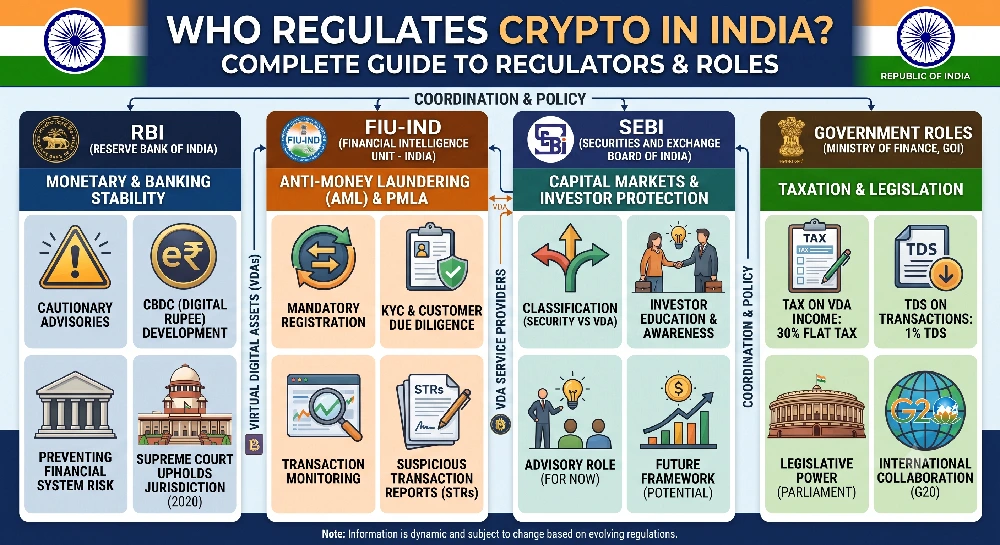
India Crypto Regulation: Key Takeaways
- India does not currently have one universal crypto regulator.
- Crypto regulation is divided across multiple authorities.
- FIU-IND is central to AML/CFT compliance for covered VDA service providers.
- Covered VDA service providers must comply with applicable PMLA requirements.
- RBI is India’s central bank but is not the universal regulator of private cryptocurrencies.
- The Digital Rupee is different from Bitcoin and other private crypto assets.
- SEBI regulates securities markets, not every cryptocurrency.
- The Income Tax Department administers crypto/VDA tax rules.
- ED can investigate relevant financial-crime and money-laundering matters.
- Company incorporation does not automatically mean crypto regulatory approval.
- FIU-IND registration should not automatically be described as a universal crypto licence.
- Paying crypto tax does not make Bitcoin legal tender.
- Offshore status does not automatically remove Indian compliance obligations.
- Crypto investors should not treat regulation as a guarantee against investment losses.
- India’s crypto regulatory framework continues to evolve.
Is There a Crypto Regulator in India?
Not in the sense of having one regulator with complete authority over the entire crypto industry.
For example, in traditional finance:
- RBI is the central banking authority.
- SEBI regulates the securities market.
- IRDAI regulates insurance.
- PFRDA regulates pensions.
Crypto does not fit neatly into only one of these traditional categories.
A single crypto ecosystem can contain:
- spot trading,
- derivatives,
- payment-related activity,
- custody,
- token issuance,
- stablecoins,
- investment products,
- DeFi,
- lending,
- staking,
- NFTs,
- wallets,
- cross-border transfers,
- crypto-to-fiat conversion,
- crypto-to-crypto exchange.
Each activity can raise different legal questions.
That is why India’s approach has developed around different laws, regulators and government agencies rather than one universal crypto regulator.
What Is the Role of the Ministry of Finance?
The Ministry of Finance is one of the most important institutions in India’s crypto policy framework.
It is particularly relevant because important crypto-related rules have been introduced through the financial and tax system.
The Ministry’s Department of Revenue is also connected with FIU-IND.
For crypto users and businesses, the Ministry of Finance matters in areas such as:
- taxation,
- anti-money laundering policy,
- financial legislation,
- policy development,
- international financial cooperation,
- implementation of financial laws,
- coordination with financial authorities.
This does not mean that the Ministry of Finance directly approves every cryptocurrency or exchange.
Its role is broader.
Think of it as part of the policy and legal framework surrounding the financial side of crypto.
What Is FIU-IND and Why Is It Important for Crypto?
The Financial Intelligence Unit–India (FIU-IND) is one of the most important authorities for the Indian crypto industry.
FIU-IND is India’s central agency for receiving, processing, analysing and sharing information relating to suspicious financial transactions with enforcement agencies and foreign financial intelligence units.
Its importance increased significantly after Virtual Digital Asset service providers were brought within India’s anti-money laundering framework.
Under the framework, specified VDA-related activities can fall within the Prevention of Money Laundering Act (PMLA).
These activities include:
- exchange between VDA and fiat currency,
- exchange between different VDAs,
- transfer of VDAs,
- safekeeping or administration of VDAs or instruments that allow control over VDAs,
- participation in or provision of financial services related to an issuer’s offer and sale of a VDA.
This is a major point for anyone operating a crypto business in India.
Does FIU-IND Regulate Bitcoin?
It is more accurate to say that FIU-IND regulates the AML/CFT obligations of covered VDA service providers, rather than saying that FIU-IND regulates Bitcoin itself.
Bitcoin is an asset on a decentralised network.
FIU-IND’s focus is on the businesses and activities covered by the PMLA framework.
For example, an exchange that provides covered services to customers can have AML obligations.
The exchange may need systems to:
- identify customers,
- conduct customer due diligence,
- monitor transactions,
- identify suspicious activity,
- maintain records,
- report prescribed information,
- maintain internal AML controls.
FIU-IND’s updated AML/CFT guidance for VDA reporting entities was updated on 8 January 2026, showing that this area continues to develop along with FATF AML standards.
What Is a VDA Service Provider?
VDA stands for Virtual Digital Asset.
A VDA service provider is a business that provides certain services involving VDAs.
The exact legal classification depends on the activity and the applicable law.
Examples can include businesses involved in:
- crypto exchange services,
- crypto-to-fiat conversion,
- crypto-to-crypto conversion,
- crypto transfers,
- custody or administration,
- certain services connected with VDA issuance.
A business falling within the applicable PMLA framework may have to register with FIU-IND as a reporting entity.
FIU-IND’s guidance states that covered service providers are required to register as reporting entities and maintain the required AML/CFT mechanisms.
What Does FIU-IND Registration Mean?
FIU-IND registration should not be confused with a general “crypto licence.”
This is one of the most important distinctions in Indian crypto regulation.
If a covered VDA service provider is registered with FIU-IND, it means that the business is subject to the relevant reporting and AML obligations under the PMLA framework.
It does not automatically mean:
- the government guarantees the business,
- the government guarantees customer funds,
- the crypto assets are approved,
- the investment is safe,
- the exchange has been approved as a bank,
- all crypto activities of the business are authorised.
Therefore, readers should be careful when an exchange uses regulatory language in its marketing.
What AML Rules Apply to Crypto Businesses?
AML means Anti-Money Laundering.
CFT means Countering the Financing of Terrorism.
Covered VDA service providers are expected to maintain systems designed to identify and reduce financial-crime risks.
This can include:
Customer identification
The business needs to know who its customers are.
This is commonly associated with KYC — Know Your Customer.
Customer due diligence
The business may need to understand the customer and assess the risk associated with the relationship.
Transaction monitoring
Crypto transactions can be monitored for unusual or suspicious patterns.
For example:
- unusual transaction activity,
- rapid movement of funds,
- suspicious source of funds,
- unusual transaction structures,
- activity connected with higher-risk situations.
Suspicious transaction reporting
Where legally required, suspicious transactions must be reported through the appropriate system.
Record keeping
Relevant records must be maintained for the periods required under applicable law.
Internal controls
Businesses need appropriate AML policies, procedures, systems and responsible personnel.
The purpose is not to stop normal crypto trading.
The purpose is to reduce the use of the financial system for:
- money laundering,
- terrorist financing,
- proceeds of crime,
- other serious financial crimes.
Does FIU-IND Regulate Individual Crypto Traders?
This needs careful wording.
FIU-IND’s primary regulatory role in this area concerns reporting entities and covered VDA service providers, rather than acting as a general trading regulator for every individual who owns Bitcoin.
An individual investor buying and holding crypto is not the same thing as an exchange operating a VDA service business.
However, individual users can still be affected indirectly.
For example, an exchange may require:
- KYC,
- identity verification,
- transaction information,
- source-of-funds information,
- additional compliance checks.
So while FIU-IND is not your personal crypto trading regulator, its AML framework can affect how you use a regulated or covered crypto service provider.
What Is the Role of RBI in Cryptocurrency?
The Reserve Bank of India (RBI) is India’s central bank.
RBI is not the general regulator of every cryptocurrency.
However, RBI is highly relevant to crypto because cryptocurrency can interact with:
- money,
- banking,
- payment systems,
- foreign exchange,
- monetary policy,
- financial stability,
- central bank digital currency.
This creates an important distinction.
Private Cryptocurrency vs Digital Rupee
Bitcoin and other private crypto assets are not the same thing as the Digital Rupee (e₹).
The Digital Rupee is India’s central bank digital currency.
It is issued within the RBI’s monetary framework.
A private cryptocurrency such as Bitcoin is fundamentally different.
Bitcoin is decentralised and is not issued by RBI.
Therefore:
Bitcoin ≠ Digital Rupee
Private crypto asset ≠ RBI-issued currency
This distinction is essential when explaining Indian crypto regulation.
Does RBI Regulate Bitcoin?
It is inaccurate to simply say:
“RBI regulates Bitcoin.”
That statement is too broad.
RBI’s mandate covers India’s central banking and financial system functions.
Its relevance to crypto can arise when crypto interacts with:
- banks,
- payment systems,
- monetary policy,
- foreign exchange,
- financial stability,
- CBDC.
So RBI is an important part of the crypto regulatory ecosystem, but it should not be presented as India’s universal Bitcoin regulator.
What About Banks and Crypto Exchanges?
This is where RBI becomes especially important.
A crypto exchange may need banking or payment relationships.
Banks themselves operate under RBI’s regulatory framework.
Therefore, the fact that a crypto exchange interacts with a bank does not mean that RBI has approved that exchange or the crypto assets traded on it.
This distinction is important:
Banking relationship ≠ crypto approval
Similarly:
Payment access ≠ government guarantee
Users should not assume that the presence of a bank, payment service or financial institution automatically means a cryptocurrency has been approved by RBI.
What Is the Role of SEBI?
SEBI stands for the Securities and Exchange Board of India.
SEBI regulates India’s securities market.
Its responsibilities include areas such as:
- investor protection,
- securities markets,
- market intermediaries,
- securities exchanges,
- listed securities,
- market integrity.
But one common mistake is to write:
“SEBI regulates cryptocurrency in India.”
That is too broad.
SEBI is not currently a universal regulator for every Bitcoin, altcoin, stablecoin, wallet or crypto exchange.
Its relevance depends on the legal nature of the product and activity and whether it falls within securities-market laws.
Could Some Crypto Assets Come Under SEBI?
Potentially, yes, depending on their structure and legal classification.
Consider a token that is designed or offered in a way that creates rights or interests similar to a traditional financial security.
That raises a different regulatory question from simply buying Bitcoin on a crypto exchange.
For example, the analysis may involve:
- what the token represents,
- what rights holders receive,
- how it is issued,
- whether there is an investment arrangement,
- whether returns are promised,
- how the product is marketed,
- who manages the arrangement,
- which laws apply.
Therefore, crypto regulation cannot be decided only by the word “token.”
The legal substance of the product matters.
Crypto Securities and Tokenised Securities
The future of crypto regulations and finance may include more tokenisation.
Traditional assets can potentially be represented through blockchain-based systems.
Examples could include:
- tokenised securities,
- tokenised funds,
- tokenised bonds,
- digital representations of financial assets.
If such a product falls within India’s securities framework, SEBI can become relevant.
This is different from saying that SEBI regulates Bitcoin itself.
What Is the Role of the Income Tax Department?
The Income Tax Department is one of the most important authorities for Indian crypto users.
Why?
Because India has created specific tax rules for Virtual Digital Assets.
This means that even when the broader regulatory framework is still developing, tax obligations can apply.
Crypto users therefore need to understand two separate questions:
Is crypto fully regulated as a financial asset?
and
How is crypto taxed?
These are not the same question.
How Is Crypto Taxed in India?
India introduced a special tax framework for income arising from the transfer of specified Virtual Digital Assets.
The widely known framework includes:
- a 30% tax rate on income from transfer of specified VDAs, subject to the applicable law,
- a 1% TDS framework under Section 194S, subject to applicable conditions.
The tax system has also changed with the new income-tax law framework taking effect from 1 April 2026, so taxpayers should use the current forms, rules and guidance applicable to the relevant transaction date rather than relying on old articles.
The Income Tax Department’s current guidance confirms that Section 194S covers TDS on transfers of VDAs and notes the transition to the new tax-law framework for events on or after 1 April 2026.
Does Paying Crypto Tax Make Crypto Legal?
No.
This is one of the most misunderstood points.
A government can tax an activity without giving that activity the same legal status as a bank deposit, legal tender or regulated security.
Taxation answers a question such as:
“How should this income be taxed?”
Regulation answers questions such as:
“Who can provide this service?”
“What disclosures are required?”
“What investor protections apply?”
“What AML rules apply?”
“Which authority supervises the activity?”
Therefore:
Crypto taxation ≠ complete crypto regulation
and:
Paying crypto tax ≠ government approval of your investment.
What Is the Role of the Enforcement Directorate?
The Enforcement Directorate (ED) is an important enforcement agency in financial-crime matters.
Its relevance to crypto can arise particularly where crypto transactions are connected with laws such as the Prevention of Money Laundering Act (PMLA) or other offences within its legal mandate.
Crypto can move across borders quickly.
It can also be converted between:
- crypto assets,
- fiat currency,
- wallets,
- exchanges,
- chains.
This can create challenges for financial-crime investigations.
ED can therefore become involved in cases involving suspected:
- money laundering,
- proceeds of crime,
- fraud,
- illegal financial activity,
- cross-border financial activity,
- other offences falling within its jurisdiction.
But again:
ED is an enforcement agency, not India’s general crypto regulator.
FIU-IND vs ED: What Is the Difference?
This distinction is very useful.
FIU-IND
Think:
Financial intelligence + AML reporting framework
FIU-IND receives and analyses financial intelligence and oversees relevant reporting obligations.
ED
Think:
Investigation + enforcement
ED can investigate and take enforcement action in cases falling within its statutory powers.
A simple example:
A covered crypto business may have AML reporting obligations involving FIU-IND.
If authorities later identify a suspected money-laundering case, an enforcement agency such as ED may become involved depending on the facts and legal jurisdiction.
So:
FIU-IND ≠ ED
They have different functions.
What Is the Role of CBDT?
CBDT stands for the Central Board of Direct Taxes.
It is part of the Department of Revenue under the Ministry of Finance and is responsible for direct-tax administration and policy within its statutory framework.
For crypto users, its relevance is mainly connected with:
- income tax,
- VDA taxation,
- TDS,
- tax reporting,
- tax administration.
This makes CBDT and the Income Tax Department highly relevant to the tax side of crypto regulation.
What Is the Role of MeitY?
MeitY stands for the Ministry of Electronics and Information Technology.
Crypto is also a technology.
It involves:
- blockchain networks,
- cryptography,
- digital assets,
- software,
- wallets,
- distributed systems,
- cybersecurity,
- digital infrastructure.
Therefore, technology policy can overlap with the crypto ecosystem.
However, MeitY should not be described as India’s general crypto financial regulator.
Its role depends on the particular technology, digital service or policy issue involved.
What Is the Role of the Ministry of Corporate Affairs?
The Ministry of Corporate Affairs (MCA) can become relevant when a crypto business is structured as an Indian company.
For example, a crypto company may have obligations under company law concerning:
- incorporation,
- directors,
- financial statements,
- corporate governance,
- statutory filings,
- beneficial ownership,
- related corporate matters.
But MCA registration of a company does not mean that the company automatically has permission to conduct every type of crypto financial activity.
This is another important distinction:
Company incorporation ≠ crypto regulatory approval
What About the PMLA?
The Prevention of Money Laundering Act, 2002 (PMLA) is central to India’s crypto AML framework.
In 2023, the government notified specified VDA-related activities under the PMLA framework.
The listed activities include:
- Exchange between VDAs and fiat currencies.
- Exchange between one or more forms of VDAs.
- Transfer of VDAs.
- Safekeeping or administration of VDAs or instruments enabling control over VDAs.
- Participation in and provision of financial services related to an issuer’s offer and sale of a VDA.
This was a major development because it brought covered VDA service providers into India’s AML reporting structure.
Why Is the PMLA Important for Crypto Exchanges?
A crypto exchange can become a gateway between users and the digital-asset market.
It may handle:
- customer onboarding,
- deposits,
- withdrawals,
- crypto transfers,
- fiat conversion,
- custody,
- trading,
- transaction records.
Because money can move through these systems, AML controls become important.
A covered reporting entity may therefore need:
- KYC procedures,
- customer due diligence,
- risk assessment,
- transaction monitoring,
- record keeping,
- suspicious transaction reporting,
- internal controls,
- compliance officers and governance arrangements where required.
FIU-IND’s guidance specifically requires covered VDA service providers to register as reporting entities and maintain mechanisms to detect and report relevant transactions.
Does India Regulate Crypto Exchanges?
The answer needs some qualification.
India does not currently operate a simple system where every crypto exchange receives one universal “crypto exchange licence” from one dedicated crypto regulator.
However, covered VDA service providers can fall under the PMLA and FIU-IND reporting framework.
This means an exchange may have important AML obligations.
But users should not confuse:
FIU-IND registration
with:
a complete licence to conduct every possible crypto financial activity.
The scope of the legal permission and compliance obligations depends on the actual business activity and applicable laws.
What Happens to Offshore Crypto Exchanges?
This is an increasingly important issue.
A crypto exchange does not necessarily avoid Indian obligations simply because the company is incorporated outside India.
If an offshore VDA service provider carries on covered activities connected with India or Indian users, Indian AML obligations can become relevant depending on the facts and applicable framework.
FIU-IND has taken action involving VDA service providers that operated in relation to Indian users, aligning with global FATF standards for VASPs.
This demonstrates why “offshore” does not automatically mean “outside Indian compliance.”
Does FIU Registration Mean an Exchange Is Safe?
No.
This is a critical point for investors.
Regulatory registration or reporting status does not eliminate investment risk.
An exchange can still face:
- hacking risk,
- operational risk,
- liquidity risk,
- counterparty risk,
- market risk,
- withdrawal risk,
- technical failures,
- legal changes.
Users should therefore treat regulatory compliance as one due-diligence factor, not as a guarantee.
Who Regulates Crypto Trading?
There is no single answer.
It depends on the type of trading.
Spot crypto trading
A user buying and selling Bitcoin or another VDA through an exchange can be affected by:
- tax rules,
- AML/KYC rules,
- exchange compliance,
- applicable financial laws.
Crypto derivatives
Derivatives raise additional regulatory questions.
The legal treatment can depend on the product structure, underlying asset, platform, customer type and applicable law.
Do not assume that because an exchange offers futures globally, the same product is automatically permitted or regulated in India.
Tokenised financial products
If a crypto-based product falls within securities laws, SEBI may become relevant.
Cross-border trading
Foreign exchange, tax, AML and other laws may become relevant depending on the transaction.
Therefore, “crypto trading regulation” is not one single legal category.
Who Regulates Crypto Futures in India?
This is a more complex question than spot crypto.
Crypto futures and derivatives can involve:
- leverage,
- margin,
- derivatives contracts,
- cross-border platforms,
- financial-market rules.
The legal analysis depends on the exact product and platform.
Therefore, users should not assume that a foreign crypto exchange offering perpetual futures automatically means that Indian residents have a regulatory green light to trade them.
For serious traders, this is an area where professional legal and tax advice may be appropriate.
Who Regulates Stablecoins in India?
Stablecoins require special attention because they sit between several areas.
A stablecoin may be designed to track:
- the US dollar,
- another fiat currency,
- a commodity,
- another asset,
- or a specific value.
But a stablecoin is not automatically a currency simply because it is designed to maintain a stable price.
The regulatory treatment can depend on:
- how the stablecoin is issued,
- what backs it,
- what rights holders receive,
- how it is marketed,
- how it is used,
- whether it interacts with the banking/payment system,
- whether it falls under another legal category.
Therefore, saying “RBI regulates all stablecoins” would be an oversimplification.
Who Regulates DeFi in India?
DeFi stands for Decentralised Finance.
It includes systems such as:
- decentralised exchanges,
- lending protocols,
- liquidity pools,
- automated market makers,
- staking protocols,
- yield protocols.
DeFi creates a major regulatory challenge because there may not be a traditional company operating the system in the same way as a centralised exchange.
The legal question can therefore become:
Who is actually providing the service?
It may involve:
- developers,
- protocol operators,
- governance entities,
- front-end operators,
- token issuers,
- custodians,
- service providers.
India’s AML framework specifically focuses on covered activities and service providers. Therefore, the fact that a protocol calls itself “decentralised” does not automatically answer every legal question.
Who Regulates Crypto Wallets?
Wallets are not all the same.
There are:
- custodial wallets,
- non-custodial wallets,
- hardware wallets,
- software wallets,
- exchange wallets,
- smart-contract wallets.
A self-custody wallet may simply provide software that allows a user to control private keys.
A custodial service may actually hold or administer crypto assets for customers.
That difference can be legally important.
The PMLA notification specifically includes safekeeping or administration of VDAs or instruments enabling control over VDAs among the activities covered by the VDA framework.
Therefore, users should not assume that every wallet provider has the same legal status.
Who Regulates Crypto Mining in India?
Crypto mining is different from operating a crypto exchange.
Mining involves activities such as:
- validating transactions,
- participating in proof-of-work networks,
- receiving block rewards,
- operating mining hardware.
The regulatory questions can include:
- income tax,
- business taxation,
- electricity use,
- corporate law,
- environmental or local rules where applicable,
- import/customs rules for equipment,
- other laws depending on the business structure.
There is no simple rule saying:
“One regulator controls all Bitcoin mining.”
The legal treatment depends on what the miner is actually doing.
Who Regulates Crypto Staking?
Staking can also take different forms.
A user may:
- stake directly on a blockchain,
- use a staking provider,
- use an exchange,
- use a DeFi protocol,
- receive staking rewards through a managed service.
The legal and tax questions can therefore differ.
If a third party is holding or administering assets, additional regulatory questions can arise.
If a staking arrangement is structured as an investment product, other legal questions may also arise.
Therefore, “staking is regulated by X” is usually too simple.
Who Regulates NFTs?
NFT stands for Non-Fungible Token.
NFTs can represent many things:
- digital artwork,
- collectibles,
- membership rights,
- game items,
- tickets,
- digital certificates,
- access rights.
The regulatory treatment can depend on what the NFT actually represents.
An NFT that is simply a digital collectible is very different from a token that represents an investment or financial right.
Therefore, the word NFT alone does not determine the regulator.
Who Regulates Crypto Payments?
Crypto payments raise several legal questions.
For example:
- Is the asset being used as payment?
- Is a payment intermediary involved?
- Is the business converting crypto to fiat?
- Does the activity involve regulated payment infrastructure?
- Are foreign-exchange rules relevant?
- Are AML obligations triggered?
This is where RBI and other financial authorities can become relevant depending on the activity.
Users should not assume that because a merchant accepts crypto, the crypto automatically becomes legal tender.
Is Cryptocurrency Legal in India?
This question requires careful language.
India recognises VDAs for specific tax and AML purposes, but this should not be confused with making private cryptocurrencies legal tender.
The current framework remains fragmented rather than a single comprehensive crypto law covering every part of the market.
That means three statements can all be true:
- crypto can be subject to tax,
- covered crypto businesses can have AML obligations,
- private cryptocurrencies are not the same as sovereign currency.
This is why “legal” needs to be defined before answering the question.
Is Bitcoin Legal Tender in India?
No.
Bitcoin is not India’s legal tender.
The Indian Rupee is the country’s sovereign currency.
The Digital Rupee is a central bank digital currency issued within RBI’s framework.
Bitcoin is a decentralised crypto asset and is not issued by the Indian government or RBI.
Therefore:
Bitcoin is not the Indian Rupee.
Bitcoin is not India’s legal tender.
Bitcoin is not the Digital Rupee.
Is Crypto Fully Regulated in India?
No.
This is perhaps the most important conclusion of the entire article.
India has created important rules around:
- taxation,
- AML,
- KYC,
- reporting,
- financial intelligence,
- specific financial activities.
But these rules do not create one complete regulatory framework for every part of the crypto industry.
It is better to describe India as having a developing and fragmented crypto regulatory framework.
Why Does India Have Multiple Crypto Regulators?
Because crypto touches many different parts of the economy.
Consider one simple example.
Suppose an Indian user buys USDT through an exchange.
One transaction can involve:
Crypto asset
↓
Exchange
↓
KYC
↓
AML monitoring
↓
Bank/payment system
↓
Tax reporting
↓
Potential cross-border transfer
One transaction can therefore create questions involving different laws and authorities.
That is why one regulator cannot easily cover everything.
A Simple Example: Who Is Involved When You Buy Bitcoin?
Suppose Rahul buys ₹50,000 worth of Bitcoin through a crypto exchange.
Step 1: Exchange account
The exchange may conduct KYC and AML checks.
FIU-IND/PMLA framework may become relevant to the covered service provider.
Step 2: Payment
The transaction may involve a bank or payment channel.
RBI and applicable payment/banking rules may become relevant to those regulated entities.
Step 3: Crypto purchase
Rahul now owns a VDA.
The legal treatment depends on the applicable laws.
Step 4: Sale
Rahul later sells the Bitcoin at a profit.
Income-tax rules become relevant.
Step 5: Tax reporting
Rahul must follow the tax rules applicable to his transaction.
Therefore, there is no single moment where one regulator says:
“Yes, I regulate this entire transaction.”
Different parts can fall under different frameworks.
A Simple Example: How an Indian Crypto Exchange Is Regulated
Imagine an exchange wants to serve Indian customers.
The exchange may have to think about:
- corporate structure,
- AML compliance,
- FIU-IND registration if covered,
- KYC,
- transaction monitoring,
- suspicious transaction reporting,
- tax obligations,
- customer protection,
- banking/payment relationships,
- cybersecurity,
- data and technology requirements,
- cross-border compliance.
The exact obligations depend on the business model.
This is why running a crypto exchange is much more complicated than simply building a trading website.
What Does “FIU-Registered Exchange” Actually Tell You?
It tells you something important about AML compliance.
But it does not answer every question about the exchange.
When evaluating an exchange, users should also ask:
- Who operates the company?
- Where is the company incorporated?
- What services does it offer?
- Is the relevant entity identified?
- What assets can Indian users trade?
- Does it support INR?
- How are withdrawals handled?
- What are the fees?
- Does it provide custody?
- What are the terms of service?
- What happens if an account is frozen?
- What customer support exists?
- What security controls are used?
Regulatory status is important, but due diligence should go further.
What Crypto Businesses Need to Understand
A crypto business should not begin with the question:
“Which crypto licence do I need?”
A better starting point is:
“What exactly is my business doing?”
For example:
Business A
Only develops blockchain software.
Business B
Runs a crypto exchange.
Business C
Provides crypto custody.
Business D
Provides crypto-to-fiat services.
Business E
Issues an investment token.
Business F
Runs a DeFi protocol.
These businesses can face very different legal questions.
A proper compliance assessment should therefore map:
Business model → activity → asset → customer → jurisdiction → applicable law → regulator → reporting obligations
This is the correct way to approach crypto compliance.
The Difference Between Regulation, Registration, Taxation and Licensing
These words are often mixed together.
They should not be.
Regulation
Rules that govern an activity.
Registration
Putting an entity or business on an official register for a specific legal purpose.
Taxation
Rules for calculating and paying tax.
Licensing
Permission to conduct a particular regulated activity, where the law requires a licence.
Therefore:
FIU-IND registration is not automatically a universal crypto licence.
Paying tax is not automatically a licence.
Company incorporation is not automatically crypto approval.
Understanding these differences can prevent major mistakes.
What Is India’s Biggest Crypto Regulatory Challenge?
The biggest challenge is that blockchain technology does not fit neatly into traditional financial categories.
A single crypto product can combine:
- technology,
- investment,
- payments,
- finance,
- cross-border transfers,
- custody,
- software,
- financial crime risks.
This creates regulatory overlap.
At the same time, blockchain networks can operate globally while regulators operate mainly within national legal systems.
This creates questions such as:
- Which country has jurisdiction?
- Who is the service provider?
- Who controls the protocol?
- Where is the customer?
- Where did the transaction occur?
- Where is the company incorporated?
- Who controls the wallet?
- Is the token a financial product?
- Is the transaction taxable?
- Does AML law apply?
These questions make crypto regulation much more complex than regulating a traditional company.
What Does the Future of Crypto Regulation in India Look Like?
India’s crypto regulatory framework is likely to continue evolving.
Possible areas of future development include:
- clearer classification of crypto assets,
- rules for stablecoins,
- crypto market intermediaries,
- investor protection,
- custody standards,
- disclosure requirements,
- market-abuse controls,
- derivatives,
- DeFi,
- cross-border crypto services,
- tokenisation,
- institutional crypto participation.
However, future regulation should not be presented as current law until it is officially enacted or notified.
This is especially important for crypto websites because regulatory information can become outdated quickly.
Why Crypto Regulation Changes So Quickly
Crypto is developing faster than many traditional financial products.
New models appear regularly:
- restaking,
- liquid staking,
- tokenised assets,
- stablecoin payment systems,
- decentralised exchanges,
- real-world assets,
- crypto lending,
- blockchain-based financial infrastructure,
- AI-powered trading systems.
Regulators therefore have to continuously evaluate whether existing laws are sufficient.
India’s FIU-IND itself continues to update its VDA AML/CFT guidance. The latest official VDA guidance available as of this article’s September 2026 update is dated 8 January 2026, aligning with broader FATF AML standards.
This is a good example of why crypto regulatory articles should include a clear “last updated” date.
Common Myths About Crypto Regulation in India
Myth 1: RBI regulates Bitcoin
Not exactly.
RBI regulates India’s central banking and financial system areas within its mandate. It is not the universal regulator of Bitcoin.
Myth 2: SEBI regulates every cryptocurrency
No.
SEBI regulates the securities market. Its relevance to a crypto asset depends on whether the activity or product falls within its legal jurisdiction.
Myth 3: FIU-IND registration means an exchange is government-approved
Not necessarily.
FIU-IND registration relates to the applicable reporting and AML framework. It should not be treated as a blanket government guarantee.
Myth 4: Paying crypto tax makes crypto legal tender
No.
Tax treatment and legal-tender status are separate concepts.
Myth 5: Offshore exchanges are outside Indian rules
Not automatically.
Indian AML and other laws can apply depending on the activity, connection with India and legal framework.
Myth 6: Crypto is completely unregulated
Also incorrect.
India already has important rules covering taxation and AML-related VDA activities.
The more accurate description is:
India has a developing, fragmented and activity-based crypto regulatory framework.
How to Think About Crypto Regulation as an Investor
You do not need to become a lawyer to understand the basic structure.
Use these five questions.
Question 1: What am I buying?
Token?
NFT?
Tokenised security?
Question 2: What am I doing with it?
Holding?
Lending?
Transferring?
Using it for payment?
Question 3: Who provides the service?
Indian exchange?
Foreign exchange?
DeFi protocol?
Custodian?
Question 4: Which law may apply?
Tax?
AML?
Securities?
Banking?
Foreign exchange?
Criminal law?
Question 5: Which authority is relevant?
FIU-IND?
RBI?
SEBI?
Income Tax Department?
ED?
MCA?
Another authority?
This five-question framework gives you a much clearer picture than simply asking whether crypto is “regulated.”
India Crypto Regulators at a Glance
| Crypto activity | Main regulatory area | Authority that may be relevant |
|---|---|---|
| Buying/selling VDA | Tax + AML + applicable laws | Income Tax Dept., FIU-IND framework |
| Crypto exchange | AML + corporate + other applicable rules | FIU-IND, MCA and other authorities |
| Crypto-to-fiat exchange | AML/financial activity | FIU-IND framework; other laws may apply |
| Crypto-to-crypto exchange | AML | FIU-IND framework |
| Crypto transfer service | AML | FIU-IND framework |
| Custody | AML + asset/service structure | FIU-IND framework and potentially other laws |
| Crypto taxation | Direct tax | Income Tax Department / CBDT |
| Banking relationship | Banking system | RBI |
| Digital Rupee | CBDC | RBI |
| Securities-related token | Securities law | SEBI, if within its jurisdiction |
| Money laundering case | Financial crime | ED and other competent agencies |
| Crypto company | Corporate law | MCA |
| Cybercrime | Cyber/criminal law | Competent law-enforcement agencies |
| Technology issues | Digital/technology policy | MeitY and other relevant authorities |
This table is a simplified guide. The exact authority can depend on the facts, product structure and law applicable at the time.
What Crypto Investors Should Check Before Using an Exchange
Before depositing money, investors should check more than the exchange’s logo or advertising.
1. Identify the legal entity
Find out:
- company name,
- country of incorporation,
- Indian entity if any,
- terms of service,
- contact information.
2. Check regulatory information
Look for relevant disclosures about:
- FIU-IND status where applicable,
- AML compliance,
- KYC,
- legal entity.
3. Understand custody
Ask:
Who controls my crypto?
If the exchange controls the private keys, it is a custodial arrangement.
If you control your own keys, the risk profile is different.
4. Understand withdrawal rules
Check:
- withdrawal limits,
- network fees,
- processing times,
- account restrictions,
- verification requirements.
5. Understand tax obligations
Keep records of:
- purchase price,
- sale price,
- transaction date,
- fees,
- wallet transfers,
- TDS,
- transaction history.
6. Do not treat regulatory status as a guarantee
Even a compliant platform can face:
- hacking,
- insolvency,
- technical problems,
- regulatory action,
- liquidity problems.
What Crypto Businesses Need to Understand
A crypto business should not begin with the question:
“Which crypto licence do I need?”
A better starting point is:
“What exactly is my business doing?”
For example:
Business A
Only develops blockchain software.
Business B
Runs a crypto exchange.
Business C
Provides crypto custody.
Business D
Provides crypto-to-fiat services.
Business E
Issues an investment token.
Business F
Runs a DeFi protocol.
These businesses can face very different legal questions.
A proper compliance assessment should therefore map:
Business model → activity → asset → customer → jurisdiction → applicable law → regulator → reporting obligations
This is the correct way to approach crypto compliance.
The Difference Between Regulation, Registration, Taxation and Licensing
These words are often mixed together.
They should not be.
Regulation
Rules that govern an activity.
Registration
Putting an entity or business on an official register for a specific legal purpose.
Taxation
Rules for calculating and paying tax.
Licensing
Permission to conduct a particular regulated activity, where the law requires a licence.
Therefore:
FIU-IND registration is not automatically a universal crypto licence.
Paying tax is not automatically a licence.
Company incorporation is not automatically crypto approval.
Understanding these differences can prevent major mistakes.
Final Answer: Who Actually Regulates Crypto in India?
The simplest accurate answer is:
No single Indian authority regulates the entire crypto industry.
Instead, India’s crypto framework is divided across different laws and government bodies.
FIU-IND is central to the AML/CFT framework for covered VDA service providers.
RBI is relevant to banking, payments, monetary policy, financial stability and India’s Digital Rupee.
SEBI regulates the securities market and can become relevant where a crypto-related product or activity falls within securities laws.
The Income Tax Department and CBDT handle taxation and tax compliance involving VDAs.
The Enforcement Directorate can investigate and enforce laws such as the PMLA in appropriate cases.
The Ministry of Finance plays a major role in financial policy, legislation and the broader regulatory framework.
Other authorities can become relevant depending on the business model, technology, corporate structure and conduct involved.
The most important lesson is this:
India regulates crypto activities through different laws and authorities rather than through one single “crypto regulator.”
For investors, this means you should look beyond the simple question of whether a crypto platform is “regulated.”
For businesses, it means compliance should begin with a detailed analysis of the exact service being provided.
And for everyone using crypto in India, the safest approach is to understand the asset, the activity, the service provider, the applicable law and the responsible authority before assuming what is permitted.
Important Regulatory Note
Crypto laws and regulatory policies can change quickly. This article is an educational guide and is not legal, tax or investment advice. The exact obligations can depend on the asset, transaction, business model, jurisdiction and date of the activity.
For a real transaction or crypto business, always check the latest official notifications, laws, circulars and guidance from the relevant Indian authorities before making a compliance decision.