What you will learn
By the end of this guide, you will understand how DeFi staking works from start to finish.
You will learn what happens when you deposit crypto, how smart contracts handle the staking process, where staking rewards come from, how liquid staking works, how you get your crypto back, and what can go wrong.
You do not need to understand coding or advanced DeFi terms to follow the process.
What you need before starting
Before using a DeFi staking service, you should have:
- A crypto wallet that supports the asset you want to stake
- The crypto you want to stake
- Enough crypto to cover network fees
- The official website or application of the staking protocol
- A basic understanding of the risks involved
Most importantly, verify the official protocol website and smart-contract address (via block explorers like Etherscan) before connecting your wallet to prevent phishing scams. A fake website can look almost identical to the real one.
How Does DeFi Staking Work?
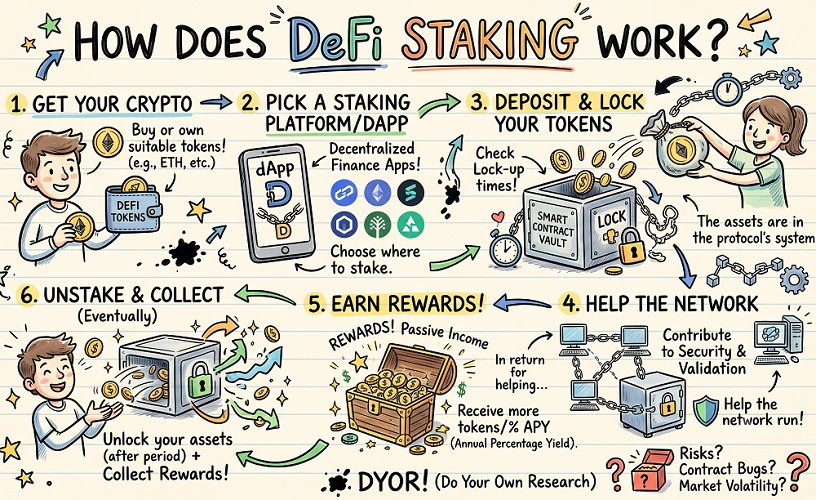
DeFi staking works by connecting your crypto to a staking protocol through blockchain transactions and smart contracts. The protocol then follows its rules to manage your staking position and distribute the rewards you are entitled to.
The exact process depends on the blockchain and protocol. DeFi staking can involve a staking pool, a liquid staking protocol, or another system built around proof-of-stake assets.
A simple way to understand the process is:
Connect wallet → deposit crypto → staking begins → rewards accumulate → rewards are reflected or distributed → withdraw or redeem
Ethereum is a useful example. Its proof-of-stake system uses staked ETH to support validators that check blocks and maintain cryptoeconomic security across the network. Validators receive rewards for correct participation and can lose money for certain failures or dishonest behavior.
Step 1: Connect your crypto wallet
Action: Open the official staking application and connect your wallet.
Explanation: Your wallet allows you to approve blockchain transactions. A true decentralized crypto wallet does not share your private key. You remain responsible for approving transactions directly from your device.
What you should see: The application should show your wallet address and the assets available for staking.
Common mistake: Connecting your wallet to a website found through an unknown advertisement, social media post, or message.
Always review basic wallet security best practices and verify the website address carefully before connecting.

Step 2: Choose what you want to stake
Action: Select the crypto asset and staking option available on the protocol.
Explanation: Different protocols support different assets and use different staking methods. Some connect users to proof-of-stake validators. Others use pooled staking, where many users combine their assets.
For example, Ethereum’s pooled staking options allow people with less than the 32 ETH needed for a solo validator to participate through decentralized solutions.
What you should see: The protocol should show information such as the staking method, expected yield, fees, withdrawal rules, and risks.
Common mistake: Choosing a staking option only because it displays a very high APY.
A high advertised return does not automatically mean a better or safer staking product. Understanding the fundamental mechanics of why staking exists will help you evaluate whether an advertised yield is sustainable.
Step 3: Deposit your crypto
Action: Enter the amount you want to stake and approve the transaction.
Explanation: Your wallet sends the crypto according to the protocol’s rules. In a smart-contract-based staking pool, the contract records and manages your position.
This is an important point: DeFi staking does not always mean that the protocol itself is the blockchain validator. A DeFi staking service may connect users to other validators or staking infrastructure.
What you should see: Your wallet should show the transaction before you approve it. After confirmation, the protocol should show your staking position.
Common mistake: Approving a transaction without reading what it does.
Never approve an unfamiliar contract simply because a website prompts you to do so. In complex decentralized finance applications, verifying smart contract permissions is critical for maintaining overall DeFi security.
Step 4: The staking system puts your crypto to work
Action: After your deposit is confirmed, the staking system performs its role according to its design.
Explanation: In proof-of-stake systems, validators use their stake as an economic incentive to behave correctly. They check transactions and participate in securing the blockchain.
With a staking pool, your crypto can be combined with other users’ assets. The pool then manages the validator side of the process.
What you should see: Your dashboard should show a staking balance, position, or token representing your stake.
Common mistake: Assuming that every product called “staking” is actually doing blockchain staking.
Some products marketed as staking or earning programs may use DeFi lending, trading, or other yield strategies instead. Official Ethereum staking documentation specifically warns users to distinguish transparent staking pools from opaque custodial yield products where asset tracking is impossible.
Where do DeFi staking rewards come from?
Staking rewards normally come from the underlying proof-of-stake network, while some DeFi products may also provide additional protocol incentives.
For a proof-of-stake network, validators receive rewards for performing their duties correctly. On Ethereum, for example, validators earn rewards for timely proposals and consensus attestations, as outlined in comprehensive analyses of crypto staking mechanics.
Your final return may therefore depend on several things:
- The blockchain’s staking reward system
- Validator performance
- Protocol fees
- The staking method
- Network conditions
- Any additional incentives offered by the protocol
This is why the displayed APY should not be treated as a guaranteed return.
How are the rewards added to your staking position?
The answer depends on the protocol.
Some staking systems directly increase your balance. Others use a token that represents your claim on the underlying staked crypto.
For example, many Ethereum liquid staking protocols issue a liquid staking token (LST) when you deposit ETH. That token represents a claim on the staked ETH and its rewards.
There are two common ways rewards can appear:
Your token balance increases: The number of tokens in your wallet grows as rewards accumulate (a rebasing model).
The token’s value relative to the underlying asset increases: Your token balance stays the same, but each token can represent a larger amount of the underlying asset (a reward-bearing model).
The exact method depends on the protocol.
What is liquid staking?
Liquid staking allows you to receive a token representing your staked position instead of simply waiting with a locked position.
For example:
ETH → staking protocol → liquid staking token
Leading implementations like Lido Finance provide liquid tokens that can potentially be held, transferred, or deployed across decentralized exchanges and money markets in wider DeFi protocols.
Holding a liquid staking token is not identical to staking directly with the base blockchain layer. The underlying ETH is managed through pooled smart contracts and external validator sets. As smart contract auditors at Consensys Diligence frequently highlight, smart contract execution introduces technical risks beyond base-layer consensus slashing.
How does unstaking work?
Action: Choose the withdrawal, redeem, or unstake option provided by the protocol.
Explanation: The way you exit depends on the staking system.
With a liquid staking protocol, you may be able to redeem your liquid staking token for the underlying asset. Some protocols may also have a withdrawal queue or depend on available liquidity.
You may also be able to sell a liquid staking token on a secondary decentralized market. However, market volatility can cause price disconnections or de-pegs from the underlying asset, as tracked widely by market outlets like CoinDesk.
What you should see: The protocol should show the amount you can receive, applicable fees, and any waiting period.
Common mistake: Assuming that every staking position can be withdrawn immediately.
Ethereum’s current documentation notes that users staking through pools or liquid staking systems generally exit through the pool’s redemption process or by selling the liquid staking token rather than using the blockchain’s validator withdrawal process directly.
A simple example of DeFi staking
Suppose you have 1 ETH and use a liquid staking protocol.
You connect your wallet and deposit the 1 ETH. The protocol uses the deposit within its staking system and gives you a liquid staking token representing your position.
The underlying ETH is then associated with validators. As those validators earn staking rewards, the value of your staking position can increase after applicable fees.
Later, you can redeem the liquid staking token through the protocol or potentially sell it on a market, completing the basic cycle of crypto staking.
The important point is that you are not simply being paid for leaving crypto in a wallet. There is an underlying staking process, and the way that process works depends on the protocol.
Common Problems
My staking transaction is still pending
Blockchain transactions can take time to confirm. Network congestion and transaction fees can affect confirmation speed.
The reward is lower than expected
The displayed rate may change. Validator performance, protocol fees, network conditions, and other factors can affect the amount of yield you receive.
I cannot withdraw immediately
Some protocols have withdrawal queues, limited liquidity, or other exit rules.
My liquid staking token is worth less than expected
A liquid staking token can trade at a price different from the value of its underlying assets, particularly during periods of market stress. You can monitor live peg deviations and market liquidity on tracking platforms like CoinGecko.
How to Fix Them
Before blaming the protocol, check these points:
- Check the transaction hash on a reputable blockchain explorer like Etherscan.
- Confirm that you are using the official protocol website to protect against crypto scams.
- Read the protocol’s withdrawal rules.
- Check whether a withdrawal queue is active.
- Check the current market structure and secondary price of any liquid staking token.
- Check the protocol’s published fees.
- Never send additional crypto to someone claiming they can “unlock” your staking funds.
If a website asks you to send crypto directly to a personal wallet to release your rewards, treat it as a major warning sign.
Security Tips
Crypto security is part of the staking process, not an optional extra.
Before staking:
- Verify the official website.
- Verify the contract address from trusted official documentation.
- Check whether the smart contract is open source.
- Look for credible security audits conducted by reputable firms like Consensys Diligence.
- Understand who operates the validators and how they maintain network cryptoeconomic security.
- Check whether the protocol has upgrade or governance controls.
- Read the withdrawal rules.
- Never share your seed phrase or private key, and implement strict wallet security measures.
- Do not approve unlimited or unfamiliar token permissions without understanding them, and periodically revoke unused allowances using tools like Revoke.cash.
- Be suspicious of guaranteed returns or urgent messages.
Ethereum’s official staking guide recommends checking how transparent a staking pool is, including whether its contracts are open source, whether its node operators are published, and whether its rules can be verified onchain.
Fees and costs
DeFi staking is not always free.
Possible costs include:
- Blockchain gas fees
- Protocol fees
- Validator or operator fees
- Withdrawal or redemption costs
- Trading fees if you sell a liquid staking token
- Price impact when exiting through liquidity pools or decentralized exchanges
The actual cost depends on the blockchain and protocol.
This is another reason not to judge a staking option by its reward rate alone. A higher advertised return can lose its appeal after fees and other risks are considered.
What to do after completing the process
Once your crypto is staked, do not simply forget about it.
Check your position periodically and keep track of:
- Your staked amount
- Rewards received
- Protocol fees
- Withdrawal conditions
- Validator or operator performance
- Smart-contract updates
- Changes to the protocol’s rules
Also keep records of your transactions. Depending on your jurisdiction and evolving global crypto regulations, staking rewards and crypto transactions may have tax consequences.
Most importantly, do not stake more than you can afford to lose. Evaluating overall protocol health via ongoing DeFi security monitoring is essential for capital preservation.
Staking can generate rewards, but the reward does not remove the risks associated with crypto, smart contracts, validators, liquidity, or the protocol itself. For broader safety best practices, consult our complete guide on crypto staking safety.
Bottom Line
DeFi staking is a process that connects your crypto to a staking system through blockchain transactions and, in many cases, smart contracts.
The basic journey is simple:
Deposit crypto → staking system manages the position → validators or the underlying protocol perform their role → rewards accumulate → you receive or redeem your share → you withdraw when the protocol allows it.
The part that needs the most attention is what happens behind the deposit button.
Before staking, find out where your crypto goes, who controls the validators, where the rewards come from, what fees apply, how withdrawals work, and what happens if something goes wrong.
That is the real key to understanding how DeFi staking works—and to deciding whether a particular staking system deserves your trust. Explore our foundational breakdown of why staking exists to learn more about the mechanics governing proof-of-stake networks.
Is DeFi staking the same as normal staking?
Not always. Direct staking can involve running your own validator, while DeFi staking may use a pool, smart contract, liquid staking token, or third-party validator infrastructure.
Where do DeFi staking rewards come from?
They can come from the underlying proof-of-stake network and, depending on the product, additional protocol incentives. The exact source should always be checked before depositing funds.
How does Ether staking work?
Ether (ETH) staking involves depositing ETH to support Ethereum’s proof-of-stake network. With solo staking, you deposit at least 32 ETH and operate a validator. With staking pools, you can participate with a much smaller amount while the pool handles validator operations.
Does DeFi staking guarantee APY?
No. Staking rewards can change, and the advertised rate may not represent your final return after fees, penalties, market movements, or other costs.
