Imagine buying a digital asset where no central company holds your money, no identity documents are uploaded to an offshore database, and the transaction settles directly on the blockchain in seconds.
That is the daily reality of DEX spot trading. While centralized exchanges function like traditional brokerage accounts with password resets and customer service desks, decentralized exchanges operate entirely on public code, letting you trade directly from your personal software wallet.
Yet, thousands of newcomers lose money every week not because the blockchain failed, but because they mistook a spot swap for a risk-free transaction, set their slippage tolerance too wide, or traded a look-alike fake token.
Whether you want to escape custodial risk, access early-stage tokens, or simply understand what happens under the hood when your wallet signs a transaction, understanding the mechanics of decentralized spot markets is essential.
What Is DEX Spot Trading?
DEX spot trading is the peer-to-peer exchange of actual cryptocurrency tokens executed directly on a blockchain through decentralized exchange smart contracts, settled immediately into a user’s self-custody wallet without any centralized broker or intermediary holding custody of the funds.
Unlike crypto futures or perpetual contracts—where traders speculate on price movements using borrowed money and contractual leverage—spot trading transfers outright ownership of the underlying digital asset at the prevailing market price.
ZenvestAI Quick Insight
Every decentralized spot trade replaces a corporate middleman with an open-source mathematical formula or on-chain order system.
When you execute a spot swap on a decentralized exchange, you retain complete custody of your private keys right up until the block validator confirms your transaction.
Key Takeaways
- Outright Token Ownership: DEX spot trades deliver real tokens straight to your self-custody wallet, eliminating third-party insolvency risks.
- No Intermediaries or Custody Lock-in: You trade directly against decentralized liquidity pools or on-chain order books, keeping full control over your assets.
- Smart Contract Execution: Trades rely on automated code architectures like Automated Market Makers (AMMs) or cross-chain aggregators rather than private corporate order ledgers.
- Visible On-Chain Costs: Total trading costs combine the protocol swap fee, network gas fees, token approval costs, and execution slippage.
- Personal Security Responsibility: Decentralization removes account-freeze risks but places full responsibility on you to verify contract addresses, liquidity depth, and wallet permissions.
At a Glance: How DEX Spot Trading Fits Your Goal
Before diving into the detailed mechanics, identify which category matches your reason for exploring decentralized trading today:
Informational Learners: Seeking clear definitions of automated market makers, on-chain mechanics, and the fundamental differences between custodial and non-custodial markets.
Commercial Researchers: Evaluating platforms like Uniswap, Raydium, and PancakeSwap to find the lowest protocol fees, best network liquidity, and lowest slippage.
Actionable Traders: Preparing to connect a wallet, inspect price quotes, verify token addresses, and execute a live swap safely.
Technical Builders & Liquidity Providers: Analyzing smart contract routing algorithms, liquidity pool math, and operational listing mechanics.
Table of Contents
- What Is DEX Spot Trading? A Complete Guide to Buying and Selling Crypto on DEXs
- What Is DEX Spot Trading? Understanding the Fundamentals
- How Does DEX Spot Trading Work? Step-by-Step Flow
- How DEXs Determine Spot Prices: The Math Behind the Screen
- What Does It Cost to Trade on a DEX?
- What Is Slippage and Price Impact?
- DEX Spot vs CEX Spot: Comparing Custody, Fees, and Access
- DEX Spot vs Crypto Futures: Ownership vs Exposure
- Step-by-Step Tutorial: How to Execute Your First DEX Spot Trade
- 10 Critical Risks of DEX Spot Trading You Must Know
- How to Inspect and Verify a Token Before Swapping
- Is DEX Spot Trading Safe? Breaking Down the Risk Layers
- Global Perspective and Market Trends (2026 Data)
- DEX Spot Trading in India: VDA Tax Framework and Compliance
- Essential Beginner Checklist
- Frequently Asked Questions
- ZenvestAI View
- Related Intelligence
- Author and Editorial Information
What Is DEX Spot Trading? A Complete Guide to Buying and Selling Crypto on DEXs
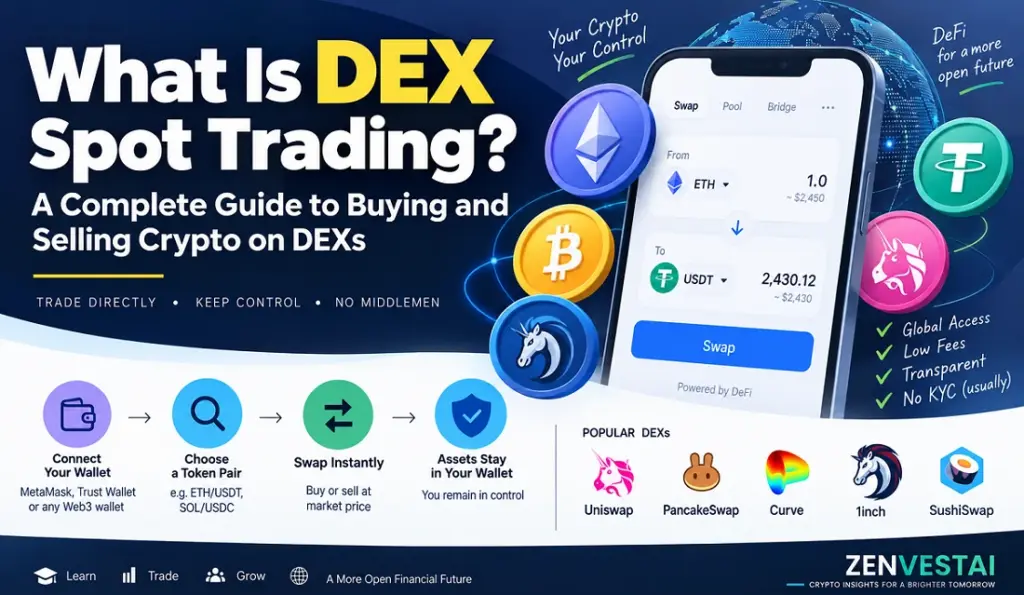
What Is DEX Spot Trading? Understanding the Fundamentals
Every financial market runs on exchange mechanisms, but decentralized exchanges reinvent the relationship between the trader and the market venue. To understand the complete picture, we must isolate the two terms that form the concept: DEX and spot trading.
What Does “DEX” Mean?
A DEX stands for Decentralized Exchange, which is an open, peer-to-peer platform powered by blockchain smart contracts rather than a corporation.
On a traditional centralized exchange like Binance or Coinbase, the company holds your deposits in its corporate omnibus wallets, records your transactions on private off-chain servers, and grants you an IOU balance on your screen.
A DEX eliminates this custodial layer entirely. There is no central operating authority managing user balances; the exchange code is deployed directly to an immutable public blockchain.
What Does “Spot Trading” Mean?
Spot trading refers to the immediate purchase or sale of a financial asset for “on-the-spot” settlement and delivery. When you execute a spot trade in any asset market, you are buying the actual tangible asset at its current market rate, rather than buying a contract that promises future delivery or synthetic exposure. Once the transaction clears, you own the asset outright, free of margin requirements, liquidation thresholds, or ongoing borrowing interest.
What Does “DEX Spot Trading” Mean?
DEX spot trading unites self-custody infrastructure with immediate physical asset delivery. When you execute a trade, you interact directly with a blockchain protocol to swap one cryptocurrency for another.
Your wallet transmits the sell token, the smart contract processes the swap according to transparent rules, and the purchased token lands directly back into your private wallet in the very same block.
Your Crypto Wallet
│
Sends Token A
▼
DEX Smart Contract / Liquidity Pool
│
Sends Token B
▼
Your Crypto Wallet
DEX spot trading is the permissionless exchange of actual cryptocurrency tokens executed on a public blockchain using self-custody wallets and smart contracts, granting immediate asset delivery without financial intermediaries or custodial deposit accounts.
Now that you understand the foundational definition of decentralized spot trading, you are probably wondering: what actually happens behind the scenes from the moment I click swap to the moment the tokens appear in my wallet? Let us examine the exact architectural journey of an on-chain trade.
How Does DEX Spot Trading Work? Step-by-Step Flow
Decentralized spot transactions follow a clear, deterministic execution pipeline that removes human discretion from order execution.
Unlike traditional brokerages where orders pass through market makers, clearing houses, and internal matching engines, a DEX spot trade follows an automated on-chain loop:
Connect Wallet → Select Trading Pair → Enter Amount → Check Price & Slippage → Approve Token → Sign Transaction → Smart Contract Executes → Tokens Arrive in Wallet
1. Connect a Self-Custody Wallet
Trading begins by linking a Web3 wallet—such as MetaMask, Phantom, or Rabby—to the decentralized exchange interface. Connecting a wallet does not transmit your funds, passwords, or private seed phrases to the website; it merely allows the decentralized application (dApp) to view your public wallet address and query your on-chain token balances.
2. Select the Trading Pair
Traders choose the base asset they wish to purchase and the quote asset they wish to spend. Common examples include ETH/USDC on Ethereum, SOL/USDC on Solana, or BNB/USDT on BNB Chain. In decentralized markets, any two tokens can form a pair as long as an on-chain venue or liquidity pool exists for them.
3. Enter the Trade Amount
You specify the exact quantity of tokens you wish to swap, such as converting 0.5 ETH into USDC. The decentralized interface immediately evaluates available liquidity to estimate how many units of the target token you will receive upon completion.
4. Check the Quoted Price, Liquidity, and Slippage
Before executing, the DEX presents an analytical quote containing vital parameters:
- Exchange Rate: The current conversion ratio between the two tokens.
- Minimum Received: The absolute fewest tokens you will receive if the price shifts during block confirmation.
- Price Impact: The percentage shift your specific trade size causes against the available liquidity pool.
- Slippage Tolerance: The maximum acceptable price deviation percentage you permit before the trade automatically cancels.
- Estimated Network Gas Fee: The payment required by blockchain validators to process the transaction.
5. Approve the Token (One-Time Contract Permission)
Before a smart contract can move tokens from your wallet, you must grant it cryptographic permission via a token approval. This is an essential educational milestone: approving a token is an isolated authorization transaction that costs a small gas fee, but it does not execute the actual trade. It simply tells the blockchain that the DEX router contract has permission to withdraw a designated amount of that specific token from your wallet.
6. Sign the Transaction
Once approved, you click “Swap” and your wallet generates a signature prompt detailing the exact parameters of the transaction. By cryptographically signing this message, you broadcast your trade order directly to the distributed network of blockchain validators or miners.
7. The Smart Contract Executes the Trade
As soon as a block validator includes your transaction in a validated block, the DEX smart contract executes the swap logic autonomously. The protocol transfers your payment tokens into the liquidity pool and releases the corresponding target tokens in an atomic operation—meaning either the entire transaction succeeds completely or it fails entirely, ensuring funds are never lost in transit.
8. Receive the Purchased Tokens
The newly acquired cryptocurrency tokens arrive directly into your self-custody wallet address. You now possess complete, sovereign control of the assets on-chain, free to store them offline, stake them, or transfer them to another address without asking anyone for withdrawal approval.
Understanding this mechanical loop raises the next logical question: if there is no traditional company or central broker matching buyers with sellers, who sets the exchange rate and ensures there is enough money to make the trade happen? The answer lies in decentralized pricing models.
How DEXs Determine Spot Prices: The Math Behind the Screen
Decentralized exchanges rely on algorithmic rules and distributed liquidity rather than corporate trading desks. Three distinct architectures dominate contemporary decentralized spot markets: Automated Market Makers, on-chain order books, and cross-chain aggregators.
1. Automated Market Makers (AMMs)
The majority of decentralized trading volume runs on Automated Market Makers (AMMs), pioneered by protocols like Uniswap. Instead of matching individual buy orders with sell orders, AMMs pool tokens inside smart contracts called liquidity pools.
Liquidity pools pair two tokens together, such as ETH and USDT. The price is determined mathematically based on the ratio of tokens remaining in the pool using the classic invariant formula:
x · y = k
Where:
- x represents the quantity of Token A in the pool.
- y represents the quantity of Token B in the pool.
- k is a fixed constant that must remain unchanged during a swap.
When you purchase Token B using Token A, you deposit Token A into the contract and withdraw Token B. Because the total supply of Token B in the pool decreases while Token A increases, the mathematical formula automatically forces the price of Token B higher for the next buyer.
Newer models, such as Concentrated Liquidity (Uniswap v3 and v4), allow liquidity providers to allocate capital within specific price ranges, dramatically improving capital efficiency and reducing price volatility for major pairs.
2. On-Chain and Appchain Order Books
While AMMs dominate general liquidity, advanced platforms—such as dYdX, Hyperliquid, or Phoenix on Solana—utilize on-chain order books. These platforms operate much like traditional financial exchanges by maintaining active queues of limit bids and asks.
High-throughput Layer 1 blockchains and dedicated application-specific rollups (appchains) allow order book engines to match trades with sub-second finality.
This architecture is favored by professional market makers who prefer placing resting limit orders rather than depositing passive capital into algorithmic AMM pools.
3. DEX Aggregators and Smart Routing
Modern traders rarely interact with a single liquidity pool in isolation. Instead, they use DEX aggregators like 1inch, Matcha, or Jupiter. Aggregators scan dozens of underlying decentralized protocols simultaneously to find the most efficient execution path.
If you are swapping a large volume of tokens, a single pool might not have enough depth, resulting in high price impact.
A smart routing aggregator can automatically split your single transaction: sending 40% of the trade through Uniswap v3, 35% through Curve Finance, and 25% through an on-chain order book.
This multi-hop pathing lowers your net slippage and secures the highest possible return on your capital.
[ Trader Order ] routes through three exchanges simultaneously:
- 40% to Uniswap Pool
- 35% to Curve Pool
- 25% to Balancer Pool
The routes combine to deliver the [ Aggregated Best Price ].
Knowing how smart contracts and algorithms calculate your price leads directly to the practical financial consideration: what are the real, all-in costs of executing a spot trade on a DEX?
What Does It Cost to Trade on a DEX?
Trading costs on decentralized venues involve distinct network and protocol components that differ substantially from the flat commissions charged by traditional brokerages.
Transparent Fee Structure
| Cost Element | What It Means | Who Receives the Fee? | Can It Be Avoided or Optimized? |
| DEX Protocol Fee | A percentage fee deducted from the swap amount (typically 0.01% to 1.0%). | Distributed to liquidity providers and protocol treasuries. | Choose pools with competitive fee tiers (e.g., stablecoin pairs often charge just 0.01%–0.05%). |
| Network Gas Fee | The computation fee required by blockchain validators to process your transaction. | Distributed to decentralized network validators and miners. | Trade during off-peak network hours, or utilize low-cost Layer 2 rollups (Arbitrum, Base) or high-speed L1s (Solana). |
| Price Impact | The downward price movement caused directly by your trade size relative to pool depth. | Market friction absorbed by the liquidity pool. | Split large orders into smaller chunks or use smart routing aggregators. |
| Execution Slippage | The variance between the quote you viewed and the final price confirmed on-chain. | Arbitrageurs or changing pool balances. | Adjust slippage tolerance settings tightly and avoid illiquid tokens. |
| Token Approval Fee | A standalone network gas charge paid when granting a smart contract permission to interact with a token. | Network validators. | Use one-time limited approvals or batch-approval features where supported. |
| Aggregator Fee | An optional small convenience surcharge added by certain front-end routing applications. | The interface or aggregator platform. | Many aggregators charge 0% extra fees on core pairs, monetizing through positive slippage or surplus sharing. |
Notice that two of the most significant costs in that breakdown—slippage and price impact—are not fixed charges at all, but fluid market behaviors.
Let us examine exactly how they work with a concrete numerical example so you never overpay.
What Is Slippage and Price Impact?
Slippage is one of the most misunderstood concepts in decentralized finance, often leading beginners to believe that a platform “stole” their tokens when mathematical execution was simply operating as designed.
Expected Price vs. Actual Execution
Slippage is the difference between the expected price of a trade when you submit it and the actual price at which the transaction executes on the blockchain.
Because public blockchains process transactions in discreet blocks, a few seconds (or minutes) always elapse between when you click “Confirm” in your wallet and when a validator includes your transaction in a valid block.
If other market participants trade against the same liquidity pool during that brief window, the pool ratio changes, altering your execution price.
A Concrete Numerical Example
- You intend to purchase Ethereum: Expected Quoted Rate = 1 ETH for $4,000 USDC.
- You set a relaxed slippage tolerance of 2.0%.
- While your transaction sits in the public mempool waiting for block confirmation, another large buyer purchases ETH from the same pool, pushing the price upward.
- Your transaction is processed at $4,080 USDC per ETH.
- Execution Slippage: You paid $80 (2%) more than your initial quote because the pool shifted before your trade finalized.
If the price had shifted by 2.1%, exceeding your preset 2.0% slippage tolerance, the smart contract would have automatically reverted the transaction, safeguarding you from an unfavorable fill.
Expected Quote:  1 ETH = $4,000 USDC
Actual Fill:     1 ETH = $4,080 USDC (2.0% Slippage within allowed tolerance)
Exceeds Limit: 1 ETH = $4,085 USDC (2.1% Slippage -> Transaction Automatically Reverts)Why Does Slippage Occur?
Four primary market conditions drive high slippage and price impact:
- Shallow Liquidity: Small pools with limited total value locked (TVL) cannot absorb moderate trades without sharp price swings.
- Disproportionate Trade Size: Submitting a $50,000 order into a pool holding only $100,000 total capital will create immense price impact.
- Market Volatility: Breaking market news triggers cascades of simultaneous trades, moving token ratios rapidly within single block intervals.
- Mempool Exploits (MEV): Automated bots scan public transaction pools to execute “sandwich attacks,” buying ahead of your trade to push the price up and selling immediately afterward for a risk-free profit.
Having explored how fees and slippage impact your bottom line, it is helpful to compare decentralized spot trading directly against the platform model most people start with: centralized exchanges.
DEX Spot vs CEX Spot: Comparing Custody, Fees, and Access
Decentralized exchanges and centralized exchanges like Binance or Coinbase both facilitate spot trading, but they represent entirely opposite philosophies regarding custody, compliance, and user sovereignty.
| Operational Feature | DEX Spot Trading | CEX Spot Trading (Binance, Coinbase, Kraken) |
| Asset Custody | Strict Self-Custody: You hold your private keys; assets remain in your wallet. | Third-Party Custodial: The exchange holds the private keys and controls your funds. |
| Account Creation & KYC | Permissionless: No identity verification, personal documents, or sign-up forms required. | Mandatory KYC: Requires government IDs, proof of address, facial scans, and background checks. |
| Settlement Method | On-Chain Settlement: Moves transparently on a public distributed ledger. | Off-Chain Internal Ledger: Updated instantly on centralized internal database servers. |
| Counterparty Risk | Zero Corporate Risk: Impossible for a DEX to freeze your account or misuse customer deposits. | Corporate Insolvency Risk: Vulnerable to exchange bankruptcies, freezes, or internal mismanagement. |
| Trading Fees | Protocol swap fee + dynamic blockchain validator gas fees. | Tiered maker/taker fee schedules; zero gas fees for internal ledger trades. |
| Token Availability | Immediate Access: Any developer or community can list a token permissionlessly. | Curated Listings: Strict corporate review processes delay or prevent token listings. |
| Customer Support | None: Code is law; no support desk can reverse an accidental transaction. | Structured Help Desk: Password resets, ticket support, and fraud assistance are available. |
| Fiat On-Ramps | Limited: Generally requires third-party payment integration or pre-funded crypto wallets. | Direct Banking Rails: Seamless bank wire transfers, credit card deposits, and local fiat currency pairs. |
Another critical point of confusion for beginners is separating spot trading from derivatives. Let us clarify why trading spot on a DEX protects you from the unique dangers of leverage and liquidations.
DEX Spot vs Crypto Futures: Ownership vs Exposure
Many traders arrive at decentralized exchanges without fully recognizing the profound structural difference between trading spot markets and trading futures or perpetual contracts.
| Dimension | DEX Spot Trading | Crypto Futures / Perpetual Contracts |
| Underlying Asset | You buy and hold the actual cryptocurrency token. | You trade a synthetic derivative contract tracking an index price. |
| Leverage & Borrowing | None: You can only trade with capital you physically hold. | High Leverage: Traders can borrow 2x to 100x their collateral value. |
| Liquidation Risk | Zero Liquidation: Even if a token drops 95%, you still retain your token balance. | Complete Liquidation: Positions are forcefully closed if market margins are breached. |
| Ongoing Holding Costs | Zero: No holding fees; hold tokens indefinitely in your private wallet. | Funding Rates: Periodic funding payments must be paid or received every few hours. |
| Primary Financial Risk | Volatility of the asset, smart contract vulnerabilities, and poor liquidity. | Market volatility magnified by leverage, sudden liquidation wicks, and counterparty margin rules. |
Spot trading grants outright ownership of the digital token itself. Futures trading provides leveraged price exposure through an ongoing financial contract without delivering the underlying asset.
Now that the conceptual foundations, cost structures, and comparative models are crystal clear, let us walk through a practical, real-world execution guide to making your first decentralized spot trade safely.
Step-by-Step Tutorial: How to Execute Your First DEX Spot Trade
Executing an on-chain spot trade requires diligence and a methodical approach. Follow this practical 10-step tutorial to conduct your swap securely.
Step 1: Choose Wallet ── Step 2: Fund Wallet ── Step 3: Select Reputable DEX
Step 6: Check Liquidity ── Step 5: Verify Contract ── Step 4: Pick Token Pair
Step 7: Set Slippage ── Step 8: Approve Token ── Step 9: Sign Transaction ── Step 10: Verify On-Chain
Step 1: Choose a Compatible Non-Custodial Wallet
Select an established self-custody wallet compatible with your chosen blockchain.
- For Ethereum and EVM-compatible networks (Arbitrum, Optimism, Polygon, Base): Install MetaMask or Rabby.
- For Solana: Install Phantom or Solflare.
- Secure your 12-to-24-word recovery seed phrase physically on paper or metal. Never store it digitally or share it with anyone.
Step 2: Fund Your Wallet with Gas Tokens
Every decentralized transaction requires native blockchain tokens to pay validator gas fees.
- If trading on Ethereum, hold ETH.
- If trading on Solana, hold SOL.
- If trading on Base, hold ETH bridged to Base.Always maintain an extra buffer of native gas tokens in your wallet so your funds never get stranded.
Step 3: Navigate to an Established DEX or Aggregator
Direct your browser to a verified, reputable trading protocol:
- Uniswap (Multi-chain AMM)
- Jupiter (Solana aggregator)
- PancakeSwap (BNB Chain and multi-chain AMM)
- 1inch or Matcha (EVM aggregators)Bookmark authentic URLs directly to prevent landing on malicious phishing clones promoted via search engine ads.
Step 4: Select Your Desired Token Pair
Connect your wallet via the interface prompt. Select the token you wish to pay with from your available balance, then select the target token you want to purchase.
Step 5: Verify the Official Token Contract Address
Never search for early-stage or obscure tokens by name alone in a DEX interface. Malicious actors routinely deploy counterfeit tokens with identical names, ticker symbols, and logos. Paste the exact smart contract address verified through trusted aggregators like CoinMarketCap, CoinGecko, or the project’s official repository.
Step 6: Inspect Liquidity Depth and Price Impact
Review the quote summary carefully. Ensure the liquidity pool has sufficient total value locked (TVL) to handle your trade size. If your order shows a price impact higher than 1%–2%, consider reducing the trade size or utilizing an aggregator.
Step 7: Configure Slippage Tolerance Manually
Access the transaction settings icon on the swap interface. For high-liquidity pairs like ETH/USDC, configure a tight slippage tolerance between 0.1% and 0.5%. For volatile, lower-cap tokens, slightly wider tolerances (1.0%–2.0%) may be required, but never set excessively high tolerances that leave your transaction vulnerable to front-running bots.
Step 8: Approve the Token Contract (If Required)
If this is your first time trading a specific ERC-20 or SPL token on this protocol, click “Approve”. Review the permissions prompt inside your wallet. Whenever possible, approve only the specific amount you intend to trade rather than granting infinite spending permissions. Confirm the approval and wait for block validation.
Step 9: Review and Sign the Swap Transaction
Click “Swap” and inspect the final breakdown:
- Expected received token total
- Maximum slippage threshold
- Network gas feeConfirm the transaction in your wallet interface. Your private key cryptographically signs the order and broadcasts it to the network.
Step 10: Verify On-Chain Confirmation
Once broadcast, monitor your block explorer (such as Etherscan or Solscan) using the transaction hash provided by your wallet. After the block achieves finality, open your wallet to confirm that the newly acquired tokens appear in your asset list.
While the execution process takes only a couple of minutes once mastered, trading in a permissionless environment requires acute threat awareness. What are the hazards you must navigate when trading on a DEX?
10 Critical Risks of DEX Spot Trading You Must Know
Decentralization shifts all custodial responsibility from corporate compliance teams directly to your own shoulders. To protect your capital, you must understand the ten primary risks present in on-chain spot trading.
- Smart Contract Bugs and Exploits: Decentralized exchanges run on code written by humans. If an underlying liquidity pool or routing contract contains an undiscovered security flaw, hackers can drain the assets locked inside the protocol.
- Counterfeit and Look-Alike Tokens: Because anyone can permissionlessly deploy a smart contract on a public blockchain, scammers frequently launch fake tokens sharing identical tickers (such as a fake “USDT” or fraudulent project coin) designed to steal funds from unsuspecting buyers.
- Honeypots and Malicious Token Logic: Some fraudulent tokens contain predatory code embedded directly into their contract logic. A honeypot token allows anyone to buy, but programmatically blocks all sell transactions, permanently locking your invested capital.
- Severe Price Impact in Shallow Pools: Trading in a pool with thin liquidity forces the algorithmic curve to slide drastically, resulting in a significantly worse fill price than the displayed market rate.
- High Execution Slippage: In fast-moving markets, sudden order inflows can cause your order to settle at the absolute worst boundary of your allowed slippage settings.
- Malicious and Unlimited Token Approvals: Granting an untrusted or compromised protocol unlimited approval to spend your tokens can allow malicious smart contracts to drain your wallet balances even months after the trade took place.
- Maximal Extractable Value (MEV) and Front-Running: Public blockchain mempools are watched constantly by automated MEV searcher bots. These bots spot pending transactions, pay higher gas fees to jump ahead, and execute sandwich attacks that extract financial value directly from your trade.
- Network Congestion and Failed Transaction Costs: During periods of extreme network mania, blockchain gas fees spike. If your transaction stalls in the mempool or runs out of allocated gas, the trade will fail—yet the network gas fee is still consumed and non-refundable.
- Irreversible Transactions and Lack of Recourse: Blockchain transactions are final. There is no customer service department to reverse an accidental transfer, refund a misdirected swap, or recover capital sent to the wrong contract address.
- Phishing Interfaces and Malicious Front-Ends: Even if an underlying smart contract is secure, cybercriminals often create clone websites or hijack domain DNS records. Connecting your wallet to a rogue front-end can trigger malicious signature requests that compromise your entire wallet balance.
Because anyone can launch a token on a DEX without corporate vetting, how can you independently verify whether an asset is genuine or a sophisticated trap?
How to Inspect and Verify a Token Before Swapping
Professional on-chain traders evaluate every unverified asset against a strict technical checklist before approving a single transaction. Use this inspection routine before trading newly discovered tokens:
- Official Smart Contract Address: Verify the address character-by-character from reputable aggregators or official project documentation rather than relying on search bar names.
- Target Blockchain Network: Confirm that your wallet is pointed to the exact network where the authentic token resides (e.g., Ethereum Mainnet vs. Base vs. Arbitrum).
- Adequate Pool Liquidity: Ensure the primary trading pool has substantial locked capital (ideally $100,000+ for microcaps; millions for major assets) to support trading volume without severe price impact.
- Daily Trading Volume: Check that reported volume represents broad, genuine activity rather than wash trading generated by a few automated addresses.
- Holder Distribution Concentration: Inspect on-chain analytics to ensure a small handful of anonymous creator wallets do not hold the vast majority of circulating supply.
- Verified Source Code: Ensure the contract code is publicly verified on explorers like Etherscan, Solscan, or BscScan, with no hidden minting functions or unverified proxy contracts.
- Sell Tax and Token Permissions: Use automated security scanners like Token Sniffer or GoPlus to confirm the contract has zero hidden transfer fees, blacklist functions, or asymmetric sell taxes.
- Locked or Burned Liquidity: Verify that the developer has locked or permanently burned the initial Liquidity Provider (LP) tokens, preventing an immediate “rug pull” drain of the pool.
- Recent Transaction History: Examine the live block explorer feed to verify that everyday wallet addresses are actively buying and successfully selling the token without transaction reverts.
- Reasonable Slippage Requirements: If a token demands a slippage tolerance higher than 2%–3% simply to process, treat it with extreme caution as it likely contains an embedded developer tax.
With so many operational hazards and safety checks, an honest investor must ask: is DEX spot trading fundamentally safe to use, or is it too risky for regular market participants?
Is DEX Spot Trading Safe? Breaking Down the Risk Layers
DEX spot trading cannot be classified simply as universally “safe” or “unsafe.” Safety in decentralized finance is not a binary guarantee; it is an operational spectrum distributed across five distinct layers:
 1. Protocol Layer  : Smart contract integrity & audits
 2. Asset Layer     : Token legitimacy & liquidity depth
 3. Wallet Layer    : Key custody & signing hygiene
 4. Execution Layer : Slippage, MEV & network gas fees
 5. User Layer      : Personal diligence & phishing safe
1. Protocol Security
Time-tested, blue-chip decentralized protocols like Uniswap, Curve, and Balancer have processed trillions of dollars in cumulative volume over several years. Their core contracts are mathematically formal, heavily audited by top cybersecurity firms, and battle-tested against multi-million-dollar economic exploits. At the base protocol level, established decentralized spot architectures have proven remarkably robust.
2. Asset Risk
The exchange protocol may be impenetrable, but the specific token you are trading could be completely worthless or malicious. Because DEX listing is permissionless, platforms do not perform the corporate due diligence typical of traditional stock exchanges. The responsibility to evaluate asset fundamentals rests entirely with you.
3. Wallet and Key Custody
In decentralized markets, you are your own bank. If you expose your private key, store your recovery phrase online, or sign a malicious permit signature on a compromised website, your funds can be stolen instantly without any platform breach occurring.
4. Execution Environment
On-chain trading environments are dynamic public arenas. Your safety depends on how you configure your execution parameters: setting sensible slippage bounds, avoiding peak congestion periods, and utilizing private RPC endpoints to shield orders from front-running MEV bots.
5. User Error
The single greatest vulnerability in decentralized trading is human error: mistyping contract addresses, sending tokens across incompatible blockchain bridges, approving unverified contracts, or panicking during market swings. When operated with disciplined security hygiene, DEX spot trading provides an exceptionally resilient, censorship-resistant trading environment.
To appreciate how these technical layers fit into the broader financial landscape, let us analyze current global market trends and real-world adoption metrics.
Global Perspective and Market Trends (2026 Data)
Decentralized spot trading has expanded from an experimental DeFi alternative into a major force in global capital allocation. Recent market milestones illustrate the structural shift underway:
- Record DEX-to-CEX Spot Volume Share: The global DEX-to-CEX spot trading volume ratio reached an unprecedented all-time high of 24%, indicating a massive, sustained migration of retail and crypto-native volume toward self-custodial venues.
- The Rise of High-Speed Networks: Propelled by rapid block finality, negligible fees, and immense token trading velocity, the Solana DEX ecosystem has repeatedly matched or outpaced major centralized institutions like Coinbase and Kraken in weekly spot trading volume.
- Aggregator Dominance: Smart order routing engines and cross-chain liquidity aggregators now process the vast majority of end-user spot volume, insulating retail traders from fragmented on-chain liquidity pools.
- Regulatory Focus and Front-End Compliance: While decentralized smart contract protocols remain autonomous and permissionless on-chain, global regulatory pressures have led commercial dApp front-end operators to implement IP geo-blocking and wallet risk screening to comply with evolving international directives.
Because crypto assets operate under diverse national legal frameworks worldwide, domestic tax and legal realities are paramount. How does decentralized spot trading fit into compliance and tax obligations, particularly for Indian market participants?
DEX Spot Trading in India: VDA Tax Framework and Compliance
Indian crypto traders frequently ask whether trading through a decentralized exchange alters their legal position or tax liabilities. The short answer is clear: using a DEX does not exempt transactions from Indian tax laws.
Are Crypto Assets Regulated as VDAs?
Under the Indian Income Tax Act, cryptocurrencies and digital tokens are classified under the statutory definition of Virtual Digital Assets (VDAs). The statutory scope covers all specified cryptographic assets, tokens, and non-fungible codes. Furthermore, the official regulatory scope was expanded from April 1, 2026, reinforcing comprehensive coverage across both centralized and decentralized digital asset transfers.
Taxation Rules on DEX Spot Swaps
Every cryptocurrency spot trade on a DEX is a taxable event under Indian law:
- Flat 30% Tax on Profits: Under Section 115BBH, income arising from the transfer of any VDA is taxed at a flat rate of 30% (plus applicable surcharge and 4% cess).
- No Setting Off of Losses: Losses incurred on one token trade cannot be set off against profits made on another token, nor can crypto losses be carried forward to subsequent financial years.
- No Deduction for Expenses: No deductions are permitted for trading costs, protocol fees, or blockchain gas fees; only the documented acquisition cost of the asset can be deducted.
- 1% TDS Considerations: Under Section 194S, a 1% Tax Deducted at Source (TDS) applies to transfers of VDAs above specified thresholds. While decentralized protocols do not automatically deduct TDS at the smart contract level, the statutory reporting obligation remains with the Indian resident executing the transfer.
Compliance and FIU-IND Enforcement Context
Traders often assume decentralized trading exists beyond regulatory purview. However, the Financial Intelligence Unit – India (FIU-IND) actively enforces compliance with the Prevention of Money Laundering Act (PMLA).
Enforcement actions reached a notable milestone in September 2026, when authorities issued formal compliance notices to 15 offshore entities regarding anti-money laundering and reporting standards. Indian residents utilizing Web3 wallets and decentralized protocols must maintain accurate, comprehensive transaction ledgers, tracking acquisition costs, on-chain transaction hashes, and fair market values in INR at the time of each trade for annual tax filings.
To ensure you are fully prepared to trade safely and responsibly, review this concise beginner checklist before executing any transactions.
Essential Beginner Checklist
Keep this operational checklist handy before confirming any decentralized spot swap:
- Gas Buffer Intact: Verified that your wallet holds sufficient native gas tokens (ETH, SOL, etc.) to complete both the token approval and the swap.
- Official Interface: Double-checked that you are using a bookmarked, authentic dApp URL, avoiding sponsored search results.
- Contract Verification: Pasted the exact smart contract address from a reliable tracking directory rather than searching by name.
- Liquidity Depth: Checked the total liquidity of the pool to ensure your trade size will not trigger severe price distortion.
- Price Impact Checked: Confirmed that the estimated price impact on your trade is within safe limits (ideally below 1%).
- Slippage Manually Set: Configured an appropriate slippage tolerance (0.1% to 1.0% for major pairs) rather than leaving defaults wide open.
- Spending Cap Reviewed: Limited the token approval allowance to the exact amount being traded rather than authorizing unlimited spending.
- Wallet Signing Inspected: Carefully reviewed the transaction details displayed inside your wallet extension before approving the cryptographic signature.
- Transaction Explorer Confirmation: Monitored the block explorer to ensure the transaction confirmed successfully with finality.
- Revoke Old Approvals: Periodically use tools like Revoke.cash to cancel unused smart contract permissions on your wallet.
Let us conclude by answering the most common questions newcomers ask when navigating decentralized spot markets.
Frequently Asked Questions
What is DEX spot trading?
DEX spot trading is the direct, peer-to-peer exchange of actual cryptocurrency tokens executed on a public blockchain via smart contracts, using self-custody wallets without third-party intermediaries or custodial accounts.
Is DEX spot trading the same as standard crypto spot trading?
Both involve buying and selling the actual cryptocurrency token for immediate ownership. The difference lies in custody and venue: standard centralized spot trading takes place on private company servers with custodial wallets, while DEX spot trading takes place on public blockchains with self-custody wallets.
Do I own the crypto after executing a DEX spot trade?
Yes. Once the blockchain transaction confirms, the purchased tokens reside directly inside your self-custody wallet address, giving you exclusive control over the private cryptographic keys.
Does DEX spot trading use leverage or borrowed money?
No. Standard spot trading involves exchanging only the assets you physically own. Trading with leverage or borrowed capital occurs exclusively in margin, futures, or perpetual contracts.
What is the primary difference between a DEX spot trade and a DEX perpetual contract?
A spot trade delivers outright ownership of the underlying token to your wallet without liquidation risk. A perpetual contract provides synthetic price exposure with leverage, requiring ongoing funding rate payments and collateral maintenance to avoid liquidation.
Do decentralized exchanges charge trading fees?
Yes. DEX trades typically incur a protocol swap fee (often 0.01% to 0.3% distributed to liquidity providers and treasuries) alongside the variable blockchain validator gas fee required to process the transaction.
What is slippage in DEX trading?
Slippage is the difference between the expected price quoted by the interface and the actual price executed on-chain, caused by price volatility or liquidity shifts while your transaction is waiting to be confirmed in a block.
Why does DEX spot trading require a self-custody Web3 wallet?
Because decentralized protocols do not maintain traditional email-and-password account databases. Your Web3 wallet serves as your cryptographic identity, account ledger, and settlement destination.
Can I trade on a DEX without identity verification (KYC)?
At the base blockchain protocol level, smart contracts are open-source and permissionless, requiring no account creation or identity verification. However, certain commercial front-end interfaces apply geo-blocking or compliance filters to meet local regulatory obligations.
Is DEX spot trading legal in India?
Cryptocurrency trading is not illegal in India, but it is strictly subject to the national Virtual Digital Asset (VDA) tax framework. Every transfer or swap of crypto assets—including on decentralized exchanges—is subject to a flat 30% tax on gains (plus applicable surcharge and cess) and mandatory reporting compliance.
ZenvestAI View
Decentralized spot trading represents the purest expression of Satoshi Nakamoto’s foundational thesis: peer-to-peer financial exchange without trusted intermediaries. Over the past five years, the sector has evolved from slow, high-gas experiments into high-performance liquidity networks capable of processing tens of billions of dollars in daily trade volume.
However, the defining superpower of decentralized trading—complete self-custody—is also its greatest test for everyday users. When code replaces corporate compliance, individual diligence replaces customer service.
Traders who thrive on decentralized exchanges are those who respect the mechanics: verifying contract addresses, auditing token permissions, managing slippage, and keeping their private keys secure.
At ZenvestAI, we view DEX spot trading not merely as an alternative to centralized exchanges, but as the foundational settlement layer for the future of global internet-native commerce.
The Bottom Line on What Is DEX Spot Trading? A Complete Guide to Buying and Selling Crypto on DEXs
DEX spot trading lets you buy and sell actual cryptocurrency tokens directly through blockchain smart contracts from your private wallet, delivering true financial ownership while requiring absolute personal responsibility for your security and execution.
Related Intelligence
- Income Tax Department of India: Virtual Digital Assets Guidelines
- Financial Intelligence Unit – India (FIU-IND) Compliance Framework
- Uniswap Protocol Architecture and AMM Documentation
- Ethereum Foundation: Smart Contracts and Gas Mechanics
- Solana Foundation: Decentralized Liquidity and High-Throughput Settlement
- International Organization of Securities Commissions (IOSCO): Policy Recommendations for DeFi
Author and Editorial Information
Author: Deepak Kumar
Editorial Review: ZenvestAI Research & Intelligence Team
Topic Focus: Decentralized Exchanges (DEXs), Spot Trading, On-Chain Trading Mechanics & Self-Custody
Review Standard: Evaluated under ZenvestAI’s People-First Financial Intelligence Framework for technical accuracy, practical clarity, and responsible crypto education.
Editorial Integrity: Explanations focus on objective DEX mechanics, transparent on-chain processes, liquidity, pricing, fees, and trading risks. Content avoids promotional claims and speculative commentary.
Regulatory and Educational Disclosure
This article is provided solely for educational and informational purposes in accordance with global regulatory principles (including guidance from IOSCO, the U.S. SEC, and the European Union’s Markets in Crypto-Assets regulation, MiCA). Nothing contained within this guide constitutes financial, investment, legal, or tax advice. Cryptocurrency trading involves substantial financial risk, including the potential loss of principal capital. Readers must evaluate their individual risk tolerance, verify applicable local tax obligations with licensed professionals, and exercise independent technical diligence before interacting with any decentralized smart contract or digital asset.
