There is a simple question behind DeFi lending:
What if you could lend or borrow crypto without walking into a bank?
That is the basic idea behind DeFi lending.
Instead of a bank deciding who can borrow, how much they can borrow, and under what conditions, a DeFi lending protocol uses blockchain, smart contracts, collateral and programmed rules to manage the process.
You can supply crypto to a lending market and potentially earn yield. Another user can deposit collateral and borrow an available asset. The protocol keeps track of the loan, interest and risk according to its rules.
It sounds simple. But there is much more happening underneath.
A borrower has to protect the loan with collateral. Interest rates can move. A fall in the collateral’s price can increase the risk of liquidation. Smart contracts, price feeds and liquidity can also create risks.
So, DeFi lending is not simply “earning interest on crypto.” It is a complete on-chain lending system with its own rules, opportunities and risks.
This guide explains DeFi lending from the ground up in simple language, with examples, formulas and practical explanations.
What Is DeFi Lending? A Complete Guide
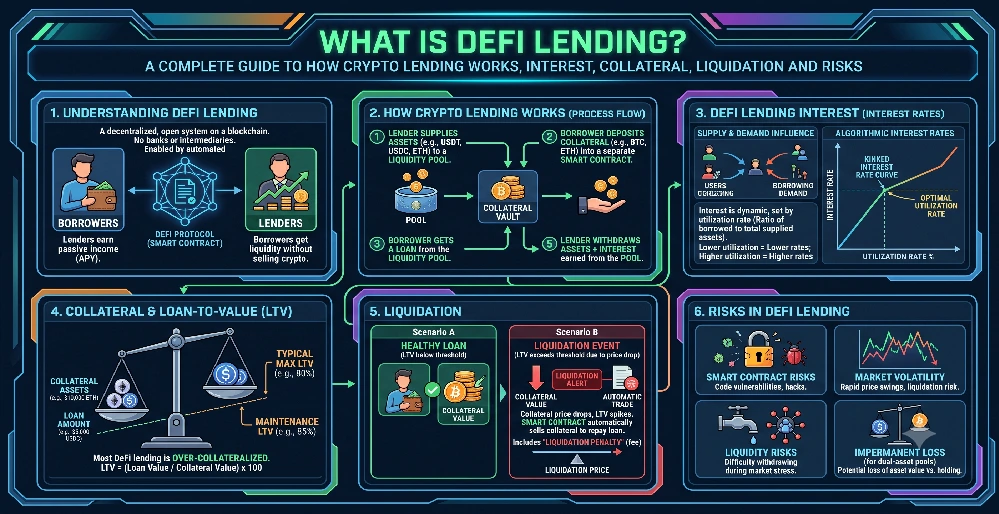
DeFi lending is a way to lend and borrow cryptocurrency through blockchain-based protocols and smart contracts instead of relying on a traditional bank or other central lender.
In a common DeFi lending model:
Lender supplies crypto → lending pool holds the assets → borrower provides collateral → borrower borrows crypto → interest is paid → lender earns a return.
Most DeFi lending systems use smart contracts to manage the basic rules of the market. Many lending designs are collateralized, meaning borrowers provide crypto assets to support their loans.
The easiest way to understand it
Imagine you have crypto that you are not using.
You could supply it to a DeFi lending protocol.
Another person may need a stablecoin or another crypto asset. Instead of applying for a bank loan, that person deposits acceptable crypto as collateral and borrows from the available pool.
The borrower pays interest.
Part of that lending activity can become the return received by suppliers.
That is the basic idea.

Why Does DeFi Lending Exist?
Traditional lending usually involves a financial institution.
You apply for a loan.
The lender checks your financial information.
The lender decides whether you qualify.
The lender sets the terms.
The lender manages repayment.
DeFi changes much of this process by moving important rules onto a distributed ledger.
There may be no traditional loan officer reviewing the application. Instead, the protocol can use programmed rules to determine how much can be borrowed, how much collateral is required, how interest changes and when a position can be liquidated.
This does not mean DeFi removes risk.
It changes where the rules and risks sit.
In traditional finance, you may depend heavily on the bank and its systems.
In DeFi, you may depend on:
- smart contracts
- blockchain networks
- price oracles
- liquidity
- collateral values
- protocol rules
- governance
That difference is one of the most important things to understand before using a DeFi lending protocol.
How Does DeFi Lending Actually Work?
The easiest way to understand DeFi lending is to follow the money.
Suppose Aryan owns ETH.
He does not want to sell it.
Instead, he supplies his ETH to a DeFi lending market.
Bob needs a stablecoin.
He deposits acceptable crypto as collateral and borrows stablecoins from the market.
Bob pays interest.
Aryan can receive a return from supplying his assets.
The smart contracts and protocol rules keep track of the position.
Here is the basic journey:
Aryan supplies crypto
↓
Crypto becomes available in the lending market
↓
Bob deposits collateral
↓
Bob borrows available assets
↓
Interest continues to accrue
↓
Bob repays the borrowed amount and interest
↓
Bob can withdraw his collateral, subject to the protocol’s rules
But there is another possible ending.
If Bob’s collateral falls sharply in value, his position can become unsafe.
Then:
Collateral value falls → risk level rises → liquidation may occur
This is why understanding collateral and liquidation is just as important as understanding interest.
What Is a DeFi Lending Pool?
A lending pool is a shared pool of crypto assets supplied by users.
Think of it like a large digital pool.
Many users can add assets to it.
Other users can borrow from the available liquidity if they meet the protocol’s rules.
This is different from saying:
“Alice personally lends 1 ETH directly to Bob.”
In a pool-based system, Alice normally supplies ETH to the market rather than choosing a particular borrower.
The protocol manages the market according to its rules.
This structure is one reason DeFi lending can operate continuously on a blockchain without requiring lenders and borrowers to meet each other directly.
A simple example
Imagine a lending pool contains:
100 ETH
Users may supply that ETH.
If borrowers take 60 ETH worth of available liquidity, the pool has:
60% utilization
If borrowing rises to 90 ETH, utilization becomes:
90%
That change can matter because many lending protocols use utilization as part of their interest-rate system.
Who Are the Main Players in DeFi Lending?
There are several important parts of the system.
The lender
The lender, often called a supplier, provides crypto to the lending market.
The goal is usually to earn interest on supplied assets.
The borrower
The borrower takes an available asset from the lending market after meeting the protocol’s requirements.
The borrower normally pays interest.
The smart contract
The smart contract contains the rules that control important parts of the lending system.
It can help manage:
- deposits
- borrowing
- repayments
- interest
- collateral
- withdrawals
- liquidations
The lending pool
The pool holds supplied assets and makes liquidity available for eligible borrowing.
The oracle
A price oracle provides price information that the protocol may need to value collateral and debt.
The liquidator
A liquidator is a market participant that can help close unsafe positions according to the protocol’s liquidation rules.
Understanding these parts makes DeFi lending much easier to follow.
Why Do DeFi Borrowers Usually Need Collateral?
This is one of the biggest differences between many DeFi loans and traditional loans.
A traditional lender can consider things such as:
- income
- credit history
- employment
- assets
- legal agreements
A DeFi protocol generally cannot simply call your employer or check your traditional credit history.
So many DeFi lending systems use collateral.
Collateral is crypto that a borrower deposits to support a loan.
A simple example
Suppose you deposit:
₹5,00,000 worth of ETH
You may then be allowed to borrow:
₹2,00,000 worth of another supported asset
Your collateral is worth more than the amount borrowed.
This is called overcollateralization.
It creates a safety buffer because crypto prices can change quickly.
The exact borrowing limit depends on the asset, protocol and market rules. There is no single DeFi-wide collateral ratio.
What Does Overcollateralized Lending Mean?
The word may sound complicated, but the idea is simple.
Overcollateralized lending means putting up more value as collateral than the value you borrow.
For example:
Collateral: ₹5,00,000
Borrowed: ₹2,00,000
The borrower has more value locked as collateral than the amount borrowed.
Why?
Because crypto prices can move quickly.
If ETH falls, the value protecting the loan also falls.
The extra collateral gives the position some room before it reaches a dangerous level.
However, overcollateralization does not make a loan risk-free.
A fast market fall can still cause liquidation.
What Is LTV in DeFi Lending?
LTV means Loan-to-Value.
It tells you how large your loan is compared with the value of your collateral.
The basic formula is:
LTV = Loan Value ÷ Collateral Value × 100
Suppose:
Collateral = ₹5,00,000
Loan = ₹2,00,000
Then:
LTV = ₹2,00,000 ÷ ₹5,00,000 × 100
LTV = 40%
That means the loan represents 40% of the collateral’s current value.
Why does LTV matter?
Because the market value of your collateral can change.
Suppose your ₹5,00,000 collateral falls to ₹4,00,000.
Your ₹2,00,000 loan has not changed.
But now:
LTV = ₹2,00,000 ÷ ₹4,00,000 × 100
LTV = 50%
The position has become riskier.
If the collateral falls further, the LTV can continue to rise.
This is why borrowers need to monitor their collateral instead of looking only at the interest rate.
What Is a Liquidation in DeFi Lending?
Liquidation happens when a borrower’s position becomes too risky under the protocol’s rules and the collateral can be sold or otherwise used to reduce the debt.
This is one of the most important risks in DeFi lending.
Imagine you borrow against Bitcoin or ETH.
You start with:
₹5,00,000 collateral
₹2,00,000 debt
Then ETH falls sharply.
Your collateral might fall to:
₹3,00,000
Your debt is still around:
₹2,00,000
Your safety margin is now much smaller.
If the position reaches the protocol’s liquidation conditions, liquidation may begin, as detailed in the Aave Risk Parameters documentation.
A liquidator can purchase or take part of the collateral under the protocol’s rules, with the proceeds helping to cover the debt.
The exact process differs between protocols.
The key lesson
Borrowing against volatile crypto means you are taking market risk even if you never sell your collateral yourself.
The market can effectively force a sale of collateral when the position becomes unsafe.
Why Can DeFi Lending Interest Rates Change?
DeFi lending rates are often connected to supply and demand.
If many people want to borrow an asset but relatively little is available to borrow, borrowing rates can rise.
If borrowing demand is lower, rates can fall.
Many lending protocols use an interest-rate model linked to utilization.
Utilization broadly tells us how much of the available liquidity is being borrowed.
For example:
Low utilization → lower borrowing pressure
High utilization → higher borrowing pressure
Many rate models become much steeper when utilization gets close to a high target level. This encourages borrowers to repay or new lenders to supply more liquidity.
Why does this matter to a borrower?
You might enter a loan when the borrowing rate looks comfortable.
Later, demand can rise.
The borrowing rate may increase.
Your loan can therefore become more expensive.
This is why a borrower should not assume that today’s rate will remain the same throughout the life of the position.
What Is Lending APY?
APY stands for Annual Percentage Yield.
In simple terms, it is a way of expressing the potential annual return while accounting for compounding under the stated assumptions.
When you supply an asset to a DeFi lending market, you may see a supply APY.
For example:
Supply APY: 5%
That does not mean you are guaranteed to make exactly 5%.
The rate can change.
Your actual return can also depend on the protocol, asset, market conditions, fees and other factors, unlike lower-volatility methods like crypto staking.
So:
APY is a rate indicator, not a promise.
What Is Borrowing APR?
APR means Annual Percentage Rate.
A DeFi interface may show a borrowing APR or another rate measure to describe the cost of borrowing.
For a borrower, the important question is:
How much will this loan cost me if the rate changes?
A loan with a low starting rate can become expensive if market conditions push the borrowing rate higher.
That is why looking only at the headline rate is not enough.
Where Does the Lender’s Interest Come From?
A common question is:
“If I lend my crypto, where does my return come from?”
In a basic lending market, borrowers pay interest for using available liquidity.
That borrowing activity creates the economic source for lender returns, subject to the protocol’s design, fees and risks.
In simple terms:
Borrower pays interest → lending market receives interest → suppliers may receive part of that return
The exact distribution varies by protocol.
There may also be protocol fees or other mechanisms.
So the displayed supply APY should not be treated as a fixed payment from the protocol.
Can You Earn Money Through DeFi Lending?
Yes, you may earn interest by supplying crypto to a DeFi lending market.
But “may earn” is important.
DeFi lending is not the same as a guaranteed bank deposit.
Your return can change.
Your asset can lose market value.
The protocol can experience technical problems.
Liquidity can become tight.
A smart-contract exploit can cause losses.
There can also be risks related to price oracles and the assets used by the protocol, which is why practicing strict DeFi security is essential.
So a high APY should never be viewed by itself.
Higher return can come with higher risk.
What Happens When a Lending Pool Has Very High Utilization?
Imagine a pool has:
₹100 crore available
Borrowers have taken:
₹95 crore
The pool is now heavily utilized.
That can have several effects.
Borrowing rates may rise.
The protocol may try to attract more suppliers.
Borrowers may have more reason to repay.
And lenders may face a practical issue:
There may be little immediately available liquidity for withdrawals.
This does not automatically mean the money is permanently lost. It means the pool’s available liquidity can become limited while assets remain borrowed.
Utilization is therefore an important number to watch when evaluating a lending market.
What Is the Role of a Price Oracle?
A lending protocol needs to know what assets are worth.
Suppose you deposit ETH and borrow a stablecoin.
The protocol needs price information to understand:
How much is your ETH worth?
That information can come through a price oracle.
The oracle helps the protocol make decisions about collateral value, borrowing limits and liquidation.
This creates another layer of risk.
If price information is wrong, delayed or manipulated, the protocol may make a bad decision.
Understanding oracle risk in DeFi is critical because price feed manipulation can lead directly to unexpected liquidations or cascading losses.
What Does a DeFi Lending Example Look Like in Real Life?
Let’s put everything together.
Suppose Rahul has:
ETH worth ₹10,00,000
He does not want to sell the ETH.
But he needs:
₹4,00,000 worth of stablecoins
He connects his crypto wallet and finds a lending market that supports his collateral and the asset he wants to borrow.
Rahul deposits his ETH.
The protocol checks the applicable collateral and borrowing rules.
He borrows the supported stablecoin.
Now Rahul has:
Collateral: ₹10,00,000
Debt: ₹4,00,000
Initial LTV: 40%
He now has liquidity without selling his ETH.
But the story does not end there.
If ETH rises
His collateral becomes more valuable.
His position may become safer, assuming the debt remains broadly unchanged.
If ETH falls
His collateral becomes less valuable.
His LTV rises.
His liquidation risk increases.
If borrowing rates rise
His loan becomes more expensive.
If he repays the debt
He may be able to withdraw his collateral, assuming all protocol conditions are satisfied.
This example shows why DeFi lending is more than simply:
“Deposit crypto and earn interest.”
For borrowers, it is an active risk-management process.
What Are the Main Ways People Use DeFi Lending?
There are two basic sides.
Lending
You supply assets to a lending market.
The objective is generally to earn interest.
For example:
You supply USDC → borrowers use USDC → you receive the applicable lending return
Borrowing
You supply collateral and borrow another asset.
For example:
You supply ETH → borrow USDC → keep the ETH exposure while accessing liquidity
Borrowing can be useful when someone wants liquidity without immediately selling an asset.
But borrowing also creates debt and liquidation risk.
Why Would Someone Borrow Crypto Instead of Selling It?
This is one of the main reasons DeFi borrowing exists.
Imagine you own Bitcoin or ETH.
You believe the asset may remain valuable in the long term.
But you need short-term liquidity.
Selling the asset would reduce your exposure to it.
Borrowing can provide another option:
Keep collateral → borrow liquidity
However, this does not mean borrowing is automatically better than selling.
You still have to:
- pay interest
- maintain enough collateral
- manage liquidation risk
- deal with market volatility
- repay the debt
Borrowing against crypto is therefore a financial decision, not free money, and requires understanding your overall risk-to-reward ratio.
What Are the Different Types of DeFi Lending?
DeFi lending is not one single design.
Pool-based lending
This is the model most beginners will encounter.
Suppliers place assets into a shared market.
Borrowers borrow from the available liquidity.
Interest rates are usually determined by protocol rules and market conditions.
Peer-to-peer lending
Here, lending can be structured more directly between lenders and borrowers.
The exact design depends on the platform.
Flash loans
Flash loans are a special type of DeFi loan.
They allow assets to be borrowed and returned within the same blockchain transaction under specific protocol rules.
They are mainly used for advanced on-chain operations such as arbitrage rather than normal personal borrowing.
Global financial institutions like the Bank for International Settlements (BIS) and academic researchers note that while collateralized pool mechanisms dominate DeFi, flash loans highlight unique, atomic composability native to smart contracts.
Early decentralized systems pioneered these models, including MakerDAO’s collateralized debt positions (CDPs). For beginners, however, pool-based collateralized lending is the most important model to understand first.
What Is the Difference Between DeFi Lending and DeFi Borrowing?
The words sound similar, so confusion is common.
The easiest way to remember them is:
DeFi lending
You provide crypto.
You may earn interest.
DeFi borrowing
You provide collateral.
You receive a loan.
You pay interest.
One person can be on one side while another user is on the other side.
The protocol connects these activities through its lending market.
How Is DeFi Lending Different From a Bank Loan?
The biggest difference is where the lending rules are handled.
| DeFi lending | Traditional lending |
|---|---|
| Runs through blockchain-based protocols | Usually runs through banks or other financial institutions |
| Uses smart contracts for many rules | Uses institutional systems and agreements |
| Often uses crypto collateral | May use income, credit history or other collateral |
| Interest can change with market conditions | Rates depend on the lender and loan terms |
| Transactions can be visible on-chain | Bank transactions are generally recorded within private systems |
| Can operate continuously on supported networks | Depends on the institution and financial system |
| Liquidation can be automated | Default recovery usually follows institutional and legal processes |
Neither model is automatically perfect.
They simply work differently. As global oversight evolves, checking guidelines on crypto regulation in India and international standards helps keep your digital asset activities compliant and secure.
What Are the Benefits of DeFi Lending?
DeFi lending has several features that attract users around the world.
Open access
Many DeFi protocols are accessible through a crypto wallet rather than a traditional bank account.
Access rules still depend on the protocol, blockchain, asset and applicable laws.
Automation
Smart contracts can automatically enforce many lending rules.
Transparency
Important activity can often be inspected on a public blockchain.
Speed
Transactions can settle according to the blockchain’s processing time rather than traditional banking schedules.
Flexible crypto liquidity
Borrowers can use supported crypto as collateral to access another asset.
Global nature
DeFi markets are built on global blockchain networks rather than being limited to one country’s banking infrastructure.
But accessibility does not mean safety.
That distinction matters.
What Are the Biggest Risks of DeFi Lending?
This is where every beginner should slow down.
A lending APY can look attractive.
But the return is only one part of the picture.
Smart contract risk
DeFi protocols depend on software.
A coding error, exploit or flawed upgrade can cause serious problems.
Unlike a traditional bank transaction, blockchain transactions may not have a simple “undo” button. Smart-contract weaknesses have historically been an important source of DeFi risk.
Liquidation risk
Borrowers can lose collateral when their position becomes unsafe.
This can happen quickly during a sharp crypto price move.
Market risk
Crypto prices can move dramatically.
If you supply ETH, the number of ETH you hold may remain unchanged while its value in dollars, euros or rupees falls.
Interest-rate risk
Borrowing and lending rates can change.
A profitable-looking strategy at one rate may become less attractive at another.
Oracle risk
Incorrect or manipulated price information can affect collateral and liquidation decisions. Understanding oracle risk in DeFi is essential because faulty price feeds remain a primary vector for protocol exploits.
Liquidity risk
A heavily borrowed liquidity pool can have limited immediately available liquidity for withdrawals.
Stablecoin risk
A stablecoin is designed to maintain a stable value, but stability is not an absolute guarantee.
If a stablecoin loses its intended value, the economics of a lending position can change quickly.
Governance risk
Some protocols allow governance participants to change parameters or other parts of the system.
Changes can affect users.
Protocol risk
A protocol may work as designed and still face problems during extreme market conditions.
Recent empirical research on Aave V3, documented in a Bank of Canada staff research series, found that liquidation events can occur in concentrated waves and highlighted liquidation risk, capital-efficiency limits and wider ecosystem fragility.
Is DeFi Lending Safe?
The honest answer is:
DeFi lending is not risk-free.
Some protocols may have strong security practices and mature markets.
That does not remove every risk.
Before using a lending protocol, you should understand:
- what assets it supports
- how collateral works
- how much you can borrow
- how interest changes
- what triggers liquidation
- how liquidation works
- where price data comes from
- how much liquidity is available
- whether the smart contracts have been reviewed
- what governance controls exist
- what happens during extreme market conditions
Think of DeFi lending as a financial system with programmable rules, not as a savings account with guaranteed returns.
Can You Lose Money With DeFi Lending?
Yes.
There are several ways.
A lender could face losses because of:
- a smart-contract exploit
- bad debt
- oracle problems
- liquidity problems
- failure of an important asset or protocol component
A borrower can lose money through:
- liquidation
- interest costs
- falling collateral prices
- borrowing-rate increases
- fees and transaction costs
There is also a simple risk that beginners sometimes forget:
The crypto asset itself can fall in value.
Suppose you lend $10,000 worth of ETH.
If ETH falls 30%, your ETH position can be worth about $7,000 before considering the lending return and other factors.
So earning interest does not automatically mean making money overall.
What Should Beginners Check Before Lending?
Do not start with:
“How high is the APY?”
Start with:
“How does this protocol work, and what can make me lose money?”
Then check the following.
Understand the asset
Know what you are supplying.
ETH, BTC, stablecoins and smaller tokens can have very different risk profiles.
Check the lending rate
Understand whether the displayed rate is variable and how often it can change.
Check liquidity
A high APY is less meaningful if the market has very limited liquidity.
Understand smart-contract risk
Look for information about the protocol’s security history and code reviews.
An audit can reduce some risks, but it is not a guarantee that a protocol cannot be exploited.
Understand the withdrawal rules
Know when and how you can remove your assets.
Understand the protocol
Do not supply money simply because a website displays a large percentage.
What Should Borrowers Check Before Taking a DeFi Loan?
Borrowers have an even bigger responsibility because their collateral can be liquidated.
Before borrowing, understand:
Your LTV
Know your current LTV.
Your liquidation threshold
Know how close you are to liquidation.
Your collateral
Ask yourself how volatile it can be.
Your borrowing rate
Understand whether it can change.
Your repayment plan
Know how you will repay the debt.
Your safety buffer
Do not assume that the maximum borrowing limit is a sensible borrowing amount. Evaluating your risk-to-reward ratio helps prevent capital wipeouts during sharp market dips.
A position that is technically allowed by a protocol may still be too risky for a particular person.
Why Borrowing the Maximum Amount Can Be Dangerous
Suppose a protocol allows you to borrow up to ₹7,00,000 against your collateral.
That does not mean you should borrow ₹7,00,000.
The closer you move toward the protocol’s maximum borrowing limit, the less room you have for a fall in collateral value.
A sudden crypto market drop can push your position toward liquidation.
A more conservative borrower may deliberately use a lower LTV to create a larger safety buffer.
This is one of the most important practical lessons in DeFi borrowing.
Maximum borrowing capacity is not the same thing as safe borrowing capacity.
What Is a Health Factor in DeFi Lending?
Some lending protocols use a health factor or a similar risk indicator.
It is designed to show how safe a borrowing position is under the protocol’s rules. As defined in the Aave protocol technical documentation, when a health factor drops below 1, liquidation can be triggered to protect the protocol’s solvency.
The exact calculation varies by protocol.
Generally:
Higher health factor → more safety buffer
Lower health factor → greater liquidation risk
Do not compare health-factor numbers between different protocols as if they were identical.
Always read the specific protocol’s documentation.
Can DeFi Lending Be Used in India?
DeFi is a global technology, so someone in India can technically interact with blockchain-based lending protocols where the relevant blockchain and protocol are accessible.
But technical access is not the same as legal or tax approval.
India’s treatment of crypto and virtual digital assets includes taxation and regulatory considerations, and the rules can change. Staying updated with India crypto regulation and knowing who regulates crypto in India is vital for compliant on-chain activity.
If you are using DeFi from India, you should consider:
- current Indian tax rules
- reporting requirements
- applicable regulations
- the legal status of the particular activity
- records of transactions
- wallet and protocol activity
Do not assume that a DeFi transaction is outside Indian tax or legal rules simply because it happens on a blockchain.
For large or complex transactions, professional advice from someone familiar with Indian virtual digital asset taxation and regulation is appropriate.
Is DeFi Lending Available 24/7?
One of DeFi’s notable features is that blockchain-based protocols can operate continuously.
There is generally no concept of a bank closing at 5 p.m.
But this does not mean everything is instant or risk-free.
You still depend on:
- the blockchain
- network congestion
- transaction fees
- protocol availability
- liquidity
- smart contracts
- wallet access
During a period of extreme market activity, transaction costs and execution conditions can also change.
What Happens to DeFi Lending During a Crypto Market Crash?
This is where the system is truly tested.
Imagine ETH falls sharply within a few hours.
Borrowers using ETH as collateral may suddenly have less collateral value.
Their LTV can rise.
Some positions may approach liquidation.
Liquidations can increase.
Borrowers may rush to repay.
Other users may try to withdraw assets.
Interest rates may change as utilization changes.
This can create a period of intense activity.
Research published by the Bank of Canada in 2026 found that liquidations in its study of Aave V3 occurred in concentrated waves, while also identifying liquidation risk and systemic fragility as important concerns.
This is why DeFi lending should be evaluated under stress conditions, not only during calm markets.
Is DeFi Lending the Same as Staking?
No.
The two can both generate returns, but they work differently.
DeFi lending
You supply an asset to a lending market.
The return generally comes from lending activity and the protocol’s rules.
Staking
You commit eligible crypto to a blockchain’s staking system or related staking service. To learn how network validation generates yield, see our guide on what crypto staking is and how it works.
The return generally comes from the network’s staking economics, reinforcing underlying cryptoeconomic security.
The risks are also different.
Lending can involve:
- borrower demand
- liquidation
- smart-contract risk
- oracle risk
- pool liquidity
Staking can involve:
- validator risk
- slashing
- lock-up or unbonding rules
- network risk
So you should not treat every crypto yield product as the same thing.
What Is the Difference Between DeFi Lending and Yield Farming?
DeFi lending is a specific activity.
Yield farming is a broader term for strategies designed to earn returns by moving or supplying assets across DeFi protocols.
A person might use a lending protocol as part of a wider yield strategy.
But:
DeFi lending ≠ all of DeFi yield farming.
This distinction is useful because high-yield strategies can introduce additional risks beyond basic lending.
What Are Some Examples of DeFi Lending Protocols?
The DeFi lending ecosystem includes well-known protocols such as:
- Aave
- Compound
- Morpho
- Spark
- Maker-related lending infrastructure and vault systems
These protocols do not all work in exactly the same way.
Their supported assets, risk controls, interest-rate models, collateral rules, liquidation systems and governance can differ. For an architectural breakdown of pool-to-peer designs, see the official Compound Protocol documentation.
So the name of a protocol alone does not tell you whether a particular lending position is suitable for you.
The broader research literature also shows that DeFi lending has several different designs and that protocol architecture affects interest rates, liquidation incentives and security risks.
What Is the Biggest Mistake Beginners Make in DeFi Lending?
One of the biggest mistakes is looking at the yield first and the risk second.
For example:
“This pool pays 15% APY.”
That sounds attractive.
But the better questions are:
What asset am I holding?
Why is the APY 15%?
Can the rate fall?
How liquid is the market?
What smart contracts am I trusting?
What happens if the asset drops 50%?
What happens if the protocol is attacked?
Can I withdraw when I want?
What are the fees?
This changes the way you look at DeFi.
Yield is only one side of the equation.
A Simple DeFi Lending Checklist
Before supplying assets:
- Understand the protocol.
- Understand the asset.
- Check the supply rate.
- Check whether the rate is variable.
- Check liquidity.
- Understand smart-contract risks.
- Understand oracle risks.
- Check withdrawal conditions.
- Avoid chasing unusually high yields without understanding the reason.
Before borrowing:
- Understand the collateral.
- Check the LTV.
- Check the liquidation threshold.
- Understand the health factor if applicable.
- Check the borrowing rate.
- Understand whether the rate can change.
- Keep a safety buffer.
- Have a repayment plan.
- Know what happens during a sharp market fall.
What Is the Future of DeFi Lending?
DeFi lending continues to evolve.
Modern research is looking beyond the simple idea of “deposit, borrow and earn interest.”
Researchers are studying:
- different collateral models
- undercollateralized lending
- flash loans
- isolated markets
- interest-rate design
- liquidation systems
- security
- yield aggregation
- leverage
- protocol risk
A 2026 study in the IEEE Xplore Digital Library describes DeFi lending as a programmable credit market and highlights how protocol design, interest-rate models, liquidation incentives and security can affect the system.
Another 2026 study of MakerDAO data found that leverage can reduce returns and increase liquidation risk, especially for less skilled users during extreme conditions.
This suggests that the future of DeFi lending is not simply about offering higher yields.
The bigger challenge is building lending markets that can remain reliable when markets become difficult.
What Is Changing Around DeFi Lending in 2026?
DeFi is also receiving more attention from regulators and financial institutions.
The Financial Action Task Force (FATF) published a 2026 report examining regulatory challenges connected with decentralized finance and highlighted concerns around illicit-finance risks as the sector evolves. For more on compliance frameworks and cross-border standards, explore our guide on FATF recommendations, VASPs, AML, and the Travel Rule.
That does not mean every DeFi lending protocol is illegal or unsafe.
It means the wider environment is becoming more important.
For users, this makes it even more useful to understand the difference between:
technology
and
legal status
and
financial risk.
They are three different questions.
FAQ
What is DeFi lending?
DeFi lending is a blockchain-based system that allows users to lend and borrow crypto through smart contracts and protocol rules rather than relying entirely on a traditional bank.
How does DeFi lending work?
Lenders supply crypto to a lending market. Borrowers generally provide collateral and borrow available assets. Borrowers pay interest, and suppliers may receive a return. Smart contracts manage many of the rules.
How do DeFi lenders make money?
Lenders can earn interest from lending activity. The actual return can change based on supply, demand, utilization, protocol fees and market conditions.
Do you need collateral to borrow in DeFi?
Many common DeFi lending systems require collateral. However, DeFi includes other models, including some undercollateralized designs and flash loans.
What is overcollateralized DeFi lending?
It means the borrower provides collateral worth more than the amount borrowed.
What is LTV in DeFi?
LTV, or Loan-to-Value, compares the value of a loan with the value of the collateral.
LTV = Loan Value ÷ Collateral Value × 100
What happens if the price of my collateral falls?
Your LTV can rise and your position can become less safe. If it reaches the protocol’s liquidation conditions, some or all of your collateral may be liquidated.
Can DeFi lending rates change?
Yes. Many lending protocols use rate models that respond to market conditions such as utilization and borrowing demand.
The Simple Way to Remember DeFi Lending
If you remember only one thing from this guide, remember this:
DeFi lending turns lending rules into blockchain-based software.
A lender supplies crypto.
A borrower provides collateral.
The borrower takes an available asset.
Interest moves according to the protocol’s rules.
The collateral protects the loan.
If the collateral falls too far, liquidation can happen.
And behind all of it are smart contracts, price data, liquidity and market conditions.
That is the heart of DeFi lending.
But there is one more lesson worth keeping.
A high APY does not automatically mean a good opportunity.
Before looking at the return, understand the asset.
Before borrowing, understand the liquidation risk.
Before trusting a protocol, understand the smart contract and its rules.
And before putting real money into any DeFi lending market, ask the most important question:
“What could make me lose this money?”
That question will often teach you more about DeFi lending than the APY displayed on the screen.
