Imagine walking up to a soda vending machine. You drop in a coin, press a button, and a cold can drops into the tray. There is no store clerk behind the glass, no bank teller checking your credit history, and no manager deciding whether they like your smile before approving the sale. The machine simply follows one clear rule: if you insert the right money, you get your drink. If you do not, your coin returns to you.
Decentralized Finance, commonly called DeFi, is that exact vending machine idea, but built for the entire global financial world.
Whether you are sitting in a cafe in Mumbai, an apartment in Tokyo, a home office in London, or a high-rise in New York, DeFi lets you borrow, save, trade, and invest without ever asking permission from a bank or waiting three business days for an international wire transfer to clear. It runs entirely on open code, transparent computer networks, and automatic digital rules.
This guide breaks down the moving parts of DeFi into plain English, showing you how smart contracts function, how trading pools manage prices with pure math, why you can earn interest without a bank, and what serious risks you must keep on your radar.
What Happens When You Take the Middleman Out of Money?
To understand why DeFi feels so different, look at how regular money moves today.
When you send money to a friend through your traditional bank, your bank does not actually move physical cash across town instantly. Instead, it adjusts a private database behind closed doors. Then, it talks to a central clearing house, which talks to your friend’s bank, which updates another private database. Along the way, each intermediary takes a small cut, checks your identity, and reserves the right to freeze the transfer if their system flags it or if the banking window has closed for the weekend.
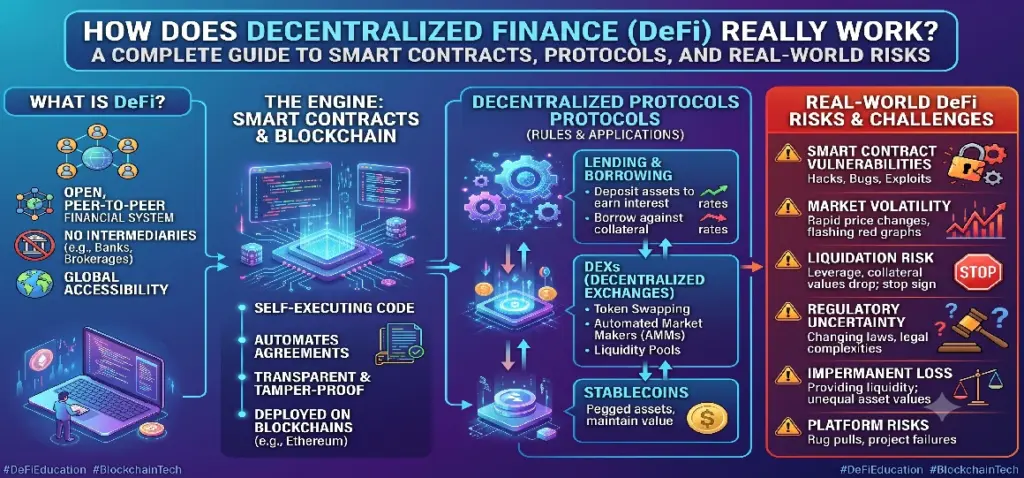
DeFi completely replaces that closed chain of intermediaries with three foundational principles:
- Permissionless Access: Anyone with an internet connection and a digital wallet can take part. There are no background checks, credit bureau scores, or geographic borders blocking the door.
- Complete Transparency: Every transaction, pool balance, and line of code sits on an open digital ledger called a blockchain. Anyone in the world can audit the entire system at any second of the day.
- Execution Certainty: Rules are written in software code that executes without bias. If your transaction meets the mathematical conditions, it succeeds. If it fails to meet them, the network cancels the action entirely, and your funds stay where they started.
What Are the Five Layers of DeFi and Why Do They Matter to Me?
Just as a modern skyscraper relies on solid bedrock, steel framing, electrical wiring, interior rooms, and an exterior doorway, DeFi is built out of five distinct layers. Each layer relies entirely on the stability of the one below it.
Layer 1: The Settlement Bedrock
This is the foundational blockchain network where everything is recorded and made final. Networks like Layer 1 leaders like Ethereum, Arbitrum, Base, Optimism, and Solana act as the ultimate ground truth. When a transaction is accepted here, it is etched into history. If this base layer ever fails or halts, every single project resting on top of it stops working too.
Layer 2: The Digital Asset Layer
This layer defines what kinds of value can move across the network. As ecosystems expand across Layer 2 scaling solutions, developers use shared digital standards so that tokens can interact smoothly:
- ERC-20 Tokens: Standard fungible tokens where every unit is identical and interchangeable, just like one dollar bill or one unit of digital gold is worth another.
- Wrapped Tokens: Native network currencies like Ether do not always fit standard token rules directly. Wrapping contracts turn them into standardized versions, like WETH, so they can play nicely with every decentralized app.
- ERC-4626 Vault Tokens: A modern, universal blueprint for interest-earning savings vaults. When you deposit an asset, the vault gives you back a receipt token that represents your principal plus your share of the growing interest pool.

Layer 3: The Protocol Engine
This is where the actual financial services live. Think of this layer as the machinery. Smart contracts here act as automated loan desks, trading markets, and savings funds. Big names like Uniswap, Aave, Compound, Curve, and MakerDAO live here, running the mathematical rules that swap tokens and manage debt.
Layer 4: The Application Interface
Most people do not want to interact directly with raw computer code. The application layer provides clean, human-friendly websites and mobile wallet apps. When you tap a button on your phone screen to swap tokens, this layer translates your click into a cryptographically signed instruction that the blockchain understands.
Layer 5: The Smart Aggregator
Imagine having an assistant who checks the price of a flight across twenty airline sites before booking your ticket. Aggregators like 1inch, Matcha, and Yearn Finance do that for DeFi. They scan multiple protocols simultaneously to route your trade through whichever path gives you the lowest fee and best price.
Because all these layers share the same public network, they behave like interlocking plastic building blocks, often called “money legos.” In traditional finance, sending money across different companies requires days of paperwork and settlement clearing. In DeFi, a single transaction can move funds through three different protocols within seconds. If any step along the way fails, the entire transaction cancels automatically, protecting your balance from getting stuck halfway through.
How Do Smart Contracts Actually Run Without a Human Boss?
A smart contract is a computer program stored permanently on a blockchain address. It holds funds, checks conditions, and releases payouts according to strict logic written into its code.
When you send an instruction to a smart contract, hundreds of independent computers around the world run the exact same calculation at the same time. Because they all start with the same blockchain state and process the same input, they arrive at the exact same answer. This is known as deterministic execution.
A loan contract does not care if the borrower is rich, poor, famous, or obscure. It only evaluates numbers: Did this wallet deposit enough collateral? If yes, release the loan. If the collateral value drops too low, trigger an automated liquidation to pay back the pool. No loan officers, no branch visits, and no human prejudice can alter the outcome.
How Does a Savings Vault Protect Your Money With Pure Math?
In older versions of DeFi, every project built its own custom code for lending pools and yield-generating vaults. That made connecting different platforms messy and risky.
The industry solved this by creating a unified standard called ERC-4626. When you place funds into an ERC-4626 vault, the contract calculates your share of the pool using a straightforward ratio:
Share Value = Total Assets in Vault / Total Shares in Circulation
As the vault collects interest from borrowers or trading activities, the total assets inside the vault grow larger, while the number of minted shares stays the same. That means each individual share steadily becomes worth more of the underlying asset over time.
To protect users, the standard enforces two vital mathematical guardrails:
- Strict Rounding Rules: When depositing money, the math always rounds down in favor of the vault, and when withdrawing, it rounds up. This prevents bad actors from exploiting tiny decimal rounding errors over millions of repeated transactions.
- Virtual Offsets to Stop Inflation Attacks: Early vaults faced a sneaky trick where the very first depositor could deposit a single penny, donate extra money directly to the vault contract to inflate the share price wildly, and cause subsequent small depositors to receive zero shares due to computer division rounding. Modern vaults insert invisible starting numbers, called virtual assets and virtual shares, ensuring that the exchange math stays fair right from the very first deposit.
How Do Blockchains Know Real-World Prices? The Oracle Puzzle
Blockchains are self-contained digital islands. By design, a blockchain cannot simply open a web browser and check today’s price of gold or the exchange rate of the US dollar, because doing so would cause different computers on the network to see slightly different prices at different seconds, breaking consensus. This puzzle is called the oracle problem.
To solve this, DeFi relies on decentralized oracle networks, like Chainlink. Independent data providers collect price feeds from dozens of global exchanges, average them together to remove outliers, cryptographically sign the data, and deliver it onto the blockchain.
There are two main ways oracles deliver this data:
- Push Oracles: The oracle network regularly pushes fresh price updates onto the blockchain whenever prices shift by a certain percentage. This keeps prices ready for any contract to read instantly, though it costs ongoing network fees.
- Pull Oracles: The oracle prepares verified price data off-chain. When you submit a trade or loan request, your transaction pulls that fresh, verified price payload with it into the blockchain contract in that exact moment, saving network costs.
Why is this so important? Because if a protocol gets lazy and tries to check the price using only its own small internal trading pool, a wealthy attacker can take out a massive temporary loan, drain one side of the pool to twist the apparent price for three seconds, borrow funds against that fake price, and walk away with millions. Secure oracles prevent these flash loan price distortions.
How Do People Trade Without an Exchange Order Book?
If you trade shares on the New York Stock Exchange or Tokyo Stock Exchange, you use an order book. Buyers list the maximum price they are willing to pay, sellers list the minimum price they will accept, and a central matching engine pairs them up.
Running millions of order placements and cancellations directly on a blockchain is far too slow and expensive. So DeFi invented Automated Market Makers, or AMMs.
Instead of matching individual buyers and sellers, an AMM stores pairs of tokens inside large community pools. You trade directly against the pool itself.
The most famous formula powering this is the Constant Product formula:
Token X Reserve * Token Y Reserve = Constant Value (k)
Think of this formula like a playground teeter-totter. If you put more of Token X into the pool, you must take out an equivalent value of Token Y so that the product of the two reserves remains balanced.
Because the formula automatically increases the cost of an asset as its remaining pool reserves shrink, the pool can never run completely out of tokens. However, if your trade is very large compared to the size of the pool, you will experience price slippage, meaning you receive slightly fewer tokens than the starting screen price indicated.
Why Can Depositing Money Make You Lose Value? The Reality of Impermanent Loss
Many people deposit tokens into AMM liquidity pools to earn a share of every trading fee. But providing liquidity comes with a unique economic surprise called impermanent loss.
Impermanent loss is the difference between what your tokens are worth inside the liquidity pool versus what they would have been worth if you had simply held them safely in your own wallet.
When the market price of one token shoots up outside the pool, automated arbitrage traders immediately swap cheaper tokens into the pool and pull the surging token out until the pool’s internal ratio matches the rest of the world. As a liquidity provider, your pool balance automatically ends up with more of the cheaper token and less of the booming token.
If the price ratio changes by:
- 1.25x (a 25% price shift): You experience roughly a 0.60% loss compared to holding.
- 1.50x (a 50% price shift): You face about a 2.02% drag.
- 2.00x (a doubling in price): You suffer a 5.72% shortfall compared to holding.
- 5.00x (a 400% price surge): You experience a 25.46% gap compared to holding.
It is called “impermanent” because if the token prices return to their exact starting ratio, the loss disappears. But if you withdraw your tokens while the prices are far apart, that loss becomes permanent. To make a genuine profit, the trading fees you collect must be larger than this price divergence drag.
Modern quantitative research also tracks Loss-Versus-Rebalancing, or LVR. This measures the hidden profit that fast arbitrage bots take from everyday liquidity providers every time prices move on external centralized exchanges before the on-chain pool has time to react.
How Do Smarter AMMs Save Capital and Cut Fees?
To make trading smoother and reduce slippage, developers built three major upgrades to early AMM designs:
1. Stableswap Curves for Pegged Tokens
When trading two stablecoins that both equal one US dollar, a standard curve causes unnecessary slippage. Protocols like Curve Finance use a hybrid formula that flattens the exchange line near the 1:1 price peg. This lets users swap millions of dollars with virtually zero slippage, while still keeping a safety curve that protects the pool if one stablecoin truly breaks its peg.
2. Concentrated Liquidity
In basic pools, your money is spread out across every price from zero to infinity, meaning most of your capital sits idle. Concentrated liquidity platforms like Uniswap v3 allow liquidity providers to specify an exact price range, such as allocating capital only between $1,800 and $2,200 for Ether. This makes every dollar work dozens of times harder, yielding higher fee rewards, though it requires closer monitoring if prices swing outside your chosen bracket.
3. All-in-One Contracts and Dynamic Hooks
Newer systems like Uniswap v4 move all trading pairs into one master contract rather than deploying hundreds of separate contracts. This architecture uses transient memory to calculate balance shifts and settles actual token movements only at the very end of a multi-step trade, drastically lowering network gas fees. It also introduces hooks, which are customizable plugins that can automatically adjust trading fees during high market volatility or fill orders like a traditional limit order.
How Can You Borrow Money Without a Credit Score or Loan Officer?
In the traditional world, getting a loan requires pay stubs, credit bureau ratings, and days of waiting. In decentralized lending protocols like Aave and Compound, you can borrow funds in seconds using over-collateralization.
Because the protocol does not know your identity, it cannot send a collection agency to your house if you fail to repay. Instead, you must deposit more value in collateral than the amount you wish to borrow. For instance, you might deposit $1,500 worth of Bitcoin to borrow $1,000 worth of a stablecoin.
The Interest Rate Seesaw
How do these lending pools set interest rates? They use an automatic formula based on the pool’s utilization rate, which is the percentage of deposited money currently borrowed out.
- Low Demand: When plenty of spare cash sits idle in the pool, the interest rate stays low to encourage borrowers.
- High Demand Kink: Once borrowing crosses a target sweet spot (often around 80% or 90% of the pool), the formula reaches an intentional “kink” and ramps rates up steeply. This high borrowing cost encourages existing borrowers to repay their loans quickly and attracts new depositors looking for juicy yields, restoring healthy pool reserves.
Continuous Interest Tracking
Instead of calculating interest manually for millions of individual accounts every minute, protocols use a shared global index. Every time a second passes, this index multiplies by the prevailing per-second interest rate. When you open or close a loan, the contract compares today’s index number to the index number from the day you started, determining your exact debt balance in a single instant computation.
What Is a Health Factor and How Do Liquidations Work?
Every loan has an automated safety score called a Health Factor. This score measures your deposited collateral against your borrowed balance:
Health Factor = (Total Collateral Value * Allowed Collateral Safety Factor) / Total Borrowed Debt
- As long as your Health Factor stays comfortably above 1.0, your loan remains safe.
- If your collateral value drops or your borrowed debt grows until the Health Factor falls below 1.0, the contract marks your account for automatic liquidation.
When a liquidation happens, independent third-party market participants step in. They pay off a portion of your borrowed debt and, in return, the contract awards them an equivalent amount of your collateral plus an extra liquidation penalty fee (often 5% to 10%). This automated mechanism keeps the lending platform fully solvent without leaving unpaid bad debt.
What Are Staking, Restaking, and the Quest for Yield?
In modern Proof-of-Stake blockchains, network security is powered by users locking up their cryptocurrency to validate transactions and keep the ledger honest. In return, validators earn regular protocol rewards.
Liquid Staking Tokens (LSTs)
Locking your coins directly into a validator node usually freezes your funds, preventing you from using them. Liquid staking protocols solved this by taking your staked tokens and handing you a receipt token in return, like stETH. These receipt tokens still accrue network staking rewards every day, but you are free to trade them, use them as loan collateral, or swap them across other DeFi apps.
Restaking and Layered Security
EigenLayer took this concept a step further with restaking. Restaking allows users to take their already-staked capital and pledge it to secure secondary networks simultaneously, such as data networks, bridges, and oracle systems, known as Actively Validated Services, or AVSs.
By doing this, you earn baseline staking rewards plus extra validation fees from the secondary services. However, this creates compounded slashing risk: if a validator operator suffers a software bug or misbehaves on just one secondary service, the smart contracts can slash and confiscate your underlying staked assets across the board. Stacking too many derivative tokens on top of one another creates complex interdependencies where a failure in one smart contract can tumble the entire stack.
Who Really Runs These Platforms? Inside DAOs and Token Voting
Instead of a traditional corporate board of directors, many DeFi protocols are governed by Decentralized Autonomous Organizations, or DAOs.
In a DAO, anyone holding the protocol’s governance tokens can participate in steering the platform. The typical governance journey looks like this:
- Community Discussion: Community members draft ideas on open public discussion forums to gauge sentiment and refine the details.
- Gas-Free Polling: Token holders use off-chain voting platforms to signal support without paying blockchain network gas fees.
- Formal On-Chain Proposal: If the idea gains strong support, a formal code proposal is submitted directly to the blockchain governance contract.
- The Timelock Waiting Period: If the vote passes, the proposal enters a mandatory timelock delay, usually lasting between 24 and 72 hours. This safety pause gives everyday users time to inspect the upcoming changes and withdraw their funds from the protocol if they disagree with the new rules before they take effect.
While DAOs offer transparent, democratic management, they face real hurdles. Voter turnout is often very low, which can allow a handful of wealthy token holders to dictate platform rules. Furthermore, if a DAO does not establish a clear legal corporate wrapper, courts may treat its members as general partners, potentially exposing individual voting members to shared legal liability for platform issues.
Old Money vs. New Money: How Does DeFi Compare to Traditional Banking?
To see the fundamental differences clearly, compare how everyday financial actions work in both worlds:
| Feature | Traditional Banking (TradFi) | Decentralized Finance (DeFi) |
| Asset Custody | Custodial: The bank or brokerage holds your money and can freeze your account. | Non-Custodial: You hold your own cryptographic private keys and retain total control. |
| Role of Intermediaries | Heavy: Relies on loan officers, clearing firms, brokers, and settlement databases. | Minimal: Automated smart contracts replace human middlemen and paperwork. |
| Settlement Speed | Slow: Takes 1 to 3 business days for wires and check clearances. | Instant: Transactions clear and settle together within seconds or minutes. |
| Ledger Transparency | Private: Internal bank balances are hidden behind corporate firewalls. | Fully Public: Every transaction, balance, and line of code is open to global audit. |
| Access Rules | Restrictive: Requires ID verification, proof of address, and minimum balance thresholds. | Open to All: Requires only an internet connection and a digital crypto wallet. |
| Interoperability | Siloed: Moving funds between different firms requires custom API links and agreements. | Modular: Protocols connect smoothly like building blocks within a single transaction. |
| Operating Hours | Limited: Operates during standard local business hours and closes on bank holidays. | Always Open: Operates 24 hours a day, 7 days a week, 365 days a year globally. |
What Can Go Wrong? Hacks, Flash Loans, and Hidden Pitfalls
While DeFi opens doors to permissionless innovation, it also introduces serious, unique risks that every user must respect.
1. Smart Contract Bugs and Reentrancy
Because smart contract code is public, anyone in the world can study it looking for loopholes. Maintaining strict DeFi security is critical against vulnerabilities like reentrancy. In this exploit, a malicious contract calls a withdrawal function, and before the target contract has time to update its internal balance records, the attacker’s contract rapidly calls the withdrawal function again and again, draining the vault before the code realizes the balance should be zero.
2. Flash Loan Exploits
A flash loan allows anyone to borrow tens of millions of dollars with zero collateral, provided the full loan amount is borrowed, used, and returned within the exact same block transaction. While developers use flash loans for legitimate arbitrage and collateral refinancing, attackers can use this sudden, massive capital to push illiquid market prices out of balance, trick poorly designed protocols, and extract treasury funds in the blink of an eye.
3. Frontrunning, Sandwich Attacks, and MEV
When you submit a trade, it sits temporarily in a public waiting room called the mempool before a validator packages it into an official block. Specialized computer programs, called searcher bots, continuously scan this waiting room for profitable opportunities.
This process is known as Maximal Extractable Value, or MEV:
- Frontrunning: A bot notices your large buy order, submits its own buy order with a slightly higher network tip to get placed right ahead of you, and pushes the purchase price up.
- Sandwich Attacks: A bot places a buy order immediately before your trade and a sell order immediately after it. Your transaction drives the price up, and the bot pockets the difference, leaving you with a worse execution price.
What Are the Real Legal Battles Shaping the Future of Code?
Governments and judicial courts around the world are grappling with how to apply centuries-old financial laws to self-running blockchain code.
Are DAO Voters Personally Liable?
In notable legal decisions, such as CFTC v. Ooki DAO and Sarcuni v. bZx DAO in the United States, courts ruled that unincorporated DAOs operating financial trading services can be classified as “unincorporated associations” or general partnerships. This means that if a DAO violates regulations or suffers negligence, token holders who actively voted on governance proposals could potentially be held personally liable for the organization’s debts and penalties.
Can Autonomous Software Be Sanctioned?
A crucial milestone arrived in November 2024 with the US Fifth Circuit Court of Appeals decision in Van Loon v. Department of the Treasury regarding the privacy protocol Tornado Cash.
The court examined whether open-source, autonomous smart contracts can be legally classified as “property” under emergency sanction laws. The court ruled that “property” requires the ability to be owned, altered, or controlled. Because the core, immutable smart contracts had their administrator control keys permanently burned during their initial setup ceremony, no single person, team, or foundation held the power to change, pause, or shut them down. As a result, the court determined that truly autonomous, immutable software deployed to a public ledger cannot be blocked as sanctionable property. This ruling established a vital legal difference between unchangeable open-source code and centralized administrative control wrappers.
What Does a Single Token Swap Look Like Step by Step?
To appreciate how smoothly these elements work together, follow what happens behind the scenes when you swap a stablecoin, like USDC, for wrapped Ether, WETH, on an exchange like Uniswap:
[ Step 1: Permission ]
Your wallet signs an approval (or a gas-saving EIP-2612 permit) allowing the swap contract to move your USDC.
        │
        ▼
[ Step 2: Transaction Signing ]
You sign the swap instruction, specifying your input amount, minimum acceptable output, and a deadline time.
        │
        ▼
[ Step 3: Mempool Broadcast ]
Your transaction travels across peer-to-peer nodes into the public waiting area, where block builders assemble it.
        │
        ▼
[ Step 4: Virtual Machine Execution ]
An execution validator processes the call. The contract verifies your deadline has not passed and pulls your USDC into the pool.
        │
        ▼
[ Step 5: Math and Slippage Verification ]
The pool calculates the output using x * y = k. If the output falls below your minimum allowed slippage, the transaction cancels and reverts.
        │
        ▼
[ Step 6: Token Delivery and Ledger Finality ]
The pool sends the new WETH directly into your wallet address, updates its internal reserves, and the network validator finalizes the block forever.
The entire sequence takes seconds, requires no human intervention, and settles completely on-chain.
Where Is Decentralized Finance Headed Next?
Decentralized finance has journeyed from an experimental crypto sandbox into an interconnected, multi-billion-dollar global financial network. By replacing opaque corporate ledgers with deterministic smart contracts, DeFi offers continuous 24/7 liquidity, global access, and open composability.
Yet, the path ahead requires solving practical challenges. Developers are working hard to protect liquidity providers from adverse arbitrage selection, building user interfaces that hide complex gas mechanics, and designing compliant legal structures for community DAOs.
As standard vault templates simplify yield generation, singleton contracts cut network transaction costs, and tamper-resistant oracles strengthen security, DeFi is steadily maturing from an alternative playground into the foundational plumbing for a more transparent, efficient, and accessible global economy.
