Key Takeaways:-
- Shared Digital Ledger: Blockchain functions as a decentralized record book managed collectively by multiple computers (nodes) without a central bank or middleman.
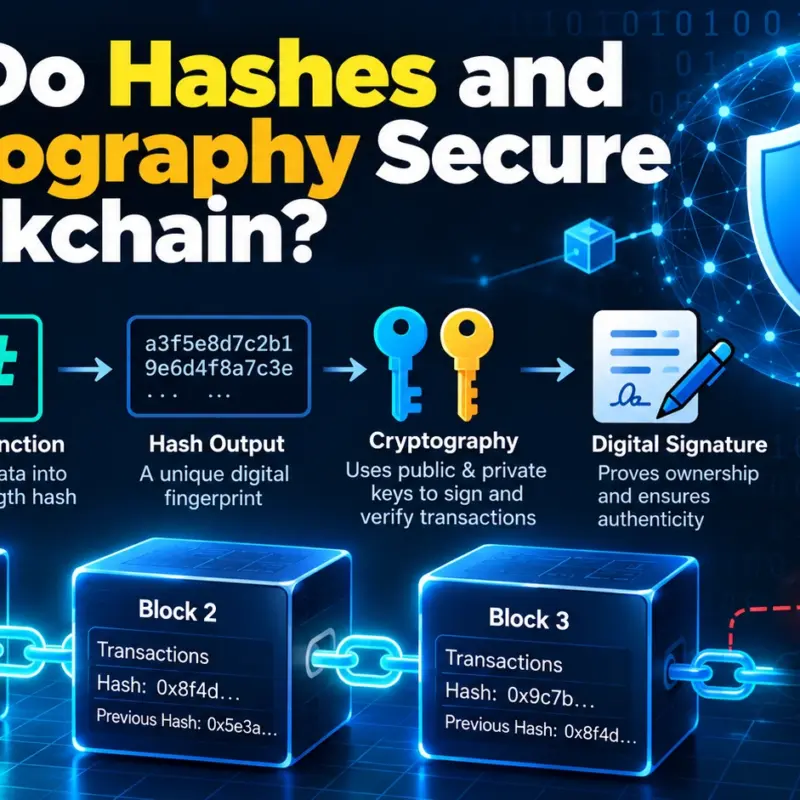
- Tamper-Evident Security: Every block is cryptographically linked to the previous one via secure hashes, meaning altering older records breaks the entire chain.
- Consensus-Driven Trust: Network participants use validation protocols like Proof of Work (PoW) or Proof of Stake (PoS) to agree on legitimate transactions.
- Technology vs. Asset: Blockchain is the underlying foundational distributed architecture; cryptocurrency is merely one application of it.
- Practical Everyday Use: Beyond crypto tokens, the system secures supply chains, digital identities, land records, and automated smart contracts.
At a Glance:-
| Feature | Centralized System (Banks/Servers) | Blockchain Network (Decentralized) |
| Control Point | Single central authority / server | Distributed network of peer nodes |
| Data Alteration | Database admin can edit entries | Practically immutable and tamper-evident |
| Verification Method | Central intermediary approval | Network consensus mechanism |
| Single Point of Failure | High (if main server crashes) | Very Low (redundant distributed copies) |
| Transparency | Closed / Private internal ledgers | Publicly verifiable or shared auditable ledger |
What This Complete Guide Covers
- Demystifying the core definition of distributed ledgers
- The exact step-by-step path of a digital transaction
- How cryptographic hashing prevents fraud and unauthorized edits
- Centralized vs. decentralized data comparison
- Real-world applications beyond digital currency
The Ultimate Beginner’s Guide: How Blockchain Works 🌐
You have likely heard technical jargon like nodes, hashes, cryptography, and consensus mechanisms, making you feel like you need a degree in computer science just to grasp the basics. It can feel overwhelming and frustrating when you simply want a clear, no-nonsense answer. You do not need a technical background. At its core, blockchain technology is simply an open, shared digital record book that multiple independent computers maintain together across the globe.
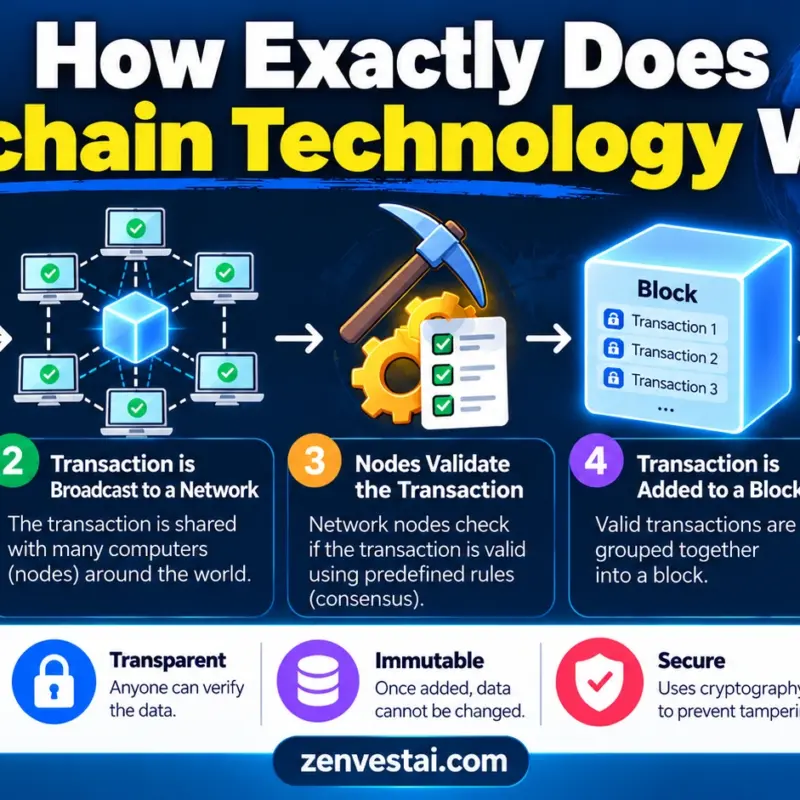
ZenvestAi Explains:- How blockchain works comes down to a four-step decentralized sequence: first, users initiate digitally signed transactions using private keys. Next, independent network computers (nodes) validate the sender’s funds and authenticity. Third, verified transactions group into a timestamped block linked to the prior block via a cryptographic hash. Finally, network nodes run a consensus mechanism (like PoW or PoS) to append the block permanently across all synchronized ledger copies, creating an auditable, tamper-resistant digital record.
What Exactly Is Blockchain? A Plain English Breakdown 📖
Traditional record systems rely entirely on a single centralized party, such as a private bank or a corporate cloud server, to verify and store your valuable data. However, blockchain technology flips this model entirely by distributing identical copies of the database across a vast network of participating computers. As explored in how distributed ledgers rewrite modern finance, no single entity possesses the unilateral power to change past transactions or shut down the entire system.
[ Traditional Database ] ---> Stored in 1 Central Bank / Server (Single Point of Failure)

[ Blockchain Network ]   ---> Synced across Node 1 = Node 2 = Node 3 = Node 4 (Decentralized)
Zenvestai Quick Insight: Think of a blockchain as an open, shared Google Sheet where everyone has view-and-add access, but no single participant can delete or edit past rows. Every new entry is permanently locked using mathematical rules that everyone inspects in real-time.
Step-by-Step: What Happens When a Transaction Is Made? ⚙️
Understanding the internal engine becomes simple when you follow an individual transfer from initiation to final settlement.
+-----------------------------------------------------------------------------------+
|               THE 5-STAGE BLOCKCHAIN TRANSACTION LIFECYCLE                        |
|                                                                                   |
|  [1. User Initiates]  --> [2. P2P Broadcast] --> [3. Validation & Grouping]      |
|  (Signs via Wallet)       (Sent to all Nodes)     (Checked against rules)         |
|                                                                                   |
|                                      |                                            |
|                                      v                                            |
|                          [4. Network Consensus]                                   |
|                          (PoW / PoS Agreement)                                    |
|                                      |                                            |
|                                      v                                            |
|  [5. Permanent Ledger Entry] <-- [Block Linked to Chain via Cryptographic Hash]   |
+-----------------------------------------------------------------------------------+
1. Initiating the Secure Transfer
Imagine Alice decides to send 1 Bitcoin to Bob. She initiates the transfer inside her digital crypto wallet application. The transaction payload contains essential transfer details and is digitally signed with Alice’s secret private key. This digital signature proves to everyone on the network that the real account owner authorized the transfer without ever revealing her private credentials.
2. Peer-to-Peer Network Broadcast
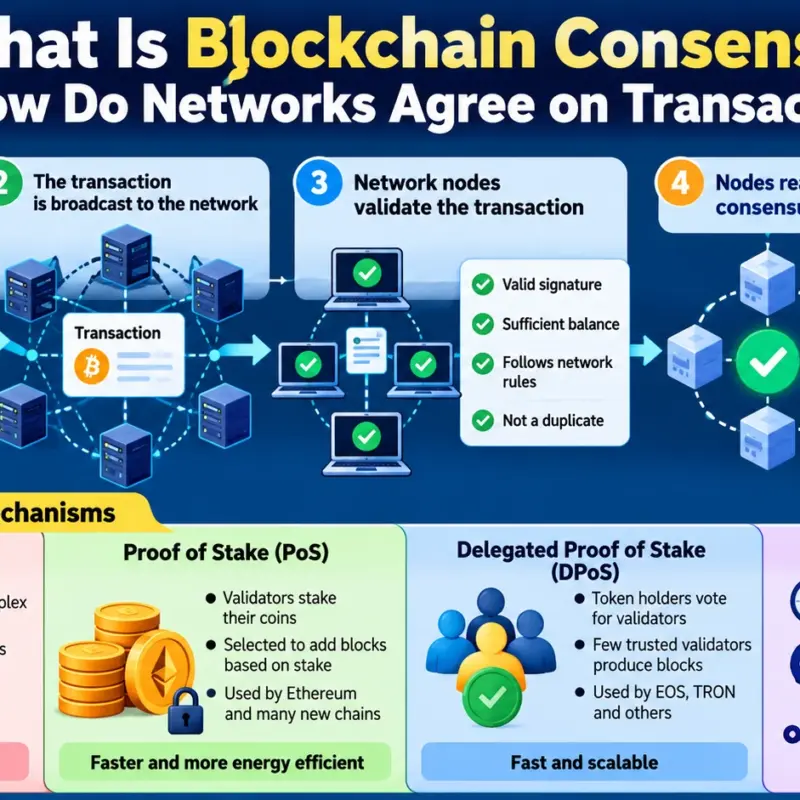
Immediately after creation, the transaction is broadcast across the peer-to-peer network. Independent computers, known as network nodes, receive this data packet and evaluate it against clear protocol parameters:
- The digital signature matches the sender’s public address.
- The sender possesses adequate funds in their account balance.
- The funds have not already been spent elsewhere (preventing double-spending).
3. Assembling Transactions Into a Block
A decentralized ledger does not record individual transfers one by one on isolated sheets. Instead, hundreds of pending, verified transactions are bundled together into a structured data block.
A standard block contains:
- An itemized collection of validated transactions
- Precise chronological timestamps and metadata
- A cryptographic reference hash pointing directly to the previous block
- Mathematical consensus proof data
Step-by-Step: How Network Agreement and Cryptographic Linking Work 🔗
Once a block is structured, the decentralized network must permanently seal it into the continuous timeline.
4. Reaching Network Consensus
Because there is no central server in charge, participating computers require a reliable method to agree on the single true version of history. This agreement system is called a consensus mechanism.
- Proof of Work (PoW): Specialized computers (miners) expend processing energy solving complex mathematical equations to propose the next block, pioneered by Bitcoin’s network design.
- Proof of Stake (PoS): Validators commit their own digital tokens as collateral (crypto staking) to earn the right to validate new blocks, as seen in Ethereum’s architecture.
Zenvestai Quick Insight: Consensus mechanisms ensure that bad actors cannot force false transactions onto the ledger. Falsifying data requires outpowering the vast majority of the network, making attacks financially irrational and practically impossible.
5. Connecting Blocks with Cryptographic Hashes
This mathematical connection is why the system is literally called a block-chain. Each new block includes the unique cryptographic hash (a digital fingerprint) of the block directly before it.
Block 100 [Hash: 7a8f...] ← Block 101 [Previous Hash: 7a8f... | Hash: 3c9b...]
If an attacker attempts to alter a transaction inside Block 100, its unique hash changes instantly. As a result, the pointer saved inside Block 101 breaks, alerting every computer on the network to reject the altered data immediately.
Why Is Blockchain Exceptionally Difficult to Alter? 🛡️
The robust security of a distributed ledger relies on multiple defensive layers working in harmony:
- Asymmetric Cryptography: Digital private-public key pairs ensure only authorized asset owners can initiate transfers.
- Cryptographic Hashing: Unique digital fingerprints make any data tampering instantly obvious across all nodes.
- Distributed Redundancy: Thousands of computers hold synchronized ledger copies, removing any single point of structural failure.
- Economic Consensus Rules: Network participants are mathematically and financially rewarded for honest validations and penalized for malicious behavior.
Blockchain Technology vs. Cryptocurrency: Clear Differences 💡
Many people confuse the underlying engine with the assets that trade on top of it.
+-------------------------------------------------------------------------------+
|                        FOUNDATION: BLOCKCHAIN TECHNOLOGY                      |
|            (Decentralized, Distributed, Immutable Ledger Infrastructure)       |
+-------------------------------------------------------------------------------+
       |                               |                                 |
       v                               v                                 v
[ Cryptocurrencies ]       [ Smart Contracts ]       [ Enterprise Tracking ]
  Bitcoin, Ethereum         Automated Agreements       Supply Chain, Health Data
- Blockchain: The core database architecture and underlying infrastructure.
- Cryptocurrency: Digital money or utility tokens that run on top of that infrastructure, powering the broader basics of the crypto market.
- Practical Non-Crypto Use Cases: Tracking agricultural supply chains from farm to shelf, modernizing wholesale asset tokenization, managing patient healthcare records securely, and automating escrow agreements via smart contracts.
Essential Glossary of Blockchain Terms
- Node: Any computer connected to the network that stores, updates, and validates copies of the ledger.
- Block: A structured digital file containing confirmed transaction records and mathematical metadata.
- Cryptographic Hash: A fixed-length string of characters generated mathematically from input data to serve as a tamper-evident digital fingerprint.
- Consensus Mechanism: A set of protocol rules (such as PoW or PoS) that decentralized nodes follow to agree on ledger updates.
- Smart Contract: Self-executing code deployed on a blockchain that triggers automated actions when predefined conditions are met.
The Bottom Line
Blockchain is not mysterious magic; it is an elegant blend of cryptographic hashing, distributed computer networks, and mathematical consensus mechanisms. It allows everyday people and institutions to trade, record agreements, and collaborate securely without having to rely blindly on an expensive central authority. As digital systems evolve across banking, trade, and smart contracts, understanding this fundamental engine puts you in complete control of your financial and digital future.
What aspect of blockchain technology do you find most interesting or confusing?
Share your questions or thoughts in the comments below, and let us know what crypto or Web3 topic you would like broken down next!
ZenvestAI Pillar Index: Distributed Architecture & Web3 Ecosystem