Most explanations of blockchain sound like they were written by computer scientists for other computer scientists. If you have ever felt frustrated reading through confusing technical jargon just to understand how digital money actually moves from person to person, you are not alone.
At its core, blockchain technology is not magic. It is simply a shared, digital notebook that thousands of independent computers keep copies of at the exact same time. Instead of trusting a single middleman like a commercial bank or a centralized tech corporation to track who owns what, the entire network watches and approves every single entry.
Understanding this system matters today more than ever. Across global finance, trillions of dollars in value, trade settlements, and cross-border payments are transitioning toward distributed ledger systems to eliminate processing delays and reduce single points of failure.
In this guide “How Exactly Does Blockchain Technology Work?”, you will learn the exact seven-step mechanism of blockchain.
How Exactly Does Blockchain Technology Work?
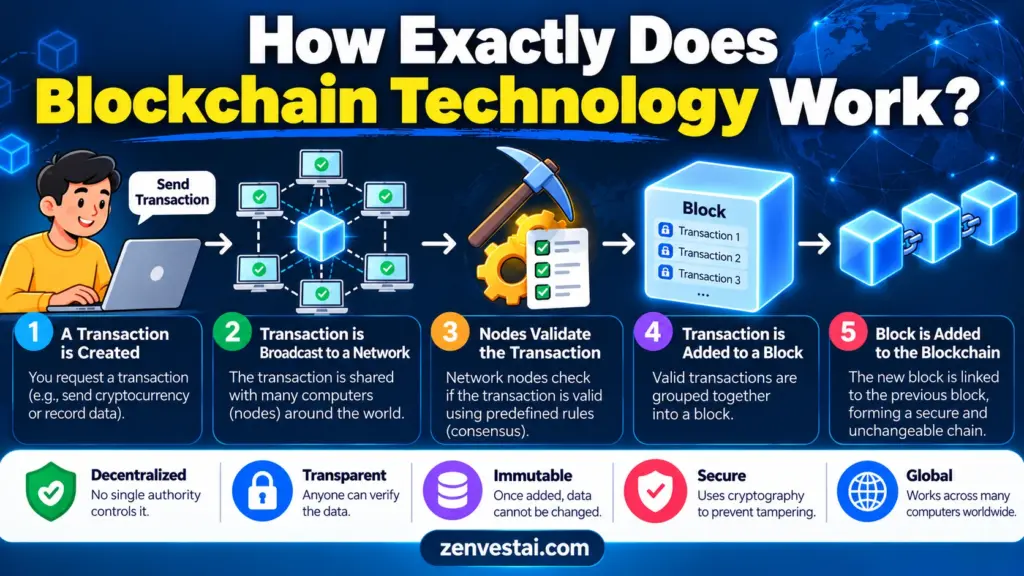
Key takeaway: The genius of this process is that it completely removes the need for a central bank or middleman. Trust is built directly into the math and the network consensus.
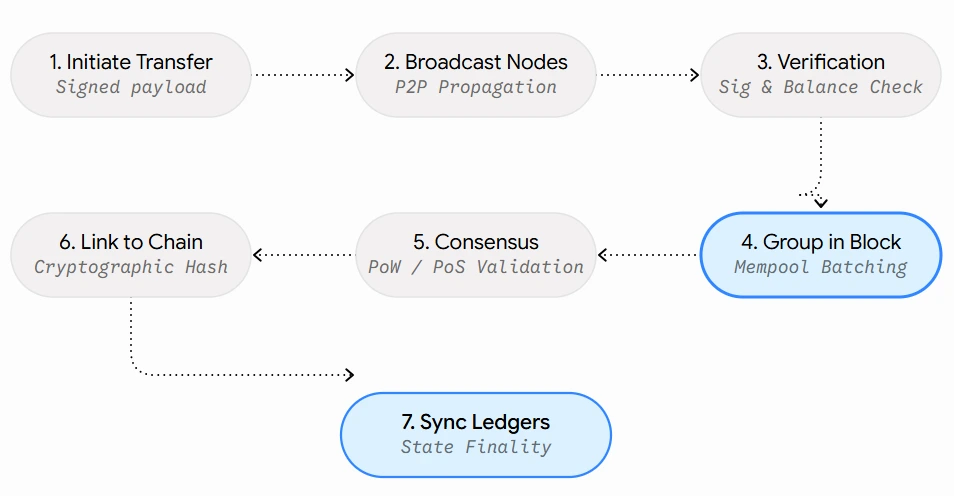
1. Initiate Transfer:- The sender constructs a transaction specifying amount, recipient, and gas fees, then signs the raw bytes with their private key.
2. Broadcast to Nodes:- The signed transaction is submitted to a gateway node and propagated across peer-to-peer network nodes via gossip protocol.
3. Verification:- Individual network nodes independently verify digital signatures, account nuances, structural format, and available token balances.
4. Group into Block:- Unconfirmed valid transactions enter the mempool and are pooled together by block proposers into a candidate block payload.
5. Consensus:- Validator or miner nodes execute the consensus mechanism (PoW mining or PoS staking) to achieve network agreement on the proposed block.
6. Link to Chain:- The validated block is assigned a unique cryptographic hash including the previous block’s hash, appending it permanently to the chain.
7. Synchronize Ledgers:- Nodes across the global network update their local copies of the distributed ledger, achieving immutable state finality.
How Blockchain Works
A blockchain works by recording transactions across a decentralized network of independent computers called nodes, bundling approved records into chronological blocks, and chaining them together permanently.
When someone initiates a transaction, it is broadcast to these independent machines. The nodes check whether the sender actually has the funds and holds the correct digital permission to move them. Once confirmed, multiple valid transfers are collected into a single block.
The network machines verify this block through an agreed set of shared mathematical rules, known as a consensus mechanism. Once verified, this block receives a permanent digital seal and attaches to the previous block in line.
Every computer on the network then updates its own identical copy of the shared ledger, creating an indelible historical record that no single person or corporation can secretly alter.
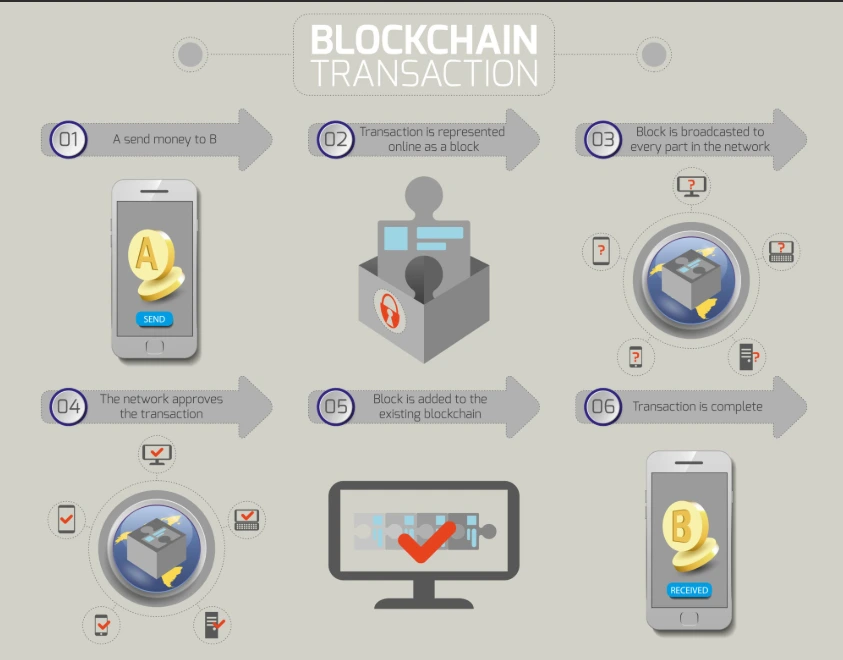
Now that you have the birds-eye view, how does this sequence operate step by step in real time?
The Seven-Step Process: What Happens Behind Every Transfer
Every digital transfer follows a strict, repeatable lifecycle. By walking through these seven functional steps, you can see how individual actions turn into permanent network history.
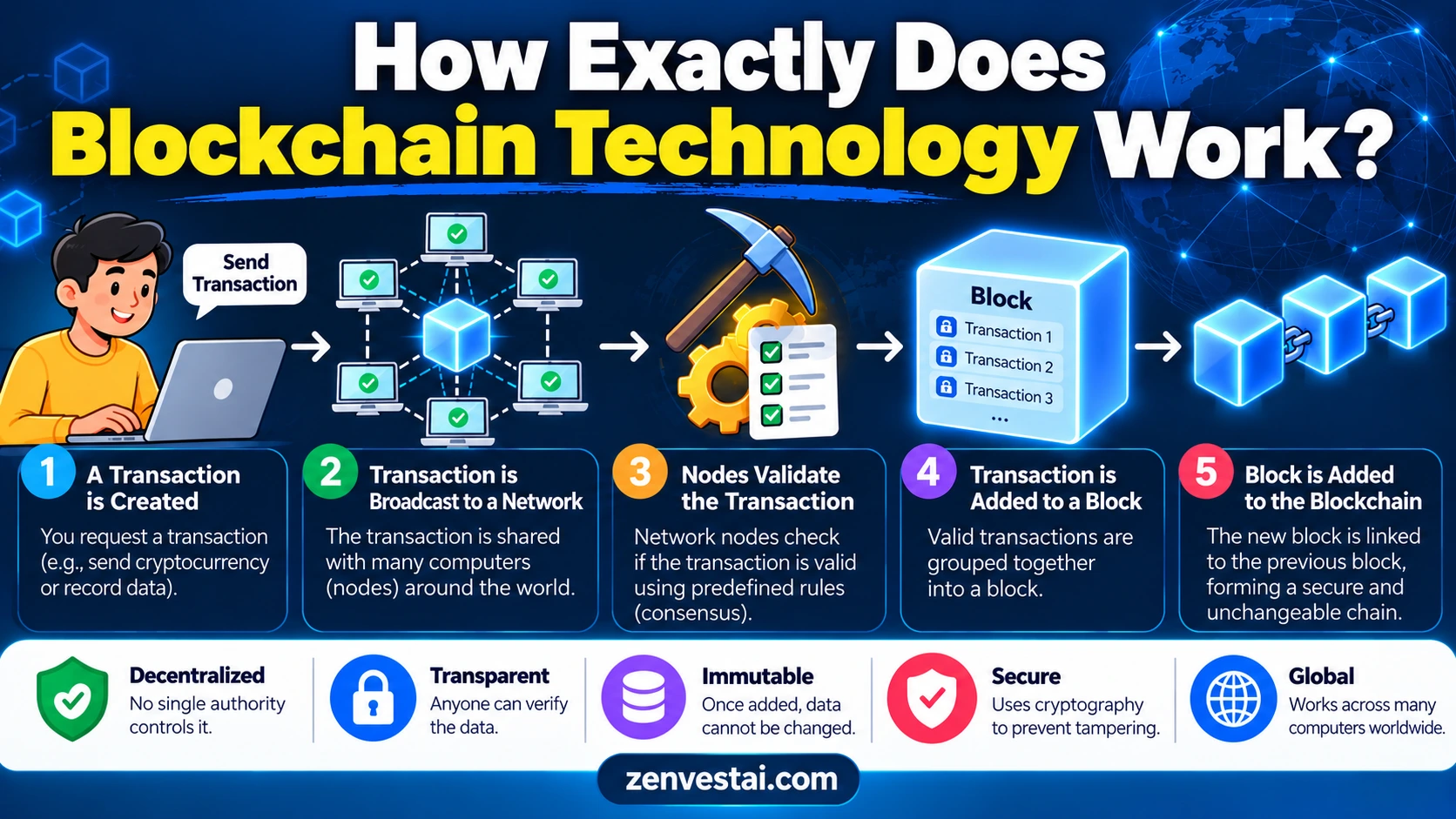
Step 1 A Transaction Is Created

A transaction begins the moment a user decides to move digital value or data to another participant. To start this transfer, the sender specifies the recipient’s address, the exact amount to deliver, and attaches a unique digital signature that proves genuine ownership.
This digital signature functions like an unforgeable wax seal; it shows everyone that the rightful account owner authorized the transaction without exposing private account keys.
At this preliminary stage, no money has actually moved yet. The transaction exists simply as a formal, cryptographically signed request waiting to be shared.
Once the request is packaged, where does it go next?
Step 2 The Transaction Is Broadcast to the Network

The sender’s computer immediately broadcasts the transaction message out to the global peer-to-peer network. Rather than traveling to a central processing hub or regional server, the signed message ripples across hundreds or thousands of participating network computers.
Each computer that receives the message passes it along to its neighboring peers within seconds. During this phase, the transaction waits in a temporary holding queue alongside other newly broadcast requests from around the world. It is visible to the network, but it remains officially unconfirmed.
Before anything can be permanently recorded, the network must verify that the transaction is legitimate.
Step 3 Independent Nodes Verify the Transaction
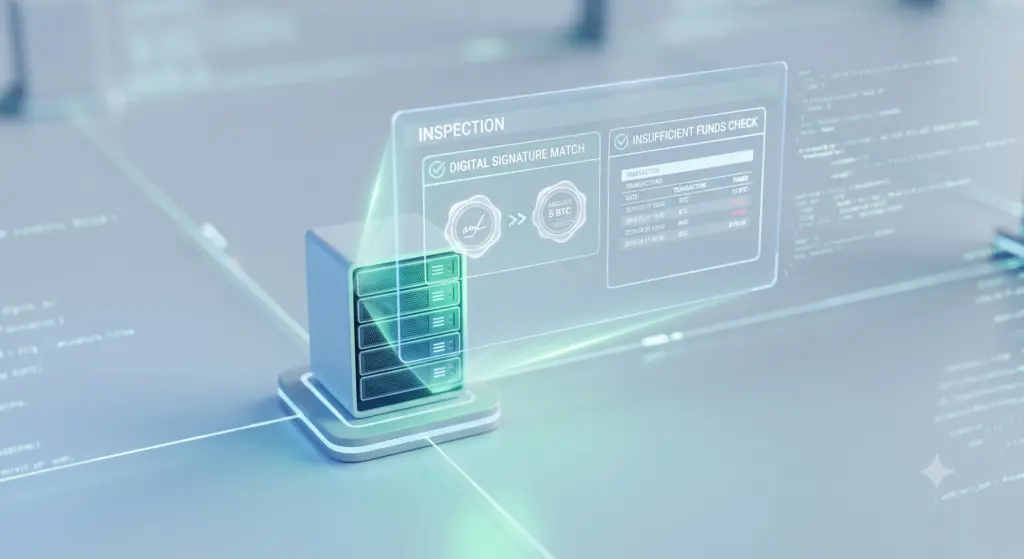
Participating computers on the network verify the authenticity and eligibility of the transaction against strict universal rules. Every participating node independently reviews the digital signature to ensure it matches the sender’s account.
Next, the node inspects the publicly available transaction history to confirm an essential requirement: the sender actually holds the necessary balance and has not attempted to spend the same funds elsewhere.
If the signature is forged or the balance is insufficient, the node discards the request on the spot. Because each node operates independently, fraudulent requests are rejected across the board without requiring human oversight.
What happens to all the transactions that pass this strict inspection?
Step 4 Valid Transactions Are Grouped into a Block

After individual transactions are validated, they are bundled together with hundreds of other approved transfers into a structured batch called a block. Think of a block as a single page in an accounting ledger.
Rather than updating the global ledger for every single isolated micropayment one by one, the system aggregates valid transactions together to optimize network bandwidth and data efficiency.
Each block contains a structured batch of recent transaction data, a timestamp marking when it was assembled, and a specific digital reference pointing directly to the completed page that came immediately before it.
Before this page can be permanently bound into the ledger, the entire network must officially agree on its validity.
Step 5 The Network Reaches Consensus
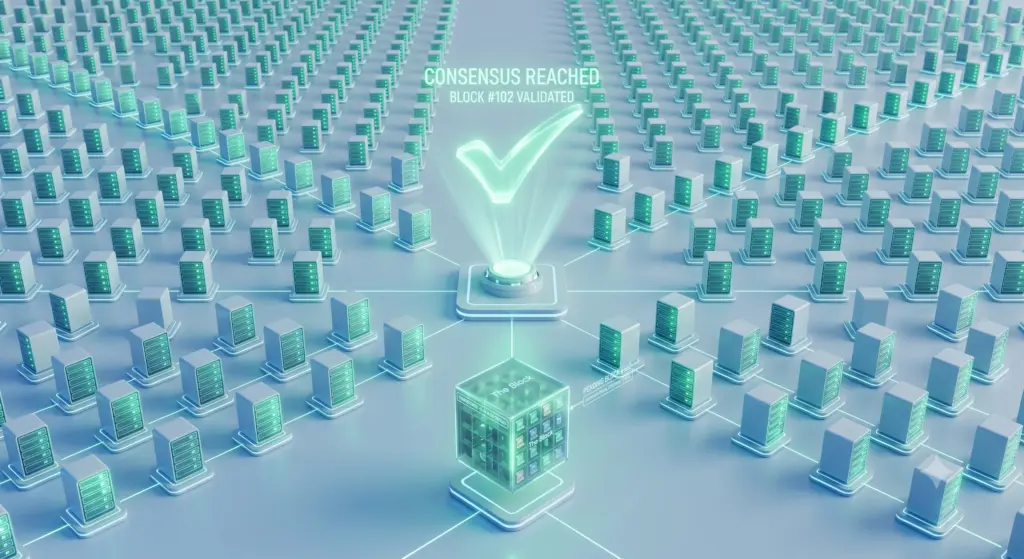
The distributed computers participate in an agreed-upon validation protocol to establish universal agreement on which block deserves to enter the chain.
Because thousands of computers operate across different continents, network latency means multiple machines might assemble slightly different batches of transactions at roughly the same time.
The network resolves this challenge through a consensus rulebook. This automated agreement protocol forces nodes to prove adherence to network rules before their proposed block is accepted by peers.
When the majority of nodes confirm that all transactions within the proposed block are valid and properly ordered, the block is officially certified.
With consensus locked in, the new block is ready to join the permanent historical timeline.
Step 6 The Block Is Added to the Chain
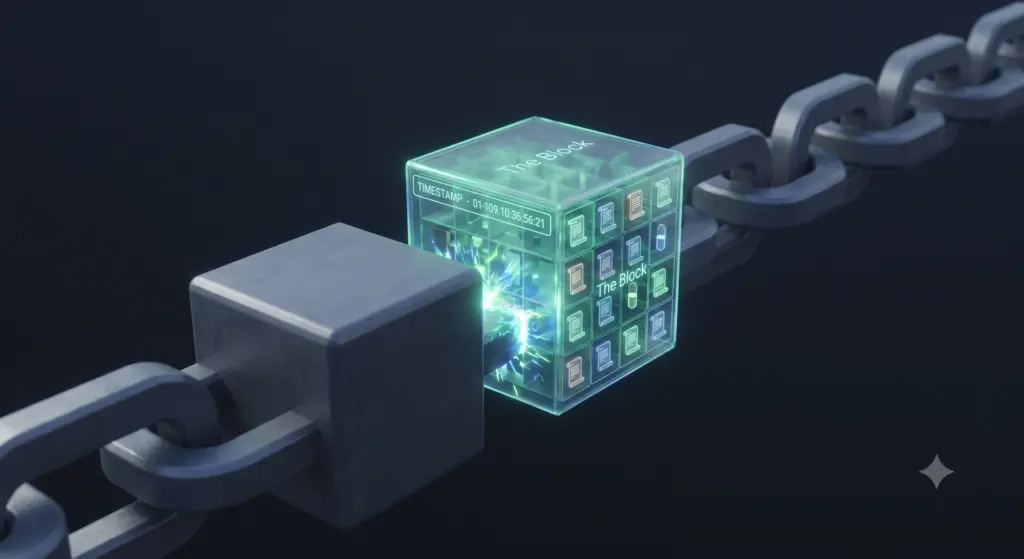
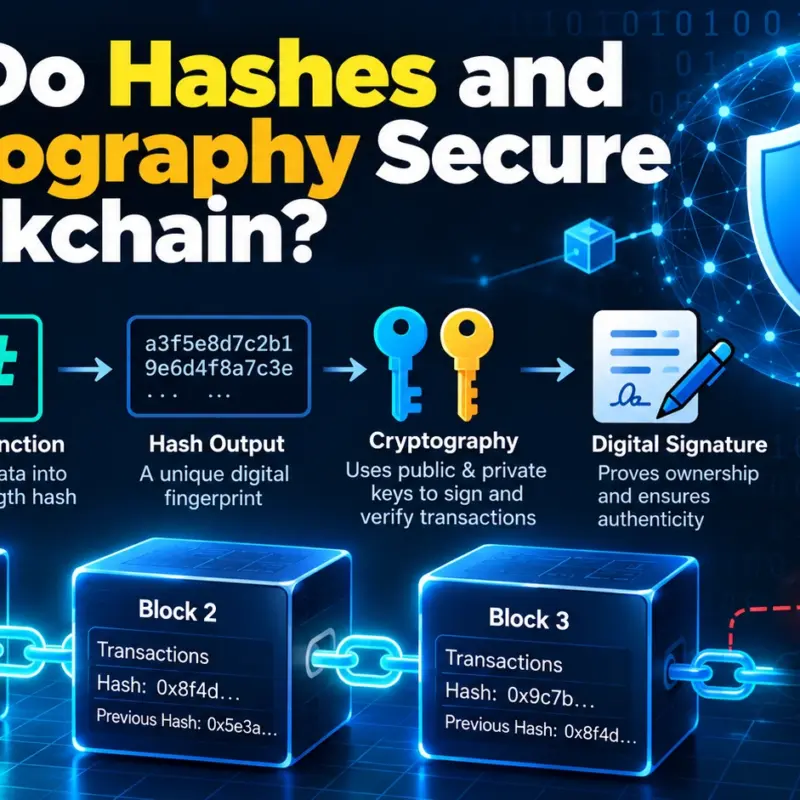
The certified block is attached directly to the end of the existing chain of historical blocks, linking them chronologically. Each block contains a cryptographic fingerprint of the block directly preceding it, creating a physical dependency between pages.
Because block number 100 contains reference data specifically derived from block number 99, you cannot insert an altered version of block 99 later without instantly breaking the mathematical connection to block 100 and all subsequent blocks. This structural continuity gives blockchain its name: it is literally an unbroken chain of chronological data blocks.
Once the block is attached, how does the rest of the world see the updated balances?
Step 7 The Distributed Ledger Is Updated

Every node across the entire network updates its local copy of the ledger to reflect the newly confirmed block. Within seconds of the new block’s acceptance, computers across the globe append it to their stored records and update account balances accordingly.
The transaction is now permanently finalized, visible on public block explorers, and irreversible. The sender’s balance drops, the recipient’s balance rises, and the cycle clears the temporary holding queue to begin again for the next batch of transfers.
To see how these seven steps operate in everyday life, let us trace a straightforward exchange between two individuals.
Putting It Together: A Simple Transfer Between Ram and Laxman
Imagine Ram wants to send $100 in digital currency directly to his brother Laxman without using an intermediary bank.
- Initiation: Ram opens his digital interface, enters Laxman’s public receiving address, sets the amount to $100, signs it with his private digital key, and clicks send.
- Network Broadcast: Ram’s transaction leaves his device and broadcasts across the distributed network.
- Node Check: An independent computer in Frankfurt and another in Tokyo check the shared public record. Both confirm Ram owns the $100 and verify his digital signature is genuine.
- Batching: The nodes place Ram’s $100 transfer into an open block alongside 1,500 other international transfers.
- Network Agreement: Nodes execute the protocol’s consensus validation, verifying that every transaction on this collective page follows network spending rules.
- Chain Attachment: The approved page attaches to the preceding block with an immutable digital timestamp.
- Settlement: The global ledger updates. Laxman sees the $100 credited to his address, while Ram’s balance shows the deduction. No bank branch, clearinghouse, or central payment gateway touched the transaction.
Why can Ram not simply alter the records later to reclaim his $100?
Why Is Blockchain So Difficult to Tamper With?
The security of a blockchain rests on three structural pillars: distribution, cryptographic linking, and collective verification. First, data distribution prevents single-point failure. If a central bank’s database server is hacked, an intruder can rewrite account balances.
On a public blockchain, however, identical copies of the ledger are stored across tens of thousands of independent computers worldwide. If an attacker manages to modify the ledger on one machine, the remaining thousands of nodes simply compare their records, identify the mismatched data, and reject the altered version immediately.
Second, the cryptographic chain link creates structural immutability. Every block includes a unique digital identifier calculated from its own transactions plus the identifier of the block before it. If an attacker attempts to go back three weeks into the past to change Ram’s transfer from $100 to $1, that single change alters that block’s mathematical identity. Consequently, the links connecting every subsequent block in the chain break instantly.
To successfully force the network to accept that altered history, the attacker would have to simultaneously overpower and rewrite the consensus of more than half of the world’s independent nodes at tremendous financial and computational cost. This makes tampering with confirmed history economically irrational and mathematically prohibitive.
Frequently Asked Questions
Can a completed blockchain transaction ever be reversed?
No. Once a transaction has been confirmed inside a block and accepted by the broader network consensus, it cannot be edited, refunded, or canceled. If a mistake is made, the recipient must voluntarily create an entirely new, separate transaction to send the funds back.
Is blockchain technology the same thing as cryptocurrency?
No. A blockchain is the underlying distributed database architecture, whereas cryptocurrencies are digital assets that run on top of that architecture. You can use blockchain technology to track supply chain goods, land deeds, or identity credentials without any digital currency involved.
What happens if an individual node goes offline or crashes?
Nothing harmful happens to the network. Because the ledger is distributed redundantly across thousands of active computers worldwide, the network continues verifying transactions normally. When the offline computer reconnects, it automatically downloads missing blocks from its peers to bring its local ledger up to date.
Who owns and controls a public blockchain?
No single corporation, government, or individual owns a public blockchain. It is maintained collaboratively by the global community of users, developers, and independent node operators who choose to run open-source software following shared mathematical rules.
The ZenvestAI View
At ZenvestAI, we view blockchain technology not as a speculative instrument, but as a foundational upgrade to how human beings establish trust across digital networks.
Historically, human commerce has always relied on trusted intermediaries banks, courts, notaries, and sovereign registries to guarantee that records remain accurate.
While these central institutions built modern finance, they also introduced single points of failure, administrative fees, and geopolitical friction. Blockchain replaces institutional trust with verifiable mathematical consensus.
For global market participants, understanding this operational architecture transforms blockchain from an intimidating buzzword into a clear, functional tool for modern digital exchange.
The Bottom Line on How Exactly Does Blockchain Technology Work?
A blockchain is simply a shared digital ledger maintained simultaneously by thousands of independent computers, where transactions are verified by math and linked permanently in chronological blocks so no single party can alter history.
Related Intelligence
- Decentralized Infrastructure vs. Centralized Cloud Systems — An architectural analysis of server resilience, data integrity, and enterprise operational risks.
- How Digital Signatures Protect Modern Financial Transfers — A non-technical overview of public and private key cryptography in everyday electronic payments.
- Global Cross-Border Settlement Mechanics and Ledger Systems — How distributed networks compare with legacy SWIFT protocols in speed, finality, and liquidity efficiency.
Author & Editorial Information
- Author: Deepak Kumar
- Publisher : ZenvestAI.Com
- Primary Source Reference: Nakamoto, S. (2008). Bitcoin: A Peer-to-Peer Electronic Cash System. Available at the Bitcoin Project Open Archive.
Regulatory & Educational Disclosure
This publication is strictly provided for educational and informational purposes by ZenvestAI. In accordance with international standards established by the International Organization of Securities Commissions (IOSCO), the U.S. Securities and Exchange Commission (SEC), and the European Union Markets in Crypto-Assets (MiCA) regulation, this content does not constitute financial advice, an investment recommendation, an endorsement, or an offer to buy or sell any digital asset, financial product, or security. Digital ledger technologies involve technological and market risks. Readers should conduct independent research and consult licensed financial professionals before making any financial commitments.