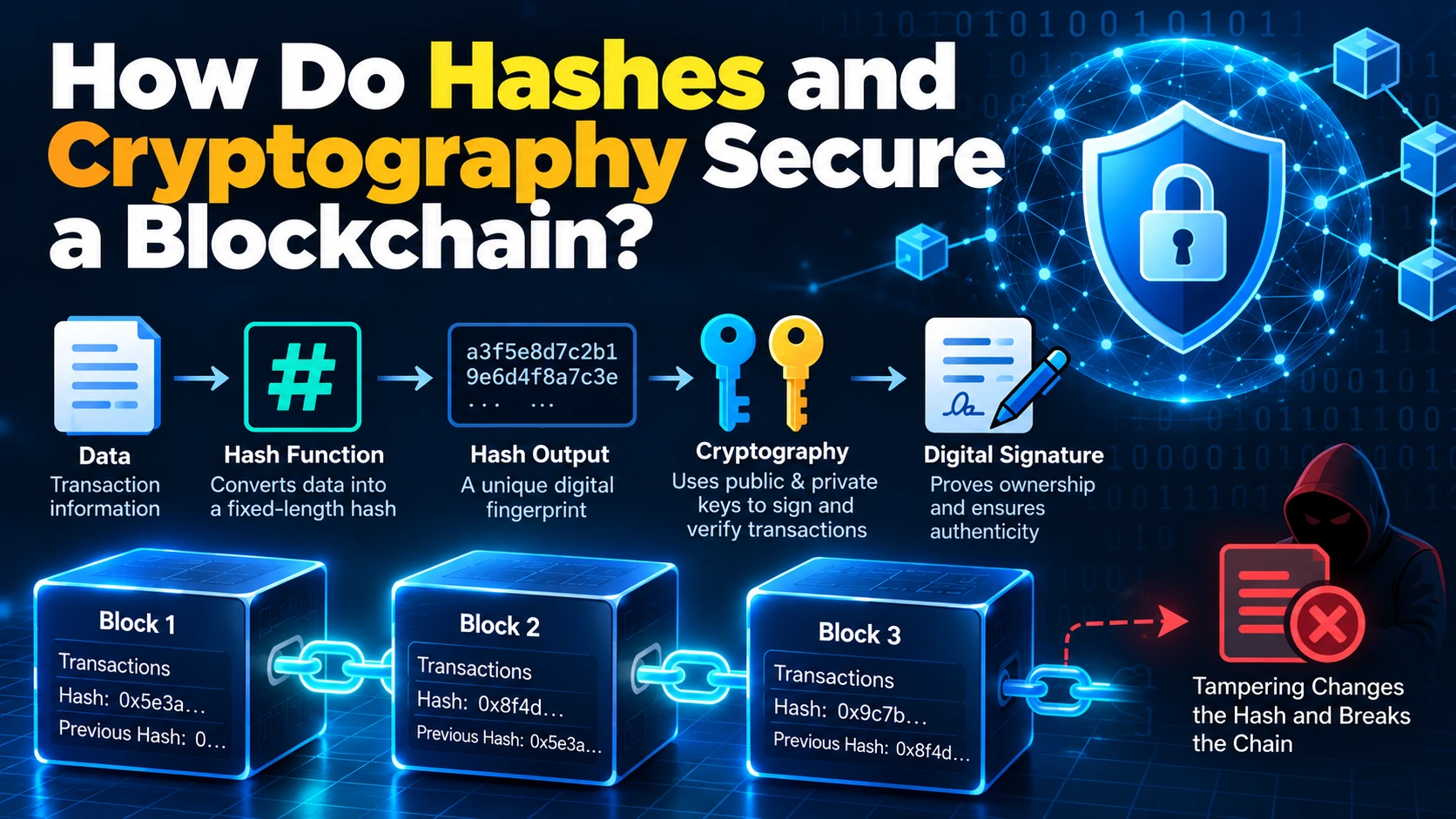
Most newcomers believe blockchain security relies on confidential mathematical secrets hidden from the world. In reality, blockchain security works because everything is visible, verifiable, and locked together with one-way mathematical rules.
If you have ever wondered how thousands of independent computers agree on account balances without a central bank, the answer lies in two building blocks: cryptographic hash functions and asymmetric cryptography.
This guide “How Do Hashes and Cryptography Secure a Blockchain?” delivers an exact, plain-English breakdown of how blocks link together, why past records cannot be altered quietly, and how mathematical proofs replace blind trust.
Before You Begin: You Are Reading Part 3
This article is the third installment in the ZenvestAI foundational blockchain series, designed to take you from core mechanics to advanced network defense. To extract the deepest value from this guide, you should review the two foundational guides that precede it:
- Part 1: How Exactly Does Blockchain Technology Work? breaks down decentralized networks, distributed nodes, and peer-to-peer consensus without central servers.
- Part 2: What Is a Blockchain Block and How Does It Store Transactions? examines the anatomy of a block, block headers, payload capacities, and Merkle trees.
How Do Hashes and Cryptography Secure a Blockchain?

If you have already read Parts 1 and 2, you know what a distributed network looks like and what sits inside a block. Now, in Part 3, we examine the invisible mathematical glue: the exact cryptographic forces that weld those blocks into an unbreakable chain.
Why Does This Matter Right Now?
As decentralized networks settle trillions of dollars in value globally, understanding the underlying security architecture protects you from costly misconceptions. Many investors assume a blockchain encrypts your transaction data so nobody can read it. That assumption is dangerously wrong: transactions are completely public, but they are protected against forgery through digital signatures and anchored against tampering through cryptographic hashes.
So, where does the security process actually begin? It starts with understanding what cryptography actually accomplishes on a distributed network.
What Is Cryptography in a Blockchain?
Cryptography in blockchain systems is used primarily for verification and identity, not for hiding transaction data. When you send cryptocurrency, your wallet does not obscure the amount or the recipient’s address.
Instead, the network uses mathematical algorithms to prove two specific facts: that the transaction was authorized by the rightful owner of the funds, and that the transaction history has not been altered after confirmation.
Modern distributed ledgers rely on two distinct cryptographic pillars to achieve this proof. The first pillar is asymmetric cryptography, which governs ownership and authorization through cryptographic key pairs. The second pillar is cryptographic hashing, which locks records into an ordered, continuous timeline.
Understanding how these pillars hold up the system requires looking at the most fundamental tool in the developer’s toolkit: the hash function.
What Is a Cryptographic Hash?
A cryptographic hash function is a mathematical formula that converts any digital input into a fixed-length string of characters. You can feed a single word, a complete financial spreadsheet, or an entire digital library into a hashing algorithm.
Regardless of the input size, the algorithm processes the binary data and produces a unique alphanumeric code of an exact, predetermined length.
Major networks rely on battle-tested hashing standards designed by cryptographers to ensure mathematical reliability. The Bitcoin network uses the SHA-256 (Secure Hash Algorithm 256-bit) standard, established by the NIST Secure Hash Standard.
Whether the input data is the number “5” or an entire ledger of ten thousand transactions, SHA-256 always generates an output that is exactly 64 hexadecimal characters long (256 bits).
To see why this output is so dependable, we need to inspect a concrete example.
A Simple Hash Example: Converting Data into a Digest
Every piece of text entered into a hashing algorithm generates an exact mathematical result known as a hash digest. Let us take a straightforward transaction record and run it through SHA-256:
- Input:
Rahul pays Raunak 1.5 BTC - Output Digest:
9d86396e95c1c4e780447d2f974cb89d9abaf245ecb3713f0c13636be6f2d2de
This output is not random noise. It is the direct mathematical consequence of passing the binary representation of that specific sentence through the algorithm’s rounds of bitwise operations, modular additions, and compression steps.
This raises an obvious question: what happens if you run the exact same text through the algorithm tomorrow?
Determinism: Why the Same Input Always Produces the Same Hash
Cryptographic hash functions are strictly deterministic, meaning an identical input will always yield the exact same output digest. If millions of independent computer nodes across the globe independently calculate the hash of Rahul pays Raunak 1.5 BTC, every single computer arrives at the identical 64-character string shown above.
Determinism allows a decentralized network to reach immediate consensus without relying on a centralized referee. A validator does not need to ask an authority whether a block’s data matches its label. The validator simply recalculates the hash locally. If the resulting string matches, the data is verified in milliseconds.
What happens, then, if an unauthorized party tries to change even the smallest fraction of that transaction?
The Avalanche Effect: Why a Small Change Creates a Completely Different Hash
A secure hash function produces what cryptographers call the avalanche effect, where changing a single bit of input completely transforms the entire output digest. If someone attempts to alter the transaction by changing a single decimal point or capitalization, the output does not change slightly—it scrambles completely.
Observe what happens when we change the lowercase “a” in Alice to an uppercase “A”:
- Input:
Rahul pays Raunak 1.5 BTC - Digest:
9d86396e95c1c4e780447d2f974cb89d9abaf245ecb3713f0c13636be6f2d2de - Input:
Rahul pays Raunak 1.5 BTC - Digest:
4b3017a41fb30424567e9f3b1401309f7a7d472288019349e5d7967b5b5971a8
Notice that the second digest shares no recognizable pattern with the first. Because of this avalanche property, unauthorized modifications cannot be disguised or blended into existing records.
At this point, many readers wonder: if hashing scrambles data, how is it different from standard encryption?
Hashing vs. Encryption: Clearing Up the Common Confusion
Hashing is a strictly one-way mathematical function, whereas encryption is a two-way process designed to hide and reveal data. Encryption takes readable plaintext and turns it into ciphertext using an encryption key; anyone holding the matching decryption key can reverse the process to read the original information.
By contrast, hashing has no key and cannot be mathematically reversed. You cannot extract Rahul pays Raunak 1.5 BTC from 9d86396e.... The hash is a verification receipt, not a vault. On a public ledger, transactions remain plain and readable so all nodes can validate balances, while hashes serve as mathematical seals ensuring the records remain unmodified.
Now let us examine how these mathematical seals bind individual transactions into a continuous chain of blocks.
How Block Hashes Connect the Chain: The Role of the Previous-Block Hash
A blockchain earns its name because each block of transaction data references the cryptographic fingerprint of the block that came immediately before it. Inside every block header, the protocol stores metadata: the timestamp, the Merkle root of all transactions inside the block, a consensus number (the nonce), and crucially, the previous-block hash.
By placing the hash of Block 1 inside the header of Block 2, Block 2 becomes mathematically dependent on Block 1. When Block 2 is hashed, that previous hash is part of the calculation.
Here is how the structural dependency links together:
Because of this cascading link, any retroactive change to Block 1 immediately alters Hash A. Because Hash A is written directly into Block 2, Block 2’s header data changes, which immediately changes Hash B. In turn, Hash C breaks instantly. An attacker attempting to alter an old balance must recalculate the hash of that block and every subsequent block across the entire network, outpacing the combined computational power of all honest nodes.
Hashes link the blocks together, but how does the network know that a transaction was actually authorized by the owner in the first place? That job belongs to digital signatures.
Digital Signatures: Proving Ownership Without Sharing Secrets
A digital signature is a cryptographic proof that verifies the creator of a message had possession of the secret key corresponding to a specific public account. In traditional banking, an account holder signs a physical paper receipt, which can be easily forged or disputed. On a blockchain, a digital signature mathematically binds your transaction details to your private key.
Every transaction broadcast to a network contains the transaction message, the sender’s public address, and the signature generated by the wallet. Independent validators test this signature against the sender’s public address using mathematical verification algorithms. The math confirms whether the private key signed that exact message without ever forcing the owner to reveal the private key itself.
To see why this works without leaks, we must look at how these keys are created.
Public and Private Keys: The Asymmetric Security Model
Blockchain networks rely on asymmetric key pairs generated through elliptic curve cryptography (such as secp256k1 in Bitcoin and Ethereum). When you create a crypto wallet, your device generates an extremely large random number known as your private key.
From this private key, the cryptographic algorithm derives your public key using one-way point multiplication on an elliptic curve. From that public key, the network applies hashing algorithms to produce your visible wallet address.
The mathematical relationship moves in one direction only:
Private Key ──(Elliptic Curve Multiplication)──> Public Key ──(Hashing)──> Public Address
Anyone with your public address can send you funds and verify your transactions. However, reversing the math to deduce the private key from a public address would take millions of years of computational work using modern supercomputers. Your private key remains confidential on your device, allowing you to generate valid signatures while keeping total control over your assets.
This brings us to a major industry debate: does this cryptographic structure make a blockchain truly unchangeable?
Why Blockchain Is Tamper-Evident Rather Than Tamper-Proof
Technically speaking, a blockchain is tamper-evident rather than physically tamper-proof. The database software does not possess a physical shield that prevents someone from rewriting a local database file on their hard drive. A malicious actor can open their local node database and edit an old transaction record to award themselves a million coins.
However, the moment they make that edit, the local hash of that block changes. That changed hash no longer matches the previous-block hash stored in the subsequent block. The entire local chain invalidates itself.
When that node attempts to broadcast its altered chain to the rest of the peer-to-peer network, neighboring nodes check the hashes, recognize the mismatch against the consensus chain, and immediately reject the falsified data. The network detects tampering instantly because the cryptographic math exposes the fraud.
This reality clarifies what the industry really means when discussing immutability.
What “Immutable” Really Means in Practice
In blockchain architecture, immutability is an economic and structural condition, not a mystical property. Data on a decentralized chain like Bitcoin or Ethereum is considered immutable because the cost to alter historical records exceeds any rational profit a dishonest party could gain.
As explained in the original Bitcoin Whitepaper by Satoshi Nakamoto, altering an established block requires rewriting all subsequent blocks and outcompeting the cumulative hash rate of the rest of the network often referred to as a 51% attack.
For established, globally distributed networks, mounting such an attack would cost billions of dollars in hardware, electricity, and coordination, only to destroy the value of the very network the attacker sought to exploit. Immutability is the practical outcome of cryptographic linkages protected by economic incentives.
Frequently Asked Questions
What happens if two different inputs produce the exact same hash?
When two different inputs produce the identical output digest, it is known as a hash collision. For modern cryptographic standards like SHA-256, the total number of possible hash combinations is 2²⁵⁶ (roughly 1.15 × 10⁷⁷). That number is close to the estimated number of atoms in the observable universe. While theoretically possible under the laws of mathematics, a collision in SHA-256 has never been observed and is computationally infeasible with existing technology.
Does a blockchain encrypt my transaction history?
No, a public blockchain does not encrypt transaction details. Anyone running a full node or checking an open blockchain explorer can read the transfer amounts, sender addresses, recipient addresses, and block timestamps. Cryptography is used to prove ownership via digital signatures and to guarantee data integrity via hashes, not to make the data private.
Can quantum computers break blockchain cryptography?
Quantum computers running Shor’s algorithm could theoretically solve the discrete logarithm problem that protects classical elliptic curve cryptography, threatening public key signatures. However, cryptographic hashing functions like SHA-256 are substantially more resistant to quantum attacks under Grover’s algorithm, requiring only larger key sizes. Furthermore, global research organizations like the NIST Post-Quantum Cryptography Standardization Project are actively standardizing quantum-resistant algorithms that decentralized blockchains can adopt through network upgrades before large-scale quantum computers become practical.
ZenvestAI View
At ZenvestAI, our research team analyzes blockchain architecture through the lens of structural engineering rather than financial hype. The true breakthrough of Web3 is not the invention of a new cryptographic formula; both SHA-256 and public-key cryptography existed decades before Bitcoin was introduced.
The genuine breakthrough was assembling these established mathematical principles into a continuous, self-referential chain linked with economic consensus. By turning data verification into a low-cost mathematical check, blockchains eliminate the need to trust counterparties. Security becomes an emergent property of transparent mathematics rather than private institutional promises.
The Bottom Line on How Do Hashes and Cryptography Secure a Blockchain?
A blockchain is secured because hashes make any past record alteration immediately obvious, while digital signatures guarantee that only the true owner of a private key can authorize the movement of funds.
Related Intelligence and Series Roadmap
- The ZenvestAI Blockchain Architecture Series:
- Part 1: How Exactly Does Blockchain Technology Work? (Network consensus, nodes, and distributed ledgers).
- Part 2: What Is a Blockchain Block and How Does It Store Transactions? (Block headers, transaction payloads, and Merkle trees).
- Part 3: How Do Hashes and Cryptography Secure a Blockchain? (Current Guide: Hashes, digital signatures, and immutability).
- Cryptographic Standards: Technical specifications of the secure hashing standard are cataloged by the NIST Computer Security Resource Center.
- Consensus Mechanisms: Technical breakdowns of protocol security and state execution can be reviewed in the Ethereum Yellow Paper by Gavin Wood.
- Network Verification: Foundational design principles of proof-of-work and chained hashing are detailed in the Bitcoin Whitepaper.
Editorial Information
- Series: ZenvestAI Masterclass: Blockchain Architecture (Part 3 of 3).
- Primary Topic: Blockchain Security, Cryptographic Primitives, and Distributed Ledger Architecture.
- Research: ZenvestAI Research & Intelligence Team.
- Target Audience: Beginners to advanced market participants seeking foundational technical clarity without unnecessary jargon.
Educational and Regulatory Disclosure
This content is published strictly for educational and informational purposes under international regulatory principles (including guidance published by IOSCO, the US SEC, and the EU Markets in Crypto-Assets regulation, MiCA). Nothing contained within this article constitutes financial, investment, legal, tax, or technical advice. Digital asset networks carry technical and market risks; always conduct independent research before interacting with cryptographic software, protocols, or digital assets.