When Math Meets Muscle: The Digital Engine Securing Billions
Proof of Work turns electricity and mathematical trial into absolute digital finality. Instead of trusting a central company, a central bank, or a boardroom of executives, the Bitcoin network relies on decentralized computers expending measurable energy to validate transactions and secure ledger state.
ZenvestAI Quick Insight
Proof of Work is not a puzzle game or an arbitrary riddle contest. It is a cost-imposing mechanism that makes rewriting historical records mathematically possible only if an attacker spends vastly more resources than the value they could hope to steal.
Key Takeaways
- Proof of Work (PoW) requires miners to burn real-world compute power and electricity to earn the right to append transactions to the global ledger.
- Mining is the ongoing process of grouping unconfirmed transactions into candidate blocks and repeatedly running cryptographic hashes until finding an output below a target threshold.
- The Block Header is the exact 80-byte package miners manipulate by incrementing a 32-bit nonce and rolling the coinbase transaction’s extraNonce.
- Nodes, not miners, enforce the rules: Miners expend hash energy to propose blocks, but thousands of independent full nodes verify and reject any block violating network consensus rules.
- Mining economics balance the programmatic block subsidy (3.125 BTC following the 2024 halving) and user-paid transaction fees.
At a Glance
| Core Parameter | Metric Value / Specification |
| Core Consensus Algorithm | Proof of Work (Nakamoto Consensus) |
| Cryptographic Hash Function | Double SHA-256 (SHA-256d) |
| Target Block Interval | Exactly 10 minutes on average |
| Difficulty Adjustment Window | Every 2,016 blocks (~14 days) |
| Current Base Block Subsidy | 3.125 BTC |
| Block Header Size | 80 bytes fixed |
Table of Contents
- What Is Proof of Work? How Bitcoin Mining Actually Works
- Why Bitcoin Relies on Proof of Work
- What Bitcoin Mining Actually Is
- Step-by-Step: The Lifecycle of a Mined Block
- What Happens When Competing Miners Find Blocks Simultaneously?
- The Economics of Difficulty Adjustment
- Energy Realities, Hardware Cycles, and Network Security
- ZenvestAI Exclusive Insight: The Thermodynamic Settlement Ratio
- Frequently Asked Questions
- ZenvestAI View
- The Bottom Line
- Related Intelligence & Primary References
What Is Proof of Work? How Bitcoin Mining Actually Works
Before You Begin: You Are Reading Part 6 Of The Series
This article is the sixth installment in the ZenvestAI foundational blockchain series, designed to take you from core mechanics to advanced network defense. To extract the deepest value from this guide, you should review the two foundational guides that precede it:
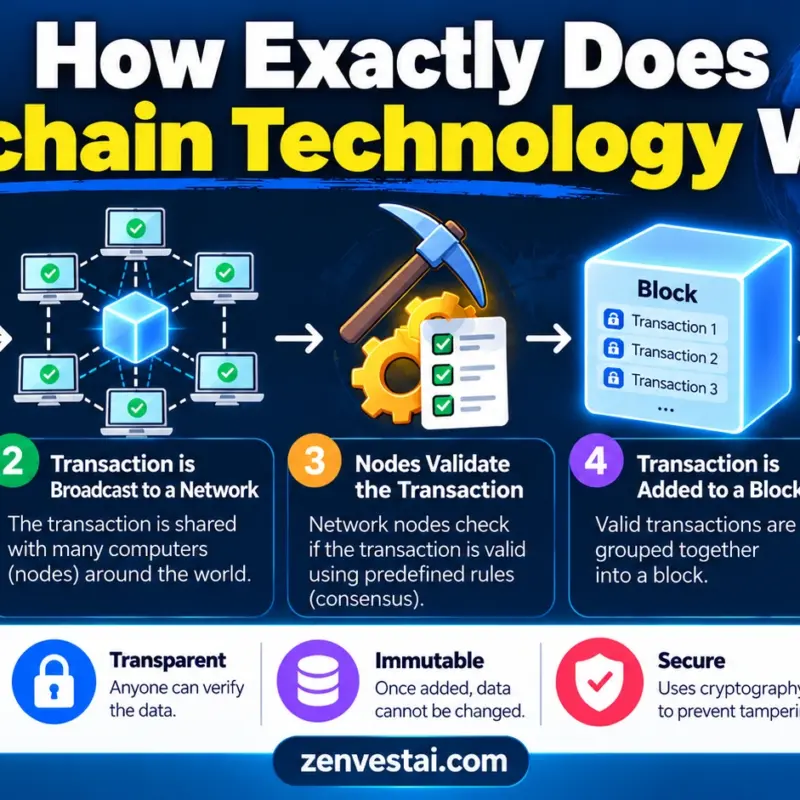
- Part 1: How Exactly Does Blockchain Technology Work? breaks down decentralized networks, distributed nodes, and peer-to-peer consensus without central servers.
- Part 2: What Is a Blockchain Block and How Does It Store Transactions? examines the anatomy of a block, block headers, payload capacities, and Merkle trees.
- Part 3: How Do Hashes and Cryptography Secure a Blockchain?
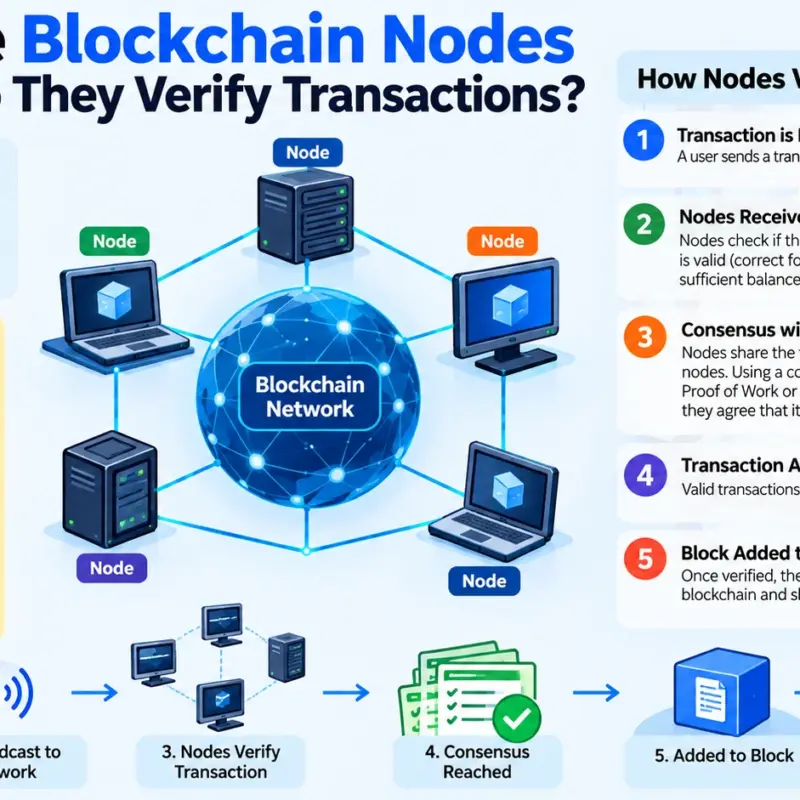
- Part 4: What Are Blockchain Nodes and How Do They Verify Transactions?
- Part 5: What Is Blockchain Consensus and How Do Networks Agree on Transactions?
Why Bitcoin Relies on Proof of Work
The core dilemma of digital cash has always been preventing the double-spend problem without relying on an intermediary. If a currency exists solely as digital information, copying and spending the exact same token twice requires no physical effort. Traditional systems solve this by giving an administrator the master key. Satoshi Nakamoto solved it by binding ledger history directly to the immutable laws of thermodynamics through the Bitcoin Whitepaper.
Proof of Work ensures that establishing consensus across thousands of distributed machines carries a verifiable computational cost. Because energy cannot be faked, printed, or hallucinated, any participant can instantly look at the longest chain with the greatest cumulative difficulty and know it represents genuine, unforgeable history.
Now that we see why computational commitment is necessary, let us look at what the participants doing this work are actually doing every second.
What Bitcoin Mining Actually Is
Bitcoin mining is the competitive, decentralized business of batching transactions and providing tamper-resistant settlement guarantees. Many newcomers picture miners sitting in front of monitors solving algebra questions, but mining in reality is pure automated probability.
Specialized computing chips known as Application-Specific Integrated Circuits (ASICs) calculate trillions of mathematical guesses per second, racing to package fresh transfers into an accepted block.
Miners do not invent transactions; they process user payments, arrange them efficiently, and commit their capital to secure the network. In exchange for this continuous effort, the protocol rewards winning miners with newly issued bitcoin alongside user transaction fees.
To truly understand how this machine functions, we must walk through every stage a transaction undergoes before achieving finality.
Step-by-Step: The Lifecycle of a Mined Block
A single bitcoin payment moves through a precise assembly line from the moment a user clicks send to its permanent recording in the ledger.
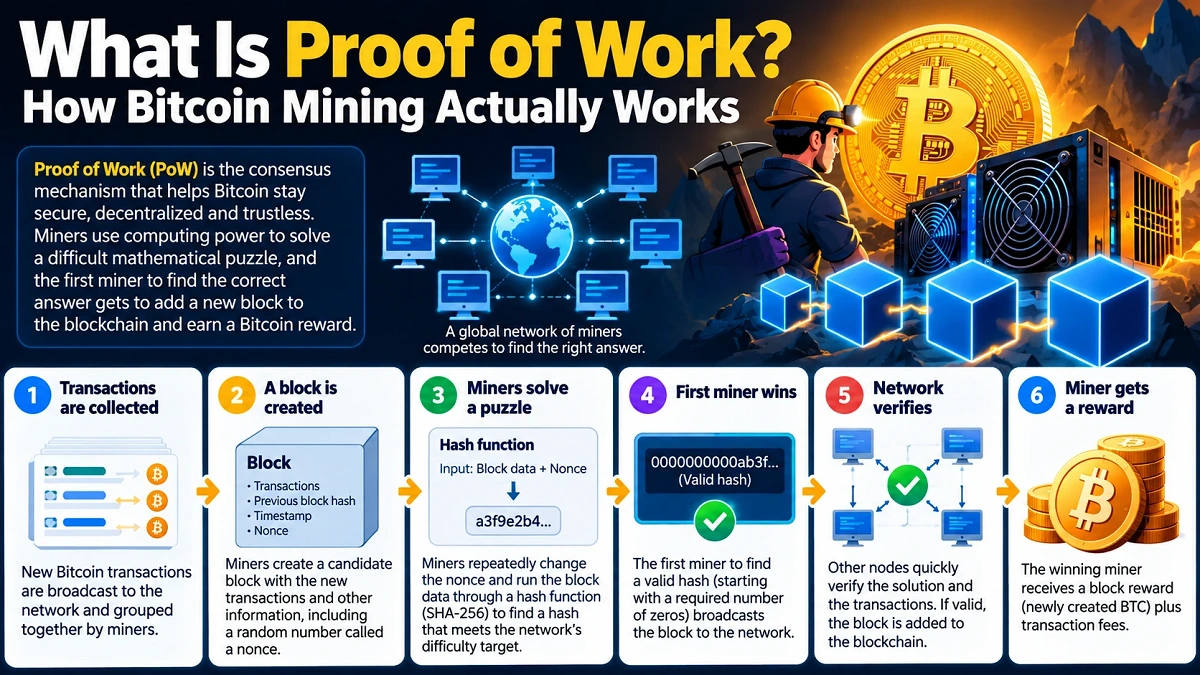
1. Transaction Collection in the Mempool
Every valid broadcast transaction lands in the local mempool (memory pool) of independent full nodes and miners across the globe. Miners continuously monitor their mempool, sorting transactions by fee density (satoshis per virtual byte) to maximize their eventual revenue. High-priority transactions with competitive fees are picked up first.
2. Constructing the Candidate Block
The miner selects transactions from its mempool up to the maximum block capacity and constructs a candidate block. At the top of this collection, the miner inserts the unique coinbase transaction, which assigns the 3.125 BTC block subsidy plus all transaction fees directly to the miner’s payout address.
The miner summarizes all transactions into a single cryptographic cryptographic root called a Merkle root. This Merkle root is then placed into the fixed 80-byte block header, alongside the version number, the hash of the preceding block, the current timestamp, and the difficulty target.
3. Solving the Hash Puzzle
Miners take the 80-byte block header and run it through the SHA-256 hash algorithm twice. The network protocol sets a dynamic rule: the resulting 256-bit hash output must be numerically less than or equal to a specific difficulty target.
The miner cannot alter the transactions or the previous block hash without changing the entire structure. Therefore, the miner increments a tiny counter in the header called the nonce (a 32-bit number) and hashes the header again.
Because SHA-256 is mathematically unpredictable, finding a number that results in a hash with the required number of leading zeros is like spinning a digital lottery wheel billions of times per second.
4. Exhausting the Nonce and Rolling ExtraNonce
A 32-bit nonce offers roughly 4.29 billion possibilities 2³². Modern industrial mining rigs calculate hundreds of terahashes per second, exhausting this entire nonce space in mere milliseconds.
When the nonce space is exhausted without finding a valid hash, the mining software modifies the extraNonce located within the coinbase transaction.
Changing the extraNonce generates a brand-new Merkle root, refreshing the entire block header and granting billions of fresh combinations to test.
5. Finding and Broadcasting a Valid Block
When an ASIC rig finally hits an output below the network target, the search ends instantly for that round. The winning miner packages the block and immediately broadcasts it across the peer-to-peer network via protocols like the Bitcoin FIBRE Network to minimize latency.
Speed of propagation is critical because any delay increases the risk that another competing miner discovers a valid block at the same height.
6. Block Verification by Independent Full Nodes
Finding a block does not automatically write it to history until the rest of the network agrees. Thousands of independent full nodes receive the broadcast block and run strict verification checks without trusting the miner:
- Did the block hash meet the difficulty target?
- Are all transactions mathematically valid without double spends?
- Does the coinbase reward equal exactly 3.125 BTC plus legitimate fees?
If even one satoshi is miscalculated or an invalid signature exists, full nodes silently reject the block. The miner forfeits all invested electricity and hardware depreciation without earning a single cent.
7. Claiming the Mining Reward
Once accepted by the nodes, the block is appended to the chain. The miner receives the coinbase reward, but the network imposes a mandatory 100-block maturation period before those newly minted coins can be spent. This prevents miners from spending rewards from blocks that might get reorganized.
This structured workflow demonstrates that miners perform arduous work, but what stops two miners from finishing at the exact same moment?
What Happens When Competing Miners Find Blocks Simultaneously?
Because thousands of miners operate concurrently across different continents, two independent miners occasionally produce valid blocks within seconds of each other. This creates a temporary split known as a competing block or accidental fork.
When nodes receive two valid competing blocks at identical height, they store both but build on whichever block they received first. The network remains briefly divided until the next block is solved. The moment another miner finds a subsequent block on top of one branch, that branch becomes the longest valid chain containing the greatest accumulated proof of work.
Nodes automatically recognize the heavier chain as the authoritative ledger. The abandoned block is termed an orphaned block (or stale block), and its transactions return to the mempool to be packaged into future blocks.
The Economics of Difficulty Adjustment
Bitcoin guarantees predictability by adjusting its mining difficulty every 2,016 blocks, which corresponds to approximately two weeks. If massive waves of modern hardware enter the network and blocks arrive faster than every 10 minutes, the network increases the difficulty target. Conversely, if miners power down due to market downturns and blocks slow down, difficulty drops.
This automated thermostat ensures that whether the total computing power is 100 Terahashes or 800 Exahashes, the issuance rate of new bitcoin remains strictly algorithmic and immune to human manipulation.
Energy Realities, Hardware Cycles, and Network Security
The energy consumed by Bitcoin mining is frequently debated, yet that expenditure serves as the physical shield defending the ledger. Reversing a transaction requires accumulating more hashing power than the entire honest rest of the network combined—an attack known as a 51% attack.
Because global mining involves hundreds of millions of watts distributed across multiple continents, executing such an attack would cost billions of dollars in specialized ASICs, electrical grid access, and site infrastructure. Furthermore, as soon as an attacker attempts to double-spend, the economic value of the network they spent billions to subvert would collapse, rendering their attack economically irrational.
Modern mining increasingly co-locates with stranded natural gas, hydroelectric spillways, and curtailed renewable installations, turning wasted curtailment energy into monetary security.
ZenvestAI Exclusive Insight: The Thermodynamic Settlement Ratio
Mainstream commentary routinely evaluates Bitcoin mining strictly through aggregate kilowatt-hours consumed. At ZenvestAI, our proprietary tracking analyzes the Thermodynamic Settlement Ratio (TSR): the precise economic value settled per joule of energy burned across 90-day moving windows.
Our research reveals that as hash rates hit historic highs, the efficiency of energy conversion into economic immutability has improved by over 340% across recent hardware generations. The network now secures more gross economic value per watt than at any prior point in cryptocurrency history, directly debunking the myth that hashrate expansion linearly degrades energy utility.
Frequently Asked Questions
Can Bitcoin mining ever run out of coins to mine?
No. The last fraction of a bitcoin will be mined around the year 2140 due to programmatic halvings occurring every 210,000 blocks. After issuance reaches 21 million BTC, miners will be compensated entirely through user transaction fees.
What is the difference between a miner and a full node?
A miner spends computing energy searching for valid nonces to create new blocks. A full node maintains a complete copy of the ledger and enforces consensus rules by verifying every block and transaction. Miners propose; nodes validate.
Could someone solve the hash puzzle using a supercomputer or quantum machine?
Standard supercomputers are general-purpose processors (CPUs/GPUs) and are thousands of times slower at SHA-256 calculations than custom ASIC miners. Quantum computers currently lack the coherent qubits required to reverse SHA-256 functions, and the network can migrate to post-quantum signature schemes if necessary.
Why cannot a miner simply fake the difficulty target?
Every full node calculates the target independently based on historical block timestamps. If a miner broadcasts a block that does not satisfy the mathematically verified target, full nodes immediately drop it.
ZenvestAI View
Proof of Work remains the only battle-tested consensus mechanism that anchors digital ownership to physical reality without introducing systemic centralized staking cartels.
The Bottom Line
Bitcoin mining does not exist to process simple math problems; it exists to make altering historical financial truth so physically expensive that honesty remains the only profitable choice.
Related Intelligence & Primary References
- Examine foundational principles in the original Nakamoto Bitcoin Consensus Architecture.
- Inspect real-time network mining difficulty adjustments at Bitcoin Block Explorer.
- Review technical documentation on header formatting at the Bitcoin Core Developer Guide.
Global Regulatory & Educational Disclosures
Educational Publication Notice: This analysis is published strictly for educational and technical informational purposes in accordance with global financial communication frameworks, including guidelines issued by the International Organization of Securities Commissions (IOSCO), the U.S. Securities and Exchange Commission (SEC), and the European Union Markets in Crypto-Assets (MiCA) regulation. Nothing in this document constitutes financial advice, investment endorsement, mining equipment solicitation, or tax counsel.