To understand how global blockchains safeguard billions of dollars in digital assets without relying on a central authority, one foundational concept must come first.
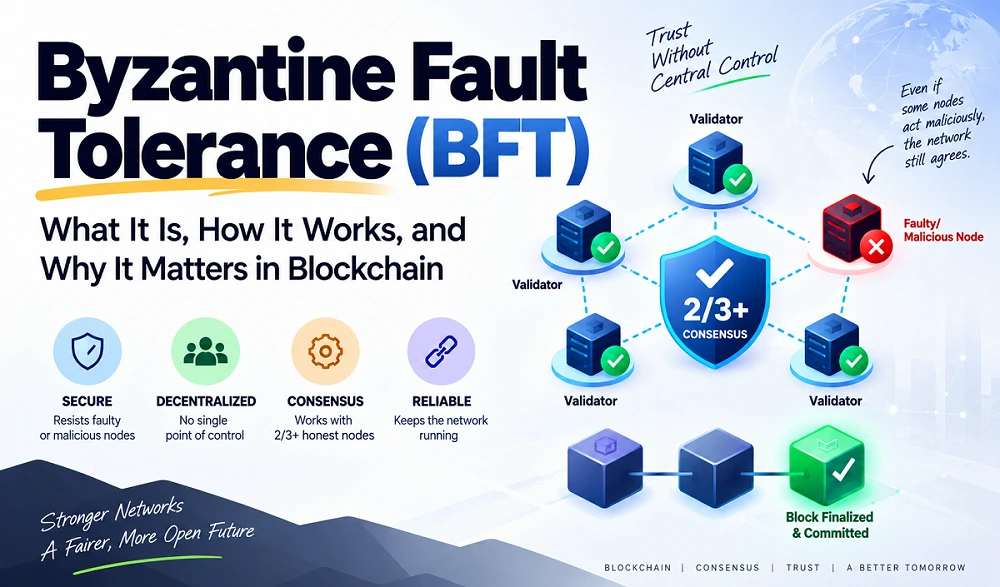
ZenvestAI Quick Answer:Byzantine Fault Tolerance (BFT) is the ability of a distributed system to reach consistent agreement and continue operating correctly even when some participating nodes behave incorrectly, maliciously, or arbitrarily.
In simple terms, imagine 10 computers connected across the globe managing a single financial balance sheet.

Some computers might suffer sudden hardware failures, while others could be secretly controlled by attackers attempting to alter account balances or send contradictory instructions to different peers.

A system with Byzantine Fault Tolerance guarantees that all honest computers reach an identical, valid decision despite the presence of bad actors or failing machines.
The National Institute of Standards and Technology explains this in NIST IR 8202: Blockchain Technology Overview. Blockchain networks are made of independent computers that do not know or trust each other.
These computers use consensus rules and shared records to communicate. Together, these tools keep everyone’s data identical and synchronized. As a result, the network runs as smoothly and accurately as if a single, trusted central authority were in charge.
At a Glance: Key Takeaways
- The Problem Solved: BFT resolves the fundamental challenge of coordinating independent computers over an imperfect network where individual nodes can crash, delay communication, or intentionally broadcast false data.
- The Classical Threshold (3f + 1): In traditional BFT architectures, a network must contain at least 3f + 1 total nodes to safely withstand f malicious or faulty nodes. That means fewer than one-third
(strictly less than 33.3%)of the consensus participants can be compromised. - Concept vs. Mechanism: BFT is an architectural security property and engineering goal, not a single proprietary blockchain consensus algorithm.
- Deterministic Finality: Unlike probabilistic Proof-of-Work systems where transactions gain security gradually with block depth, BFT-based blockchains achieve immediate, irreversible finality the instant a block is committed.
- Sybil Resistance Synergy: BFT governs consensus voting rules, but it relies on economic mechanisms like Proof of Stake (PoS) to prevent an attacker from fabricating unlimited fake validator identities.
Before examining how distributed systems reach consensus, we must clearly define what Byzantine Fault Tolerance means in computing and finance.
Table of Contents
- Byzantine Fault Tolerance (BFT): What It Is, and How It Works
- What Is Byzantine Fault Tolerance?
- What Is the Byzantine Generals Problem?
- Why Does Byzantine Fault Tolerance Matter in Blockchain?
- How Does Byzantine Fault Tolerance Work?
- What Is the 3f + 1 Rule?
- Byzantine Fault Tolerance in Blockchain
- What Is PBFT (Practical Byzantine Fault Tolerance)?
- BFT vs. Proof of Stake: What Is the Difference?
- Protocol Evolution: PBFT vs. Tendermint vs. HotStuff
- BFT vs. Bitcoin’s Nakamoto Consensus
- Safety vs. Liveness in BFT Systems
- What Happens When Byzantine Nodes Attack?
- Advantages of Byzantine Fault Tolerance
- Limitations of Byzantine Fault Tolerance
- Is Something New Happening in Byzantine Fault Tolerance?
- Real-World Applications of Byzantine Fault Tolerance
- Byzantine Fault Tolerance: A Practical Numerical Example
- Common Misconceptions About Byzantine Fault Tolerance
- Frequently Asked Questions About Byzantine Fault Tolerance
- ZenvestAI View
- Related Intelligence and Research Foundations
Byzantine Fault Tolerance (BFT): What It Is, and How It Works
What Is Byzantine Fault Tolerance?
Every digital network that handles financial transactions must guarantee that its shared records remain accurate, tamper-proof, and synchronized across every participant.
In standard distributed computing, network nodes can experience two distinct categories of failure:
- Crash Failures (Fail-Stop): A node simply stops functioning, loses electrical power, or drops offline. It does not transmit false or misleading data; it simply goes silent.
- Byzantine Failures (Arbitrary or Malicious): A node behaves arbitrarily and unpredictably. It may crash, delay network packets, selectively drop messages, forge transactions, or deliberately send conflicting data to different participants to sow confusion.
Byzantine Fault Tolerance is the architectural property of a system that withstands arbitrary Byzantine failures. A BFT network continues processing user transactions reliably, strictly preserving two fundamental guarantees:
- Consistency (Safety): All honest nodes agree on the exact same ledger state and transaction ordering.
- Availability (Liveness): The network remains fully responsive and continues producing blocks without halting.
In cryptocurrency and Web3 infrastructure, network participants are referred to as validators or validator nodes.
Because anyone around the world can theoretically operate, attack, or compromise a node, consensus protocols must assume by default that a percentage of participants will behave dishonestly.
BFT provides the mathematical and cryptographic safeguards ensuring honest validators always prevail.
To understand why computer scientists named this critical challenge after an ancient empire, we need to examine the theoretical problem that started it all.
What Is the Byzantine Generals Problem?
The term originates from a landmark 1982 computer science paper titled The Byzantine Generals Problem, authored by Leslie Lamport, Robert Shostak, and Marshall Pease.
The authors created an intuitive allegory: Imagine several divisions of the Byzantine army surrounding an enemy fortress. Each division is stationed separately and commanded by its own general. The generals communicate solely through human messengers traveling across the battlefield.
To succeed, all divisions must execute the exact same plan simultaneously—either attacking all at once or retreating in unison. A fragmented strategy where half the army attacks while the other half retreats will result in total defeat.
The critical complication is that some generals are traitors seeking to sabotage the mission.
A traitorous general might send an “Attack” order to two camps and a “Retreat” order to two others. Furthermore, messengers can be intercepted, captured, delayed, or replaced.
The fundamental challenge is clear: How can the loyal generals coordinate and reach a unanimous agreement despite the presence of traitors actively spreading contradictory messages?
The Byzantine Generals Analogy Mapped to Blockchain
| Byzantine Allegory Component | Blockchain Equivalent | Network Function |
| Army Generals | Validators / Nodes | Independent servers verifying transactions and proposing new blocks. |
| Messengers | Peer-to-Peer (P2P) Gossip Messages | Network packets transmitting proposed blocks, votes, and digital signatures. |
| Traitorous Generals | Byzantine / Compromised Nodes | Corrupted validators double-voting, lying about balances, or going offline. |
| Attack or Retreat Order | State Transition / Block Proposal | The collective decision to finalize or reject a proposed batch of transactions. |
| Unanimous Battle Plan | Distributed Consensus | Identical ledger balances maintained across all honest nodes on the network. |
Once computer scientists proved that coordination under arbitrary failure conditions was mathematically possible, the next question became how to apply this theory to real distributed ledger systems.
Why Does Byzantine Fault Tolerance Matter in Blockchain?
Byzantine Fault Tolerance is not just an optional feature in blockchain; it is the foundational engine that makes decentralized digital money possible in the first place.
In traditional software systems, computers operate in closed, protected environments. Companies like Google, Amazon, or Visa use classic consensus systems (such as Paxos or Raft) that only handle crash failures.
These systems assume that every server in their private data center is fundamentally honest.
If a single server in a Raft cluster is hacked and begins broadcasting fake ledger entries or contradictory numbers, the entire database breaks down because it has zero defenses against deliberate deception.
Blockchains exist in an open, adversarial world where real money is at stake, participants are anonymous, and attackers have massive financial incentives to lie. Without Byzantine Fault Tolerance, the entire concept of a trustless public blockchain collapses.
Here is exactly why BFT is indispensable to modern blockchain networks:
1. It Solves the Double-Spending Problem Without a Bank
In a physical cash economy, you cannot hand the same $20 bill to two different merchants. In a digital network without a central administrator, copying and transmitting digital data is practically free.
BFT matters because it provides the mathematical consensus rule that forces every computer on earth to agree on which transaction occurred first.
By requiring a cryptographic supermajority before a block is accepted, BFT makes it impossible for an attacker to double-spend the same cryptocurrency balance twice across different parts of the network.
2. It Replaces Blind Trust with Cryptographic Proof
Traditional financial institutions require you to place complete trust in a centralized board of directors, database administrators, and government regulators to protect your balance sheet.
BFT matters because it eliminates the single point of failure. Even if several validator nodes are seized by hackers, compromised by malicious insiders, or subjected to government censorship, the blockchain continues executing transactions honestly.
You no longer need to trust who runs the computers; you only rely on the mathematical reality that honest nodes outnumber the malicious threshold.
3. It Guarantees Absolute State Synchronization Across the Globe
As formally defined in NIST IR 8202: Blockchain Technology Overview, a blockchain functions as a replicated state machine. For a global ledger to function reliably, every node from Tokyo to Frankfurt must maintain the exact same balance sheet at every second.
BFT matters because it provides orderly, synchronized state transitions. Even when international internet traffic lags, data packets drop, or nodes receive messages out of order, the BFT voting protocol guarantees that all honest machines transition to the exact same new state in lockstep.
4. It Delivers Irreversible, Legally Enforceable Settlement (Deterministic Finality)
In global finance, institutional settlements and multi-million-dollar cross-border payments cannot remain in a state of uncertainty where a transaction might be reversed or reorganized hours later.
BFT matters because it produces deterministic, irreversible finality. The moment a BFT block receives the required two-thirds supermajority of validator votes, the transaction is permanently written to the ledger. There are no probabilistic risks, no chain reorganizations, and no 60-minute waiting periods for confirmations.
This mathematical certainty is what makes modern blockchains viable for institutional clearing houses, decentralized exchanges, and real-world asset tokenization.
5. It Aligns Economic Incentives with Network Defense
In modern Proof-of-Stake blockchains, BFT provides the unambiguous mathematical evidence needed to punish bad actors.
Because BFT protocol rules are mathematically strict, any attempt by a validator to act maliciously—such as signing two conflicting blocks at the exact same height—generates cryptographic proof of betrayal that any node can verify.
BFT matters because it turns dishonest behavior into an instant financial penalty: the network automatically identifies the offender’s public key and burns their staked collateral (slashing), making an attack economically self-destructive.
ZenVestAI Quick Insight: Without BFT, a blockchain is simply an insecure, slow distributed database vulnerable to the first person who decides to lie. With BFT, it becomes an unshakeable global settlement layer capable of operating securely across an untrusted world.
To see how systems prevent these failures in practice, we must walk through the step-by-step consensus mechanism that nodes execute during every block.
How Does Byzantine Fault Tolerance Work?
BFT protocols reach consensus through structured, sequential rounds of proposals, message exchanges, and cryptographic voting.
While specific implementations vary, most modern BFT protocols follow a standard multi-step progression:
Block Proposal → Validator Verification → Vote Broadcasting → Consensus Threshold Check → 2/3+ Agreement → Block Finalized & Committed
Step 1: A Designated Leader Proposes a Block
During each round or epoch, the protocol selects a validator (often called the leader or proposer) using a deterministic, verifiable algorithm. The proposer gathers pending user transactions, bundles them into a proposed block, and broadcasts it across the peer-to-peer network.
Step 2: Validators Independently Verify the Proposal
Upon receiving the proposed block, every active validator independently evaluates the transactions against the network’s strict execution rules. They verify cryptographic digital signatures, ensure sending accounts hold sufficient balances, and confirm that no double-spend attempts exist.
Step 3: Validators Broadcast Cryptographic Votes
Validators do not merely keep their verification internal; they sign a cryptographic message expressing their approval or rejection of the proposal and broadcast this vote to all other validators (or directly to the round leader).
Step 4: The Protocol Applies Voting Rules
Each validator tallies the incoming signed votes from its peers across the network. To guarantee absolute safety, the protocol requires a supermajority of the total network voting power—typically greater than two-thirds (> 66.7%).
Step 5: Consensus Is Reached and State Is Committed
Once a validator observes that more than two-thirds of the network has voted in favor of the proposal, it writes the block permanently to its local storage database. At this precise instant, the block is considered finalized.
Step 6: Honest Nodes Synchronize to the Same State
Because the cryptographic voting threshold ensures that two conflicting proposals could never both gather a two-thirds supermajority, all honest nodes append the identical block to their local chain, preserving unbroken consistency across the ecosystem.
This reliance on voting thresholds brings us to the core mathematical equation governing classical BFT systems.
What Is the 3f + 1 Rule?
In distributed systems, the mathematical threshold that determines how many faulty nodes a network can survive is defined by the classical 3f + 1 rule.
Formally introduced in foundational distributed computing literature, many classical Byzantine fault-tolerant protocols operating in partially synchronous networks require that the total number of nodes, denoted as n, satisfies:
n ≥ 3f + 1
Where:
- n represents the total number of independent validators participating in the active consensus set.
- f represents the maximum number of Byzantine (malicious, compromised, or offline) nodes the network can tolerate without failing.
Expressed as a percentage, a classical BFT system can tolerate up to, but strictly less than, one-third of its total consensus participants behaving dishonestly:
f < n / 3
Why Is 3f + 1 Necessary?
To understand the mathematics intuitively, consider what an honest node must do to make progress when network delays exist:
- In a network of n nodes where f nodes are Byzantine, up to f nodes might crash or refuse to communicate.
- Because an honest node cannot distinguish between a node that has crashed and a node that is merely experiencing internet congestion, it cannot wait for all n messages. It must be able to proceed after receiving n – f responses.
- However, among those
n - f responsesthat arrived promptly, up to f of them could have originated from malicious nodes that actively lied. - Therefore, to ensure that the honest, correct messages outnumber the malicious ones, the remaining authentic responses
(n - f) - f = n - 2fmust strictly exceed the number of faulty nodes (f):
(n - f) - f > f → n - 2f > f → n > 3f → n ≥ 3f + 1
Classical Fault Tolerance Thresholds
| Total Validators (n) | Maximum Tolerated Byzantine Nodes (f) | Minimum Honest Votes Required (2f + 1) | Maximum Byzantine Fault Percentage |
| 4 | 1 | 3 | 25.0% |
| 7 | 2 | 5 | 28.6% |
| 10 | 3 | 7 | 30.0% |
| 13 | 4 | 9 | 30.8% |
| 100 | 33 | 67 | 33.0% |
Important Technical Distinction: The 3f + 1 rule is the standard for traditional BFT systems operating with regular internet delays.
However, researchers have built specialized models for different network conditions. In a strictly timed network where messages are guaranteed to arrive quickly, systems can tolerate more failures—up to nearly half the nodes (f < n / 2).
In completely unpredictable networks where delays are unlimited, systems use randomized steps to reach agreement. As explained in NIST IR 8202: Blockchain Technology Overview, a protocol’s design assumptions directly determine how many bad actors it can safely survive.
Now that we understand the mathematics, we can clarify how BFT relates specifically to modern blockchains.
Byzantine Fault Tolerance in Blockchain
One of the most frequent points of confusion among cryptocurrency investors and developers is the distinction between a system property and an algorithmic implementation.
Core Fact: Byzantine Fault Tolerance is not a specific blockchain consensus protocol; it is a security property that a consensus protocol achieves.
When developers describe a blockchain as a “BFT blockchain,” they mean the network utilizes a consensus protocol mathematically structured to resist Byzantine actors. The primary real-world application of BFT within modern Web3 systems occurs in BFT-style Proof of Stake (PoS) networks.
In these systems:
- Validators lock up (“stake”) financial capital in the form of cryptocurrency tokens to earn voting rights in the consensus process.
- The network runs a BFT state-machine protocol where validators cast cryptographically signed votes on proposed transaction blocks.
- The protocol delivers deterministic finality: the moment a block receives two-thirds plus one (2/3 + 1) of the staked voting power, it is permanently locked into the ledger history and cannot be reorganized or rolled back.
Prominent blockchain ecosystems using BFT-style consensus engines include Cosmos (CometBFT / Tendermint), Aptos and Sui (HotStuff / Mysticeti variants), Hedera, and enterprise networks like Hyperledger Fabric.
To trace the evolution of these protocols, we must look at the first algorithm that made BFT practical for real-world networks.
What Is PBFT (Practical Byzantine Fault Tolerance)?
Before 1999, Byzantine consensus algorithms were largely theoretical and considered far too computationally slow for real-world production networks.
That changed when Miguel Castro and Barbara Liskov published their breakthrough paper, Practical Byzantine Fault Tolerance (PBFT), at the OSDI conference in 1999.
PBFT proved that a distributed system could operate in asynchronous environments like the internet while providing high-performance state-machine replication.
PBFT operates via a view-by-view system led by a designated primary node (the leader) alongside backup nodes, progressing through three explicit message phases:
- Pre-Prepare Phase: The primary node assigns a sequence number to a client’s request, bundles it, and broadcasts a PRE-PREPARE message to all backup nodes.
- Prepare Phase: Each node validates the message and broadcasts a PREPARE message to every other node in the network. Each node collects messages until it possesses a quorum of 2f + 1 valid prepare messages, establishing that all honest nodes agree on the sequence order of the request within the current view.
- Commit Phase: Nodes broadcast a COMMIT message to all peers. Once a node gathers 2f + 1 commit messages, it commits the transactions locally to its state machine and returns an execution confirmation to the client.
The PBFT Bottleneck: Communication Overhead
While PBFT was an engineering milestone, it had a major architectural drawback: quadratic message complexity, expressed mathematically as O(n²).
Because every node must broadcast prepare and commit messages to every other node in the network, the total volume of network messages scales with the square of the participant count:
- In a network of 4 nodes, message traffic is negligible.
- In a decentralized network of 1,000 public validators, quadratic communication generates approximately 1,000,000 network interactions per block, rapidly saturating network bandwidth and causing performance to collapse.
Consequently, original PBFT remains best suited for permissioned or consortium networks with small, designated validator groups (typically under 20 to 50 nodes).
Understanding PBFT’s scalability limits clarifies why modern public blockchains combine BFT logic with separate economic mechanisms like Proof of Stake.
BFT vs. Proof of Stake: What Is the Difference?
Newcomers to cryptocurrency often treat BFT and Proof of Stake (PoS) as competing alternatives. In reality, they perform entirely separate functions that complement one another.
- Proof of Stake (PoS) is an economic Sybil-resistance and validator-selection mechanism. It determines who gets to participate in consensus and how heavily their vote is weighted, based on the quantity of economic capital they have bonded to the network.
- Byzantine Fault Tolerance (BFT) is the consensus and agreement framework. It dictates how those selected validators communicate, vote, detect dishonest behavior, and finalize ledger transitions.
Without PoS, an open, permissionless BFT network would be destroyed by a Sybil attack: an adversary could launch 10,000 virtual computers at near-zero cost, easily capture more than one-third of the consensus set, and halt or corrupt the blockchain.
Conversely, PoS alone does not finalize blocks; it requires a consensus protocol (such as a BFT voting engine) to coordinate the staked nodes.
Modern networks combine both: Proof of Stake solves the identity and economic alignment layer, while BFT solves the message ordering and finality layer.
Comparative Breakdown
| Feature | Byzantine Fault Tolerance (BFT) | Proof of Stake (PoS) |
| Primary Domain | Distributed consensus, message protocols, fault tolerance. | Economic security, validator eligibility, Sybil defense. |
| Core Question Answered | “How do participants agree on the validity and order of transactions?” | “Who is allowed to participate, and what happens if they lie?” |
| Enforcement Mechanism | Cryptographic threshold signatures and multi-round voting rules. | Capital bonding, staking yields, and automated slashing penalties. |
| Fault Mitigation | Survives up to f < n / 3 arbitrary network failures or malicious attacks. | Discourages attacks by permanently burning staked capital if double-signing occurs. |
| Finality Type | Deterministic (immediate and mathematically irreversible upon quorum). | Dependent on the underlying consensus engine (probabilistic or deterministic). |
As blockchain architects sought to scale these systems to hundreds of validators, they developed second- and third-generation BFT protocols to replace PBFT.
Protocol Evolution: PBFT vs. Tendermint vs. HotStuff
To bring BFT into production blockchains with dozens or hundreds of distributed validators, engineers modernized classical state-machine replication.
1. Tendermint-Core (CometBFT)
Developed by Jae Kwon and Ethan Buchman in 2014, Tendermint adapted BFT specifically for blockchain architecture. Tendermint replaces complex view changes with structured two-step voting rounds (consisting of Prevote and Precommit stages) locked to specific block heights.
If a proposer fails, validators simply advance their internal round timer. Tendermint powers the Cosmos ecosystem, delivering 1-second to 6-second deterministic finality across networks with 100 to 180 active validators.
2. HotStuff (Pipelined BFT)
Introduced in 2018 by researchers at VMware and detailed in HotStuff: BFT Consensus in the Lens of Blockchain, HotStuff solved the leader-change communication bottleneck that afflicted both PBFT and early Tendermint implementations.
In HotStuff, validators do not broadcast messages to every peer; instead, they send votes directly to the round leader, who aggregates them into compact threshold signatures (Quorum Certificates) and broadcasts the summary back.
- This reduces communication complexity to linear overhead, expressed as O(n) during both normal operations and view changes.
- Furthermore, HotStuff pipelines consensus stages: the prepare phase of one block serves as the pre-commit phase of the previous block, dramatically boosting transaction throughput.
- HotStuff served as the foundational consensus engine for Meta’s Diem project and directly underpins modern Layer-1 blockchains including Aptos (AptosBFT) and Sui (Mysticeti / Bullshark engines).
BFT Protocol Comparison Matrix
| Architectural Metric | PBFT (1999) | Tendermint / CometBFT (2014) | HotStuff / AptosBFT (2019+) |
| Communication Complexity | O(n²) normal; O(n³) view-change | O(n²) all-to-all gossip | O(n) linear via star topology |
| Leader Handover Cost | Extremely high; complex view-change logic | Moderate; round skips on timeout | Low; seamless pipelining of leader handoffs |
| Finality Characteristic | Immediate deterministic commit | Deterministic block-by-block | Pipelined deterministic commit |
| Target Operating Environment | Permissioned consortiums (< 30 nodes) | Public PoS chains (100 to 200 validators) | High-throughput Layer-1s (100 to 500+ nodes) |
| Primary Production Examples | Hyperledger Fabric, early private chains | Cosmos Hub, Osmosis, Celestia | Aptos, Sui, Diem (historical) |
Having analyzed BFT-style consensus, we can now compare it directly against the system that introduced blockchain to the world: Bitcoin.
BFT vs. Bitcoin’s Nakamoto Consensus
Many cryptocurrency articles incorrectly state that Bitcoin does not possess Byzantine fault tolerance. In reality, Bitcoin solves the Byzantine Generals Problem using a completely different design philosophy: Nakamoto Consensus.
Bitcoin creator Satoshi Nakamoto took a radically different route than classical computer scientists. Traditional systems rely on a private list of validators exchanging rounds of votes. Satoshi Nakamoto replaced voting entirely.
Instead, Nakamoto combined Proof of Work, cryptographic hashing, and peer-to-peer messaging with the Longest-Chain Rule. Under this rule, the network simply follows the chain that required the most computational effort to create.
Key Differences
- Validator Set Dynamics: Classical BFT requires an explicit, known roster of validators to calculate what constitutes a two-thirds (2/3) supermajority. Nakamoto consensus is completely open and permissionless: miners can join or leave the network at any second without notifying anyone or breaking protocol rules.
- Deterministic vs. Probabilistic Finality: BFT protocols provide deterministic finality. When a block is finalized by a BFT quorum, it cannot be altered without an overt, provable violation of protocol rules. Bitcoin provides probabilistic finality. A newly mined block could technically be reorganized if another miner secretly creates a longer valid chain. As more blocks are built on top of a Bitcoin transaction, the mathematical probability of a reversal drops toward zero, but it never reaches absolute finality. This is why cryptocurrency exchanges require users to wait for 3 to 6 block confirmations.
- Fault Tolerance Threshold: Classical BFT tolerates up to 33.3% Byzantine voting power. Nakamoto consensus tolerates up to 50% of malicious computing power (hashrate), assuming synchronous network propagation.
BFT vs. Nakamoto Consensus
| Operational Dimension | BFT Consensus (e.g., Tendermint, HotStuff) | Nakamoto Consensus (e.g., Bitcoin) |
| Underlying Sybil Shield | Staked financial capital (Proof of Stake). | Thermodynamic computational energy (Proof of Work). |
| Membership Model | Known, closed, or bonded validator roster. | Open, dynamic, and anonymous miner participation. |
| Finality Speed | Instantaneous (sub-second to a few seconds). | Probabilistic (approximately 60 minutes for high security). |
| Failure Mode (≥ Threshold) | Network halts safely to protect data integrity. | Blockchain forks or suffers a double-spend reorganization. |
| Energy Consumption | Minimal (lightweight server computation). | High (requires ongoing computational work). |
To evaluate how BFT protocols behave under extreme stress, we must examine the core tension of distributed computing: the trade-off between safety and liveness.
Safety vs. Liveness in BFT Systems
In 1985, researchers Fischer, Lynch, and Paterson published one of the most famous results in computer science: the FLP Impossibility Theorem.
It proved that in an asynchronous network where messages can be arbitrarily delayed, no deterministic consensus protocol can simultaneously guarantee both Safety and Liveness if even a single node can experience an unannounced crash failure.
Every consensus protocol must balance these two properties:
- Safety (“Nothing bad happens”): The system guarantees that honest nodes will never finalize conflicting states. There will never be two valid block 100s, and a transaction will never be both confirmed and cancelled simultaneously.
- Liveness (“Something good eventually happens”): The system guarantees that it will never freeze indefinitely. Valid transactions will continually be processed, blocks will continue to be produced, and the network will remain operational.
The Classic BFT Choice: Safety Over Liveness
Faced with the FLP trade-off, classical BFT protocols prioritize Safety over Liveness.
If a catastrophic network partition occurs or more than one-third (> 33.3%) of validators go offline simultaneously, a BFT network will deliberately halt (stop producing new blocks) rather than risk producing two conflicting chains.
In institutional finance, halting a network to conduct an audit is far preferable to allowing fraudulent double-spend transactions.
Conversely, Nakamoto consensus systems like Bitcoin prioritize Liveness over Safety. If an international undersea cable disconnects North America from Europe, both sides of the Bitcoin network will continue mining blocks and accepting transactions independently.
When the cable is repaired, the shorter chain will be discarded, creating painful transaction rollbacks for anyone whose block was reorganized away.
Understanding how protocols prioritize safety brings us to the actual mechanics of malicious attacks.
What Happens When Byzantine Nodes Attack?
When bad actors control validator nodes, their goal is typically to freeze the network, double-spend digital currency, or extract profit by manipulating transaction sequencing.
Here are the primary attack vectors BFT protocols are engineered to neutralize:
1. Equivocation (Double-Signing)
An equivocation attack occurs when a validator signs two conflicting messages for the exact same block height or round—for instance, voting “Yes” on Block A while simultaneously voting “Yes” on Block B to different peers.
The BFT Defense: Because finalizing a block requires greater than two-thirds (> 2/3) of all votes, a double-spend via equivocation is mathematically impossible unless more than one-third of the validator set colludes.
In modern PoS networks, equivocation is easily proven cryptographically: any node that observes two contradictory signed messages from the same validator submits them to the network, triggering immediate slashing (the permanent burning of the attacker’s staked capital).
2. Message Withholding and Censorship
A malicious leader or colluding group of validators might accept transactions into their private pool but deliberately refuse to include them in proposed blocks, or withhold their own votes to delay finality.
The BFT Defense: BFT protocols employ strict round-timeout clocks. If a designated leader fails to broadcast a valid block within an assigned window (e.g., 2 seconds), the remaining nodes broadcast timeout votes, skip the unresponsive leader, and automatically rotate consensus leadership to the next validator in line.
3. Sybil and Collusion Invasions
If an attacker manages to acquire more than one-third (> 33.3%) of the total network voting power:
The Consequence: The attacker cannot unilaterally write fraudulent balances to the ledger (because honest nodes will reject invalid state changes), but they can launch a liveness denial-of-service attack by withholding all votes, causing the network to halt indefinitely.
The Recovery: Recovering from a greater than 33.3% Byzantine stall requires out-of-band social consensus: honest node operators coordinate through validator channels, identify the offending cryptographic public keys, and execute a hard fork that freezes or slashes the attacker’s stake to restore the network.
Evaluating these threats provides a balanced look at the core strengths and inherent trade-offs of BFT designs.
Advantages of Byzantine Fault Tolerance
Byzantine Fault Tolerance forms the foundation of modern enterprise networks and high-throughput blockchains for distinct architectural reasons:
- Instant, Deterministic Finality: BFT networks eliminate the uncertainty of probabilistic confirmations. Once a block is committed by the validator quorum, it is finalized immediately, enabling sub-second settlement for decentralized exchanges, payment rails, and gaming.
- Exceptional Energy Efficiency: Unlike Proof of Work, which expends vast electrical power solving hash puzzles, BFT protocols achieve security purely through cryptographic message exchanges and capital staking.
- High Transaction Throughput: Because BFT networks do not rely on artificial block-time delays to stabilize chain propagation, modern pipelined BFT engines can process thousands of transactions per second with low latency.
- Strong Institutional and Regulatory Compatibility: Regulated financial institutions require contractual settlement finality. BFT’s mathematical guarantee that transactions cannot be reorganized makes it the standard choice for central bank digital currency (CBDC) pilots and institutional finance settlement networks.
Limitations of Byzantine Fault Tolerance
Despite its strengths, Byzantine Fault Tolerance is not a universal solution for every distributed ledger, and it introduces clear trade-offs:
- Strict Scalability Ceilings on Validator Counts: Because BFT protocols rely on continuous peer-to-peer voting, message traffic increases dramatically as the validator set expands. While Bitcoin and Ethereum support tens or hundreds of thousands of mining or staking nodes, BFT chains typically cap their active validator sets between 100 and 300 nodes to preserve network performance.
- Vulnerability to Coordinated Halts at 33.4%: While a Proof-of-Work blockchain requires an attacker to amass more than 50% of the global hashrate to disrupt the chain, a BFT network’s liveness can be compromised if just 33.4% of validators coordinate to stop voting.
- Complexity of Implementation: Developing secure, production-grade BFT consensus code is notoriously difficult. Edge cases in network timing, leader rotation logic, and state synchronization can introduce critical vulnerabilities that stall networks or cause consensus forks.
- Network Synchrony Sensitivity: While modern protocols are designed for partial synchrony, severe internet partitions or widespread denial-of-service (DDoS) attacks against validator infrastructure can slow throughput to zero by triggering endless leader-timeout rounds.
These performance bottlenecks have spurred substantial research into the next generation of BFT protocols.
Is Something New Happening in Byzantine Fault Tolerance?
Consensus research is currently experiencing a renaissance, driven by the demand for sub-second Web3 applications and institutional financial settlement.
Rather than altering the mathematical definition of BFT, researchers are redesigning how protocols execute and order communication:
1. DAG-Based Consensus Architectures (Directed Acyclic Graphs)
Pioneered by academic breakthroughs like Narwhal, Tusk, and Bullshark, modern high-performance blockchains decouple data dissemination (mempool distribution) from transaction ordering (consensus).
Instead of forcing a single leader to handle block transmission and consensus ordering simultaneously, all validators continuously broadcast transaction batches into a shared DAG structure.
Once the data is distributed across the network, validators run an ultra-lightweight, zero-message-overhead BFT algorithm locally over the DAG graph to determine the total transaction order.
This architecture allows chains like Sui to achieve high throughput with low transaction latency.
2. Optimistic Fast-Path BFT (HotStuff-2)
Recent protocols implement dual-path consensus:
- The Fast Path: Under normal conditions when all nodes are honest and network latency is low, the protocol bypasses intermediate voting phases and achieves consensus in as few as two communication steps with unanimous (100%) agreement.
- The Fallback Path: If any node fails or behaves suspiciously, the engine automatically drops back to standard three-step BFT voting rules to guarantee safety.
3. Parallelized Execution Combined with Pipelined BFT
Modern Layer-1 blockchains like Aptos combine pipelined HotStuff variants with optimistic software transactional memory (Block-STM).
By pipelining consensus so that multiple blocks are voted on simultaneously while executing transactions across multiple CPU cores in parallel. These networks push state-machine replication toward the physical limits of hardware and fiber-optic cables.
These real-world implementations show how foundational research from 1982 continues to power modern computing infrastructure.
Real-World Applications of Byzantine Fault Tolerance
Byzantine Fault Tolerance extends far beyond cryptocurrency and financial ledgers into mission-critical computer systems:
REAL-WORLD BFT
[01] PUBLIC BLOCKCHAINS
Cosmos • Aptos • Sui
[02] ENTERPRISE
Hyperledger Fabric • R3 Corda
[03] AEROSPACE
Boeing 777 • NASA spacecraft
[04] DISTRIBUTED DATABASES
CockroachDB • Google Spanner
Public Web3 Infrastructure: Protocols like Cosmos, Celestia, Aptos, Sui, and Hedera use BFT consensus to secure billions of dollars in decentralized finance, cross-chain communication, and sovereign rollups.
Enterprise Distributed Ledgers: Platforms such as Hyperledger Fabric use PBFT-derived consensus plugins to coordinate private supply chains, interbank settlements, and international trade tracking where all participants have verified corporate identities.
Mission-Critical Aerospace Systems: Long before cryptocurrency existed, aircraft manufacturers like Boeing utilized Byzantine-tolerant redundant computers in flight-control platforms (such as the Boeing 777 fly-by-wire system) to ensure that faulty sensor data or electromagnetic interference could not override pilot commands.
High-Reliability Distributed Cloud Databases: Globally replicated database clusters rely on Byzantine and crash-fault consensus engines to prevent database corruption during sudden cloud datacenter outages.
To see these mechanisms in action, let’s step through a concrete numerical example.
Byzantine Fault Tolerance: A Practical Numerical Example
To understand the mathematical mechanics in a real scenario, consider an active validator set of 7 nodes on a decentralized finance network:
- Total Validators (n): 7
- Using the classical formula: n ≥ 3f + 1
- Solving for f: 7 ≥ 3f + 1 → 6 ≥ 3f → f ≤ 2
The network can withstand up to f = 2 Byzantine nodes while preserving complete safety and liveness.
To commit any new block, the protocol requires a supermajority quorum of:
Quorum Threshold = 2f + 1 = 2(2) + 1 = 5 valid votes
Scenario A: Two Validators Turn Malicious (f = 2)
Suppose Validators 6 and 7 are compromised by hackers:
- The leader proposes Block #500.
- The 5 honest validators (Validators 1, 2, 3, 4, and 5) verify the transactions and find them valid.
- The 2 malicious validators refuse to vote and go offline, or attempt to send invalid votes.
- The remaining 5 honest nodes broadcast valid votes.
- Because 5 votes meet the required threshold of 5, the block commits successfully. The network processes transactions normally without interruption.
Scenario B: Three Validators Turn Malicious (f = 3)
Suppose Validator 5 is also compromised, bringing the total number of Byzantine nodes to 3:
- The leader proposes Block #501.
- Only 4 honest validators remain (Validators 1, 2, 3, and 4).
- Even if all 4 honest nodes vote to approve the block, the maximum vote count they can assemble is 4.
- Because 4 is strictly less than the required quorum of 5, the protocol cannot finalize the block.
- The Outcome: The network halts block production safely. Although the blockchain stops processing new transactions (temporary loss of Liveness), the honest nodes never allow the 3 attackers to force an invalid double-spending block into the ledger (preservation of Safety).
Now that we have walked through the mechanics, we can address several widespread misconceptions.
Common Misconceptions About Byzantine Fault Tolerance
Despite its importance in distributed systems, several recurring myths surround BFT:
Misconception 1: “BFT and Proof of Stake Are the Same Thing”
- Reality: BFT is a consensus protocol governing message verification and voting thresholds; Proof of Stake is an economic staking mechanism providing Sybil resistance. They are complementary systems that operate at different layers of the blockchain stack.
Misconception 2: “BFT Requires Every Validator to Be Honest”
- Reality: The fundamental purpose of BFT is to guarantee consistent operations when participants are dishonest. A properly configured BFT network can function as intended even when up to one-third of the nodes actively attempt to sabotage it.
Misconception 3: “BFT Is a Single Proprietary Algorithm”
- Reality: BFT is a broad architectural classification. PBFT, Tendermint, HotStuff, Fast-BFT, and DBFT are all distinct algorithms, each featuring unique trade-offs in message complexity, leader election rules, and performance.
Misconception 4: “Implementing BFT Makes a Blockchain Completely Invulnerable”
- Reality: BFT guarantees consensus-layer agreement under specific mathematical assumptions. It cannot protect against smart contract bugs, application-layer economic exploits, bridge hacks, or social engineering targeting private validator signing keys.
Misconception 5: “Every Modern Blockchain Uses Classical BFT”
- Reality: Many leading blockchains utilize hybrid or alternative consensus models. Bitcoin relies on pure Nakamoto consensus; Ethereum utilizes Gasper (a hybrid combining Casper FFG for BFT-style checkpoint finality with LMD-GHOST for fork choice); and Solana uses Tower BFT, an optimized PBFT variant coupled with Proof of History.
To address remaining technical questions, here is a concise reference covering common queries.
Frequently Asked Questions About Byzantine Fault Tolerance
What is Byzantine Fault Tolerance in simple terms?
Byzantine Fault Tolerance (BFT) is the capacity of a computer network to reach an identical, correct agreement on data even if some connected computers lie, transmit corrupted messages, or shut down entirely.
What problem does BFT solve?
BFT resolves the Byzantine Generals Problem in computer networking. It prevents distributed systems from fracturing into conflicting realities or accepting double-spend transactions when there is no central authority verifying the data.
What is the Byzantine Generals Problem?
The Byzantine Generals Problem is an allegory formulated by Leslie Lamport, Robert Shostak, and Marshall Pease in 1982. It illustrates the difficulty multiple independent parties face when trying to agree on a single coordinated strategy over an imperfect communication network with traitors present.
What is the 3f + 1 rule?
The 3f + 1 rule defines the minimum number of total nodes (n) a classical BFT network needs to tolerate a specific number of Byzantine nodes (f). For example, to tolerate 1 bad actor, a network needs at least 3(1) + 1 = 4 nodes.
How many Byzantine nodes can a classical BFT system tolerate?
A classical BFT system operating in a partially synchronous network can tolerate up to, but strictly less than, one-third (< 33.3%) of its consensus participants behaving maliciously or failing.
Is BFT the same as Proof of Stake?
No. Proof of Stake is an economic mechanism that selects who is allowed to validate blocks based on locked financial collateral. BFT is the mathematical consensus protocol that dictates how those selected validators cast votes and finalize blocks.
What is PBFT?
PBFT stands for Practical Byzantine Fault Tolerance, a milestone consensus algorithm introduced by Miguel Castro and Barbara Liskov in 1999. It proved that BFT state-machine replication could function efficiently over asynchronous networks like the internet using a three-phase message process (Pre-prepare, Prepare, Commit).
Is Tendermint a BFT protocol?
Yes. Tendermint (now CometBFT) is a prominent, open-source BFT consensus engine developed for blockchains. It powers the Cosmos ecosystem, offering deterministic block finality across independent, sovereign networks.
What is HotStuff?
HotStuff is a third-generation, leader-based BFT protocol created in 2018. It reduces network message overhead from quadratic complexity O(n²) to linear complexity O(n) through threshold signatures and pipelined voting phases. It serves as the consensus foundation for networks like Aptos and Sui.
Does Bitcoin use BFT?
Bitcoin does not use a classical BFT voting algorithm. Instead, it achieves Byzantine fault tolerance through Nakamoto Consensus, an innovative combination of Proof of Work, thermodynamic energy consumption, and the Longest-Chain Rule.
Why is BFT important for enterprise and financial blockchains?
BFT delivers deterministic finality, meaning blocks are permanently locked the moment they are approved. This eliminates chain reorganizations, making BFT essential for financial institutions that require legal and settlement certainty.
What happens when more than one-third of validators become Byzantine?
If Byzantine validators exceed 33.3% of the voting power, classical BFT protocols prioritize Safety over Liveness and halt block production. This prevents the attackers from executing double-spends or writing invalid state data, giving human operators time to resolve the issue out-of-band.
ZenvestAI View
At ZenvestAI, we view Byzantine Fault Tolerance not as an arcane branch of 1980s computer science, but as the mathematical cornerstone of the entire decentralized economy.
When mainstream investors evaluate Layer-1 blockchains, they often fixate on surface metrics like marketing slogans or theoretical transactions per second (TPS). Experienced systems analysts look deeper: they examine the underlying consensus engine.
Whether an ecosystem chooses Tendermint’s rock-solid stability, HotStuff’s pipelined efficiency, or a high-throughput DAG-based architecture like Mysticeti dictates how that blockchain balances network latency, hardware requirements, and decentralization.
As sovereign nations and institutional clearing houses move real-world financial assets onto distributed rails, deterministic finality is transitioning from an academic preference into a regulatory requirement. Understanding BFT architecture is essential for assessing which digital networks possess the engineering foundations to survive for decades.
The Bottom Line on Byzantine Fault Tolerance (BFT)
Byzantine Fault Tolerance is the mathematical mechanism that enables distrustful computers to agree on an unalterable financial truth without needing a centralized authority.
Related Intelligence and Research Foundations
To explore the primary literature and formal frameworks behind distributed consensus, consult these key foundations:
- NIST IR 8202: Blockchain Technology Overview — A comprehensive government analysis of state-machine replication, permissioned versus permissionless systems, and Byzantine consensus models.
- The Byzantine Generals Problem (Lamport, Shostak, Pease, 1982) — The foundational academic paper defining arbitrary fault tolerance.
- Practical Byzantine Fault Tolerance (Castro & Liskov, 1999) — The landmark paper introducing polynomial-time BFT consensus for distributed networks.
- HotStuff: BFT Consensus in the Lens of Blockchain (Yin et al., 2019) — The breakthrough research paper establishing linear view-change BFT consensus for modern Layer-1 blockchains.
Editorial & Author Information
- Research Desk: ZenvestAI Infrastructure & Systems Architecture Team
- Research Area: Distributed Systems, Byzantine Consensus & Layer-1 Architecture
- Editorial Standard: Prepared and reviewed using ZenvestAI’s educational standards for technical rigor, clarity, accuracy, and accessible learning.
Regulatory and Educational Disclosure
This educational guide is provided exclusively for informative and conceptual learning purposes and does not constitute financial, investment, legal, or technical advisory services. In compliance with global regulatory guidelines established by the US SEC, the International Organization of Securities Commissions (IOSCO), and the European Union Markets in Crypto-Assets Regulation (EU MiCA), educational overviews of cryptographic distributed systems must not be construed as endorsements or investment solicitations for any digital asset, protocol, or financial product.