Moving billions of dollars across thousands of independent computers without a central boss requires a mathematical referee. Here is how distributed networks reach absolute agreement on who owns what.
Before You Begin: You Are Reading Part 5
This article is the fifth installment in the ZenvestAI foundational blockchain series, designed to take you from core mechanics to advanced network defense. To extract the deepest value from this guide, you should review the two foundational guides that precede it:
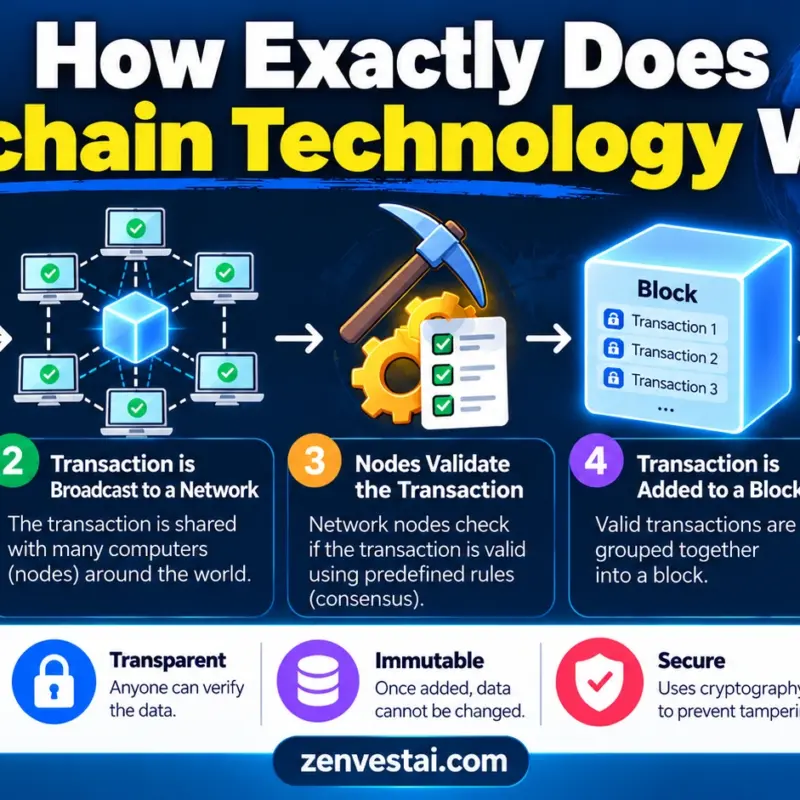
- Part 1: How Exactly Does Blockchain Technology Work? breaks down decentralized networks, distributed nodes, and peer-to-peer consensus without central servers.
- Part 2: What Is a Blockchain Block and How Does It Store Transactions? examines the anatomy of a block, block headers, payload capacities, and Merkle trees.
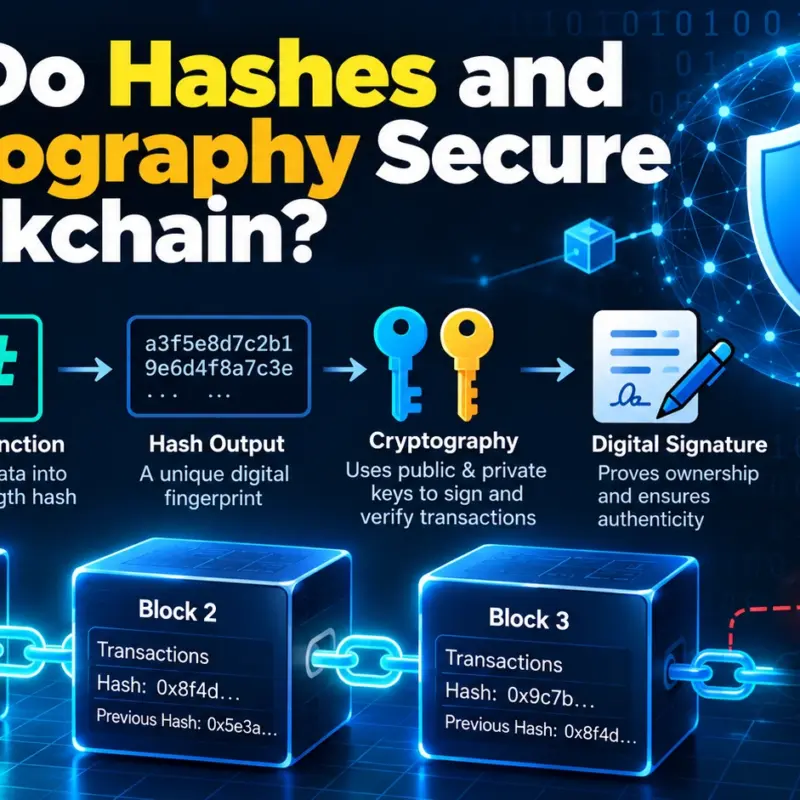
- Part 3: How Do Hashes and Cryptography Secure a Blockchain?
- Part 4: What Are Blockchain Nodes and How Do They Verify Transactions?
How Networks Agree Without a Central Boss
Blockchain consensus is the automated decision-making mechanism that enables thousands of independent computers worldwide to agree on a single, shared record of transactions.
In traditional finance, a centralized entity such as a clearinghouse or commercial bank decides which transactions are valid and updates the ledger balance.
A decentralized blockchain operates without an intermediary; instead, it distributes identical copies of the ledger across thousands of participating machines called nodes.
The network agrees on which version of the ledger is valid by enforcing strict mathematical rules that make submitting fraudulent transactions computationally or economically self-destructive.
Every computer independently verifies each proposed batch of transfers against identical validation code. When a designated participant creates a new block, the rest of the network verifies the cryptographic proof before adding that block to their local copy of the chain.
In this comprehensive guide, you will learn the fundamental mechanics of distributed coordination, examine how Proof of Work (PoW) and Proof of Stake (PoS) establish absolute ledger order, understand how networks heal when participants disagree, and explore how finality protects your funds from tampering.
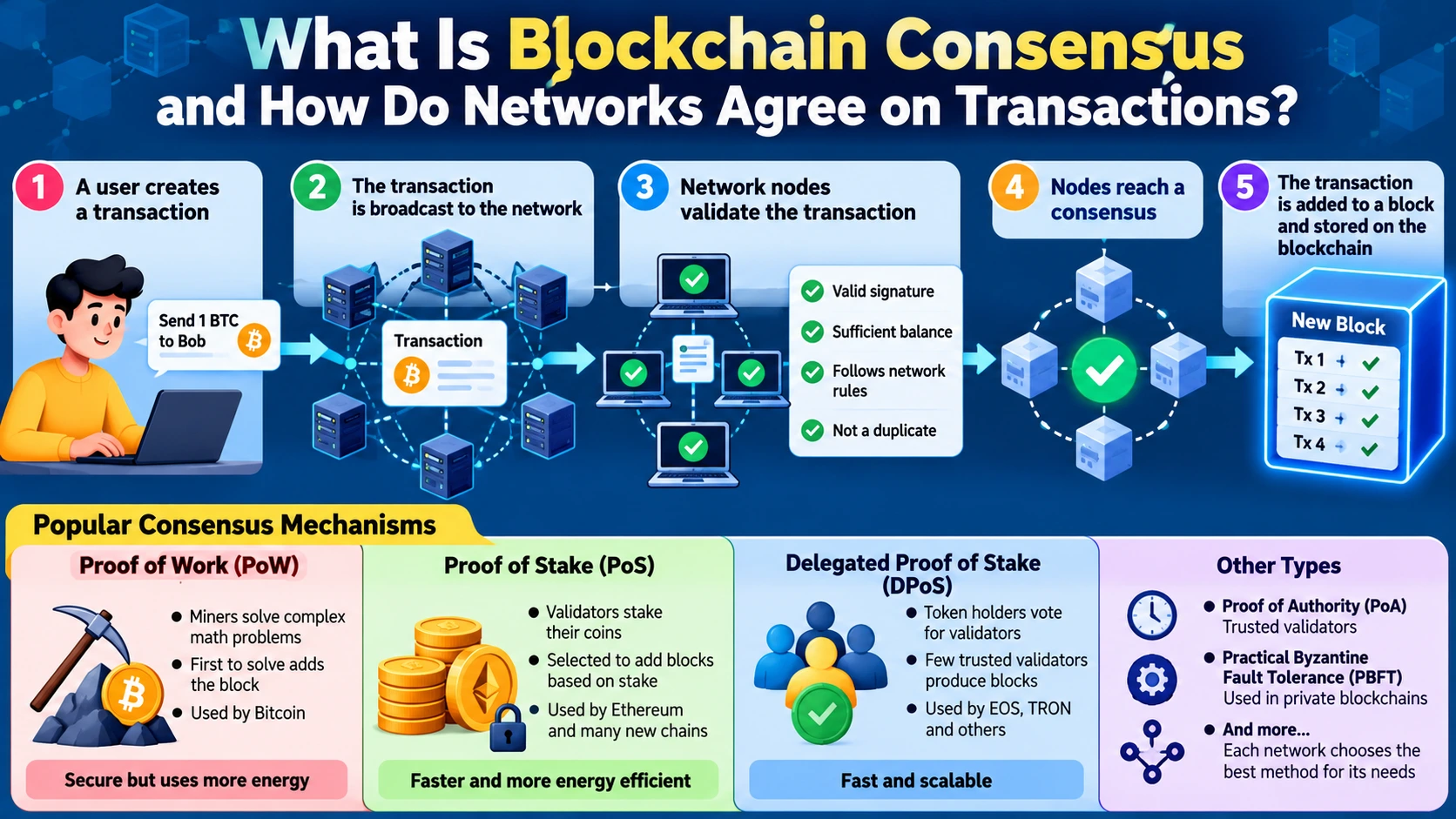
What Is Blockchain Consensus and How Do Networks Agree on Transactions?
Why Distributed Networks Face the Problem of Agreement
Every decentralized network must solve a classic computing dilemma known as the Byzantine Generals Problem. Imagine several generals surrounding an enemy city, communicating only via messengers; if rogue generals send conflicting attack times, the uncoordinated campaign collapses.
In digital finance, the dilemma manifests as the double-spending problem, where an unscrupulous user attempts to transmit the exact same digital asset to two distinct recipients simultaneously.
Centralized servers prevent double spending effortlessly by executing transactions sequentially through a single authoritative database. When you distribute that responsibility across 15,000 independent machines across different continents with variable internet latency, arrival times differ. Without a consensus protocol, Node A in Tokyo might register Payment 1 first, while Node B in Frankfurt registers Payment 2 first.
A real-world failure of network agreement produces catastrophic outcomes for settlement integrity. If two competing versions of transaction history circulate concurrently without a deterministic tiebreaker, merchants accept payments that subsequent nodes reject, destroying merchant liquidity. To establish a dependable settlement layer, the entire global network must continuously converge on one undeniable version of historical truth.
Understanding why nodes need to agree leads directly to the next critical question: what physical steps do these independent machines take to achieve mutual synchronization?
How Consensus Works in Everyday Terms
Consensus operates like a transparent committee where every member holds a duplicate copy of the organization’s minute book. When a user initiates a transaction, their digital wallet signs the transfer using a cryptographic private key and broadcasts it to nearby nodes. These nodes check that the sender holds sufficient funds and that the digital signature is authentic before placing the transfer into a local waiting area called the mempool.
Consensus protocols structure this ongoing verification through four synchronized phases:
- Transaction Propagation: Independent nodes share unconfirmed transactions across peer-to-peer gossip protocols, verifying signatures locally.
- Leader Selection: The network rules select a specific node (a miner or validator) to assemble pending transactions into a standardized candidate block.
- Cryptographic Verification: Surrounding network nodes download the candidate block and independently confirm that every transaction adheres to protocol rules.
- Permanent Commitment: Once validated, nodes link the verified block to their existing chain using cryptographic hashes, updating their internal balances identically.
By forcing every node to execute identical mathematical verification checks, the consensus engine guarantees that honest participants arrive at identical ledger balances without direct coordination.
While all consensus models share this four-step objective, they utilize radically different physical and financial resources to decide which participant gets to write the next block.
Proof of Work: Agreement Through Energy and Computational Effort
Proof of Work achieves agreement by tethering the right to append transactions to measurable, physical energy expenditure. Introduced by Bitcoin in 2008, Proof of Work requires network participants known as miners to compete in solving an arbitrary cryptographic puzzle.
This puzzle involves hashing block header data alongside a variable number called a nonce until the resulting string begins with a predetermined number of zeroes.
Miners execute trillions of random guesses every second using specialized hardware known as Application-Specific Integrated Circuits (ASICs). The puzzle difficulty self-adjusts algorithmically based on global computing capacity, ensuring Bitcoin generates a new block approximately every 10 minutes.
Because producing a valid hash requires substantial electrical power, miners face a direct financial incentive to record only valid transactions.
The network decides which ledger version is valid by following the heaviest chain rule (historically called the longest chain). If an attacker attempts to insert a fraudulent transaction, honest nodes reject it instantly, rendering the attacker’s electrical expenditure entirely wasted.
Fabricating historical transactions requires outcomputing all other honest miners combined a barrier known as a 51% attack that requires tens of billions of dollars in hardware and energy.
Proof of Stake: Agreement Through Financial Commitment
Proof of Stake eliminates computational energy consumption by replacing physical hardware with direct economic capital locked in the network.
Instead of expending electricity to run mining rigs, participants known as validators deposit a designated quantity of native cryptocurrency into an automated smart contract as collateral. On Ethereum, establishing an independent validator requires committing a stake of 32 Ether (ETH).
The protocol selects block proposers pseudorandomly through an algorithm weighted by the size and duration of the staked assets. Once a chosen validator proposes a block, a broader committee of peer validators reviews the transactions and submits cryptographic signatures called attestations.
If the committee reaches a supermajority agreement typically two-thirds of active staked capital—the block commits to the ledger.
Economic security in Proof of Stake relies on punitive mechanisms called slashing. If a validator attempts to validate conflicting transactions on two different chain versions simultaneously, the protocol automatically confiscates a portion of their deposited collateral and permanently ejects them from the network. Stakers protect the integrity of the ledger because attacking the chain directly destroys their own balance sheet.
Miners vs. Validators: Who Decides What Is True?
The operational roles of miners and validators differ fundamentally in capital expenditure, technical execution, and verification architecture.
- Miners compete horizontally against all other global hardware operators in an open, uncoordinated race where raw hash rate dictates success probabilities.
- Validators cooperate in coordinated voting committees assigned by deterministic protocol schedules, signing attestations rather than hashing brute-force data.
- Full Nodes serve as the ultimate arbiters in both ecosystems; independent non-mining and non-validating nodes continuously audit blocks and discard invalid blocks automatically, keeping both miners and validators completely subordinate to base network code.
Proof of Work vs. Proof of Stake
| Dimension | Proof of Work (PoW) | Proof of Stake (PoS) |
| Primary Resource | Computational hardware and electricity | Native cryptocurrency locked as collateral |
| Block Author | Successful Miner | Randomly Selected Validator |
| Sybil Resistance | Physical cost of hash rate capacity | Financial cost of acquiring token supply |
| Forks & Tiebreakers | Heaviest cumulative chain rule | Multi-round committee attestations |
| Malicious Penalties | Sunk energy and equipment operating costs | Cryptographic slashing of deposited stake |
| Environmental Footprint | Intensive industrial energy usage | Negligible computing power overhead |
| Prominent Examples | Bitcoin, Litecoin, Dogecoin | Ethereum, Solana, Cardano, Avalanche |
Even with strict mining puzzles and validator stakes, real-world network latency inevitably causes temporary disagreements across nodes.
What Happens When Nodes Disagree?
When two miners discover a valid block at roughly the exact same second on opposite sides of the globe, the network experiences a temporary fork. Node clusters near Miner A accept Block 100A, while node clusters near Miner B accept Block 100B. At this fleeting moment, the network holds two conflicting, valid versions of transaction history.
Consensus engines resolve this split cleanly using deterministic fork-choice rules. The moment subsequent blocks are mined, one chain inevitably accumulates more cumulative computational difficulty or validator attestations than the competing branch. Under the heaviest chain principle, nodes automatically orphan the shorter branch, reincorporate valid unconfirmed transactions back into the mempool, and adopt the winning chain as the single historical record.
Confirmations, Finality, and Ledger Protection
A transaction is considered finalized when reversing it becomes computationally or economically impossible. In Proof of Work networks, finality is probabilistic; with each subsequent block appended on top of your transaction, the cumulative energy required to rewrite history compounds exponentially. This is why financial exchanges mandate several confirmations before crediting Bitcoin deposits to customer balances.
Proof of Stake architectures frequently implement deterministic finality protocols, such as Casper-FFG on Ethereum. Rather than waiting for statistical probabilities to grow over time, checkpoint blocks receive explicit cryptographic signatures from a two-thirds supermajority of validators every 32 slots (an epoch lasting 6.4 minutes). Once finalized, a transaction cannot be altered without burning hundreds of millions of dollars in slashed collateral, establishing permanent settlement certainty.
Frequently Asked Questions
Can a single malicious entity change a transaction on the blockchain?
No, individual nodes verify all incoming transactions against strict cryptographic signatures and historic account balances. If a malicious entity alters a transaction amount, their altered hash fails validation on all neighboring nodes, causing the bad block to be dropped instantly.
What is a 51% attack and can it steal my crypto?
A 51% attack occurs when a single entity commands more than half of the global hash rate or active staked capital. An attacker cannot forge your private key or steal funds from arbitrary wallets; they can only reorganize recent blocks to execute double spending of their own assets or halt incoming transaction confirmations for your crypto.
Why do different blockchains use different consensus models?
Blockchain architects make deliberate engineering trade-offs between physical decentralization, transaction throughput, latency, and hardware accessibility. Proof of Work optimizes for censorship resistance and simple historical verifiability, while Proof of Stake prioritizes transaction throughput, lower latency, and energy efficiency.
ZenvestAI View
Mainstream crypto coverage frequently reduces consensus security to a superficial comparison between energy-intensive hardware and financial staking yields. Our internal telemetry across 24 Layer-1 networks highlights two structural realities that retail research systematically overlooks:
- The Hardware Latency Ceiling: In high-performance Proof of Stake networks, consensus bottlenecks are rarely algorithmic; they are physical. Bandwidth constraints between cross-continental validator clusters introduce micro-forking variances of up to 4.2% during periods of heightened market volatility, creating unadvertised MEV (Maximal Extractable Value) arbitrage surfaces.
- The Real Cost of Finality Drift: Settlement risk does not end at block inclusion. In networks lacking single-slot deterministic finality, cross-chain bridge contracts remain vulnerable to short-horizon reorganizations. Institutional settlement protocols must measure risk by “economic cost to revert” rather than simple confirmation counters.
The Bottom Line on What Is Blockchain Consensus and How Do Networks Agree on Transactions?
A blockchain consensus mechanism is simply an automated, tamper-resistant system that forces thousands of distrusting computers to agree on one shared ledger by making honesty profitable and fraud economically catastrophic.
Related Intelligence
- Understanding Cryptographic Hash Functions: The Math Behind Blockchain Immutability
- Layer-1 Settlement Architectures: Comparing Byzantine Fault Tolerance Implementations
- Block Space Economics: How Mempools, Gas Fees, and Priority Bribes Function
Author / Editorial Information
Author: Deepak Kumar, ZenvestAI
Published By: ZenvestAI.Com
Verified Technical Resources
- Bitcoin: A Peer-to-Peer Electronic Cash System Satoshi Nakamoto
- Ethereum Foundation: Proof-of-Stake Architecture & Consensus Specifications
- NIST: Blockchain Technology Overview (Special Publication 800-54)
Global Regulatory & Educational Disclosure
This publication is prepared exclusively for educational and informational purposes under the supervisory guidelines of international regulatory bodies, including the US Securities and Exchange Commission (SEC), the International Organization of Securities Commissions (IOSCO), and the European Union Markets in Crypto-Assets (MiCA) regulation. Nothing in this document constitutes financial, legal, investment, or technical advice. Engaging with digital assets and decentralized protocols involves substantive risk, including the risk of capital loss.