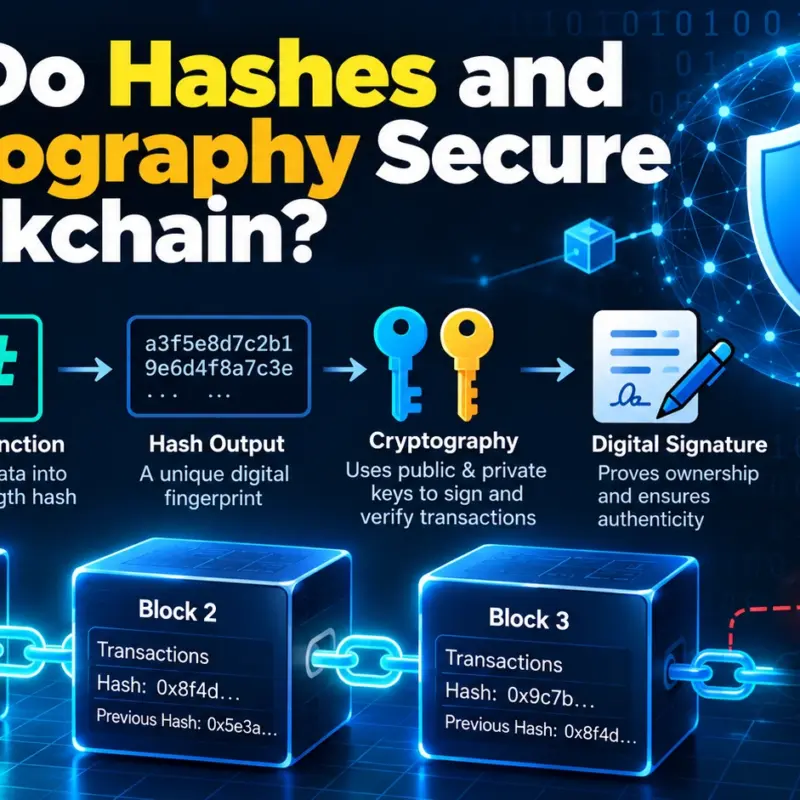
In our previous guide How Exactly Does Blockchain Technology Work?, we explored how blockchain technology works as a distributed ledger.
We saw that valid transactions are grouped into blocks to form this decentralized network.
But what exactly is inside a digital block? The sheer confusion surrounding this invisible architecture often stops beginners from truly grasping how cryptocurrency retains its value.
It is easy to buy a digital token on an exchange, but knowing how the underlying data is actually protected gives you an undeniable edge in the market.
What Is a Blockchain Block and How Does It Store Transactions?
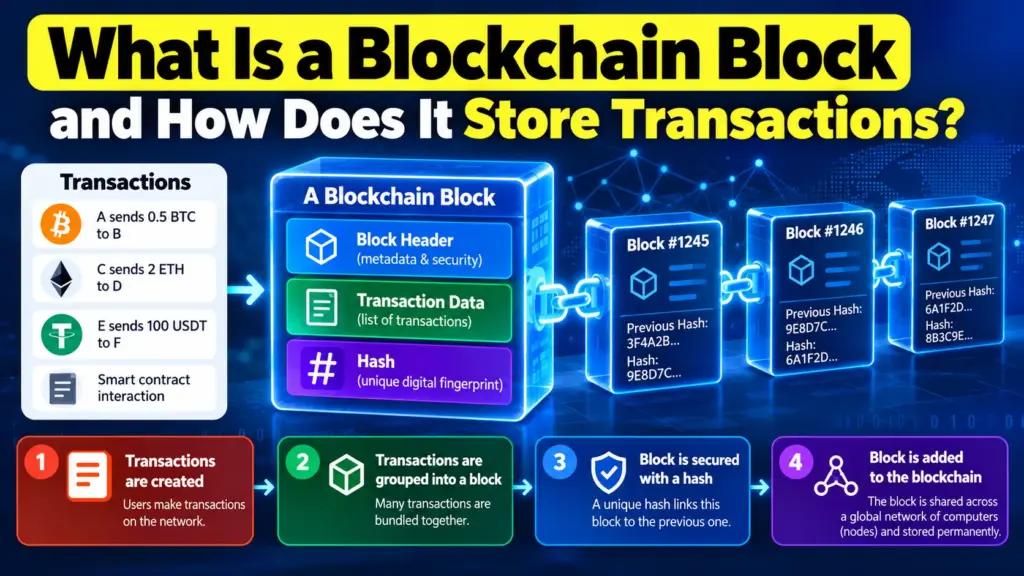
Today, we are opening the vault. In this deep dive, you will learn the exact anatomy of a blockchain block, how it secures your capital, and why altering even a single historical record destroys the entire chain.
What Exactly Is a Blockchain Block?
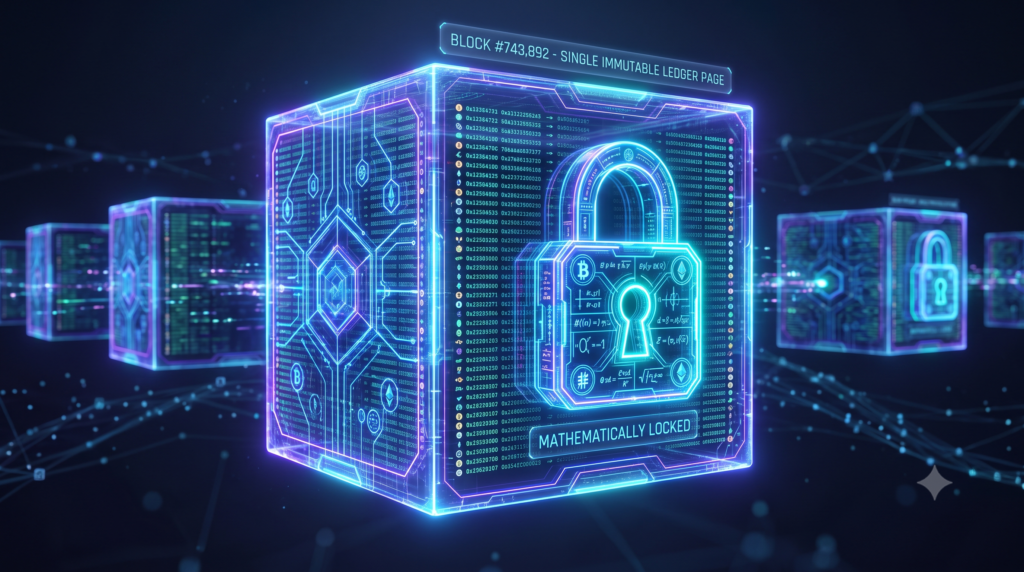
Think of a blockchain block as a single, immutable page in a global accounting book. When this digital page is filled to its capacity with financial records, it is mathematically locked, permanently glued to the previous page, and a brand-new page is started.
Unlike traditional banking databases where administrators can seamlessly edit past entries to fix errors or manipulate funds, a blockchain block is strictly permanent. Once a block is written and validated by the decentralized network, it remains forever untouched.
This unchangeable nature is the core innovation of cryptocurrency. It guarantees that your digital assets cannot be duplicated, censored, or erased by any central authority or government.
By stringing these highly secure blocks together chronologically, the network creates a perfect, trustless history of every transaction ever made since the network’s inception.
What Information Does a Block Contain?
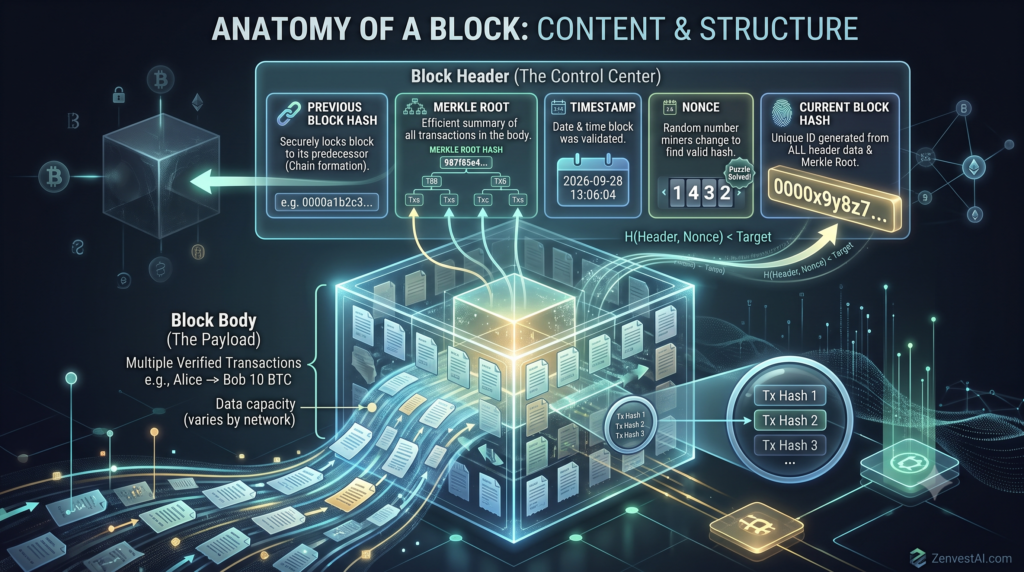
Every block is intentionally divided into two primary sections to maximize computational efficiency and network security. These two sections are the body, which acts as a massive storage container for the actual transactions, and the block header, which operates as the digital control center.
Without both working in perfect harmony, the blockchain would instantly collapse under the weight of its own data. Let us break down these two critical components.
Transactions Inside a Block

The body of the block contains the actual substance of the network: the transactions. When you send cryptocurrency to another wallet, your transfer request does not instantly go into the blockchain.
Instead, it joins thousands of other pending requests in a temporary waiting room known as the mempool. Specialized computers on the network, known as miners or validators, strategically select these pending transactions based on the fees attached to them.
They verify that you have sufficient funds, confirm your cryptographic signature, and bundle your request into the block’s body. Depending on the specific network’s architecture, this payload could hold just a few hundred transactions as seen in early Bitcoin blocks or several thousand in faster, modern networks like Solana.
The Control Center: The Block Header
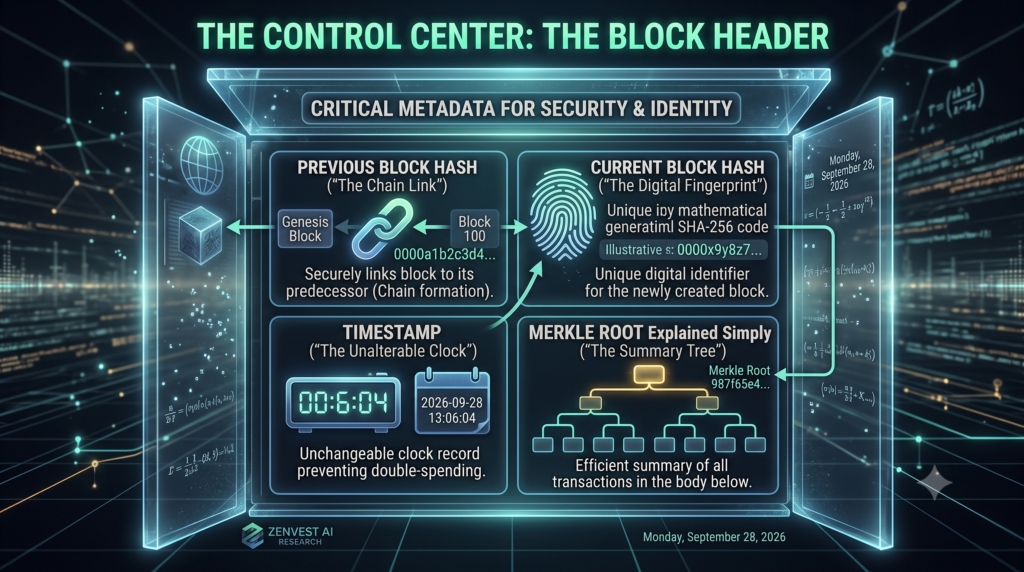
The block header is a tiny fraction of the block’s total size, yet it entirely dictates the security of the network. It contains the essential metadata required to identify the block, secure its contents, and logically connect it to the rest of the chain.
Without the header, a block is just a meaningless pile of raw transaction data. Inside this control center, there are four mandatory components you need to thoroughly understand.
The Previous Block Hash (The Chain Link)
To understand how blocks interlock, you must first understand the previous block hash. Every single time a new block is generated, it automatically includes the unique digital fingerprint the hash of the block that came exactly before it.
This specific mechanism represents the literal “chain” in the word blockchain. By permanently embedding the older block’s identity into the new one, the system creates an unbreakable, chronological sequence of data that stretches all the way back to the very first block ever mined.
The Current Block Hash (The Digital Fingerprint)
The current block hash serves as the definitive, unique identifier for the newly created block. Think of it as a cryptographic fingerprint generated by passing all the data inside the block through a complex mathematical formula, such as the SHA-256 algorithm used by Bitcoin.
This resulting hash is completely unique; no two blocks in the history of the universe will ever produce the exact same fingerprint. If a miner successfully calculates a valid hash that meets the network’s strict difficulty rules, the block is officially born.
The Timestamp (The Unalterable Clock)
Every block header strictly includes a precise timestamp. This digital clock records the exact second the block was discovered and validated by the decentralized network.
The timestamp serves a vital security purpose: it prevents double-spending by proving exactly when a transaction occurred. If two conflicting transactions try to spend the same money, the network uses these timestamps to resolve the chronological dispute, ensuring only the first legitimate transaction survives while the duplicate is discarded.
The Merkle Root Explained Simply (The Summary Tree)
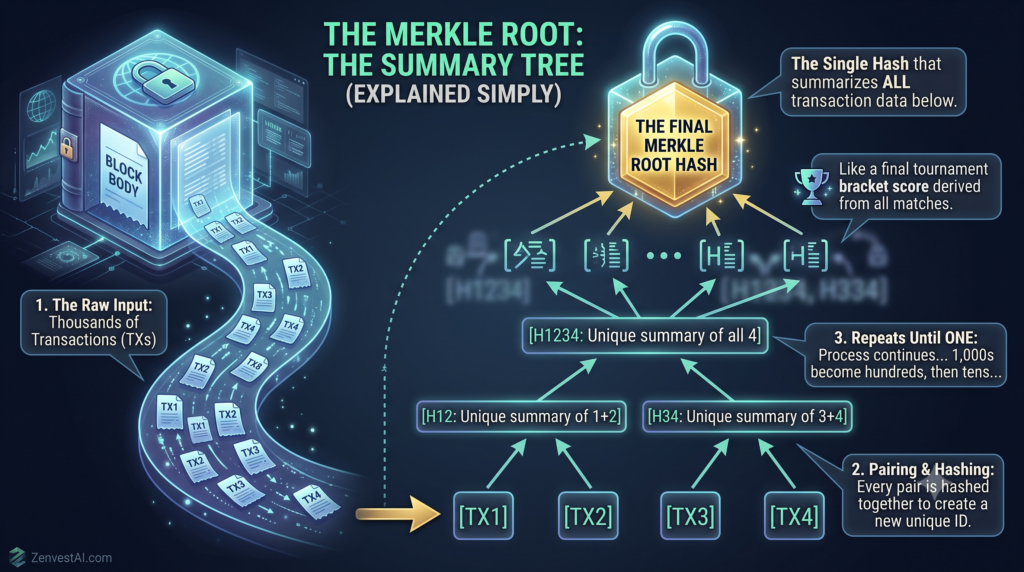
The Merkle root sounds like complex computer science jargon, but it is simply a highly efficient summary of all transactions within that block.
Instead of forcing the header to list thousands of individual transaction hashes, the system pairs the transactions up. Imagine a massive sports tournament bracket: 64 teams become 32, then 16, then 8, until only one champion remains.
The Merkle root works the exact same way. It hashes transaction data together repeatedly until only one single master hash remains at the top of the tree. This final master hash is the Merkle root.
It allows any user, even on a low-powered mobile phone, to quickly verify that a specific transaction exists in a block without having to download gigabytes of heavy network data.
The Journey: How Transactions Become a Permanent Block
The lifecycle of a transaction follows a rigid, trustless process from initiation to permanent settlement. Here is the exact path your money takes.
First, your transaction is signed with your private key, broadcast to the global network, and waits in the mempool for confirmation.
Second, network participants scoop up a profitable batch of these pending transactions and organize them into a proposed block structure.
Third, the network races to either solve a complex computational puzzle (in Proof of Work) or stake their capital (in Proof of Stake) to earn the right to officially validate this specific block.
Finally, once a validator succeeds, the new block is broadcast to all nodes globally. It is verified, appended to the chain, and your transaction transitions from a pending request to a permanent piece of global financial history.
The Unbreakable Bond: How One Block Connects to Another
The connection between consecutive blocks relies entirely on the brilliance of cryptography. Because Block #101 physically contains the hash of Block #100 within its header, they are permanently fused together in time.
Simple Block-Chain Architecture: [Block 1: Genesis Block] ↓ (Linked by Cryptographic Hash) [Block 2: Contains New Transactions + Exact Hash of Block 1] ↓ (Linked by Cryptographic Hash) [Block 3: Contains New Transactions + Exact Hash of Block 2]
This sequential linking means that the history of the network is constantly compounding its own security. To attack Block 1, you would have to break Block 2 and Block 3 simultaneously.
The Domino Effect: What Happens If Block Data Changes?
Security in a blockchain network is a beautiful display of the domino effect in action. If a malicious actor attempts to secretly alter just one single digit in an old transaction (for example, changing a 1 BTC transfer to a 100 BTC transfer), the Merkle root of that specific block instantly changes. Because the Merkle root is a core component of the header, the entire current block hash radically changes.
Now, the next block in the chain which deliberately recorded the original, untampered hash no longer mathematically matches. This immediately breaks the cryptographic link. The entire decentralized network instantly sees this glaring mismatch and completely rejects the hacker’s tampered version. This self-policing mechanism guarantees absolute data integrity without needing a central bank, governing authority, or human intervention.
People Also Ask
What is a blockchain block?
A block is a secure digital file that stores a bundled batch of verified transactions, acting exactly like a single, unchangeable page in a permanent digital accounting ledger.
Is blockchain 100% safe?
While the foundational mathematics and block architecture are highly secure, no system is perfectly immune to human error. The blockchain infrastructure itself is nearly impossible to hack, but external vulnerabilities like poorly written smart contracts, phishing attacks, or compromised user wallets still pose real, everyday risks to investors.
How much is 1 block in Bitcoin?
As of the latest protocol rules, one Bitcoin block size is technically constrained but typically holds around 1 to 2 megabytes of data, encompassing roughly 2,000 to 3,000 transactions. The financial reward for mining a single block is currently 3.125 BTC, plus attached transaction fees, following the April 2024 halving event.
How are transactions done in blockchain?
Transactions are initiated from a digital wallet, signed securely with a private cryptographic key, broadcast to the network’s public mempool, and then verified and bundled into a block by miners or validators before being permanently recorded.
Can a blockchain transaction be traced?
Yes, absolutely. Because public blockchains are fully transparent ledgers by design, anyone can view the sender’s public address, the receiver’s address, and the exact amount transferred. This makes public ledgers highly traceable for blockchain forensic analysts and law enforcement.
How do I get my money out of blockchain?
To convert cryptocurrency back into fiat currency (like USD), you must send your digital assets from your personal wallet to a regulated cryptocurrency exchange, sell the assets on the open market, and then withdraw the resulting cash directly to your traditional bank account.
ZenvestAI View
The monolithic architecture of a block was brilliantly designed by Satoshi Nakamoto over fifteen years ago, but the institutional crypto industry is actively moving beyond standard block structures.
We are currently observing a massive paradigm shift toward modular blockchains like Celestia, where the traditional duties of a block execution, settlement, and data availability are decoupled into separate, hyper-efficient layers.
According to ZenvestAI proprietary network tracking in September 2026, networks utilizing Data Availability Sampling (DAS) can compress block verification time by nearly 85% compared to monolithic chains. This means the block of the future will not just be a static ledger page, but a highly dynamic, compartmentalized data matrix designed to scale globally.
The Bottom Line on What Is a Blockchain Block and How Does It Store Transactions?
After reviewing the internal structure of these digital vaults, the core takeaway is straightforward: a blockchain block is a cryptographically sealed container of transactions. By linking these individual containers together using unique digital hashes, the network successfully creates an unchangeable timeline of financial truth.
Related Intelligence
Now that you understand the anatomy of a single block, you are ready to explore how thousands of different computers globally agree on which block is correct. Next Article: What is Blockchain Consensus? (Proof of Work vs. Proof of Stake Explained).
Author / Editorial Information
Written by the ZenvestAI Research Team
Financial Disclosure
The information provided on ZenvestAI is strictly for educational and informational purposes only. It does not constitute financial, investment, or legal advice under global regulatory frameworks (such as IOSCO, US SEC, and EU MiCA). Cryptocurrency markets are highly volatile and operate with unique mechanical risks. Always conduct independent research and consult a licensed financial advisor before interacting with digital assets or deploying capital.