What if you could trade, lend, borrow and put your crypto to work without using a traditional bank for every step? That is the basic idea behind decentralized finance, better known as DeFi ↗.
DeFi is a part of the crypto and blockchain world that uses blockchains ↗, crypto assets and smart contracts ↗ to provide financial services.
With DeFi, people can:
- Swap crypto
- Lend digital assets
- Borrow crypto
- Provide liquidity
- Stake assets
- Use stablecoins
- Explore derivatives
- Use yield strategies
- Access financial applications through a crypto wallet ↗
But there is an important point to understand from the beginning.
DeFi is not simply “crypto without banks.”
It is a new way of building financial services.
At the beginner level, DeFi may look very simple:
Connect wallet → choose token → confirm transaction → receive token
Behind that simple action, however, there may be smart contracts, liquidity pools ↗, price oracles ↗, collateral rules, liquidations, governance systems and other technology.
That is why DeFi can be exciting and risky at the same time.
This guide explains DeFi from the ground up. You will learn what DeFi means, how it works, what people use it for, how DeFi users can earn returns, what can go wrong, how to evaluate a protocol, and what Indian users should understand about taxes and regulation ↗.
Important: DeFi is high-risk. Even when a protocol works as designed, you can still lose money because of falling crypto prices, liquidation, smart-contract problems, liquidity issues, scams, stablecoin failures and other risks.

What Is DeFi?
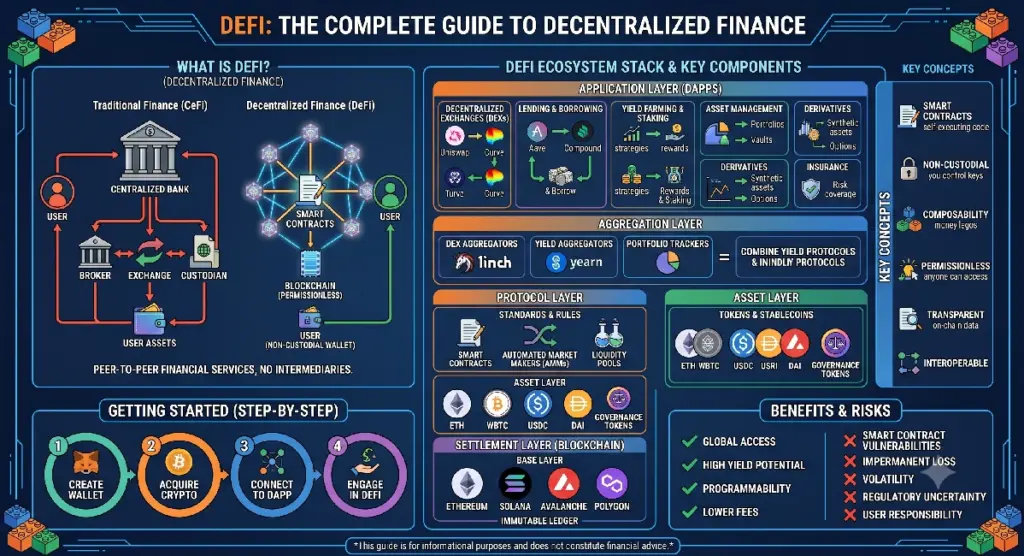
DeFi stands for decentralized finance.
It refers to financial applications and protocols built on blockchain networks.
Traditional finance normally depends on institutions such as:
You → Bank or financial institution → Financial system → Other party
DeFi can instead work more like:
You → Crypto wallet → Smart contract → Blockchain
The smart contract contains rules that can automatically carry out an action when certain conditions are met.
Ethereum describes DeFi ↗ as an open financial system that can provide services such as borrowing, lending and trading through blockchain technology and smart contracts.
The simplest way to understand the idea is:
DeFi tries to replace some financial middlemen with software and blockchain-based rules.
That does not mean there are no people or companies involved.
Developers, governance groups, stablecoin issuers, oracle providers ↗, wallet companies and other infrastructure providers can still play important roles.
So, decentralized does not always mean completely decentralized.
Why Was DeFi Created?
Traditional financial systems have worked for a very long time, but they can have limits.
A bank may decide:
- Who can open an account
- Who can receive a loan
- What documents are required
- Which services are available
- When transactions can be processed
DeFi takes a different approach.
Many DeFi applications are built to be open to anyone who has the required blockchain assets, wallet and network access.
Ethereum describes DeFi as a global, open alternative to parts of the existing financial system.
This creates several possible advantages:
- Open access
- Programmable financial services
- Global availability
- Self-custody in many applications
- Transparent blockchain records
- Automated execution
- Ability to connect different applications
But openness comes with responsibility.
In traditional finance, a bank may help reverse or investigate certain transactions.
In self-custody DeFi, you may be responsible for your own wallet, transactions and security.
How Does DeFi Work?
A simple DeFi system can be understood through several layers:
Blockchain → Assets → Smart Contracts → Protocols → Applications → Wallet
Let’s look at each one.
1. Blockchain
The blockchain is the base layer.
It records transactions and keeps track of accounts, assets and smart contracts.
Ethereum ↗ is one of the largest DeFi ecosystems, but DeFi is not limited to Ethereum. DeFi applications now exist across many blockchain networks.
The blockchain provides the environment where transactions and smart-contract actions take place.
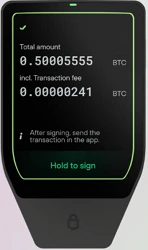
2. Crypto Assets
DeFi needs digital assets.
These can include:
- ETH
- Stablecoins
- Governance tokens
- Wrapped assets
- Liquid-staking tokens
- Tokenized real-world assets ↗
- Other cryptocurrencies
These assets can be traded, deposited, borrowed, used as collateral or placed into liquidity pools.
3. Smart Contracts
A smart contract is a program stored on a blockchain.
It contains rules that tell the blockchain what should happen when certain conditions are met.
For example, a lending protocol may have rules for:
- Depositing assets
- Borrowing assets
- Calculating interest
- Setting collateral requirements
- Checking loan health
- Liquidating collateral
The great advantage is automation.
But automation creates a serious risk too.
If the code has a major problem, the problem can be executed automatically.
That is why smart-contract security is one of the most important parts of DeFi.
4. DeFi Protocols
A DeFi protocol is a collection of smart contracts designed to provide a particular financial service.
Protocols can be built for:
- Decentralized trading
- Lending
- Borrowing
- Liquid staking
- Stablecoins
- Derivatives
- Yield strategies
- Asset management
For example, a lending protocol connects lenders and borrowers through blockchain-based rules.
Analytics platforms like DefiLlama ↗ and current Ethereum ecosystem resources track major protocols across lending, borrowing, DEXs, liquid staking and other financial applications.
5. DeFi Applications
A DeFi application, or dApp, is the interface you use to interact with a protocol.
Think of it this way:
Protocol = engine
Application = dashboard
Wallet = your key
You visit an application, connect your wallet and request an action.
The application then helps you interact with the underlying smart contracts.
What Can You Do With DeFi?
DeFi has grown far beyond simple crypto swaps.
Here are some of its major uses.
1. Swap Crypto
A decentralized exchange, or DEX, allows users to exchange one crypto asset for another (optimized by automated DEX routing ↗).
For example:
ETH → USDC
Instead of placing the trade through a centralized exchange, your wallet can interact directly with a DEX.
Some DEXs use liquidity pools and automated market makers instead of the traditional order-book model.
2. Lend Crypto
Suppose you have USDC that you do not currently need.
You may be able to deposit it into a DeFi lending protocol.
Other users can borrow from the available liquidity.
You may receive interest in return for supplying your assets.
This is one of the basic DeFi models.
3. Borrow Crypto
DeFi can also allow users to borrow digital assets.
Most common DeFi lending systems require collateral.
For example:
You deposit ₹10 lakh worth of crypto
and
borrow ₹5 lakh worth of stablecoins.
Why not borrow the full ₹10 lakh?
Because the system needs protection if your collateral loses value.
If the value of your collateral falls too much, the protocol may liquidate part of your position.
4. Provide Liquidity
Many DEXs depend on liquidity pools ↗.
A liquidity provider deposits assets into a pool.
For example:
ETH + USDC
Traders then use the pool to swap between the assets.
The liquidity provider may receive a share of trading fees.
But this is not guaranteed profit.
Liquidity provision has its own risks, including impermanent loss.
5. Staking
Some blockchain networks allow users to stake crypto ↗ to help support network operations and security.
Liquid-staking protocols can create tokens representing staked positions.
Those tokens may then be used in other DeFi applications.
This is an example of DeFi’s ability to connect different financial products.
6. Yield Strategies
DeFi users can also use strategies designed to seek returns from their crypto.
These may involve:
- Lending
- Staking
- Liquidity provision
- Vaults
- Protocol incentives
- Yield trading
- Other automated strategies
This area is often called yield farming ↗ or yield optimization.
But remember:
Higher yield usually means you need to examine higher or more complex risks.
7. Stablecoins
Stablecoins ↗ are one of the most important parts of DeFi.
They are crypto assets designed to maintain a relatively stable value against a reference asset, often the U.S. dollar.
Examples include:
- USDC
- USDT
- DAI
- USDS
Stablecoins are useful because they give DeFi users a relatively stable unit for trading, lending and borrowing.
However, “stable” does not mean “risk-free.”
A stablecoin can face:
- Depeg risk
- Reserve risk
- Issuer risk
- Liquidity risk
- Smart-contract risk
8. Derivatives
Advanced DeFi applications can offer derivatives.
These may include:
- Perpetual contracts ↗
- Options ↗
- Synthetic assets
- Structured products
This is a more advanced area of DeFi.
Beginners should first understand basic swaps, wallets, lending and risk management before experimenting with leverage or complex derivatives.
What Is a Liquidity Pool?
A liquidity pool ↗ is a collection of crypto assets deposited into a smart contract.
Imagine a pool containing:
100 ETH + $250,000 USDC
A trader can use the pool to swap ETH for USDC or USDC for ETH.
Liquidity providers supply the assets.
In return, they may receive part of the trading fees.
This is one of the key ideas behind automated DeFi trading.
What Is an AMM?
AMM stands for Automated Market Maker.
An AMM uses a mathematical formula and liquidity pools to help determine trading prices.
One well-known model uses:
x × y = k
Here:
- x = amount of token A
- y = amount of token B
- k = constant
When someone buys one asset from the pool, the balance changes.
That change affects the price.
Uniswap ↗ is a well-known example of an AMM-based DEX, and Ethereum’s current DeFi directory describes Uniswap as an automated liquidity protocol using a constant-product formula.
What Is Impermanent Loss?
Impermanent loss is one of the most misunderstood risks in DeFi.
Suppose you provide:
ETH + USDC
Now imagine ETH’s price changes sharply.
The liquidity pool automatically changes its asset balance as traders use the pool.
You may end up with a different mix of ETH and USDC than you would have had by simply holding the two assets.
The difference is commonly called impermanent loss ↗.
You may still earn trading fees.
But those fees may or may not be enough to offset the loss.
So remember:
Liquidity fees are not guaranteed profit.
What Is Yield Farming?
Yield farming means using DeFi applications and strategies to seek returns on crypto assets.
A simple strategy could look like:
Deposit → Earn yield → Receive rewards → Reinvest
Some strategies are relatively simple.
Others are highly complex.
Imagine you see:
“50% APY”
It is easy to think:
“If I put ₹1 lakh here, I will earn ₹50,000.”
But that is not how DeFi yield should be understood.
The token price could fall.
The reward token could lose value.
The protocol could be attacked.
Liquidity could fall.
Your position could be liquidated.
The advertised APY could also change.
So the better question is:
“Where does this yield actually come from?”
That question is far more useful than simply looking at the biggest percentage.
How Do People Make Money From DeFi?
There are several possible sources of DeFi returns.
Lending Interest
You supply assets to borrowers and may receive interest.
Trading Fees
You provide liquidity ↗ and may receive a share of trading fees.
Staking Rewards
You may receive rewards for participating in a staking system ↗.
Protocol Incentives
Some protocols distribute tokens to attract liquidity or users.
Token Price Appreciation
A DeFi token may increase in value.
But this is speculation.
It is not guaranteed income.
Market-Making Strategies
Advanced users can provide liquidity or use automated strategies.
Arbitrage ↗
Some traders attempt to profit from price differences between markets ↗.
This can require fast execution, technical tools and strong risk management.
DeFi Is Not a Guaranteed Passive-Income Machine
This point is worth repeating.
You may see claims such as:
“20% APY”
“50% yield”
“Earn every day”
“Risk-free yield”
Do not judge a DeFi opportunity by the number alone.
High yields ↗ can come from:
- Token emissions
- Temporary rewards
- High borrowing demand
- Protocol subsidies
- Leverage
- Volatile assets
- Other incentives
The key question is:
Who is paying the yield, and why?
If you cannot answer that question clearly, you should not deposit money simply because the APY looks attractive.
DeFi vs Traditional Finance
| Traditional Finance | DeFi |
|---|---|
| Banks and financial institutions | Smart contracts and protocols |
| Account-based access | Wallet-based access |
| Intermediaries are common | Some processes can be automated |
| Often permissioned | Many applications are open-access |
| Institution may control custody | Users can often use self-custody |
| Closed systems are common | Open and composable systems |
| Regulation is built into institutions | Regulation varies by activity and jurisdiction |
| Customer support may be available | Users may have limited or no direct support |
However, do not assume DeFi has no intermediaries.
Many DeFi systems depend on:
- Developers
- Governance groups
- Stablecoin issuers ↗
- Oracles ↗
- Bridges
- Infrastructure providers
- Front-end operators
So decentralization is better understood as a spectrum, not a simple yes-or-no label.
DeFi vs Crypto: What Is the Difference?
This is a common beginner question.
Crypto ↗ is the larger category.
DeFi is one part of the crypto and blockchain ecosystem.
Think of it this way:
Crypto = digital assets + blockchain ecosystem
DeFi = financial services built using blockchain and digital assets
Bitcoin ↗ can be held as a digital asset without being used in a DeFi application.
A DEX, lending protocol or liquidity pool is part of DeFi.
So:
DeFi is part of crypto, but crypto is much bigger than DeFi.
The DeFi Technology Stack
You can understand DeFi more easily by looking at its layers.
Blockchain Layer ↗
Provides the base infrastructure.
Asset Layer
Contains tokens, stablecoins ↗ and other digital assets.
Smart-Contract Layer ↗
Contains the rules and logic.
Protocol Layer
Provides functions such as lending, trading and staking.
Application Layer
Provides the interface users interact with.
Wallet Layer ↗
Allows users to hold assets and sign blockchain transactions.
Ethereum’s own DeFi explanation presents a similar layered model covering the blockchain, assets, protocols and applications.
What Are Oracles in DeFi?
A smart contract can see information on its blockchain.
But it does not automatically know everything happening outside that blockchain.
For example:
“What is the current price of ETH in U.S. dollars?”
A DeFi protocol may need an oracle ↗ to obtain that information.
Oracles therefore play an important role in:
- Lending
- Borrowing
- Liquidations
- Derivatives
- Stablecoins
- Other DeFi applications
But this creates another risk.
If a protocol receives incorrect or manipulated price data, it can make incorrect decisions.
Therefore:
Oracle risk ↗ is DeFi risk.
What Is Composability?
One of DeFi’s most powerful ideas is composability.
It means one DeFi application can interact with another.
For example:
Wallet → DEX → Lending protocol → Stablecoin → Yield strategy
One protocol can use liquidity or tokens created by another protocol.
This creates what is often called “money legos.”
It can make DeFi powerful.
But it also creates a major weakness.
If one important component fails, other connected systems can also be affected.
What Are Flash Loans?
A flash loan is a special type of DeFi loan.
A user can borrow assets without providing normal collateral, but the loan generally has to be borrowed and repaid within the same blockchain transaction.
If the required repayment does not happen, the transaction can fail.
Flash loans can be used for advanced strategies such as:
- Arbitrage ↗
- Collateral changes
- Liquidation strategies
They are powerful but complicated.
For a beginner:
Learn about flash loans before trying to use them.
What Is Liquidation?
Suppose you deposit crypto as collateral and borrow stablecoins.
Your position is safe only while the collateral value remains high enough compared with your debt.
Imagine:
Collateral = ₹10 lakh
Borrowed = ₹5 lakh
Now suppose the collateral falls sharply.
The loan may reach the protocol’s liquidation level.
At that point, the protocol can sell some of your collateral to help repay the debt.
This process is called liquidation.
It is one of the biggest risks of DeFi borrowing.
What Is MEV?
MEV stands for Maximal Extractable Value.
In simple terms, it refers to value that can be captured by influencing the order or inclusion of transactions in a blockchain.
MEV can involve:
- Arbitrage
- Liquidations
- Sandwich attacks
- Transaction ordering
You do not need to understand every detail of MEV to make a basic token swap.
But advanced DeFi users should understand one important point:
The price you see on your screen may not always be the exact price at which your transaction executes.
This is why slippage and transaction settings matter.
Is DeFi Safe for Beginners?
DeFi can be learned by beginners, but it should not be treated as beginner-safe.
This is an important difference.
A savings account and a DeFi yield strategy are not the same thing.
A DeFi user can face:
- Smart-contract risk ↗
- Wallet risk ↗
- Phishing
- Fake websites
- Token scams ↗
- Liquidity risk
- Impermanent loss ↗
- Liquidation
- Oracle failure ↗
- Bridge risk
- Stablecoin depegging ↗
- High network fees
- Transaction mistakes
A Better Beginner Approach
Use this order:
Learn → Observe → Start small → Review → Increase only when you understand the risk
Never start with money you cannot afford to lose.
How to Start Using DeFi
If you are completely new, follow a simple path.
Step 1: Learn Blockchain Basics
Understand:
- Blockchain ↗
- Bitcoin ↗
- Ethereum ↗
- Wallets ↗
- Addresses
- Private keys
- Gas fees
- Tokens
Step 2: Set Up a Self-Custody Wallet
A self-custody wallet ↗ gives you control over your crypto keys.
That also means you have more responsibility.
Never share your:
Seed phrase
or
Private key
with anyone.
Step 3: Fund Your Wallet Carefully
Start with an amount you can afford to lose.
Do not transfer your entire crypto portfolio into a new protocol simply because someone online recommends it.
Step 4: Learn to Read Transactions
Before confirming a transaction, check:
- Blockchain network
- Token
- Amount
- Gas fee
- Contract
- Slippage
- Approval request
Step 5: Start With Simple Actions
A simple token swap is easier to understand than leveraged yield farming.
Step 6: Understand Token Approvals
Token approvals allow a smart contract to interact with your tokens.
Before approving a contract, understand what you are giving it permission to do.
Step 7: Study the Protocol
Before depositing funds, understand:
- What the protocol does
- Where the yield comes from
- What could go wrong
- How withdrawals work
- Who controls upgrades
- What happens during a market crash
How to Evaluate a DeFi Protocol
Do not choose a protocol simply because it offers the highest APY.
Use a checklist.
What Does the Protocol Do?
Can you explain the protocol in one simple sentence?
If you cannot, stop and learn more.
How Much Liquidity Does It Have?
Low liquidity can make entering or exiting a position harder.
How Long Has It Been Operating?
A long history does not guarantee safety.
But a protocol with a longer track record gives you more history to study.
Has the Code Been Audited?
An audit can identify certain security problems.
But remember:
Audited does not mean guaranteed safe.
Who Controls the Protocol?
Look at:
- Governance
- Upgrade keys
- Multisigs
- Admin controls
- Emergency functions
Where Does the Yield Come From?
This may be the most important question.
What Happens During a Market Crash?
Understand:
- Collateral rules
- Liquidation
- Withdrawal conditions
- Oracle behaviour
- Stablecoin risk
The Major Risks of DeFi
DeFi has many benefits, but it also introduces new risks.
Smart-Contract Risk ↗
A coding error can cause serious losses.
Market Risk
The crypto asset you hold can fall sharply.
Liquidity Risk
You may not be able to exit at the price you expect.
Impermanent Loss
Liquidity providers can perform worse than simply holding the underlying assets.
Liquidation Risk
Borrowed positions can be forcibly closed when collateral becomes insufficient.
Oracle Risk ↗
Incorrect price data can cause serious problems.
Bridge Risk
Moving assets between blockchains can introduce additional risks.
Stablecoin Risk ↗
A stablecoin can lose its intended price peg.
Governance Risk
Governance participants or administrators may change important protocol rules.
Wallet Risk ↗
If you lose your seed phrase or sign a malicious transaction, the protocol may not be able to recover your assets.
Is DeFi Legal in India?
This question needs a careful answer.
There is no simple rule saying that every DeFi activity in India is automatically “legal” or “illegal.”
India has a tax framework for Virtual Digital Assets ↗, and certain businesses providing VDA-related services are covered by anti-money-laundering requirements.
FIU-India’s updated January 2026 guidelines identify FIU-IND as the AML/CFT/CPF regulator ↗ for relevant Virtual Digital Asset Service Providers and set out compliance requirements including customer due diligence, transaction monitoring, suspicious transaction reporting and record keeping.
Indian rules also cover specified VDA-related activities carried out as a business, including exchange between VDAs and fiat currency, exchange between different VDAs, transfer of VDAs, certain custody or administration services, and certain financial services connected with a VDA issuer’s offer or sale.
This does not mean that every decentralized protocol is itself a regulated Indian financial institution.
That distinction matters.
A DeFi protocol may be accessible from India, but accessibility does not automatically mean that the activity has the same regulatory status or consumer protection as a regulated bank or securities platform.
Indian users should therefore be particularly careful with:
- DEXs
- Lending protocols
- Stablecoins ↗
- Derivatives ↗
- Token issuance
- Yield products ↗
- Cross-border activity
- Commercial VDA services
For significant or complicated activity, speak with a qualified Indian tax or legal professional.
DeFi and India’s Digital Rupee
Do not confuse DeFi with India’s digital rupee, or e₹.
The e₹ is India’s central bank digital currency issued by the Reserve Bank of India.
RBI describes e₹ as the digital form of the Indian rupee and states that it is legal tender and a liability of the Reserve Bank of India.
DeFi, by contrast, refers to blockchain-based financial applications and protocols.
So:
e₹ = India’s central bank digital currency
DeFi = blockchain-based financial applications and protocols
They are very different concepts.
DeFi Tax in India
Indian users also need to understand the tax side of crypto.
The Income Tax Department currently states that gains from Virtual Digital Assets are subject to 30% tax under Section 115BBH ↗, along with applicable surcharge and 4% cess. It also provides a Schedule VDA for transaction-wise disclosure in relevant income-tax returns.
This is important because DeFi activity can involve many different transactions.
For example:
- Token swaps
- Liquidity positions ↗
- Staking rewards ↗
- Lending returns
- Governance tokens
- Airdrops
- Derivatives ↗
- Borrowing
- Tokenized assets ↗
The tax treatment of complex DeFi activity should not be guessed.
Keep detailed records.
For each transaction, consider recording:
- Date
- Token
- Quantity
- INR value
- Transaction hash
- Gas fee
- Acquisition cost
- Disposal value
- Protocol
- Wallet address
For complicated DeFi activity, professional tax advice is strongly recommended.
What Are DeFi Tokens?
A DeFi token is a crypto token connected to a DeFi protocol or ecosystem.
Depending on the project, a token may be used for:
- Governance
- Protocol incentives
- Voting
- Staking ↗
- Utility
- Economic exposure
But there is an important difference between a protocol and its token.
Owning a protocol token does not automatically mean that you own the protocol’s revenue or receive guaranteed dividends.
Always study the token’s actual economics.
Top DeFi Tokens to Know
There is no permanent list of the “top 10 DeFi tokens.”
Crypto rankings change constantly.
CoinGecko’s current DeFi category includes a wide range of assets across DEXs, lending, derivatives, liquid staking, stablecoin issuers and other DeFi-related categories.
For educational purposes, these are important DeFi-related tokens to know:
| Token | Ecosystem / Role |
|---|---|
| UNI | Uniswap ecosystem |
| AAVE | Aave lending ecosystem |
| MORPHO | Lending infrastructure |
| SKY | Sky ecosystem |
| ENA | Ethena ecosystem |
| LDO | Lido liquid-staking governance |
| PENDLE | Yield-trading infrastructure |
| CRV | Curve ecosystem |
| COMP | Compound lending ecosystem |
| SNX | Synthetix derivatives ecosystem |
This is an educational list, not a ranking or investment recommendation.
Current market data should always be checked before publishing a live “top DeFi tokens” ranking because prices, market caps and category classifications change.
The bigger lesson is:
Do not buy a DeFi token simply because it appears on a top-10 list.
Study the protocol behind it.
DeFi Token vs DeFi Protocol
These are different things.
Protocol
The actual blockchain-based financial infrastructure.
Token
A digital asset associated with that ecosystem.
A protocol can have strong usage while its token has very different economics.
When researching a DeFi project, look at:
Protocol usage → Fees → Revenue → Token utility → Token supply → Unlocks → Governance → Valuation
That gives you a much better picture than simply looking at the token price.
What Is TVL?
TVL stands for Total Value Locked.
It generally refers to the value of assets deposited in DeFi protocols, based on the methodology used by the particular data provider.
TVL can help you understand the scale of a protocol or sector.
But TVL is not the same as market capitalization.
A protocol can have:
High TVL + low token market cap
or:
High token market cap + low TVL
So:
Never judge a DeFi project using TVL alone.
TVL vs Market Cap vs FDV
These three numbers are often confused.
TVL
The value of assets deposited in a protocol or DeFi ecosystem.
Market Capitalization
The market value of the circulating token supply.
FDV
Fully diluted valuation based on the project’s total or assumed token supply.
A serious DeFi researcher should understand all three.
DeFi Governance
Many DeFi protocols use governance systems.
Token holders may vote on:
- Protocol parameters
- Fees
- Treasury spending
- Supported assets
- Risk settings
- Upgrades
But governance is not always completely decentralized.
A protocol may still have:
- Multisig administrators
- Upgrade keys
- Emergency controls
- Core development teams
So when evaluating decentralization, ask:
Who can change the rules?
That question can reveal more than simply looking at whether a protocol has a governance token.
DeFi and Real-World Assets
Another important area is the connection between DeFi and real-world assets, or RWAs ↗.
Blockchain systems can be used to represent or manage interests connected with assets such as:
- Government securities
- Funds
- Credit
- Real estate-related assets
- Commodities
- Other financial instruments
This can connect traditional financial assets with blockchain infrastructure.
But it also creates additional risks involving:
- Legal ownership
- Custody
- Counterparties
- Regulation
- Asset verification
So tokenization ↗ does not remove traditional financial risk.
It can simply put some of it into a blockchain-based structure.
Is DeFi Really Decentralized?
Not always.
This is one of the most important advanced ideas to understand.
You may have:
Decentralized smart contracts + centralized front end
or:
Decentralized protocol + centralized stablecoin issuer ↗
or:
Decentralized application + centralized oracle dependency ↗
or:
Open governance + powerful administrators
Therefore, do not ask only:
“Is this DeFi decentralized?”
Ask:
“Which parts are decentralized, and which parts are still controlled by a person, company or small group?”
That is a much better question.
The DeFi Risk Pyramid
You can think about DeFi risk in layers.
Level 1 — Wallet Risk ↗
Can you safely control your wallet?
Level 2 — Transaction Risk
Can you avoid phishing, fake contracts ↗ and malicious approvals?
Level 3 — Smart-Contract Risk ↗
Can the code fail or be exploited?
Level 4 — Market Risk
Can the underlying asset fall sharply?
Level 5 — Liquidity Risk ↗
Can you exit your position?
Level 6 — Protocol Risk
Can the protocol survive extreme market conditions?
Level 7 — Systemic Risk
What happens if another connected protocol fails?
Advanced DeFi users think about all seven levels.
Beginner DeFi Checklist
Before depositing money into a DeFi protocol, ask yourself:
☐ Do I understand what the protocol does?
☐ Do I know which blockchain I am using?
☐ Do I understand gas fees?
☐ Do I control my wallet?
☐ Have I safely backed up my seed phrase ↗?
☐ Did I verify the official contract address?
☐ Do I understand token approvals?
☐ Do I know where the yield ↗ comes from?
☐ Do I understand liquidation risk?
☐ Do I understand impermanent loss?
☐ Do I understand stablecoin risk ↗?
☐ Do I know how I will exit?
☐ Am I using money I can afford to lose?
If several answers are no, stop and learn more before depositing.
DeFi Glossary
AMM: Automated Market Maker. A system that uses liquidity pools and mathematical rules to support trading.
APY: Annual Percentage Yield. A way of expressing an annualized return that can include compounding.
DEX: Decentralized Exchange. A blockchain-based application used to trade digital assets.
dApp: Decentralized Application. An application that interacts with blockchain-based systems.
TVL: Total Value Locked. A measure of assets deposited into a protocol or DeFi ecosystem.
LP: Liquidity Provider ↗. A user who supplies assets to a liquidity pool.
LP Token: A token or position representing a user’s share of liquidity in some DeFi systems.
Impermanent Loss: A loss that can occur when providing liquidity compared with simply holding the underlying assets.
Smart Contract: A blockchain-based program ↗ that follows predefined rules.
Oracle: A system that provides external data, such as asset prices, to blockchain applications.
Liquidation: The forced closing or sale of collateral when a borrowing position becomes unsafe.
Slippage: The difference between the expected price and the actual execution price.
MEV: Maximal Extractable Value. Value that can be captured through transaction ordering or inclusion opportunities.
Governance Token: A token that may allow holders to participate in protocol governance.
DeFi: Beginner to Advanced Learning Path
If you are completely new to DeFi, do not start with complicated yield farming.
Follow a simple learning path.
Stage 1 — Learn Blockchain
Start with:
Blockchain ↗ → Bitcoin ↗ → Ethereum ↗ → Wallets ↗
Stage 2 — Learn Crypto
Then understand:
Tokens → Stablecoins ↗ → Gas → Transactions
Stage 3 — Learn DeFi
Move to:
DEX → Swaps → Liquidity Pools ↗ → Lending
Stage 4 — Learn Risk
Then study:
Impermanent Loss → Liquidation → Smart-Contract Risk ↗ → Oracle Risk ↗
Stage 5 — Learn Advanced DeFi
Only after that, study:
Yield Farming ↗ → Leverage → Derivatives ↗ → Flash Loans → MEV
Stage 6 — Learn DeFi Research
Finally, learn:
TVL → Tokenomics → Revenue → Fees → Governance → Security ↗
This approach is much better than chasing the highest APY you can find.
Bottom Line
DeFi is much more than a way to earn yield on crypto.
It is an emerging financial system built around:
Blockchain + Smart Contracts + Digital Assets + Protocols + Wallets + Liquidity
It allows people around the world to access financial applications for trading, lending, borrowing, staking, liquidity and other activities without relying entirely on traditional financial intermediaries.
But there is no magic here.
Decentralization does not remove risk.
It changes where some of the risk sits.
Instead of depending mainly on a bank, a DeFi user may have to manage:
Code risk + Market risk + Liquidity risk + Wallet risk + Governance risk + Regulatory risk
That is why the smartest DeFi approach is not:
“Where can I get the highest APY?”
It is:
“How does this protocol work?”
Then:
“Where does the yield come from?”
Then:
“What could make me lose money?”
And finally:
“Is the potential return worth that risk?”
That is the foundation of responsible DeFi.
