At first, DeFi staking and crypto staking can sound like the same thing. Both involve putting crypto to work and earning rewards. But there is an important difference in what your crypto is actually doing.
Crypto staking is mainly connected to helping secure a Proof-of-Stake blockchain. DeFi staking is a broader term for using decentralized finance protocols and strategies to earn rewards. The two can overlap, but they are not automatically the same.
This guide explains the difference in simple terms, including how each works, where rewards come from, what risks you take, how APY fits in, and which option may make more sense for different users.
What this guide covers
- What crypto staking means
- What DeFi staking means
- How both methods work
- Where the rewards come from
- The main differences between them
- Risk comparison
- APY and return differences
- Liquid staking and restaking
- A simple real-world example
- Which option may suit beginners
- What to check before choosing a staking method
DeFi Staking vs Crypto Staking: What’s the Difference?
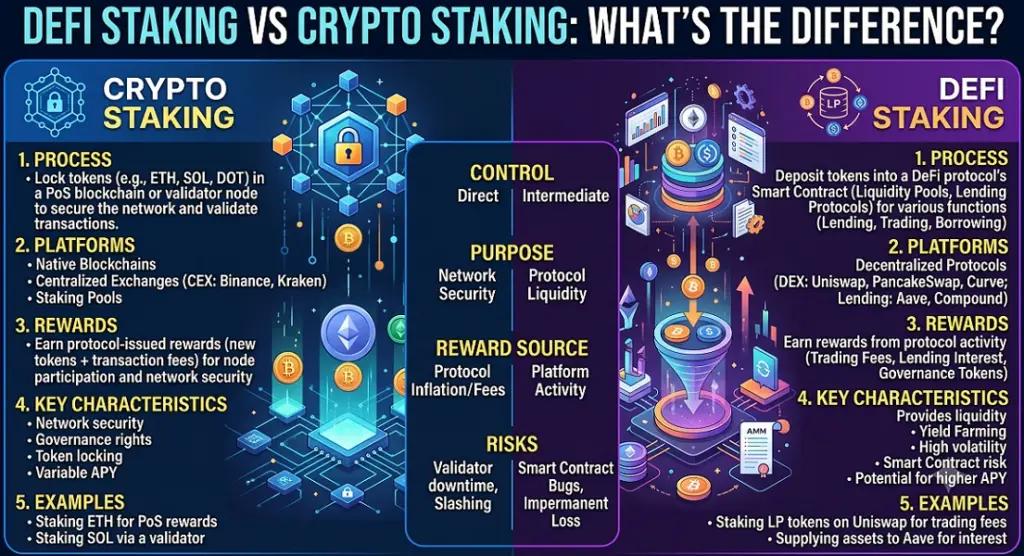
DeFi staking vs crypto staking at a glance
The easiest way to understand the difference is to look at the purpose behind each one.
| Feature | Crypto Staking | DeFi Staking |
|---|---|---|
| Main purpose | Help secure a Proof-of-Stake blockchain | Earn rewards through a DeFi protocol or strategy |
| Where it happens | Blockchain network | DeFi protocol or smart contract |
| Main mechanism | Proof of Stake | Depends on the protocol |
| Rewards | Mainly network staking rewards | May come from fees, incentives, token rewards or other mechanisms |
| Validator involvement | Usually involved | Not always required |
| Smart-contract risk | Depends on the staking method | Often an important risk |
| Lock-up | Depends on the blockchain | Depends on the protocol |
| Main risks | Price, validator, slashing and lock-up risks | Smart-contract, protocol, liquidity, price and strategy risks |
| Complexity | Usually easier to understand | Can be more complex |
| Beginner friendly | Generally easier | Depends on the specific protocol |
The important point is that DeFi staking is not one single technical process. The term is used broadly, so you need to look at the exact protocol and understand what it does with your crypto.

What is crypto staking?
Crypto staking usually means committing or delegating crypto to a Proof-of-Stake network so you can help the network operate and earn rewards.
Proof of Stake, often called PoS, is a way for a blockchain to reach agreement about transactions and new blocks without using the same mining model used by Proof-of-Work networks.
Instead of miners doing the work, validators play an important role.
A simple way to think about crypto staking is:
Hold a PoS token → Stake or delegate it → Validator participates → Network stays secure → Rewards are distributed
Ethereum is a well-known example. When users stake ETH, their stake supports Ethereum’s Proof-of-Stake system. Validators help propose and check blocks and can receive rewards for following the network’s rules.
How does crypto staking work?
The exact process depends on the blockchain, but the basic idea is similar.
First, you hold a cryptocurrency that supports Proof-of-Stake.
You then choose a way to stake it. You may operate a validator yourself, delegate your stake to a validator, or use a staking service or pool.
Your staked assets then become part of the network’s staking system.
If the validator performs its duties correctly, rewards can be earned according to the network’s rules.
However, staking does not remove market risk. The value of the crypto itself can rise or fall while you are earning staking rewards.
Where do crypto staking rewards come from?
Crypto staking rewards mainly come from the blockchain’s own reward system.
Depending on the network, rewards may be connected to:
- New token issuance
- Network activity
- Transaction-related rewards
- Validator participation
- Network staking conditions
The exact reward system is different for each blockchain.
That is why you should not think of staking rewards as simple bank interest. Staking rewards are linked to how a blockchain operates.
What is DeFi staking?
DeFi staking generally refers to using a decentralized finance protocol or strategy to earn rewards from crypto assets.
The important word here is “generally.”
Unlike native Proof-of-Stake staking, DeFi staking does not describe one universal mechanism.
Depending on the protocol, it may involve:
- Token staking
- Governance staking
- Liquidity-related strategies
- Liquid staking
- Restaking
- Protocol incentives
- Other yield strategies
This is why two platforms can both use the phrase “DeFi staking” while doing very different things.
How does DeFi staking work?
A simple DeFi staking process can look like this:
Connect your wallet → Choose a protocol → Deposit or stake assets → Smart contract runs the agreed rules → Rewards are earned → Withdraw when allowed
The actual process depends on the protocol.
For example, one DeFi protocol may reward users for locking its token. Another may reward users for supplying liquidity. Another may use deposited assets as part of a different DeFi strategy.
So the phrase “I am staking in DeFi” is not enough information by itself.
You need to ask:
What exactly is my crypto doing inside this protocol?
That question can tell you much more than the advertised APY.
So, what is the biggest difference?
The biggest difference is the purpose behind the staking activity.
Crypto staking is mainly about blockchain security
With native Proof-of-Stake staking, your stake is part of the blockchain’s consensus system.
The basic purpose is to help the network validate transactions and maintain its security.
Crypto staking → support the blockchain → earn network rewards
DeFi staking is mainly about using a DeFi protocol
With DeFi staking, the main goal is generally to participate in a decentralized financial protocol and earn rewards or yield.
The exact source of that return depends on the protocol.
DeFi staking → use a DeFi protocol → earn protocol-based rewards or yield
This is a more useful distinction than simply saying that one is “centralized” and the other is “decentralized.” Both can involve decentralized technology, but their purpose and reward mechanism can be different.
How are the rewards different?
The source of the reward is one of the most important things to understand before staking.
Crypto staking rewards
Native crypto staking rewards are generally connected to the blockchain’s staking mechanism.
The network sets the rules for:
- How validators participate
- How rewards are calculated
- How penalties work
- How much can be earned
- How staking affects the network
The actual reward rate can change over time.
DeFi staking rewards
DeFi rewards depend on the specific protocol.
They may come from:
- Protocol fees
- Trading fees
- Token incentives
- Token emissions
- Protocol revenue
- Other DeFi mechanisms
This means two DeFi products offering “staking” may have completely different sources of return.
That is why APY should never be the first thing you look at.
First understand where the return comes from.
Does a higher APY mean better staking?
No. A higher APY does not automatically mean a better or safer staking option.
This is one of the most common mistakes beginners make.
Imagine one option offers a 4% APY while another advertises 25%.
The 25% figure may look much more attractive.
But you still need to ask:
- Why is the APY so high?
- Is it paid in the same asset?
- Is it funded by token incentives?
- Can the reward rate change quickly?
- Is there a lock-up?
- Can the token lose value?
- Is there smart-contract risk?
- Are there fees?
- Is the strategy sustainable?
A high APY can come with higher or additional risk.
So the better question is not:
“Which one has the highest APY?”
It is:
“Where does this return come from, and what am I risking to earn it?”
What are the risks of crypto staking?
Crypto staking still carries risk, even when the staking process itself works as expected.
Crypto price risk
The value of your staked cryptocurrency can fall.
For example, suppose you stake $1,000 worth of a token and earn rewards. If the token’s market value later falls sharply, the value of your original holdings plus rewards can still be lower in dollar terms.
Staking rewards cannot protect you from a major price fall.
Lock-up and unbonding risk
Some networks require you to wait before your assets become available after you stop staking.
This period is often called an unbonding period.
That can matter if you suddenly need access to your crypto.
Validator risk
If you delegate your crypto to a validator, that validator has responsibilities.
Poor performance or rule violations can affect rewards and, on some networks, may lead to penalties.
Slashing risk
Slashing is a penalty that can reduce a validator’s stake when serious network rules are broken.
The exact rules vary by blockchain.
Opportunity cost
Your crypto may be locked or committed to one activity while another opportunity appears elsewhere.
That does not necessarily mean staking is bad. It simply means your choice has a cost.
What are the risks of DeFi staking?
DeFi staking can introduce risks that go beyond normal Proof-of-Stake staking.
Smart-contract risk
DeFi protocols often rely on smart contracts.
A smart contract is software that automatically carries out programmed rules.
If that software contains a serious flaw, users may lose funds.
Protocol risk
A DeFi protocol can have problems beyond its code.
Its design, governance, economic model, incentives or other parts of the system may fail.
Liquidity risk
You may not always be able to exit a position at the price you expect.
This can become especially important when the asset or market has low liquidity.
Token price risk
DeFi rewards may look attractive, but the token you receive as a reward can lose value.
A high token reward does not necessarily mean a high real return.
Impermanent loss
If a DeFi strategy involves providing liquidity to a trading pool, you may face impermanent loss.
This is a specific risk of some liquidity-providing strategies and should not automatically be treated as a risk of every form of DeFi staking.
Exploit and hack risk
A protocol can be attacked or exploited.
Even if a platform has existed for a long time, that does not make losses impossible.
Strategy risk
More complex DeFi strategies can introduce more moving parts.
The more complicated the strategy, the more important it is to understand exactly what is happening with your assets.
Is DeFi staking the same as crypto staking?
No. They can overlap, but they are not necessarily the same.
Consider a simple example.
You stake ETH in a way that directly supports Ethereum’s Proof-of-Stake network.
That is native crypto staking.
Now imagine you receive a token representing your staked position and later use that token in another DeFi protocol to earn additional rewards.
The second step introduces a DeFi use case.
This is why staking and DeFi can connect without being identical.
One activity can support blockchain security, while another can use a staking-related asset inside a financial protocol.
How do liquid staking and restaking fit into this?
These terms are often mixed together, but they describe different ideas.
Native staking
Native staking means staking directly within a Proof-of-Stake network.
Its main purpose is to participate in the network’s consensus and security system.
Liquid staking
Liquid staking allows you to stake an asset while receiving a token that represents your staked position.
That token may then be usable elsewhere, including in DeFi.
This can give users more flexibility than simply locking an asset without a transferable representation.
DeFi
DeFi is the broader area of decentralized financial applications and protocols.
It includes activities such as lending, borrowing, trading, liquidity provision and other financial strategies.
Restaking
Restaking generally involves using already-staked assets or staking rights to help secure additional services or systems and potentially earn additional rewards.
It adds another layer to the staking process.
The relationship can therefore look something like:
Native staking → liquid staking → DeFi use → possible additional staking or restaking
But these are not four names for the same activity.
Can you use staked crypto in DeFi?
Sometimes, yes.
This is one reason the difference between the two can become confusing.
A user may first stake an asset, receive a liquid representation of that stake, and then use that representation in a DeFi application.
In that situation, staking and DeFi are connected.
But the fact that an asset can move between these systems does not mean native staking and DeFi staking are technically identical.
The key is to look at each step separately.
Which one is better for beginners?
Basic crypto staking is usually easier for a beginner to understand than a complex DeFi strategy.
With native staking, the main idea is relatively simple:
Stake → help secure the network → earn staking rewards.
DeFi can involve more steps.
You may need to understand:
- Wallets
- Smart contracts
- Liquidity
- Protocol rules
- Token incentives
- Fees
- Price risk
- Withdrawal conditions
That does not mean DeFi is always unsuitable for beginners.
It means beginners should understand the mechanism before chasing the return.
Which one is safer?
Neither should be described as completely safe.
The risks are simply different.
| Risk | Crypto Staking | DeFi Staking |
|---|---|---|
| Crypto price risk | High | High |
| Lock-up risk | Possible | Possible |
| Validator risk | Yes | Not always |
| Slashing risk | Possible | Depends on strategy |
| Smart-contract risk | Depends on method | Often important |
| Protocol risk | Lower in native staking | Important |
| Liquidity risk | Depends on method | Can be important |
| Impermanent loss | Usually not a native staking risk | Possible in liquidity strategies |
| Strategy complexity | Usually lower | Can be higher |
Native staking can have fewer layers of risk, but it is not risk-free.
DeFi can offer more flexibility, but additional flexibility can also mean additional risks.
A simple $1,000 example
Suppose you have $1,000 worth of crypto.
Option A: Crypto staking
You stake a Proof-of-Stake asset through a staking method.
Your asset participates in the network’s staking system.
You earn network-based staking rewards.
The main things you need to watch include:
- Token price
- Staking reward rate
- Lock-up or unbonding
- Validator performance
- Possible penalties
Option B: DeFi staking
You deposit an asset into a DeFi protocol.
The protocol uses your assets according to its rules.
You receive rewards based on that protocol’s mechanism.
Now you may need to consider:
- Token price
- APY changes
- Smart-contract risk
- Protocol risk
- Liquidity
- Fees
- Withdrawal conditions
The important lesson is simple:
The difference is not just the APY. The real difference is what your crypto is doing to generate that return.
What should you check before choosing a staking method?
Do not choose a staking option only because its APY looks attractive.
Use this checklist first.
1. Where do the rewards come from?
Understand the actual source of the return.
2. What happens to your crypto?
Know whether you are staking, lending, providing liquidity, depositing into a smart contract or using another strategy.
3. Is there a lock-up?
Check whether you can withdraw immediately.
4. Is there an unbonding period?
Some staking systems require a waiting period after you stop staking.
5. Is there smart-contract risk?
If your assets interact with a smart contract, understand that additional risk.
6. Is there slashing risk?
Check whether the staking system can penalize validators or delegators.
7. What happens if the token price falls?
Calculate the possible impact of price movement rather than looking only at the reward percentage.
8. Is the APY sustainable?
A very high APY may be supported by temporary incentives.
9. What fees do you pay?
Look at deposit, withdrawal, trading, protocol and other applicable fees.
10. Do you understand the strategy?
If you cannot explain in simple words how the protocol generates your reward, slow down before depositing your crypto.
What is the biggest mistake people make when comparing staking options?
The biggest mistake is comparing APYs without comparing the risks behind them.
A 5% return from one mechanism and a 20% return from another cannot be judged by the numbers alone.
The two products may have completely different:
- Risk levels
- Reward sources
- Lock-up periods
- Liquidity
- Smart-contract exposure
- Token economics
- Fees
APY is a number. It is not a complete risk report.
Which should you choose: DeFi staking or crypto staking?
There is no single option that is best for everyone.
Your choice should depend on what you want to do with your crypto.
| Your priority | What may fit better |
|---|---|
| Simple staking | Basic crypto/PoS staking |
| Supporting a blockchain | Crypto staking |
| Exploring DeFi opportunities | DeFi |
| More strategy choices | DeFi |
| Lower complexity | Basic staking |
| Exploring advanced yield strategies | DeFi |
| Learning the basics first | Crypto staking |
| Maximum flexibility | Depends on the specific DeFi strategy |
This does not mean one category is always better.
The better option depends on your goal, your understanding of the risks and the exact protocol or staking method you use.
The bottom line
Crypto staking and DeFi staking can both help you earn rewards from crypto, but they do not always work in the same way.
Crypto staking is mainly connected to helping secure Proof-of-Stake blockchain networks and earning network-based rewards.
DeFi staking is a broader term for using decentralized finance protocols or strategies to earn rewards. The return may come from fees, incentives, token rewards or other mechanisms.
The two can overlap. Liquid staking can connect native staking with DeFi, and other strategies can add more layers.
But the most important rule is simple:
Do not choose a staking option because the APY looks high. First understand where the reward comes from, what happens to your crypto and what risks you are taking.
For beginners, understanding the mechanism behind the reward is more important than finding the biggest percentage.
Frequently asked questions
Is DeFi staking the same as crypto staking?
No. Crypto staking usually refers to participating in a Proof-of-Stake blockchain’s staking system. DeFi staking is a broader term for earning rewards through decentralized finance protocols and strategies. The two can overlap, especially when staking-related assets are later used in DeFi.
Is DeFi staking safer than regular staking?
Not necessarily. Both have risks. Native staking can involve price, validator, lock-up and slashing risks. DeFi strategies can add smart-contract, protocol, liquidity and strategy risks. The safety of any option depends on the specific blockchain, protocol and method being used.
Which gives higher returns, DeFi staking or crypto staking?
There is no fixed answer. DeFi protocols may advertise higher APYs, but the rate can depend on incentives, fees, token emissions and market conditions. Native staking rewards are also different across networks. A higher APY does not automatically mean a better return after considering price and other risks.
Can I lose my crypto through DeFi staking?
Yes, it is possible. DeFi users can face smart-contract failures, protocol exploits, liquidity problems, token price declines and other risks. The exact risks depend on the protocol and strategy. Before depositing funds, understand how the protocol works and what could cause a loss.
What is the difference between staking and DeFi?
Staking can be part of a blockchain’s Proof-of-Stake security system, while DeFi refers to a much broader group of decentralized financial applications. DeFi includes activities such as lending, borrowing, trading and liquidity provision. Some staking-related assets can also be used inside DeFi.
Is liquid staking DeFi staking?
Not exactly. Liquid staking is a staking method that generally gives users a token representing their staked position. That token can sometimes be used in DeFi. So liquid staking can connect staking with DeFi, but the two terms do not mean the same thing.
Is restaking the same as DeFi staking?
No. Restaking generally involves using already-staked assets or staking rights to help secure additional services or systems. DeFi staking is a broader term that can describe different ways of earning rewards through DeFi protocols. Some strategies can involve both concepts.
Which staking method is better for beginners?
Basic Proof-of-Stake staking is generally easier to understand. A beginner can first learn how staking rewards, validators, lock-ups and network risks work. More complex DeFi strategies can be explored later after understanding smart contracts, liquidity, fees and protocol risks.
Do I need a crypto wallet for DeFi staking?
Often, yes, when interacting directly with a DeFi protocol. A user may need a compatible crypto wallet to connect to the protocol and approve transactions. However, the exact process depends on the platform or service being used.
Where do staking rewards come from?
It depends on the type of staking. Native Proof-of-Stake staking rewards are linked to the blockchain’s reward system. DeFi rewards can come from protocol fees, trading activity, token incentives, emissions or other mechanisms. Always check the specific source of the advertised return.
A final question to ask before you stake
Before putting your crypto into any staking product, ask yourself:
“Can I explain in simple words where my reward comes from and what could make me lose money?”
If the answer is no, don’t let the APY make the decision for you.
Understand the product first.
Then compare the return.
Educational & Informational Resource: This article is provided for general educational and informational purposes only. It is not financial, investment, legal, tax, or trading advice, and it should not be treated as a recommendation to buy, sell, stake, or use any crypto asset or DeFi protocol. Crypto assets and DeFi products can involve substantial risk, including loss of capital, smart-contract failure, liquidity risk, market volatility, protocol risk, and other risks. Rules and regulatory treatment can vary by country and may change over time. Always conduct your own research and consider seeking independent professional advice where appropriate.
