A crypto option can look simple when you first see it: a call, a put, a strike price, a premium, and an expiration date.
But the expiration date is much more than a date printed beside the contract.
As expiration approaches, time value disappears, gamma can become more important, hedging needs can change, open interest can shift, and the final settlement process can become a major market reference.
That is why two Bitcoin options with the same strike price can behave very differently when one expires tomorrow and the other expires three months from now.
The important question is not simply, “When does the option expire?”
The better question is: What happens to the option, the underlying market, liquidity, open interest and hedging flows as that expiration gets closer?
This guide explains that entire process step by step.
Crypto options commonly use daily, weekly, monthly and quarterly expiration cycles. On major venues such as Deribit and OKX, these cycles currently include expiries at 08:00 UTC. Although the exact contract rules, settlement method and available expiries depend on the exchange and product. Deribit and OKX both currently document daily, weekly, monthly and quarterly option expiries around this schedule.
For Indian readers, 08:00 UTC is 1:30 PM IST.
But there is an important warning already: 08:00 UTC should not be treated as a universal rule for every crypto options market. CME’s Bitcoin futures options, for example, use a different expiration and settlement framework.
That difference is exactly why understanding expiration cycles matters.
Table of Contents
- What This Article Covers
- The Simple Idea Behind a Crypto Option Expiration Cycle
- What Exactly Expires?
- The Four Main Crypto Option Expiration Cycles
- Daily Crypto Option Expiries: When the Clock Gets Very Short
- Weekly Crypto Option Expiries: Why Friday Matters
- Monthly Crypto Option Expiries: The Larger Time Horizon
- Quarterly Crypto Option Expiries: The Bigger Calendar Markers
- Why 08:00 UTC Matters in Crypto Options
- What Actually Happens When a Crypto Option Expires?
- Expiration and Daily Settlement Are Not the Same Thing
- A More Technical Look at the Final Settlement Price
- What Happens to Time Value as Expiration Approaches?
- Why Gamma Becomes So Important Near Expiration
- What Is Expiration Pin Risk?
- How Gamma Can Create a Pin-Like Market
- Expiration Pin Risk vs Max Pain
- How Open Interest Changes Around Expiration
- The Four Greeks That Matter Most Around Expiration
- Daily vs Weekly vs Monthly vs Quarterly: What Really Changes?
- Why Crypto Expiration Is Different From Traditional Markets
- Can Options Expiry Move Bitcoin or Ethereum?
- A Practical Example: BTC Near a Large Expiration Strike
- Three Things That Could Happen Near the Strike
- How to Read a Crypto Options Expiry Calendar
- The Advanced Expiry Framework: Date → Strike → Gamma → Flow
- A ZenvestAI Expiration Pressure Framework
- ZenvestAI Insight: The Expiry Clock Has Three Different Clocks
- Why the Settlement Method Can Matter More Than the Expiry Date
- What Traders Commonly Get Wrong About Expiration
- A Professional Crypto Option Expiration Checklist
- Frequently Asked Questions
- Related Intelligence
- Primary Sources and Further Reading
- Author & Editorial Information
- Disclosure
The goal is not to tell you what trade to make.
The goal is to help you understand what the expiration clock is doing to the options market.
The Simple Idea Behind a Crypto Option Expiration Cycle
A crypto option expiration cycle is the schedule that determines when option contracts reach their expiration date and are settled according to their contract specifications.
The main cycles are:
- Daily
- Weekly
- Monthly
- Quarterly
The important point is that an expiration cycle is not just a calendar event. It is a change in the economic life of an option. Imagine buying a BTC call option with a strike of $100,000. If the option expires in 90 days, there is a lot of time for Bitcoin to move.
If the same option expires tomorrow, there is very little time left for that move to happen. That difference affects the option’s:
Time value → Theta → Gamma → Delta → Hedging → Settlement
This chain becomes more important as expiration approaches.
What Exactly Expires?
Before looking at daily and weekly cycles, it helps to separate several terms that are often mixed together.
Expiration date
The expiration date is the date on which the option reaches the end of its contractual life.
Expiration time
The expiration time is the exact time on that date when the contract reaches expiration.
For many major crypto options venues, 08:00 UTC is an important expiration time. Deribit currently specifies daily options at 08:00 UTC, weekly options on Friday at 08:00 UTC, monthly options on the last Friday of the month at 08:00 UTC, and quarterly options on the last Friday of March, June, September and December at 08:00 UTC.
Strike price
The strike price is the price level used to determine the option’s intrinsic value at expiration.
Underlying asset
The underlying is the asset or reference price on which the option is based, such as BTC or ETH.
Settlement price
The settlement price is the price or reference value used under the contract’s rules to determine the final settlement amount.
This is where exchange-specific details become extremely important.
Intrinsic value
At expiration, an option’s remaining value is determined by whether it finishes in-the-money.
For a call:
Call intrinsic value = max(Underlying price − Strike price, 0)
For a put:
Put intrinsic value = max(Strike price − Underlying price, 0)
The settlement mechanism can differ between exchanges, so the formula should always be considered together with the contract specification.
The Four Main Crypto Option Expiration Cycles
The four main expiration horizons create four different ways of looking at time.
| Expiration cycle | Typical schedule | Main characteristic | Typical market use |
|---|---|---|---|
| Daily | Every day | Very short maturity | Short-term positioning and hedging |
| Weekly | Usually weekly | Short-term exposure | Weekly positioning |
| Monthly | Usually monthly | Intermediate horizon | Portfolio and event hedging |
| Quarterly | Mar/Jun/Sep/Dec | Longer horizon | Strategic positioning |
These are general categories, not universal rules for every exchange.
For example, Deribit currently lists daily, weekly, monthly and quarterly option expiries, while the number of contracts available at each maturity can vary by underlying and contract type. OKX also currently documents daily, weekly, monthly and quarterly expiries for its BTC/USD and ETH/USD options.
That leads to the next question: What makes each cycle different?
Daily Crypto Option Expiries: When the Clock Gets Very Short
Daily options have the shortest standard expiration horizon. On Deribit, daily options expire every day at 08:00 UTC. OKX also currently documents daily options expiring every day at 08:00 UTC. Daily options compress a large amount of option risk into a very short period.
There may be only hours left for Bitcoin or Ethereum to move far enough to change the option’s payoff. That makes time decay and gamma sensitivity particularly important.
Why daily options behave differently
Suppose BTC is trading at $100,000 and a $100,000 call expires later today. There is little time remaining. If BTC moves from $100,000 to $101,000, the option can change significantly.
If BTC does not move, much of the option’s remaining time value can disappear rapidly. This is the basic idea behind time compression. The clock is not simply running. It is removing optionality.
Daily expiry and 0DTE
The term 0DTE, meaning “zero days to expiration,” is often used for options that expire on the current day. Crypto markets make this concept particularly interesting because crypto trades around the clock.
There is no traditional stock-market closing bell that stops BTC trading overnight. The option still has a defined expiration time, however.
That creates an unusual combination: 24/7 underlying market + fixed option expiration time
The result is that a BTC option can remain exposed to spot-market movements almost continuously right up to its expiry.
The important daily-expiry question
Do not ask only:
“Where is BTC right now?”
Also ask:
“How much time is left for BTC to move before the option expires?”
That is the heart of short-dated option analysis.
Weekly Crypto Option Expiries: Why Friday Matters
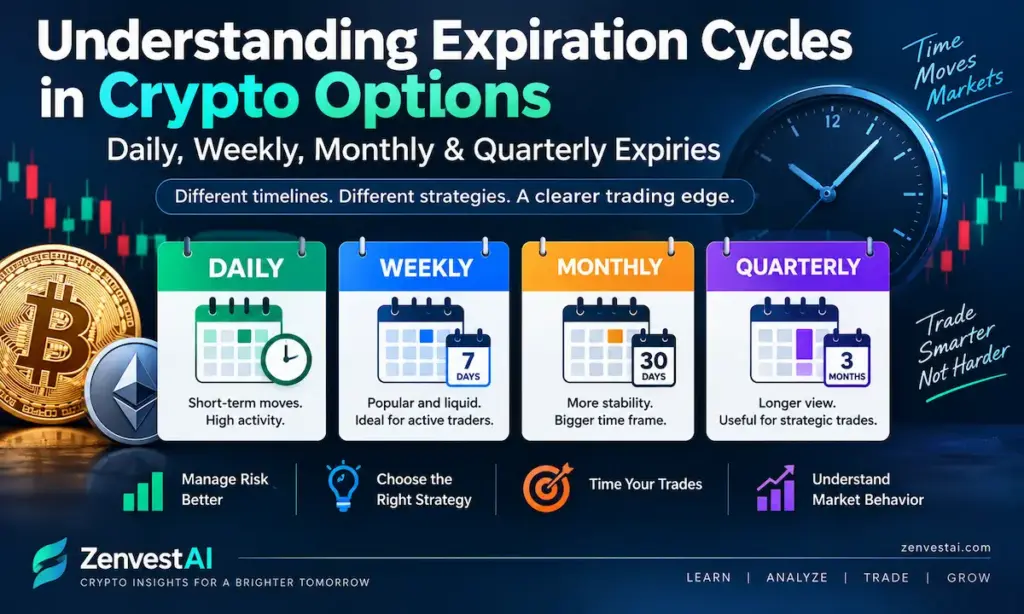
Weekly options provide a slightly longer window than daily options. On Deribit, weekly options expire each Friday at 08:00 UTC. OKX currently follows the same 08:00 UTC Friday convention for weekly options. Weekly expiries are important because market participants can concentrate short-term positions around a known date.
That can make certain strikes more visible through:
- open interest;
- trading volume;
- implied volatility;
- gamma exposure;
- dealer hedging;
- rolling activity.
But there is an important distinction.
A large weekly expiry does not automatically mean Bitcoin will rise, fall or stay at a particular strike.
The expiration date tells you that contracts are reaching the end of their life. It does not tell you the direction of the underlying.
The Friday expiration chain
A useful way to think about weekly expiry is:
Open Interest → Hedging → Time Decay → Expiration → Position Closure or Roll
This is not a prediction model. It is a framework for understanding what is changing in the derivatives market. And once the weekly expiry is understood, the next question becomes larger:
What happens when much more capital is positioned around a monthly or quarterly expiry?
Monthly Crypto Option Expiries: The Larger Time Horizon
Monthly options sit between short-term weekly contracts and longer quarterly contracts.
Deribit currently specifies monthly options to expire on the last Friday of each calendar month at 08:00 UTC. OKX also currently documents the last Friday of each calendar month at 08:00 UTC for its monthly options.
Monthly expiry can matter because traders have more time to build positions around:
- portfolio hedges;
- macro events;
- institutional positioning;
- volatility exposure;
- directional views;
- structured products.
The important idea is position concentration.
If a large amount of open interest is concentrated around a particular monthly expiry, analysts may watch the associated strikes more closely.
But again:
Open interest is evidence of outstanding contracts, not proof of future price direction.
That distinction is essential.
Quarterly Crypto Option Expiries: The Bigger Calendar Markers
Quarterly options extend the expiration horizon further.
The standard quarterly months are:
- March
- June
- September
- December
Deribit currently specifies quarterly options expiring on the last Friday of each calendar quarter at 08:00 UTC. OKX also documents quarterly expiries within the March, June, September and December cycle.
Quarterly expiries can be relevant to longer-term hedging and strategic positioning because participants have more time to establish and manage exposure. A quarterly option can behave very differently from a daily option even if both have exactly the same strike price.
Why?
Because time changes the value of optionality.
A three-month option has more opportunity for the underlying to move. A one-day option has very little time remaining. That difference takes us directly into one of the most important parts of expiration analysis:
What happens to the option as the clock approaches zero?
Why 08:00 UTC Matters in Crypto Options
The 08:00 UTC timestamp has become an important reference point in crypto derivatives, particularly on major venues such as Deribit and OKX.
For Indian readers:
08:00 UTC = 1:30 PM IST
But 08:00 UTC should never be treated as a universal rule for every crypto derivatives product.
Deribit currently documents 08:00 UTC for its daily settlement and option expiry framework, while OKX also currently documents 08:00 UTC option expiries.
CME’s Bitcoin futures options use a different settlement structure. CME currently states that its Bitcoin futures options terminate on the last Friday of the contract month, with final settlement based on the CME CF Bitcoin Reference Rate at 4:00 p.m. London time.
This gives us a simple professional rule:
Never assume an expiration time. Check the contract specification.
The exchange name alone is not always enough.
You also need to know the underlying, contract type and settlement method.
What Actually Happens When a Crypto Option Expires?
Expiration is the moment when the option stops being a live option contract. But the final process depends on the exchange.
The general sequence is:
Trading period → Expiration time → Settlement reference → Payoff calculation → Position closure
Consider a simplified call option.
Suppose:
- BTC strike = $100,000
- Final settlement value = $103,000
The call finishes $3,000 in-the-money before considering contract size and the exchange’s exact settlement mechanics. If the settlement value instead ends at $98,000, the call has no intrinsic value at expiration. The exact amount credited or debited depends on the contract specifications.
Deribit’s current settlement mechanics
Deribit currently states that its options are European-style and cash-settled, with final delivery prices for expiring instruments calculated using a 30-minute TWAP of the relevant Deribit Index from 07:30 to 08:00 UTC.
That detail matters. The final settlement value is not necessarily the last BTC price printed at exactly 08:00 UTC. Instead, under the documented Deribit mechanism, the final delivery price is based on the specified TWAP window.
This is a good example of why professional options analysis should focus on contract mechanics rather than headlines.
Expiration and Daily Settlement Are Not the Same Thing
This is one of the most common sources of confusion.
Daily settlement does not automatically mean that an option has expired.
On Deribit, routine daily settlement occurs at 08:00 UTC for futures and perpetual contracts. Open positions continue after that daily settlement. Final expiration is different because an expiring contract reaches the end of its contractual life.
Think about it this way:
| Daily settlement | Final expiration |
|---|---|
| A recurring settlement event | The end of the contract |
| Can occur every day | Occurs on the specified expiry |
| Open position can continue | Expiring option is closed/settled |
| Updates relevant P&L/accounting | Determines final option payoff |
| Does not mean the option has expired | Ends the option’s life |
This distinction becomes even more important when analyzing BTC or ETH around 08:00 UTC.
A trader who sees “08:00 UTC settlement” and assumes every option is expiring at that moment can misunderstand the market.
The expiration date and product specification still matter.
A More Technical Look at the Final Settlement Price
Settlement is not just a timestamp. It is a pricing mechanism. Different exchanges can use different reference prices, averaging periods and settlement assets.
For example, Deribit currently uses a 30-minute TWAP from 07:30 to 08:00 UTC for the delivery price of relevant expiring instruments.
OKX currently documents a one-hour time-weighted average price of the index during the last hour before expiration for its options settlement price.
This is a major technical point:
Two exchanges can have the same 08:00 UTC expiration time but use different settlement-price calculations.
Therefore: Expiration time ≠ settlement-price methodology
Both must be studied.
What Happens to Time Value as Expiration Approaches?
An option has two broad components of value:
Option value = Intrinsic value + Extrinsic value
Extrinsic value is often called time value.
Time value reflects the possibility that the underlying can move favorably before expiration. As expiration approaches, there is less time for that possibility to become reality. Therefore, time value generally declines. This is the basic idea behind theta decay.
But the decay is not always smooth. An option near the money can become extremely sensitive to small changes in the underlying as expiration approaches. That is where gamma becomes important.
Why Gamma Becomes So Important Near Expiration
Gamma measures how quickly an option’s delta changes when the underlying price changes.
Near expiration, an at-the-money option can have significant gamma sensitivity. Imagine BTC is trading close to a call option’s strike. A small move higher can push the option toward a much higher delta.
A small move lower can push it toward a much lower delta. The hedge required against that option can therefore change quickly.
This creates a potential chain:
BTC moves → Delta changes → Hedge requirement changes → Hedging flow changes → Market impact may change
That does not mean every expiry creates a feedback loop. It means that positioning and hedging can become more sensitive near important strikes.
What Is Expiration Pin Risk?
Expiration pin risk refers to the possibility that the underlying trades around a heavily concentrated option strike near expiration, potentially interacting with hedging flows and making that strike especially important to market participants.
Suppose BTC is trading around $100,000. Now imagine a large amount of option open interest is concentrated around the $100,000 strike for an expiry happening later that day.
The $100,000 level becomes a market reference.
Traders may monitor:
- open interest;
- gamma;
- delta;
- hedging activity;
- spot liquidity;
- futures basis;
- perpetual funding;
- implied volatility.
But there is a critical warning:
Large open interest does not prove that BTC will be pinned to $100,000.
The direction of dealer gamma exposure matters. The size and type of positions matter. The underlying market’s liquidity matters. And external events can overwhelm option-related flows.
Therefore, pin risk should be treated as a market structure possibility, not a guaranteed price outcome.
How Gamma Can Create a Pin-Like Market
The mechanics become clearer with a simple example. Imagine a large concentration of options near a $100,000 BTC strike. As BTC moves toward the strike, the delta of near-the-money options can change quickly.
If market makers are hedging their exposure, they may need to adjust positions in BTC or related derivatives. Those hedge adjustments can influence short-term order flow. In some market conditions, that flow can contribute to price remaining close to a strike.
But the opposite can also happen. If positioning creates hedging flows that reinforce the move away from the strike, the market can move sharply through it.
That is why saying:
“High gamma always pins price.”
is incorrect.
The better framework is:
Strike concentration + gamma exposure + dealer positioning + liquidity + time remaining
Together, these factors tell a much more complete story.
Expiration Pin Risk vs Max Pain
The terms pin risk and max pain are sometimes used as if they mean the same thing.
They do not.
| Concept | What it means |
|---|---|
| Expiration pin risk | A possible market-microstructure effect around concentrated strikes |
| Max pain | A theoretical price level derived from option open-interest distribution |
| Open interest | Outstanding option contracts |
| Gamma concentration | Sensitivity of delta to changes in the underlying |
Max pain is not a guaranteed expiration price.
It is a calculation.
It does not automatically capture:
- dealer gamma positioning;
- hedging direction;
- spot liquidity;
- futures flows;
- perpetual funding;
- macro news;
- large directional trades;
- position rolls.
This is why professional analysis should never reduce an expiry to one number called “max pain.”
How Open Interest Changes Around Expiration
Open interest, or OI, tells us how many outstanding contracts remain open. It does not tell us the complete directional exposure of the market.
That distinction matters.
A simplified expiration lifecycle looks like this:
New contracts → OI builds → Strike concentration develops → Traders hedge/close/roll → Expiration → Contracts settle
Around an important expiry, watch how OI changes rather than looking at one static snapshot.
OI by expiry
This tells you where positions are concentrated in time.
For example:
- daily;
- weekly;
- monthly;
- quarterly.
OI by strike
This tells you where contracts are concentrated by price. For BTC, you might see large concentrations around round numbers such as $90,000, $100,000 or $110,000.
But round numbers are not automatically “support” or “resistance.” They are simply price levels where option positioning may be concentrated.
Call OI and put OI
Calls and puts provide additional information about the structure of the options market. But a call is not automatically bullish and a put is not automatically bearish.
Options can be used for:
- hedging;
- spreads;
- volatility trading;
- income strategies;
- structured positions;
- relative-value trades.
Therefore, OI must be interpreted in context.
The Four Greeks That Matter Most Around Expiration
Expiration does not affect every Greek in the same way.
Delta
Delta measures how much an option’s value is expected to change for a move in the underlying, all else equal. As expiration approaches, an option’s delta can move rapidly toward a more binary outcome around the strike.
Gamma
Gamma measures the rate at which delta changes. Gamma is particularly important around near-the-money options close to expiration.
Theta
Theta represents the sensitivity of an option’s value to the passage of time. As the clock approaches expiration, time decay becomes increasingly important.
Vega
Vega measures sensitivity to changes in implied volatility. Short-dated options can still respond strongly to volatility changes, but the relationship between maturity and vega means that longer-dated options generally carry more time-related volatility exposure.
Rho
Rho measures sensitivity to interest rates. For very short-dated crypto options, interest-rate sensitivity is often less important than delta, gamma, theta and implied volatility.
The practical message is simple:
When studying expiration, start with gamma and theta, then add delta, IV and the broader positioning picture.
Daily vs Weekly vs Monthly vs Quarterly: What Really Changes?
The expiration cycle changes the amount of time available for the underlying to move.
| Factor | Daily | Weekly | Monthly | Quarterly |
|---|---|---|---|---|
| Time remaining | Hours to days | Days | Weeks to months | Months |
| Time decay pressure | Often very high | High | Moderate | Lower |
| Gamma sensitivity near expiry | Can be very high | High | Moderate to high | More dependent on maturity |
| Main focus | Immediate market movement | Short-term positioning | Intermediate positioning | Longer-term exposure |
| Pin-risk relevance | Can be high around major strikes | Can be high | Can be important | More dependent on positioning |
| Liquidity | Asset/exchange dependent | Asset/exchange dependent | Often deeper in major contracts | Often deeper in major contracts |
These are general tendencies, not rules.
An extremely liquid weekly BTC option can be more actively traded than an illiquid quarterly altcoin option. That is why maturity must always be considered alongside liquidity, strike, IV and open interest.
Why Crypto Expiration Is Different From Traditional Markets
Crypto brings an important structural difference to options markets:
The underlying market trades continuously.
Bitcoin does not stop trading simply because a traditional market session ends. That means an option approaching expiration can remain exposed to spot-market movement throughout the day and night.
This creates a particularly important relationship:
Continuous spot market + fixed expiration timestamp
A $100,000 BTC strike can be approached at 3 AM UTC just as it can during a major U.S. trading session. The option clock continues to run.
That makes the final hours before expiry especially interesting when:
- liquidity is thin;
- open interest is concentrated;
- gamma is high;
- major macro news arrives;
- futures basis changes;
- funding changes;
- traders roll positions.
Can Options Expiry Move Bitcoin or Ethereum?
Expiration can influence market activity, but the relationship should not be simplified into “options expiry moves Bitcoin.”
Several forces can interact around expiration:
Dealer hedging
Market makers may adjust hedges as option deltas change.
Position closing
Traders may close options rather than hold them into expiry.
Position rolling
Traders can move exposure from the expiring contract into a later maturity.
Futures and perpetual hedging
Participants may use futures or perpetual contracts to manage option exposure.
Liquidity
Large orders can have different market impact depending on available liquidity.
External events
Macro data, central-bank decisions, ETF flows, regulatory news or major crypto-specific events can dominate expiry-related positioning.
Therefore:
Expiration can alter positioning and hedging flows, but the direction and size of any resulting market move are not mechanically determined by the expiry itself.
That distinction separates market analysis from simplistic expiry narratives.
A Practical Example: BTC Near a Large Expiration Strike
Consider a hypothetical market.
BTC is trading at:
$100,000
A large weekly option expiry is approaching.
Suppose a large amount of open interest is concentrated around:
$100,000
The first mistake would be to immediately conclude:
“BTC will finish at $100,000.”
We do not know that.
Instead, build the analysis step by step.
Step 1: Check the expiry
When exactly does the option expire?
Step 2: Check the settlement method
What reference price will determine the final settlement?
Step 3: Check OI
How much open interest exists?
Step 4: Check strike concentration
Is the OI concentrated around $100,000 or spread across many strikes?
Step 5: Check gamma
Is meaningful gamma concentrated near that strike?
Step 6: Check liquidity
Can relatively small flows move the underlying significantly?
Step 7: Check other markets
What are futures basis and perpetual funding showing?
Step 8: Check external events
Is a major macro or crypto-specific event happening at the same time?
Now the expiry becomes a market-structure problem, rather than a guessing game.
Three Things That Could Happen Near the Strike
The market does not have one guaranteed expiry outcome.
Scenario 1: BTC remains near the strike
If positioning and hedging flows support trading around the strike, price may spend meaningful time near it.
That can look like a pin. But correlation does not prove that option hedging caused the behavior.
Scenario 2: BTC moves strongly away
If spot demand, liquidation flows, macro news or other positioning overwhelms expiry-related flows, BTC can move rapidly away from the strike. High open interest does not create a price ceiling.
Scenario 3: Traders roll their positions
Some participants may close the expiring option and establish a position in a later expiry. In that case, open interest can migrate from one expiry to another. This is why watching only the expiring contract can produce an incomplete picture.
How to Read a Crypto Options Expiry Calendar
An expiry calendar becomes much more useful when you stop treating it as just a list of dates. For every major expiry, ask five basic questions.
1. When does it expire?
Record:
- date;
- UTC time;
- your local time.
For Indian readers, remember:
08:00 UTC = 1:30 PM IST
2. How much open interest is expiring?
A large expiry deserves more attention than a small one.
But size alone is not enough.
3. Where is the open interest concentrated?
Look at OI by strike.
A $10 billion expiry spread evenly across many strikes is structurally different from $10 billion concentrated around one or two strikes.
4. What does implied volatility show?
Compare IV across:
- daily;
- weekly;
- monthly;
- quarterly expiries.
This is the IV term structure.
A sudden change in short-dated IV can indicate that traders are pricing a different level of near-term uncertainty.
5. What does the rest of the derivatives market show?
Look at:
- futures basis;
- perpetual funding;
- volume;
- liquidations;
- spot volume;
- gamma exposure;
- delta exposure.
The expiry should be read as part of the wider market.
The Advanced Expiry Framework: Date → Strike → Gamma → Flow
ZenvestAI’s practical way to read an expiry can be reduced to four layers.
Layer 1: Date
When does the contract expire?
Layer 2: Strike
Where is the largest concentration of OI?
Layer 3: Gamma
How sensitive is the positioning around those strikes?
Layer 4: Flow
What are traders and hedgers actually doing as expiry approaches?
This creates a better analytical chain:
Expiry date → Strike concentration → Gamma exposure → Hedging flow → Market behavior
It is more useful than simply asking:
“What is max pain?”
A ZenvestAI Expiration Pressure Framework
One original way to think about expiration risk is to treat it as a five-part pressure map rather than relying on one metric.
Call it the:
It is not an exchange indicator or a prediction model. It is a ZenvestAI analytical framework for organizing expiry information.
The five components are:
- Expiry proximity
- OI concentration
- Gamma concentration
- Liquidity conditions
- Cross-market confirmation
The closer the expiry, the more concentrated the OI and gamma, and the thinner the relevant liquidity, the more carefully the market structure should be examined. But the fifth component is critical.
Cross-market confirmation matters.
If spot, futures, perpetuals and options all show positioning around the same level, the expiry deserves more attention. If only the options market shows a large strike concentration while spot and futures are trading normally, the signal should be treated with more caution. This framework is intended as an analytical lens, not a trading signal.
ZenvestAI Insight: The Expiry Clock Has Three Different Clocks
Another useful way to analyze expiration is to separate three clocks that traders often mix together.
Clock 1: Calendar clock
How much time remains until the official expiration?
Clock 2: Volatility clock
How much implied volatility is the market pricing for that remaining time?
Clock 3: Positioning clock
How quickly are traders changing, closing or rolling their positions?
These clocks can move differently.
For example:
- only two hours remain;
- IV rises sharply;
- traders rapidly roll positions.
The calendar clock says time is disappearing. The volatility clock says uncertainty is increasing. The positioning clock says market participants are actively changing exposure. That combination can be much more informative than the expiry date alone.
This is one of the areas where expiration analysis moves from a simple calendar exercise into genuine derivatives research.
Why the Settlement Method Can Matter More Than the Expiry Date
Two options can expire at exactly the same time and still have different settlement behavior.
Consider the difference between:
Last traded price
and
TWAP-based settlement
A last traded price can be affected by a single transaction. A time-weighted average spreads the reference across a defined period.
Deribit currently uses a 30-minute TWAP from 07:30 to 08:00 UTC for the delivery price of relevant expiring instruments. OKX currently documents a one-hour time-weighted average of its index price before expiration for options settlement.
This is why a professional expiry checklist should always include:
“What price actually settles this contract?”
Not:
“What price did BTC show at 08:00?”
Those are not necessarily the same thing.
What Traders Commonly Get Wrong About Expiration
Expiration creates plenty of bad assumptions.
Mistake 1: “Every expiry moves Bitcoin.”
It does not.
An expiry is a contract event, not a guaranteed directional catalyst.
Mistake 2: “Max pain tells me where BTC will finish.”
It does not guarantee the settlement price.
Mistake 3: “Large OI means price will be pinned.”
Large OI shows outstanding contracts.
It does not reveal the entire hedging structure.
Mistake 4: “08:00 UTC is universal.”
It is not.
Exchange and contract specifications differ.
CME’s Bitcoin futures options provide a clear example of a different settlement framework.
Mistake 5: “Daily settlement means my option expired.”
Not necessarily.
Daily settlement and final expiration are separate concepts on platforms such as Deribit.
Mistake 6: “I only need total open interest.”
Strike-level OI and expiry-level OI provide much more useful context.
Mistake 7: “Gamma automatically creates a pin.”
Gamma matters, but positioning direction, liquidity and hedging behavior matter too.
Mistake 8: “Options expiry is the only thing moving the market.”
Macro news, spot flows, futures, perpetuals, liquidations and large orders can all dominate.
Mistake 9: “The largest strike is always the strongest support or resistance.”
An option strike is not automatically a technical support or resistance level.
Mistake 10: “Expiration analysis is a standalone trading signal.”
It is better treated as one layer of market structure.
A Professional Crypto Option Expiration Checklist
Before analyzing a major expiry, work through this checklist.
Contract information
Expiration date
Expiration time
Exchange
Underlying index
Call or put
Strike price
Exercise style
Settlement currency
Expiration structure
Daily, weekly, monthly or quarterly
Total open interest
OI by strike
OI by expiry
Call/put distribution
Volume
Volatility
 Implied volatility
 IV term structure
 IV skew
 Near-the-money IV
 Changes in short-dated IV
Risk positioning
Gamma concentration
Delta exposure
Dealer positioning where reliable data is available
Futures basis
Perpetual funding
Settlement
Official settlement time
Settlement-price formula
TWAP or other reference mechanism
Settlement window
Delivery or cash-settlement method
Market conditions
Spot liquidity
 Futures liquidity
 Major liquidation zones
 Macro events
 Crypto-specific events
 Position rolls
Frequently Asked Questions
What is crypto option expiration?
Crypto option expiration is the scheduled point at which an option reaches the end of its contractual life and is settled according to the exchange’s rules.
How often do crypto options expire?
Crypto options can expire daily, weekly, monthly and quarterly, depending on the exchange, underlying asset and contract.
What are daily crypto options?
Daily options are contracts that expire each day. They have very short maturities, making time decay and near-expiry gamma particularly important.
What are weekly crypto options?
Weekly options expire once a week, commonly on Friday on major venues such as Deribit and OKX.
When do monthly crypto options expire?
On Deribit and OKX, monthly options currently expire on the last Friday of the month at 08:00 UTC. Exchange-specific specifications should always be checked.
When do quarterly crypto options expire?
Quarterly options generally use the March, June, September and December cycle. Deribit and OKX currently document quarterly expiries around the last Friday of each calendar quarter at 08:00 UTC.
What time do crypto options expire?
There is no single universal time across all crypto options markets. Deribit and OKX currently use 08:00 UTC for the option expiries described in their documentation, while other venues and products can use different rules.
What is 08:00 UTC in India?
08:00 UTC is 1:30 PM IST.
Is crypto option expiry always at 08:00 UTC?
No. 08:00 UTC is an important convention on several major crypto derivatives venues, but traders must check the individual contract specification.
What is expiration pin risk?
Expiration pin risk is the possibility that an underlying trades around a heavily concentrated option strike near expiration, potentially interacting with hedging flows.
Does high open interest guarantee a price pin?
No. Open interest shows outstanding contracts. It does not by itself reveal the full hedging structure or guarantee where the underlying will trade.
What is the difference between expiration and settlement?
Settlement can be a recurring process used to realize or update P&L, while expiration is the end of an option’s contractual life. On Deribit, daily settlement occurs at 08:00 UTC, while an option that reaches its expiry at that time is handled through the final settlement process.
Does Bitcoin always move during options expiry?
No. Expiration can change positioning and hedging flows, but the direction and size of any market movement depend on the broader market.
What happens to an option after expiration?
The option reaches the end of its contractual life and is settled according to its terms. The exact settlement process depends on the exchange and contract.
Is max pain the same as the expiration price?
No. Max pain is a theoretical calculation based on option open interest. It is not a guaranteed settlement price.
The Bottom Line On Understanding crypto option expiration Cycles in Crypto Options: Daily, Weekly, Monthly & Quarterly Expiries
Crypto option expiration cycles tell you when contracts reach the end of their life, but the real analytical value lies in understanding what happens as that deadline approaches.
Daily, weekly, monthly and quarterly expiries create different time horizons.
As expiration approaches:
time value declines → theta becomes important → gamma can become concentrated → delta can change rapidly → hedging needs can change → open interest can close or roll → settlement determines the final outcome
And one final rule is worth remembering:
Never analyze an expiry from the date alone.
Check the expiry time, settlement method, open interest, strike concentration, Greeks, volatility, liquidity and broader derivatives positioning.
Related Intelligence
For a deeper understanding of the concepts used in this guide:
- Crypto Options Greeks — Delta, Gamma, Theta, Vega and Rho
- Implied Volatility in Crypto Options — Historical Volatility, IV Rank, IV Percentile, Smile and Skew
- How Crypto Options Pricing Works — Intrinsic Value, Time Value and Black-style pricing
- Types of Crypto Options — Calls, Puts, American-style and European-style options
- Crypto Options Open Interest — How to read positioning by strike and expiry
- Crypto Options Max Pain — What the metric measures and what it does not tell you
Author & Editorial Information
Published by: ZenvestAI Research & Intelligence Team
Editorial Focus: Digital assets, crypto derivatives, options, volatility and market structure
Research Standard: Reviewed under ZenvestAI’s People-First Financial Intelligence Framework, with emphasis on technical accuracy, plain-language explanation, exchange-specific contract rules and practical market interpretation.
Methodology: Exchange specifications are treated as primary sources for contract mechanics. Market-structure concepts are explained separately from forecasts or trading options recommendations.
Important: Exchange rules, listed expiries, settlement mechanisms and available contracts can change. Readers should verify the current specifications of the exchange and instrument they are trading before relying on an expiry schedule.
Disclosure
This article is provided for educational and informational purposes only. It is not investment advice, financial advice, trading advice, or a recommendation to buy or sell any digital asset, option, futures contract or other financial instrument. Crypto derivatives involve substantial risk, including the possibility of losing more than the initial premium or margin depending on the product and position structure. Options can involve complex risks related to volatility, leverage, liquidity, settlement, assignment or exercise mechanics, and counterparty or platform risk. Exchange examples in this article are provided to explain market mechanics. They should not be interpreted as an endorsement of any exchange or trading venue. Readers should review the current contract specifications, fees, settlement rules and applicable laws before trading.