Crypto options can look complicated because the same contract can be described in several different ways.
A Bitcoin option, for example, can be a call or put, while its exercise style can be American or European. These terms answer different questions.
One tells you what right the option gives you. The other tells you when that right can be exercised.
That distinction is the key to understanding types of crypto options.
This matters because crypto options are now part of the wider digital-asset derivatives market, with products offered across major global venues.
CME Group currently lists cryptocurrency options linked to Bitcoin, Ether, Solana and XRP futures, while Deribit offers European-style crypto options.
So, if you are searching for a simple answer to “What are the types of crypto options?”, the answer starts with two basic dimensions:
- Call vs. Put — what the option gives the holder the right to do.
- American-style vs. European-style — when the option can be exercised.
Once you understand those two dimensions, crypto options become much easier to read.
Table of Contents
- Types of Crypto Options: Calls, Puts, American-Style and European-Style Options Explained
- What This Article Covers
- First, What Is a Crypto Option?
- The Two Questions That Define a Crypto Option
- Crypto Call Options: The Right to Buy
- Crypto Put Options: The Right to Sell
- Call vs. Put: The Difference in One Table
- What Does American-Style Mean in Crypto Options?
- What Does European-Style Mean in Crypto Options?
- An Important Crypto Options Detail: European Does Not Mean You Must Hold Until Expiry
- American vs. European Crypto Options
- Why European-Style Options Matter So Much in Crypto
- The Four Basic Combinations of Crypto Options
- American Call: What Does It Mean?
- American Put: What Does It Mean?
- European Call: What Does It Mean?
- European Put: What Does It Mean?
- The Most Important Concept: Type Is Not the Same as Style
- Strike Price: The Number Behind the Contract
- Expiration Date Is Not the Same as Exercise Style
- Premium: What the Option Buyer Pays
- The Buyer Has a Right; the Seller Has an Obligation
- Why the Exercise Style Matters to Crypto Traders
- A Practical Bitcoin Example
- A Second Example: Changing Only the Exercise Style
- What About Crypto Options That Settle in Cash?
- Why “European” Does Not Mean “European Market”
- How Major Crypto Markets Illustrate These Types
- A Contract Can Change More Than One Thing
- What Beginners Often Get Wrong
- How to Read a Crypto Option in 30 Seconds
- A Simple Mental Model for Crypto Options
- Are There Only Four Types of Crypto Options?
- Why Contract Specifications Matter More Than the Name
- ZenvestAI Research Insight: The Two-Axis Framework
- A Deeper Point: Exercise and Closing Are Different Actions
- Why the Difference Matters More as You Become Advanced
- The Global View: Do Not Assume One Market Represents All Crypto Options
- What Should You Check Before Calling an Option “American” or “European”?
- Frequently Asked Questions
- ZenvestAI View
- Sources and Further Reading
- Author & Editorial Information
Types of Crypto Options: Calls, Puts, American-Style and European-Style Options Explained

The goal of this article is simple: by the end, you should be able to look at a crypto-options contract and understand what type it is and what its exercise rules mean.
First, What Is a Crypto Option?
A crypto option is a derivative contract whose value is linked to an underlying digital asset or crypto-related instrument.
The buyer of an option receives a right, not an obligation, under the contract. The seller, often called the writer, takes on the corresponding obligation if the contract is exercised according to its terms.
The underlying can be Bitcoin, Ether, another cryptocurrency, or, depending on the venue, a crypto futures contract.
An option also has important terms such as:
- Underlying asset
- Call or put
- Strike price
- Expiration date
- Premium
- Exercise style
- Settlement method
The most important point for beginners is this:
An option type and an exercise style are not the same thing.
A call tells you the direction of the contractual right.
A put tells you the other direction.
American and European tell you when that right can be exercised.
That distinction will guide everything that follows.
The Two Questions That Define a Crypto Option
When you see a crypto-options contract, ask two questions.
Question 1: Is it a call or a put?
This identifies the right attached to the contract.
Question 2: Is it American-style or European-style?
This identifies when that right can be exercised.
Think of the contract as having two labels:
Call / Put + Exercise Style
For example:
Bitcoin Call + European Style
or
Bitcoin Put + American Style
These are not four competing categories. They are two separate properties that can describe the same option.
Crypto Call Options: The Right to Buy
A call option gives the buyer the right to buy the underlying asset at the specified strike price, subject to the contract’s exercise and settlement rules.
The buyer does not have to exercise the option.
That word — right — is important.
Suppose Bitcoin is trading at $100,000 and a simplified call option has a strike price of $105,000.
If Bitcoin later rises significantly above $105,000, the call may have value because the holder has a contractual right connected to buying at the lower strike price.
If Bitcoin remains below the strike at expiration, the call may expire without exercise value, depending on the contract’s settlement rules.
The buyer’s cost is the premium paid for the option.
The basic relationship is:
Call → Right to Buy
The broader options market uses the same basic definition. The Options Industry Council describes a call as giving its owner the right to purchase the underlying at the strike price.
A Simple Bitcoin Call Example
Imagine:
- Bitcoin price: $100,000
- Call strike: $105,000
- Expiration: 30 days
- Premium: $2,000
The call does not mean that you automatically buy Bitcoin today.
It gives you a contractual right connected to the $105,000 strike.
If Bitcoin moves to $120,000 by expiration, the option can have significant intrinsic value.
If Bitcoin remains below the strike at expiration, the call may have no intrinsic value.
The exact economic result depends on the premium, contract size, settlement method and the specific exchange’s rules.
This is why simply saying “Bitcoin went up, so the call made money” is incomplete.
The strike, premium and expiration still matter.
Crypto Put Options: The Right to Sell
A put option gives the buyer the right to sell the underlying at the specified strike price, subject to the contract’s terms.
The basic relationship is:
Put → Right to Sell
Imagine Bitcoin is trading at $100,000 and you hold a put with a $95,000 strike.
If Bitcoin falls substantially below $95,000, the put can gain intrinsic value at expiration under a standard option payoff structure.
If Bitcoin remains above the strike, the put may expire without intrinsic value.
Again, the premium matters.
The buyer pays for the option. The option does not guarantee a profit simply because the underlying eventually moves in the expected direction.
The Options Industry Council similarly defines a put as giving its owner the right to sell the underlying at the strike price.
Call vs. Put: The Difference in One Table
The easiest way to understand the first major classification is to place calls and puts side by side.
| Feature | Call Option | Put Option |
|---|---|---|
| Basic right | Right to buy | Right to sell |
| Strike price | Price used for the contractual purchase right | Price used for the contractual sale right |
| Typical market view | Often associated with upside exposure | Often associated with downside exposure |
| Buyer pays | Premium | Premium |
| Seller receives | Premium | Premium |
| Main directional reference | Higher underlying price can increase intrinsic value | Lower underlying price can increase intrinsic value |
| Can be American or European? | Yes, depending on contract | Yes, depending on contract |
The important word is “can.”
A call is not automatically American.
A put is not automatically European.
The call/put classification and the exercise-style classification are separate.
That brings us to the second half of the puzzle.
What Does American-Style Mean in Crypto Options?
American-style describes when an option may be exercised.
An American-style option can generally be exercised before expiration or on expiration, subject to the specific contract’s rules.
The name can cause confusion.
American-style does not mean the option must be traded in the United States.
It is a term describing exercise rights, not geography.
CME Group explicitly notes that American and European style are not regional classifications. They describe different forms of option exercise.
The Options Industry Council gives the same basic definition: an American-style option can be exercised at any time up to and including expiration.
An American-Style Call
An American-style call gives the holder the right to buy according to the contract’s strike and can generally be exercised before expiration.
So the complete description is:
American Call = Call + Early Exercise Permitted
An American-Style Put
An American-style put gives the holder the right to sell according to the contract’s strike and can generally be exercised before expiration.
So:
American Put = Put + Early Exercise Permitted
The important point is that American-style changes when exercise can happen. It does not change the basic meaning of a call or put.
What Does European-Style Mean in Crypto Options?
European-style options can generally be exercised only at expiration.
Again, the word “European” is about the exercise rule, not the location of the trader or exchange.
CME Group describes European-style options as options that can be exercised only at expiration.
The Options Industry Council also uses this definition.
This is especially relevant in crypto because major crypto-options venues use European-style structures.
For example, Deribit’s current documentation states that its options are European-style and cannot be exercised before expiry. Its current linear USDC options are also described as European-style, with automatic exercise at expiry under the contract rules.
CME Group’s current cryptocurrency-options FAQ likewise states that its cryptocurrency options are European-style and cannot be exercised early.
An Important Crypto Options Detail: European Does Not Mean You Must Hold Until Expiry
This is one of the most common beginner mistakes.
A European-style option can only be exercised at expiration.
But that does not mean you must keep the position until expiration.
You can generally close the position by trading the option itself before expiration, provided the market and contract allow it.
The distinction is:
Exercise = use the contractual right.
Close = trade the option position to exit it.
The Options Industry Council specifically explains that a European-style option can be closed by a sale before expiration even though it cannot be exercised before expiration.
Deribit makes the same distinction in its current documentation: European options cannot be exercised before expiry, but traders can close positions in the open market before expiry.
American vs. European Crypto Options
Now we can put the two exercise styles directly beside each other.
| Feature | American-Style | European-Style |
|---|---|---|
| Exercise before expiry | Generally permitted | Not permitted |
| Exercise at expiry | Yes | Yes |
| Main difference | Exercise flexibility | Exercise restricted to expiry |
| Geographic meaning | None | None |
| Can position be closed before expiry? | Generally yes | Generally yes |
| Exact rules | Depend on contract | Depend on contract |
The key difference is therefore exercise timing.
It is not about whether one option is “American” because it trades in America or “European” because it trades in Europe.
Why European-Style Options Matter So Much in Crypto
European-style exercise is particularly important when looking at major crypto-options markets.
CME’s current cryptocurrency options documentation states that its cryptocurrency options are European-style. The listed products include options on Bitcoin, Ether, Solana and XRP futures, including certain micro contracts.
Deribit also states that it offers European-style crypto options. Its current product documentation covers both inverse and linear options.
This gives us an important global lesson:
You should never assume the exercise style of a crypto option from the asset alone.
You need to check the contract specifications.
A Bitcoin option is not defined completely by the fact that its underlying is Bitcoin.
Its exchange, contract type, settlement method, expiration rules and exercise style also matter.
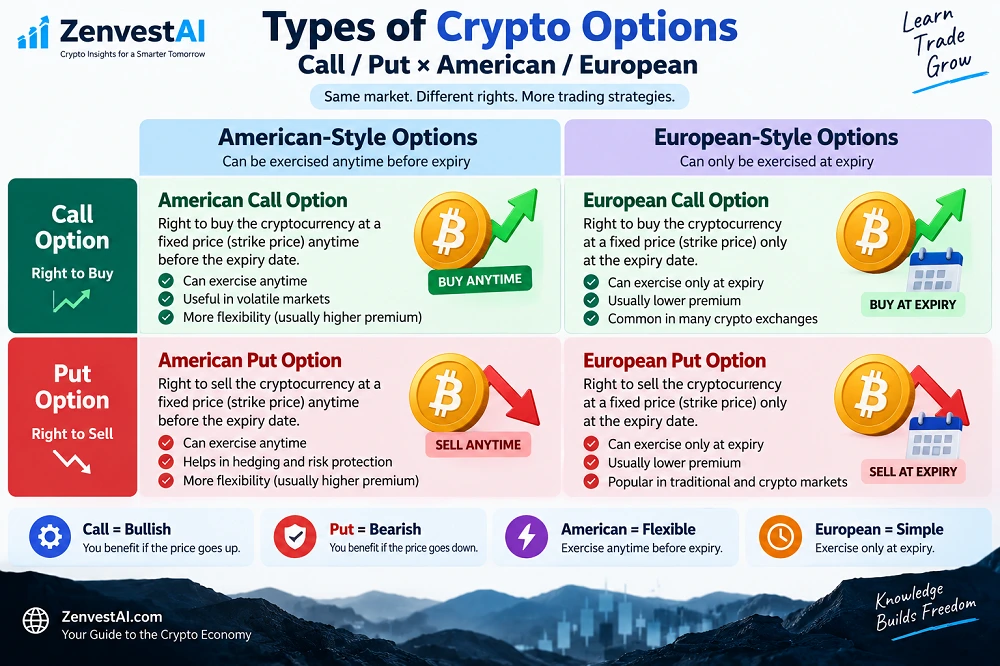
The Four Basic Combinations of Crypto Options
Now the two classifications can be combined.
There are four basic combinations:
- American Call
- American Put
- European Call
- European Put
This is easier to understand as a grid.
| Call | Put | |
|---|---|---|
| American-style | American Call | American Put |
| European-style | European Call | European Put |
This table is one of the most useful mental models for understanding types of crypto options.
The horizontal direction tells you what right you have.
The vertical direction tells you when you can exercise it.
American Call: What Does It Mean?
An American call combines two features:
Call → right to buy.
American → exercise can generally occur before or at expiration.
So an American call gives the holder a right to buy according to the strike price and contract terms, with exercise flexibility before expiration.
The exact mechanics depend on the contract.
American Put: What Does It Mean?
An American put combines:
Put → right to sell.
American → exercise can generally occur before or at expiration.
The holder therefore has the contractual right to sell according to the strike and can exercise before expiration under the applicable rules.
European Call: What Does It Mean?
A European call combines:
Call → right to buy.
European → exercise only at expiration.
This structure is common in crypto options offered by major venues such as Deribit and CME’s cryptocurrency-options products.
European Put: What Does It Mean?
A European put combines:
Put → right to sell.
European → exercise only at expiration.
This is not a different kind of put in terms of its basic directional right.
The difference is the exercise timing.
The Most Important Concept: Type Is Not the Same as Style
This is where many explanations of crypto options become confusing.
A call or put is the option’s type.
American or European is the option’s exercise style.
So saying:
“There are four types of crypto options: calls, puts, American and European.”
is not technically precise.
A better explanation is:
Crypto options have two basic classification dimensions: option type and exercise style. Option type can be a call or put. Exercise style can be American or European.
This terminology matters because ZenvestAI’s goal is not simply to make options sound easy. It is to make them accurate and easy at the same time.
Strike Price: The Number Behind the Contract
The strike price is the price specified in the option contract for the call or put right.
For a call, it is associated with the right to buy.
For a put, it is associated with the right to sell.
Consider a simplified Bitcoin call:
- BTC price: $100,000
- Strike: $105,000
- Expiration: December 2026
- Style: European
- Type: Call
The important information is now visible.
It is a call, so its contractual right is to buy.
It is European-style, so that right can only be exercised at expiration.
The strike is $105,000.
The expiration tells you when the exercise right can be used under the European-style rule.
This is why reading the contract specification is more useful than simply looking at the name of the underlying asset.
Expiration Date Is Not the Same as Exercise Style
Another common mistake is treating expiration and exercise style as the same thing.
They are related, but they are different.
The expiration date tells you when the option contract reaches its expiry.
The exercise style tells you when the holder can exercise.
With a European option:
Exercise → expiration only
With an American option:
Exercise → before expiration or at expiration, subject to the contract
This distinction becomes especially important when comparing products from different exchanges.
Premium: What the Option Buyer Pays
The premium is the price paid for an option.
If you buy a call, you pay a premium.
If you buy a put, you pay a premium.
The premium is separate from the strike price.
For example:
- Strike price: $100,000
- Option premium: $3,000
The $100,000 is the contractual strike.
The $3,000 is the price paid to acquire the option.
This distinction is basic, but it is essential.
A common beginner error is to think the strike price is the amount paid to purchase the option.
It is not.
The premium is what you pay for the option contract.
The Buyer Has a Right; the Seller Has an Obligation
Crypto options have two sides.
The buyer or holder purchases the option.
The seller or writer takes the other side.
For a call:
Buyer → right to buy
Seller → obligation associated with that call if exercised
For a put:
Buyer → right to sell
Seller → obligation associated with that put if exercised
The Options Industry Council describes this relationship in its options overview.
This distinction becomes even more important when understanding American-style exercise because early exercise can create assignment considerations for sellers in markets where that structure exists.
Why the Exercise Style Matters to Crypto Traders
Exercise style may appear like a small technical detail, but it changes how the contract works.
With an American-style option, early exercise can be part of the contract.
With a European-style option, early exercise is prohibited.
That affects how a trader thinks about the position.
It also affects how an options market is structured and managed.
CME notes that European-style options can give market participants certainty that early exercise will not occur.
For crypto traders, this is especially useful because many major crypto-options products are European-style.
A Practical Bitcoin Example
Let’s use one simple example to connect everything.
Suppose BTC is trading at:
$100,000
You are looking at two hypothetical options.
Option A
BTC Call
Strike: $105,000
Style: European
Expiration: 30 days
This means:
- It is a call.
- The contractual right is to buy.
- It is European-style.
- Exercise is restricted to expiration under the style.
- The position may still be traded before expiration if the market permits it.
Option B
BTC Put
Strike: $95,000
Style: European
Expiration: 30 days
This means:
- It is a put.
- The contractual right is to sell.
- It is European-style.
- Exercise is restricted to expiration under the style.
- The option itself may still be bought or sold before expiration.
The two contracts are both European-style.
But one is a call and the other is a put.
That is the distinction you should keep in your head.
A Second Example: Changing Only the Exercise Style
Now imagine two otherwise similar call options.
Call A
Call + American-style
Call B
Call + European-style
Both are calls.
Both provide a right connected to buying at the strike.
The key difference is when exercise is allowed.
Call A can generally be exercised before or at expiration.
Call B can be exercised only at expiration.
This is why “call versus European” is not a proper comparison.
The correct comparisons are:
Call vs. Put
and
American vs. European
Those are two separate questions.
What About Crypto Options That Settle in Cash?
Settlement is another contract feature that should not be confused with option type or exercise style.
A crypto option can have a particular settlement method.
For example, Deribit’s current documentation describes European-style options with cash settlement. Its inverse options documentation states that the settlement involves payment of the option’s intrinsic value rather than exchanging the underlying asset for the strike price.
Its current linear USDC options documentation describes a European-style structure where in-the-money options are settled through a process involving a futures contract and USDC settlement.
This shows why reading only the words “Bitcoin call” is not enough.
You should also know:
What is the exercise style?
What is the settlement method?
What is the underlying?
What is the expiration?
Those details complete the picture.
Why “European” Does Not Mean “European Market”
This deserves its own explanation because the terminology can mislead beginners.
A European-style option does not have to be traded in Europe.
An American-style option does not have to be traded in America.
The names describe exercise conventions.
CME Group explicitly makes this point in its educational material.
So when you read:
European-style Bitcoin option
do not interpret it as:
“Bitcoin option traded in Europe.”
Interpret it as:
“Bitcoin option whose exercise is restricted to expiration under its European-style rules.”
That simple correction can prevent a major misunderstanding.
How Major Crypto Markets Illustrate These Types
Real-world crypto markets make the classification easier to see.
CME’s current cryptocurrency-options products include options on Bitcoin futures, Ether futures, Solana futures and XRP futures, alongside certain micro contracts. CME states that its cryptocurrency options are European-style.
Deribit also states that it offers European-style crypto options. Its documentation includes BTC and ETH products as well as other supported digital assets depending on the product structure.
This gives beginners a useful lesson:
The underlying asset does not determine the exercise style.
Bitcoin does not automatically mean American or European.
Ethereum does not automatically mean American or European.
The contract specification determines the rules.
A Contract Can Change More Than One Thing
Crypto options are not defined only by call or put.
Two options can both be BTC calls but still have different:
- Expiration dates
- Strike prices
- Settlement currencies
- Settlement methods
- Underlying instruments
- Contract sizes
- Exercise styles
This is why professional crypto-options analysis begins with the contract specification rather than assumptions.
What Beginners Often Get Wrong
Understanding what not to assume is almost as important as learning the definitions.
Mistake 1: Thinking calls are always bullish bets
A call is commonly associated with upside exposure, but call technically describes the contractual right to buy.
The word itself does not describe the trader’s entire position or strategy.
Mistake 2: Thinking puts are always about selling Bitcoin immediately
A put provides a contractual right to sell according to its terms.
It does not mean the trader automatically sells Bitcoin when the put is purchased.
Mistake 3: Thinking European options cannot be traded before expiry
They can generally be closed by trading the option.
What is restricted is exercise, not necessarily secondary-market trading.
Mistake 4: Thinking American and European refer to geography
They refer to exercise style.
Mistake 5: Thinking all crypto options have the same exercise rules
They do not.
The contract specification is the authority.
Mistake 6: Ignoring settlement
A contract’s exercise style does not by itself tell you exactly how settlement occurs.
You need to read the exchange’s specifications.
How to Read a Crypto Option in 30 Seconds
When you see a crypto-options contract, use this checklist.
Step 1: Identify the underlying
Is it:
BTC?
ETH?
SOL?
XRP?
Or is it a crypto futures contract?
Step 2: Identify the option type
Look for:
C = Call
P = Put
Many option symbols use C and P, although exact notation varies by venue.
Step 3: Find the strike
The strike price tells you the contractual price associated with the call or put.
Step 4: Find the expiration
Look for the date and exact expiration time.
Step 5: Find the exercise style
Check whether the contract is:
American-style
or
European-style
Do not guess.
Step 6: Check settlement
Determine whether the contract is:
- Cash settled
- Physically settled
- Settled into a futures position
- Or subject to another specified mechanism
Step 7: Check the contract specification
This final step is the one professionals should never skip.
Exchange rules can determine the exact exercise, settlement and expiration process.
A Simple Mental Model for Crypto Options
If you remember only one framework from this article, remember this:
TYPE
→ Call = right to buy
→ Put = right to sell
STYLE
→ American = exercise before or at expiry, subject to contract rules
→ European = exercise at expiry
CONTRACT
→ Strike
→ Expiration
→ Premium
→ Settlement
→ Underlying
This three-layer model makes crypto options much easier to understand.
Are There Only Four Types of Crypto Options?
For the specific classification discussed here, there are four basic combinations:
- American Call
- American Put
- European Call
- European Put
But crypto-options markets can have many different contract specifications and product structures.
For example, options can differ by:
- Underlying asset
- Underlying futures contract
- Expiration schedule
- Strike price
- Settlement currency
- Settlement method
- Contract size
- Trading venue
Therefore, “four types” should not be interpreted as saying that the entire global crypto-options market contains only four products.
The four combinations describe the two fundamental classification dimensions covered in this guide.
Why Contract Specifications Matter More Than the Name
A contract name can tell you a lot.
But it does not always tell you everything.
Suppose you see:
BTC Call
That tells you the underlying and option type.
It does not necessarily tell you:
- Whether it is American or European
- When exactly it expires
- How it settles
- What currency is used for settlement
- What the contract size is
That information lives in the contract specifications.
This is one of the most important habits for anyone moving from beginner-level crypto education toward professional derivatives research.
ZenvestAI Research Insight: The Two-Axis Framework
ZenvestAI’s useful way to classify crypto options is to treat every option as a point on a two-axis framework.
The first axis asks:
What right does the holder have?
Call → Buy
Put → Sell
The second axis asks:
When can that right be exercised?
American → Before or at expiry
European → At expiry
This produces the four basic combinations.
The advantage of this framework is that it prevents a common category error.
A call and a European option are not alternatives.
They describe different properties.
A contract can be:
European Call
or:
American Call
Likewise, a put can be either American-style or European-style, depending on the contract.
That is a cleaner way to understand the global crypto-options market.
A Deeper Point: Exercise and Closing Are Different Actions
This distinction deserves another look because it affects how you read real crypto-options markets.
Imagine you own a European Bitcoin call.
Bitcoin suddenly moves sharply higher two weeks before expiration.
You might decide that you want to exit the position.
You are not required to exercise the option.
Instead, you can potentially sell the option position in the market.
The option’s market value can change before expiration because its price reflects more than just its immediate exercise value.
This is why a European option can still be actively traded before expiry.
Deribit’s documentation specifically explains that its European options cannot be exercised before expiry while allowing positions to be closed in the market before expiry.
Why the Difference Matters More as You Become Advanced
A beginner may only ask:
“Is this a call or put?”
An advanced options researcher asks more questions:
What is the exercise style?
What is the underlying?
What is the settlement mechanism?
What is the expiration time?
What is the strike?
What is the contract size?
What happens automatically at expiry?
These questions do not change the basic definitions.
They make the definitions useful in the real market.
That is the natural progression from learning what a crypto option is to understanding how a particular crypto-options contract actually works.
The Global View: Do Not Assume One Market Represents All Crypto Options
Crypto is a global market.
Bitcoin trades around the clock.
Crypto derivatives are available across multiple jurisdictions and venues.
But that does not mean every venue uses identical contract rules.
CME’s cryptocurrency options and Deribit’s crypto options both illustrate European-style structures, but their underlying instruments and settlement arrangements can differ.
That means a worldwide crypto-options explainer should teach the general classification first and then ask readers to check the exact contract specifications of the venue they use.
This approach is safer and more accurate than making a universal statement about every crypto option.
What Should You Check Before Calling an Option “American” or “European”?
Use five checks:
1. Exchange or venue
Who lists the contract?
2. Contract specification
What does the official specification say about exercise?
3. Underlying
Is the option based directly on an asset, an index, or a futures contract?
4. Settlement
How is the option settled?
5. Expiration rule
When does exercise or automatic settlement occur?
This five-point check is simple enough for beginners and useful enough for advanced readers.
Frequently Asked Questions
What are the main types of crypto options?
The two main option types are calls and puts. Crypto options can also be classified by exercise style as American-style or European-style.
What is a crypto call option?
A crypto call option gives the buyer the right to buy the underlying asset at the specified strike price, subject to the contract’s rules.
What is a crypto put option?
A crypto put option gives the buyer the right to sell the underlying asset at the specified strike price, subject to the contract’s rules.
What is an American-style crypto option?
An American-style option can generally be exercised before expiration or on expiration, subject to the specific contract’s rules.
What is a European-style crypto option?
A European-style option can generally be exercised only at expiration.
Can a European crypto option be sold before expiration?
Yes. Exercise and closing a position are different actions. A European-style option cannot be exercised before expiration, but its position can generally be closed by trading the option before expiry if the market allows it.
Does European-style mean the option is traded in Europe?
No. European-style refers to exercise timing, not geography.
Are Bitcoin options American-style or European-style?
It depends on the specific contract and venue. For example, CME’s current cryptocurrency options are European-style, and Deribit also offers European-style options.
Can a call be European-style?
Yes.
A call describes the right to buy, while European-style describes when the option can be exercised.
Can a put be American-style?
Yes.
A put describes the right to sell, while American-style describes the exercise timing.
What are the four basic combinations?
The four combinations are:
American Call
American Put
European Call
European Put
Is an option’s exercise style the same as its settlement method?
No.
Exercise style tells you when exercise is permitted.
Settlement method tells you how the contractual result is settled.
These should be checked separately in the contract specifications.
ZenvestAI View
The easiest way to understand types of crypto options is to stop thinking of “call, put, American and European” as four competing categories.
They answer two different questions.
Call or Put?
That tells you what right the option gives the buyer.
American or European?
That tells you when that right can be exercised.
Put the two together and the structure becomes clear:
Call + American = American Call
Put + American = American Put
Call + European = European Call
Put + European = European Put
For beginners, this framework removes much of the confusion surrounding cryptocurrency options. For more advanced readers, it provides the correct foundation for reading real contract specifications.
The global crypto market also shows why precision matters. CME currently describes its cryptocurrency options as European-style, while Deribit describes its options as European-style as well, but their underlying products and settlement structures can differ.
So the professional habit is simple: Never identify a crypto option from its name alone. Read the contract.
That one habit can prevent mistakes that start with a very basic misunderstanding of what the option actually is.
Sources and Further Reading
For readers who want to verify the definitions and examine real-world contract specifications, ZenvestAI recommends going directly to primary or industry-standard educational sources:
- CME Group — European vs. American Style Options — explanation of exercise styles.
- CME Group — Cryptocurrency Options FAQ — current CME cryptocurrency-options products and exercise rules.
- Deribit — Linear USDC Options — current product specifications and European exercise rules.
- Deribit — Inverse Options — BTC and ETH inverse option specifications.
- Options Industry Council — Options Exercise FAQ — independent educational reference for exercise and closing positions.
- Options Industry Council — Basic Options Terminology — calls, puts, strike price and exercise-style terminology.
Author & Editorial Information
Published by: ZenvestAI Research Desk
Editorial Desk: Digital Assets & Crypto Derivatives Research
Website: ZenvestAI — zenvestai.com
Financial Disclaimer: This article is educational and explains crypto-options terminology and contract structures. It is not investment, trading, legal, tax or financial advice. Crypto derivatives can involve substantial risk, and contract specifications can change by venue and jurisdiction. Readers should verify the current official specifications, eligibility requirements and applicable laws before trading.