Key Takeaways:-
- Options are risk-design instruments: They allow traders to pre-determine their exact risk profile before entering a trade.
- Limited risk protects capital: As an option buyer, your worst-case loss is strictly limited to the premium paid, even during sudden market crashes.
- Payoffs are non-linear: Option values do not move 1:1 with the underlying asset price, offering unique leverage and risk dynamics.
- Volatility is tradable: You can profit from the magnitude and speed of price swings without predicting whether the market will go up or down.
- Hedging preserves portfolios: Protective puts provide portfolio insurance for spot holdings without triggering taxable sales or forfeiting long-term upside.
ZenvestAi Explains
Crypto options provide traders with flexible financial instruments to design custom risk-and-reward profiles rather than simply betting on price direction.
Unlike linear spot trading, crypto options allow you to achieve asymmetric risk, secure non-linear capital exposure, trade implied volatility, generate yield through premiums, and execute precise downside tail-risk hedging for your Bitcoin portfolio.
While option buyers benefit from strictly capped maximum losses, trading options requires navigating multi-variable dynamics including strike price selection, expiration time decay, and market volatility shifts.
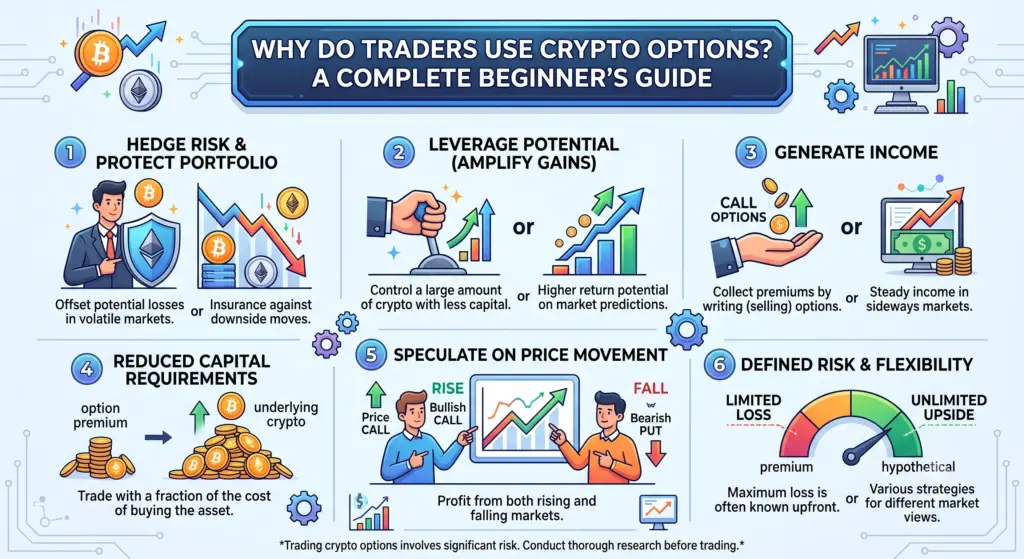
Why Do Traders Use Crypto Options? A Complete Beginner’s Guide
What This Guide Covers
- The Fundamental Reason Traders Choose Options
- Asymmetric Risk Profiles Explained
- Non-Linear Capital Leverage vs. Spot Trading
- Trading Volatility and Generating Yield
- Downside and Tail-Risk Portfolio Protection
- Multi-Variable Analysis: Price, Time, and Volatility
- Option Buyer vs. Option Seller Comparison
- Beginner Decision Framework and Next Steps
📊 ZenvestAI Quick Read
- Primary Purpose: Crypto options are utilized to customize risk-and-reward outcomes, manage volatility, generate premium income, and protect portfolio downside rather than simply guessing market direction.
- Limited Risk: Option buyers can benefit from potentially large price moves while limiting their maximum loss to the upfront option premium.
- Capital Efficiency: Options provide non-linear market exposure, allowing traders to control large crypto positions with significantly less upfront capital compared to spot purchases.
- Portfolio Hedging: Buying protective put options acts like insurance against extreme market crashes (tail risk), preventing panic selling in continuous 24/7 crypto markets.
- Core Trade-off: Greater flexibility introduces layered complexity, including time decay (theta), shifting implied volatility (IV), and expiration deadlines.
Crypto options are not used only to bet on whether Bitcoin or another cryptocurrency will go up or down. Traders use them because options can provide different ways to manage risk, use capital, trade volatility, generate income, and protect a portfolio during large market moves.
The important point is that options behave differently from simply buying or selling crypto.
With spot trading, your profit and loss generally moves directly with the price of the cryptocurrency. With options, the value of your position can change because of several factors, including:
- The crypto price
- Time remaining until expiry
- Implied volatility
- The option’s strike price
This gives traders much more flexibility—but it also makes options more complicated. If you are just getting started, our complete breakdown on how crypto options work explores these pricing components in depth.
In this guide, we will focus specifically on why traders use crypto options, including four important reasons:
- Different risk and reward levels
- Non-linear capital leverage
- Volatility trading and yield generation
- Precise downside and tail-risk hedging
1. What Is the Main Reason Traders Use Crypto Options?
Before understanding the individual benefits, it helps to understand one simple idea:
Crypto options allow traders to design a specific risk-and-reward outcome instead of simply buying or selling an asset.
Imagine Bitcoin is trading at ₹90 lakh. You believe Bitcoin could rise significantly, but you are not comfortable risking a large amount of money by buying Bitcoin directly.
You have two choices:
- You could buy BTC via spot trading.
- Or you could consider a call option.
The option may allow you to participate in a potential rise in Bitcoin while putting a known limit on the amount you can lose as the option buyer. That difference is one of the biggest reasons traders use options.
However, this does not mean options are automatically safer. Options have their own risks, and an option can expire worthless.
Zenvestai Quick Insight: Crypto options allow you to define exact risk parameters before entering a trade. While spot purchases expose your full invested capital to market downturns, buying a call option lets you participate in Bitcoin’s upside with your maximum risk strictly capped at the premium paid, creating an asymmetric risk profile.
2. Understanding Different Risk and Reward: Risk Less Than the Potential Reward ⚖️
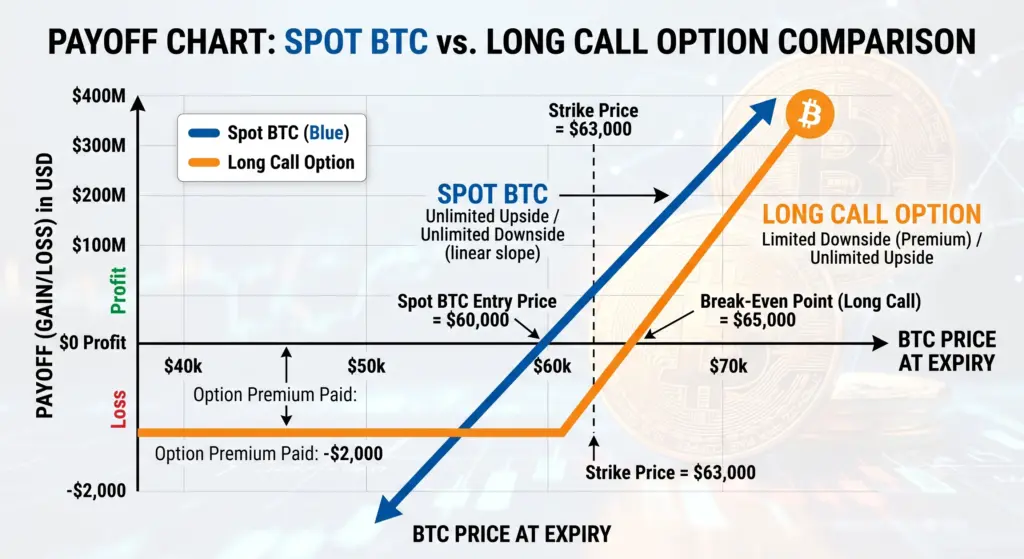
One of the most attractive features of buying options is the possibility of an asymmetric risk profile, which forms the cornerstone of any disciplined risk-to-reward ratio strategy.
In simple language, this means:
You can have a relatively small, clearly defined loss while keeping the possibility of a much larger gain.
Simple Example
Suppose Bitcoin is trading at ₹90,00,000. You purchase a Bitcoin call option with:
- Strike price: ₹95,00,000
- Option premium: ₹1,50,000
- Expiry: 30 days
You pay ₹1,50,000 for the option.
If the trade goes completely against you and the option expires worthless, your maximum loss as the buyer is generally the ₹1,50,000 premium, ignoring fees and other costs. You do not lose ₹90 lakh simply because Bitcoin falls. Your risk was defined when you entered the trade.
What If Bitcoin Rises?
Suppose Bitcoin rises sharply to ₹1.10 crore.
The option may become valuable because you have the right to buy Bitcoin at the ₹95 lakh strike price, depending on the option’s terms and settlement method. Your potential profit can therefore become several times larger than the premium you initially paid.
This creates the basic asymmetric structure:
- Limited downside + potentially much larger upside
That is very different from simply buying Bitcoin with a large amount of capital.
3. Why Different Risk and Reward Matters in the Crypto Ecosystem
Crypto markets are known for large and sometimes sudden price movements. Bitcoin, Ethereum, and other digital assets can move significantly within hours or days.
This creates an unusual situation for traders: a trader may have a strong market view but still be uncomfortable putting a large amount of capital at risk. Options can help structure that view.
Scenario Comparison:
- Without an option:
- You invest ₹5,00,000 directly in BTC.
- If BTC falls 20%, your position could lose approximately: ₹1,00,000
- With an option:
- Suppose you spend ₹50,000 on a call option.
- If the option expires worthless, your loss may be limited to approximately: ₹50,000
- But if BTC makes a sufficiently large move in your expected direction, the option could potentially become worth substantially more than ₹50,000.
The important lesson is not that the option will definitely make more money. It is that the trader has changed the shape of the risk.
4. Crucial Reality: Why Limited Risk Does Not Mean Guaranteed Profit
This is one of the most important points for beginners. An asymmetric payoff does not mean “Pay a small amount and automatically make a large profit.”
You still have to be correct about several things. For a purchased option, you generally need the market to move sufficiently in your favor before the option loses too much value from time passing.
You can correctly predict that Bitcoin will rise and still lose money if:
- Bitcoin does not rise enough
- Bitcoin rises too late
- Volatility falls
- The option expires
- The premium was too expensive
Practical Example:
You purchase a call option because you expect BTC to rise. BTC moves from ₹90 lakh to ₹92 lakh. You were technically correct that Bitcoin would rise, but the move may not be large enough to overcome the premium you paid. Knowing when to secure gains with structured rules like a Take Profit (TP) strategy is critical.
Therefore:
Direction alone is not enough when trading options.
5. How Non-Linear Capital Leverage Works in Options Trading
Another major reason traders use crypto options is non-linear exposure. This sounds complicated, but the basic idea is simple.
With a normal spot position, a 5% movement in the cryptocurrency generally produces approximately a 5% movement in the value of the asset position. Options do not necessarily behave this way.
Their value can change by a different percentage than the underlying cryptocurrency. This is called non-linear payoff behavior, which differs considerably from linear derivatives like crypto futures trading.
6. What Does Non-Linear Mean for Crypto Options?
Let’s use a simple example:
- Suppose BTC is trading at: ₹90,00,000
- You buy a call option for: ₹1,00,000
- If BTC increases by 10%, it moves to approximately: ₹99,00,000
The value of your option does not simply have to increase by 10%. Depending on the strike price, expiry, implied volatility and other factors, the option could increase by a much larger percentage—or could still lose value.
This is because an option’s price is not based only on Bitcoin’s current price; it is influenced by several variables. This creates a non-linear relationship between BTC’s price and the option’s value.
7. Gaining Large Crypto Exposure With Less Initial Capital
This is another reason traders are attracted to options. Instead of purchasing a large amount of cryptocurrency, a trader can purchase an option contract by paying a premium.
Capital Allocation Example:
- You have: ₹2,00,000
- Choice A: You could use the entire amount to buy spot BTC.
- Choice B: Or you might use a smaller amount, such as ₹50,00,0, to purchase an option position and keep the remaining capital available for other strategies, such as crypto staking.
This does not mean the trader has “free money.” The option premium can be completely lost. The advantage is that the trader does not necessarily have to commit the same amount of capital as a comparable spot position.
8. Capital Efficiency vs. Excessive Leverage: Finding the Balance
It is important to separate capital efficiency from reckless leverage. Sophisticated traders often manage cross-instrument capital requirements using portfolio margin financing to optimize balance efficiency safely.
- Capital efficiency means: Using capital in a way that gives you the exposure you want without unnecessarily tying up all your money.
- Excessive speculation warning: A trader may think: “I only need ₹20,000 to control a much larger exposure.” That can be dangerous. If the option expires worthless, the entire ₹20,000 premium may be lost. Traders starting out should explore techniques to trade with low capital responsibly.
Therefore, options should not be viewed simply as a shortcut to bigger profits. A better way to think about them is:
Options allow you to build a specific payoff using less upfront capital, but the smaller upfront cost comes with its own risks.
9. The Core Difference Between Linear and Non-Linear Trading
Understanding this difference makes crypto options much easier to understand.
Spot Trading (Linear)
- You buy ₹1,00,000 worth of BTC.
- If BTC rises 10%, your position is approximately: ₹1,10,000
- If BTC falls 10%, your position is approximately: ₹90,000
- The relationship is relatively straightforward.
Option Trading (Non-Linear)
- You buy an option for ₹10,000.
- BTC may rise 10%, but the option might rise:
- 20%
- 50%
- 100%
- or potentially less
- (depending on the option’s characteristics and market conditions).
Similarly, BTC may move slightly in your favor while your option loses value because of time decay or changes in volatility. That is why options are described as non-linear instruments.
Linear vs. Non-Linear Exposure
| Trading Type | Initial Capital Required | Price Movement Impact | Maximum Risk |
| Spot Trading (Linear) | Full asset purchase price | Direct 1:1 proportional gain/loss | Full value of purchased coin |
| Option Buying (Non-Linear) | Only the option premium | Exponential/variable gain or loss | Strictly limited to premium paid |
10. How Traders Trade Volatility Instead of Pure Direction 📈
This is one of the biggest differences between crypto options and ordinary spot trading.
- A spot trader generally asks: “Will Bitcoin go up or down?”
- An options trader can also ask: “How much will Bitcoin move?” and “How volatile will the market become?”
This introduces volatility trading, an essential component of professional market structure analysis.
Zenvestai Quick Insight:
Trading volatility with options allows you to profit from price magnitude rather than direction. When market turbulence or major announcements are anticipated, strategies like straddles gain value from sharp price swings in either direction, overcoming the limitations of standard spot market trading.
11. What Is Volatility in Crypto Markets?
Volatility simply describes how much and how quickly an asset’s price moves in the crypto market.
Imagine Bitcoin moves like this:
- Low-volatility environment:
₹90 lakh → ₹90.5 lakh → ₹89.8 lakh → ₹90.2 lakh(The market is relatively quiet.) - High-volatility environment:
₹90 lakh → ₹96 lakh → ₹88 lakh → ₹1.00 crore(The market is moving much more aggressively.)
Options become particularly interesting in these situations because their prices are strongly influenced by expectations about future volatility.
12. What Is Implied Volatility (IV) and Why Does It Matter?
Implied volatility, often called IV, is the market’s estimate of how much an asset may move in the future, reflected through option prices.
You do not need to understand the mathematical formula immediately. Think of it this way:
Implied volatility is partly the market’s price tag for expected future movement.
- When traders expect large future movements, option premiums can become more expensive.
- When expected movement decreases, option premiums can become cheaper.
13. Why Do Active Traders Care About Volatility Shifts?
Suppose Bitcoin is trading around ₹90 lakh. There is a major economic announcement tomorrow. Traders tracking crypto news expect a large move but do not know the direction.
Bitcoin could potentially move:
₹90 lakh → ₹84 lakh- or:
₹90 lakh → ₹96 lakh
A trader may not have a strong directional opinion, but they may believe: “Bitcoin is likely to move much more than the market currently expects.”
Options can provide ways to express this view. This is something that is much harder to do using simple spot trading.
14. Buying Volatility: Profiting From Explosive Price Action
Some traders buy options when they believe future volatility is likely to increase.
For example, a trader may buy both:
- A call option
- A put option(at suitable strikes and expiry).
This type of structure can potentially benefit from a large move in either direction. The idea is not “Bitcoin will go up.” Instead, the idea is: “Bitcoin will move significantly.”
However, there is a major catch: the move must generally be large enough and occur soon enough to compensate for the premium paid. If Bitcoin remains quiet, the options can lose value.
15. Selling Volatility: Capitalizing on Expensive Market Premiums
Other traders take the opposite approach. They may believe that options are too expensive because the market is expecting a very large move. They may sell options and collect premiums.
Example:
A trader sells an option and receives a ₹30,000 premium. If the option expires without value, the seller may keep much or all of that premium, subject to fees and the specific contract.
This is one way traders attempt to generate income from option premiums. But this strategy comes with significant risks.
16. Options as a Strategic Yield-Generation Tool
Option selling is sometimes described as a way to generate premium income, providing an alternative source of yield alongside DeFi and liquidity pools.
The basic concept is easy:
Sell option → Receive premium → Manage position → Potentially keep premium
Example:
A trader believes Bitcoin is unlikely to rise above a certain level before expiry. Bitcoin is trading at ₹90 lakh. The trader sells a call option with a higher strike price.
- Suppose the trader receives: ₹25,000
- If BTC remains below the strike at expiry, the option may expire worthless, allowing the trader to retain the premium, subject to the contract’s terms.
This can create a potential income stream.
17. The Hard Truth: Why Option Selling Is Not Free Income
This is extremely important. The ₹25,000 premium is not guaranteed profit. The trader has taken on an obligation.
If Bitcoin makes a large move against the seller, losses can become much larger than the premium received.
Risk Scenario:
You receive ₹25,000. But Bitcoin suddenly makes a massive move. Your loss could become ₹50,000, ₹1,00,000, ₹5,00,000 or more, depending on the option structure, collateral, hedging and whether the position is covered or uncovered.
Therefore:
Premium income is compensation for taking risk. It is not free money.
Zenvestai Quick Insight:
Option selling allows crypto investors to generate steady premium income by taking on defined or undefined obligations.
However, this is not free yield; sellers face substantial downside if the underlying cryptocurrency moves sharply against the strike price, requiring disciplined risk management.
18. Covered Option Strategies: Enhancing Long-Term Holdings
Experienced traders sometimes use options together with an existing crypto portfolio.
For example, a trader already owns Bitcoin. Instead of simply holding BTC, they may sell a call option against part of their holdings. This is commonly known as a covered call.
- The trader receives a premium.
- In return, the trader accepts an obligation that can limit some upside if Bitcoin rises beyond the option’s strike price.
The strategy can therefore be viewed as:
- Hold BTC + collect option premium + accept limited upside
It may be useful for traders who are willing to sell their Bitcoin at a predetermined price.
19. Using Crypto Options for Downside Protection and Hedging 🛡️
Another major reason traders use crypto options is hedging. Hedging means taking a position designed to reduce the impact of an unwanted market move.
Suppose you own ₹10,00,000 worth of Bitcoin. You believe BTC could fall sharply over the next month. But you do not want to sell your Bitcoin because:
- You want to continue holding it
- You have a long-term investment view
- You may face tax or transaction considerations
- You do not want to lose exposure if Bitcoin rises
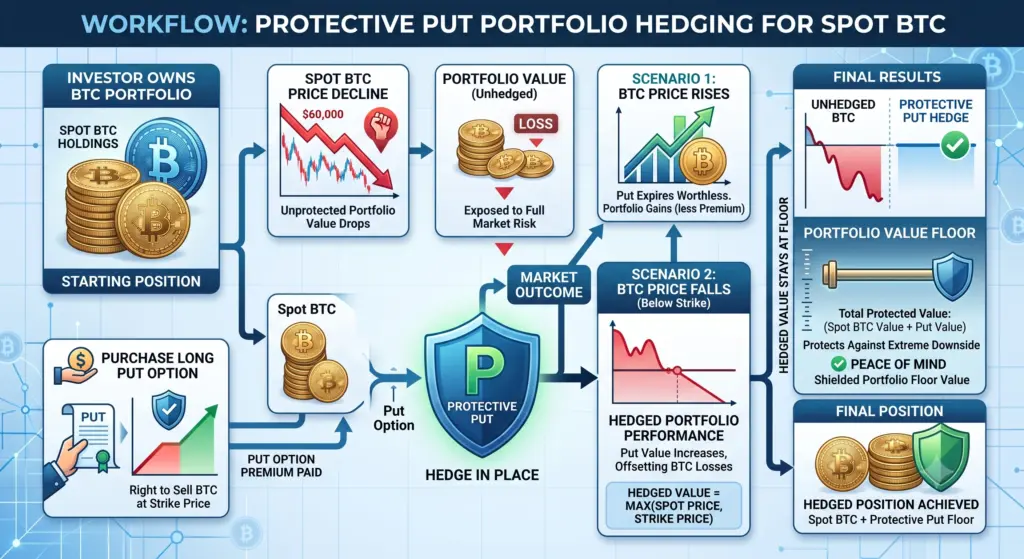
Instead, you could consider buying a put option.
20. How a Put Option Functions Like Portfolio Insurance
A put option can provide the right to sell an asset at a predetermined strike price, depending on the contract terms. This can make a put option function somewhat like insurance for a crypto portfolio.
Insurance Structure:
- Your BTC portfolio: ₹10,00,000
- You buy protective puts for: ₹40,000
If Bitcoin falls sharply, the value of your BTC holdings decreases. But the put option may increase in value. The gain from the put can help offset some of the loss in the underlying portfolio.
You paid ₹40,000 for this protection. That is similar to paying an insurance premium.
21. Why Savvy Investors Accept the Recurring Cost of Hedging
Some beginners may ask: “Why would I pay ₹40,000 for an option if I don’t want to make money from it?”
Because the objective of a hedge is not necessarily to make money; the objective is to reduce unwanted risk.
Think about car insurance: you pay for insurance hoping you never need to use it. If you have an accident, however, the insurance can become extremely valuable.
Protective options can work in a similar way:
- If Bitcoin keeps rising, your put option may lose value.
- But if Bitcoin crashes, the put can potentially provide protection.
22. Tail-Risk Hedging: Protecting Against Extreme Market Crashes
Crypto markets can experience extreme price movements. A tail event is an unusually large market move that happens outside what many traders normally expect.
Crash Example:
Bitcoin is trading at ₹90 lakh. A trader worries about an extreme crash to ₹65 lakh. The trader may use far-out-of-the-money put options to create protection against an extreme downside event.
This is known as tail-risk hedging. The goal is not necessarily to protect against every small daily movement. Instead, the goal is to reduce the damage caused by an unusually large crash.
23. Why Tail-Risk Hedging Is Essential in 24/7 Crypto Markets
Crypto markets operate continuously. Unlike traditional stock markets, crypto trading generally does not stop for weekends. Major events can happen at any time.
Examples include:
- Exchange failures
- Security incidents and crypto scams
- Crypto regulatory changes
- Major liquidation events
- Unexpected economic news
- Stablecoin de-pegs
- Sudden market-wide risk-off moves
A portfolio that looks safe during normal conditions can become highly exposed during extreme volatility. Options can provide another tool for preparing for those situations.
24. How Options Help Traders Define Risk Before Trade Entry
One of the strongest benefits of options is the ability to know certain risk characteristics before entering a trade. For an option buyer, the maximum loss can generally be determined from the premium paid.
Example:
- Option premium = ₹30,000
- If the option expires worthless, the buyer’s loss may be: ₹30,000 + applicable fees
This can be easier to plan around than a position where losses continue increasing as the market moves against you.
However, defined risk does not mean low risk. Losing 100% of a ₹30,000 premium is still a 100% loss on the capital committed to that option.
25. Building Diverse Market Views Beyond Simple Buy and Sell
Another reason options are popular is flexibility. A trader does not have only two choices: Buy BTC or Sell BTC. Options allow traders to construct many different views:
- View 1: BTC will rise strongly — Possible approach: Buy call option
- View 2: BTC will fall strongly — Possible approach: Buy put option
- View 3: BTC will remain within a range — Possible approach: Certain option-selling or spread structures may be considered.
- View 4: BTC will make a very large move but direction is uncertain — Possible approach: Certain combinations of calls and puts may express that view.
- View 5: BTC may crash — Possible approach: Buy protective puts
The exact strategy depends on the trader’s objective, risk tolerance, expiry, strike selection and market conditions.
26. Separating Directional Bias From Volatility Expectations
This is an important concept for beginners.
- With spot trading: “I think BTC will rise.”
- With options, you can potentially express:
- “I think BTC will rise sharply.”
- “I think BTC will fall sharply.”
- “I think BTC will stay within a narrow range.”
- “I think the market is underestimating future volatility.”
- “I want protection if BTC crashes.”
This is why professional traders use options as risk-management and portfolio-construction tools, not merely as leveraged bets.
27. Locking in Future Crypto Prices for Business and Institutional Operations
Businesses and large investors sometimes care more about price certainty than speculation.
Suppose a crypto business expects to receive Bitcoin in the future. The business may be concerned that BTC could fall significantly before it receives or sells the asset. Options can potentially be used to create a floor or ceiling around future prices.
This gives the participant more control over financial risk. The same principle can apply to institutional investors, miners, funds and large crypto holders.
28. How Options Strategically Complement Spot Holdings
Options do not have to replace spot crypto; they can work alongside it:
- Spot BTC + Protective Put = Portfolio with downside protection
- Spot BTC + Covered Call = Potential option premium while accepting a ceiling on upside
This makes options useful as an additional layer around an existing crypto portfolio.
29. Managing Overall Portfolio Risk With Multi-Asset Hedging
Imagine an investor has:
- ₹5,00,000 BTC
- ₹3,00,000 ETH
- ₹2,00,000 other crypto assets
- Total portfolio: ₹10,00,000
The investor is bullish over the long term but is worried about a major short-term market crash. Selling everything may not be desirable.
Instead, the investor could explore an options-based hedge for part of the portfolio. The objective becomes:
Stay invested + reduce extreme downside risk
This is a more sophisticated use of options than simply trying to make quick profits.
30. How Hedging Eliminates Panic Selling During Market Drops
One practical advantage of hedging is psychological.
Imagine Bitcoin falls 25%. Without protection, an investor may panic and sell at the worst possible moment. With a properly structured hedge, part of the portfolio’s downside may be offset by the option position.
This does not eliminate losses, but it can potentially make the overall portfolio easier to manage during extreme market conditions.
31. Beyond Spot Price: Six Key Variables Professional Traders Monitor
When trading options, experienced traders monitor several variables:
- Underlying price: What is Bitcoin or Ethereum doing?
- Strike price: At what price is the option based?
- Expiration: How much time remains?
- Premium: How much does the option cost?
- Implied volatility: How much future movement is the market pricing in?
- Liquidity: Can the position be entered and exited efficiently?
These factors interact with one another. That is why options require more understanding than simple spot trading.
32. Understanding the Impact of Time Pressure and Expiration
Options have an expiration date. This creates something that spot traders do not normally experience in the same way: time pressure.
Suppose you buy a BTC call option with 7 days remaining. You expect BTC to rise. But Bitcoin moves sideways for the next six days. Even if BTC eventually starts moving in your expected direction, the option may have already lost significant value because very little time remains.
This is called time decay.
33. Why Time Decay (Theta) Fundamentally Changes Trade Risk
Consider two identical call options:
- Option A: Expires tomorrow.
- Option B: Expires in 90 days.
Both have the same underlying asset and similar strike prices. The longer-dated option generally has more time for the expected move to happen. The shorter-dated option has much less time.
Therefore, an option buyer is not simply betting on direction. They are effectively making a decision about:
Direction + magnitude + timing + volatility
That is one reason options can be powerful but complicated.
34. The Four Pillars: Summary of Why Traders Use Crypto Options
At this point, we can simplify everything into four major purposes:
- Asymmetric Risk: Traders can structure positions where the potential reward is significantly larger than the predefined loss. For option buyers, the premium paid generally defines the maximum loss.
- Non-Linear Capital Exposure: Options can provide substantial exposure to an underlying crypto asset without requiring the trader to purchase the entire underlying position. The payoff does not move one-for-one with the crypto price.
- Volatility and Premium Income: Traders can take views on volatility itself. Option sellers can collect premiums, while option buyers can potentially benefit when volatility and price movements work in their favor. But premium selling involves potentially significant risk.
- Downside and Tail-Risk Protection: Put options and other option structures can help protect portfolios against significant declines. This can allow investors to maintain crypto exposure while preparing for adverse market conditions.
35. Comprehensive Real-World Case Study: Combining All Four Ideas
Suppose you own:
- ₹10,00,000 worth of BTC
- Bitcoin is trading at: ₹90 lakh
You believe Bitcoin could reach ₹1.10 crore over the next few months, but you are also worried about a sudden crash. Instead of simply holding BTC, you could think about using options for two different purposes:
- Upside participation: A call option could provide additional upside exposure using a smaller upfront premium.
- Downside protection: A put option could provide protection against a major fall.
The result is a portfolio designed around two different objectives:
Participate in upside + protect against extreme downside
This is the real power of options. They allow traders to shape the payoff of a portfolio rather than relying only on the direction of the cryptocurrency.
36. Unique Market Characteristics That Make Crypto Options Attractive
Crypto has several characteristics that make options particularly useful:
- 24/7 markets: Crypto markets generally operate around the clock.
- High volatility: Large price movements can create both opportunities and risks.
- Rapid market cycles: Crypto sentiment can change very quickly.
- Strong leverage demand: Many traders want capital-efficient exposure.
- Institutional participation: Funds and professional traders increasingly use derivatives for hedging, positioning and volatility management.
Because of these characteristics, crypto options can serve purposes beyond simple speculation.
37. The Double-Edged Sword: Why More Flexibility Creates More Complexity
This is where beginners need to be careful. Options give you more choices, but more choices also mean more ways to make mistakes.
You can lose money because:
- You chose the wrong direction
- The move was too small
- The move happened too late
- Implied volatility fell
- Time decay reduced the option’s value
- The premium was too expensive
- Liquidity was poor
- You misunderstood the settlement rules
- You used too much capital
- You sold options without understanding the potential loss
Therefore:
The flexibility of options is both their biggest strength and one of their biggest risks.
38. Comprehensive Comparison: Option Buyers vs. Option Sellers
It is useful to understand the difference between both sides of an options trade:
| Feature | Option Buyer | Option Seller |
| Cash Flow | Pays premium | Receives premium |
| Position Rights | Has a right | Takes an obligation |
| Risk Profile | Usually has defined maximum loss equal to premium paid | Can face much larger losses depending on structure |
| Market Benefit | Benefits from favorable price movement | Benefits when option expires with little or no value |
| Time Decay Impact | Can be exposed to time decay | Can benefit from time decay |
| Volatility Stance | May buy volatility | May sell volatility |
Neither side is automatically “better.” Each side is taking a different type of risk.
39. Strategic Evaluation: Why Traders Do Not Use Options for Every Single Trade
If options are so flexible, why not use them all the time?
Because options have costs and complexities that spot trading does not have in the same form. For example:
- Premiums can be expensive
- Time decay can work against buyers
- Implied volatility can change
- Liquidity can vary
- Spreads can increase trading costs
- Contracts have expiry dates
- Different strikes behave differently
Sometimes simply buying or selling the underlying cryptocurrency is more appropriate. The best instrument depends on the trader’s objective.
40. Essential Mindset: Viewing Options as Risk Tools, Not Profit Machines
A common beginner mistake is to think: “Options require less money, so I can make more profit.” That is incomplete.
Options can provide capital efficiency, but they also introduce additional risks. A ₹10,000 option can potentially become ₹20,000, ₹30,000 or more. But it can also become ₹0.
That is why the correct mindset is:
Use options to structure risk—not simply to chase large returns.
41. The Critical Pre-Trade Question Every Trader Must Answer
Before entering an options trade, a trader should be able to answer:
What exactly am I trying to achieve?
Is the goal:
- Speculation?
- Portfolio protection?
- Volatility exposure?
- Premium income?
- Reducing downside risk?
- Gaining upside exposure?
- Improving capital efficiency?
If you cannot answer this question, you may be using an option simply because it looks attractive. That is dangerous.
42. A Practical 5-Step Decision Framework for Beginners 💡
Before using crypto options, think through these five questions:
- What is my market view? — Do I expect: up / down / sideways / large movement?
- How much can I lose? — Know the maximum possible loss before entering.
- How long do I need the trade to work? — An option has an expiry.
- Am I trading direction or volatility? — These are not always the same thing.
- Am I protecting my portfolio or trying to make money? — A hedge and a speculative trade have different objectives.
43. The Bigger Picture: Asking Advanced Questions in Crypto Trading
Crypto options are powerful because they allow traders to move beyond the simple question: “Will Bitcoin go up or down?”
Instead, traders can build positions around questions such as:
- “How much could Bitcoin move?”
- “When could the move happen?”
- “Is volatility likely to increase?”
- “How much downside am I willing to accept?”
- “How can I protect my BTC holdings?”
- “Can I generate premium income while accepting a specific risk?”
These are the questions that make options valuable to advanced traders and investors. You can continue building your knowledge across our comprehensive crypto education library.
44. Final Takeaway and What You Should Understand Next
Crypto options are used because they give traders more control over risk and potential returns than simply buying or selling cryptocurrency.
The four major reasons are:
- Asymmetric risk — option buyers can potentially limit their loss to the premium paid while keeping significant upside potential.
- Non-linear capital exposure — options can create exposure that does not move one-for-one with the underlying cryptocurrency and may require less upfront capital than buying the underlying asset directly.
- Volatility and yield opportunities — traders can take positions based on expected market volatility, while option sellers may collect premiums in exchange for taking risk.
- Downside and tail-risk hedging — puts and other structures can help protect a crypto portfolio from large or unexpected market declines.
But these benefits come with important trade-offs: options have time decay, changing volatility, expiry dates, premium costs, liquidity risks and potentially complex payoff structures.
So the goal should not be to use options simply because they offer leverage. The better approach is to understand what risk you want to take, what risk you want to avoid, and what outcome you want the option to create.
In one sentence:
Crypto options give traders the flexibility to design a specific risk-and-reward outcome—whether the goal is speculation, capital efficiency, volatility trading, income generation, or portfolio protection.
What You Should Understand Next
Once you understand why traders use crypto options, the next important step is understanding the actual building blocks that determine an option’s price and risk:
- Call vs. put options
- Strike price
- Option premium
- Expiration date
- In-the-money (ITM)
- At-the-money (ATM)
- Out-of-the-money (OTM)
- Intrinsic value
- Time value
- Implied volatility
- Delta, gamma, theta and vega (The Option Greeks)
- Option payoff diagrams
These concepts explain why an option can gain or lose value even when Bitcoin moves in the direction you predicted. For a full beginner walkthrough, check out our guide on how crypto options work.
Glossary of Essential Crypto Options Terms
- Call Option: A financial contract giving the buyer the right, but not the obligation, to buy an underlying cryptocurrency at a specified strike price within a set timeframe.
- Put Option: A financial contract giving the buyer the right, but not the obligation, to sell an underlying cryptocurrency at a specified strike price within a set timeframe.
- Strike Price: The set price at which an option holder can buy (call) or sell (put) the underlying asset upon exercise.
- Option Premium: The upfront cash price that the buyer pays to the seller for the rights granted by the option contract.
- Expiration Date (Expiry): The pre-set date and time when an options contract becomes void and ceases to exist.
- Implied Volatility (IV): The market’s forward-looking expectation of how volatile the underlying cryptocurrency’s price will be over the lifespan of the contract.
- Time Decay (Theta): The rate at which the value of an option contract decreases as its expiration date approaches.
- Tail-Risk Hedging: An investment strategy aiming to protect a portfolio against rare, extreme, and catastrophic market downturns.
The Bottom Line: Comprehensive Summary
Crypto options are sophisticated financial instruments designed to give investors and traders complete control over their risk architecture. Rather than being confined to simple directional bets, options allow market participants to craft asymmetric payoffs, deploy capital efficiently, capture yield through option premiums, and insulate portfolios against sudden tail-risk crashes. Success in options trading requires balancing directional expectations with timing, volatility, and disciplined risk management.
Join the Discussion!
Have you used crypto options to hedge your Bitcoin holdings, or are you exploring options primarily for asymmetric upside? Share your thoughts, strategies, and questions in the comments below! Review our editorial policy, disclaimer, and privacy policy for community standards and risk disclosures.