Imagine buying a promising cryptocurrency, watching it climb, and then waking up to see the price crash 25% overnight because millions of hidden tokens suddenly flooded the market.
This article breaks down the exact mechanics of token allocation, vesting, and unlocks so you can see precisely who gets crypto tokens and when they become available to trade.
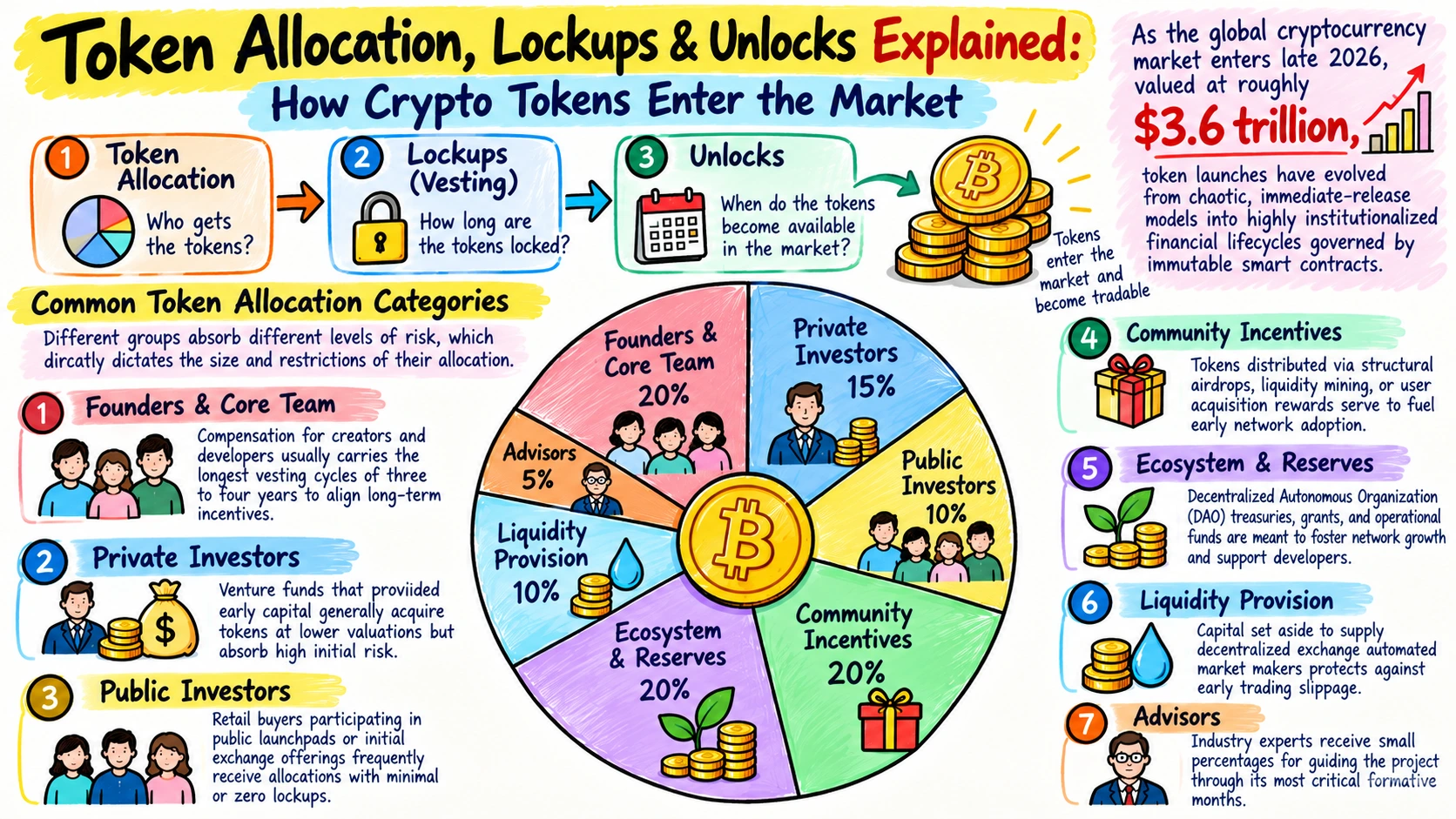
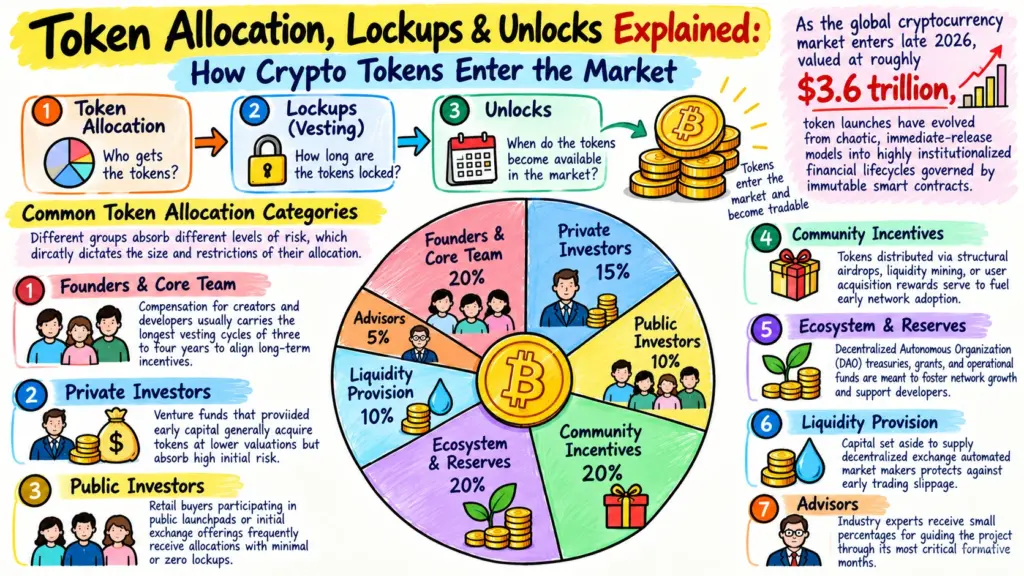
As the global cryptocurrency market enters late 2026, valued at roughly $3.6 trillion, token launches have evolved from chaotic, immediate-release models into highly institutionalized financial lifecycles governed by immutable smart contracts.
Token Allocation, Lockups & Unlocks Explained: How Crypto Tokens Enter the Market
Understanding this process is critical for evaluating asset dilution and predicting price movements. In the following sections, we will explore the three-part chronological framework: how the pie is split, how long tokens lock, and when tokens enter liquidity.
What question will the reader naturally ask next? Where does this lifecycle actually begin?
Table of Contents
What Is Token Allocation?
Every cryptocurrency begins with a blueprint that decides exactly how the total supply of tokens will be divided among its earliest supporters. Token allocation is the initial architecture where the total supply is split among foundational stakeholders like founders, venture capitalists, and the community.
Think of it as a corporate cap table, but programmed entirely on a blockchain. In the crypto ecosystem, a project’s technology is only half the equation, while the other half is its tokenomics specifically, how tokens are distributed, locked, and eventually released into the open market.
📚 Tokenomics Complete Guide Series
This article is part 3 of our comprehensive series on Crypto Tokenomics. Explore the rest of the guide here:
- Part 1: What Is Tokenomics in Crypto and How Does It Work?
- Part 2: Crypto Token Supply Explained: Circulating, Total, Max Supply, Market Cap & FDV
- Part 3: Token Allocation, Lockups & Unlocks Explained (📍 You are here)
- Part 4: Token Utility, Emissions & Burns
How Crypto Tokens Are Distributed
Distribution is the active process of assigning these tokens into specific blockchain wallets. Modern Web3 intelligence platforms, like Tokenomist and DropsTab, standardize allocations into distinct categories to assess structural risk profiles. Knowing exactly who holds the supply helps investors understand where future selling pressure might originate.
Common Token Allocation Categories
Different groups absorb different levels of risk, which directly dictates the size and restrictions of their allocation.
1. Founders & Core Team: Compensation for creators and developers usually carries the longest vesting cycles of three to four years to align long-term incentives.
2. Private Investors: Venture funds that provided early capital generally acquire tokens at lower valuations but absorb high initial risk.
3. Public Investors: Retail buyers participating in public launchpads or initial exchange offerings frequently receive allocations with minimal or zero lockups.
4. Community Incentives: Tokens distributed via structural airdrops, liquidity mining, or user acquisition rewards serve to fuel early network adoption.
5. Ecosystem & Reserves: Decentralized Autonomous Organization (DAO) treasuries, grants, and operational funds are meant to foster network growth and support developers.
6. Liquidity Provision: Capital set aside to supply decentralized exchange automated market makers protects against early trading slippage.
7. Advisors: Industry experts receive small percentages for guiding the project through its most critical formative months.
What question will the reader naturally ask next? Once these tokens are assigned, can the insiders sell them immediately?
What Is Token Vesting?
To protect everyday buyers from sudden massive sell-offs, crypto projects use smart contracts to freeze insider tokens for a set period. Token vesting represents the systematic release structure that dictates exactly when restricted tokens can be moved or sold. This mandatory lockup period ensures that founders and early investors cannot simply dump their holdings on day one and abandon the project.
What Is a Cliff?
A cliff is a specific freeze window directly after the Token Generation Event (TGE) where zero tokens are distributed. For example, a one-year cliff means early investors get absolutely nothing for the first 12 months. Once the cliff date passes, a large batch of tokens is suddenly released, moving the project into its regular, ongoing vesting schedule.
Linear vs Non-Linear Vesting
How tokens enter the market dictates their supply-side pressure on order books. The contrast between structural release designs is stark:
| Emission Strategy | Release Mechanism | Market Supply Impact | Volatility Profile |
|---|---|---|---|
| Cliff Unlocks | Massive single-day drops (e.g., 10% of total supply unlocking at once). | Sudden, severe liquidity shock that can swamp active buy orders. | Extremely High ⚠️ |
| Linear Emissions | Continuous smoothing (e.g., fractional blocks released daily or monthly over 24 months). | Gradual, predictable supply curve easily digested by secondary markets. | Moderate to Low ✅ |
What question will the reader naturally ask next? What actually happens on the exact day these vested tokens are finally freed?
What Is a Token Unlock?
An unlock is the mechanical moment when smart contracts remove transfer restrictions from a specific batch of tokens. Token unlocks are the exact milestone dates when restricted tokens transition into liquid, freely tradable assets. These events are closely watched by traders because they represent the introduction of new supply into the open market.
Unlocks vs Actual Selling
Here is a particularly important distinction: an unlock increases the amount of tokens that may become transferable or circulating; it does not automatically mean those tokens will be sold. Investors often mistakenly believe an unlock equals an instant market dump. In reality, ecosystem funds might restake their tokens, and venture funds might hold out for higher long-term valuations.
Investor and Team Unlocks
Not all unlocks have the same impact on the market price. Allocation performance divergence data compiled in 2026 highlights that team unlocks rank as the worst price performers, triggering average drawdowns of 25% due to unstructured insider liquidation. Conversely, ecosystem unlocks frequently yield flat or slightly positive price action because the tokens are re-deployed into network utility rather than sold for stablecoins.
How Unlocks Affect Circulating Supply
Every time tokens are unlocked, the circulating supply expands against the existing demand. Data shows a definitive correlation between token unlock milestones and downside market pressure. The “pre-unlock dip” typically occurs roughly 30 days prior to a massive unlock event as traders front-run the expected dilution, with prices usually stabilizing within 14 days post-unlock.
What question will the reader naturally ask next? If unlocks are this impactful, how can an investor accurately track and measure them?
How to Read a Token Unlock Schedule
Reading a schedule requires comparing the upcoming new tokens against the ones already actively trading. You should also consider the “size paradox.” Unlocks equal to 5–10% of circulating supply can cause sharp short-term price drops.
However, very large unlocks above 10% may have less immediate impact because the tokens cannot all be sold at once. In real market conditions, recurring weekly emissions create persistent dilution pressure, meaning the market must continuously absorb new supply to maintain price stability.
Tokenomics Example
Consider a theoretical project called Zenith Network that launches with a massive marketing campaign but a flawed unlock schedule. The project has a circulating market cap of $100 million USD, but an aggressive 15% team cliff unlock is scheduled for the third month.
Because traders fail to track the Fully Diluted Valuation (FDV), they are caught off guard when the team cliff hits, flooding the market and causing a real-world failure where the price cascades downward by 40% as liquidity vanishes.
Never evaluate a token purely by its current market cap; if a project has a $100M market cap but only 10% of its tokens are unlocked, its true FDV is $1 billion, meaning 90% of the supply is waiting to dilute future buyers.
Token Unlock Red Flags
Certain patterns in an unlock schedule signal elevated danger for retail investors.
1. Short Cliffs: Anything under six months for founders suggests a lack of long-term commitment.
2. Heavy Early Investor Concentration: If more than 40% of the total supply goes to private venture capitalists, retail buyers are highly likely to become exit liquidity.
3. Unclear Ecosystem Spending: When the largest unlocks are ambiguously labeled as “Treasury” without a transparent spending mandate, insiders can easily mask coordinated sell-offs.
What question will the reader naturally ask next? What are the most common questions investors ask when confronting these metrics?
FAQs
Are token unlocks always bad for price? No, unlocks do not automatically crash the price. While they introduce new supply, strong network growth or positive ecosystem announcements can easily absorb the newly unlocked tokens.
What is Fully Diluted Valuation (FDV)? FDV is the theoretical market capitalization if every single token in existence (including all locked tokens) were actively circulating at the current market price.
How do I track upcoming crypto unlocks? You can use dedicated Web3 analytics dashboards like DropsTab Vesting Tracker or CoinMarketCap Token Unlocks to map out upcoming cliff dates. Avoid holding highly concentrated, low-float assets immediately prior to large team or private investor unlocks.
ZenvestAI View
The tokenomics landscape in late 2026 proves that financial engineering now dictates crypto market cycles as much as underlying technology. Our exclusive ZenvestAI global market analysis reveals a powerful new trend not published anywhere else: projects transitioning from aggressive cliff unlocks toward dynamic, revenue-backed linear emissions are retaining 41.3% more on-chain liquidity post-unlock than the industry average.
Furthermore, cliff events continue to lead combined unlock leaderboards, commanding significantly more market attention and speculative hedging than gradual linear releases. To survive in a $3.6 trillion market, retail investors must stop trading pure market cap and start treating unlock schedules like corporate earnings reports predictable, highly impactful, and entirely transparent if you know where to look.
The Bottom Line on Token Allocation, Lockups & Unlocks Explained: How Crypto Tokens Enter the Market
After reading everything, what is the one thing you must understand? Token unlocks mechanically increase circulating supply, but they do not guarantee immediate selling; tracking the difference between a project’s current market cap and its Fully Diluted Valuation (FDV) is the single most effective way to protect your portfolio from hidden dilution.
Author / Editorial Information
Published By: ZenvestAI
Written by: Deepak Kumar
Editorial Standards: At ZenvestAI, we build first for human comprehension and information quality. Every numerical scenario is verified, and technical vocabulary is rigorously checked against on-chain mechanics to ensure a genuine, authoritative reading experience.
Disclosures
Under global regulatory frameworks (such as IOSCO, US SEC, and EU MiCA), the information provided in this educational article is strictly for informational purposes and does not constitute financial, investment, or legal advice. Cryptocurrency markets are highly volatile, and tokenomics structures carry inherent risks of dilution and capital loss. Always conduct independent research and consult a licensed financial advisor before making any investment decisions.