Many traders joke that options pricing looks like ancient Greek, but mastering these five risk gauges is the single sharpest way to protect your Bitcoin and Ethereum portfolio from sudden market swings.
Crypto Options Greeks are risk-sensitivity metrics that show how an option’s theoretical market price changes, when underlying cryptocurrency prices, time to expiration, implied volatility, or interest rates shift.
The five primary Greeks are Delta (Δ), Gamma (Γ), Theta (Θ), Vega (ν), and Rho (ρ).
Rather than forecasting where a coin will trade tomorrow, these mathematical tools act like a live dashboard, measuring how an option contract responds to specific market forces.
In digital asset markets, where Bitcoin and Ethereum trade around the clock with annualized volatility frequently exceeding 60%, watching the Greeks helps you to separate calculated risk management from pure guesswork.
Key Takeaways
- The Greeks Are Risk Dashboards: They calculate sensitivity to price (Delta), acceleration (Gamma), time decay (Theta), volatility (Vega), and interest rates (Rho).
- Crypto Markets Are 24/7: Time decay never stops on weekends, and extreme spot volatility causes Greeks to fluctuate much faster than in traditional stocks.
- Greeks Work as a Team: An option’s live market price reflects simultaneous shifts across multiple variables; a directional win from Delta can be erased by an adverse move in Vega or Theta.
- Units and Position Size Matter: Always multiply individual contract Greeks by your total position volume to determine your true cash-equivalent exposure.
Why This Matters Right Now
The digital asset derivatives landscape has undergone a massive structural shift. According to research published in the Bybit + Glassnode: The State of Crypto Derivatives Report, crypto options have expanded to capture nearly 50% of Bitcoin’s notional open interest, putting options trading on equal footing with perpetual futures.
Institutional desks and individual traders now use crypto options contracts across venues like Deribit, Bybit, and CME Group to generate yield, hedge spot holdings, and speculate with defined risk.
However, entering crypto options without understanding the Greeks often leads to painful surprises.
You frequently buy an out-of-the-money call, watch Bitcoin rise, and still lose money because time decay or a collapse in volatility crushed the contract value.
Learning how the Greeks operate together solves this confusion and gives you a clear lens into options pricing.
Table of Contents
- Key Takeaways
- What Are Crypto Options Greeks?
- Why Are Greeks Important in Crypto Options?
- Delta (Δ): Directional Exposure
- Gamma (Γ): The Speed of Delta
- Theta (Θ): The Effect of Time
- Vega (ν): Sensitivity to Implied Volatility
- Rho (ρ): Interest-Rate Sensitivity
- Crypto Options Greeks at a Glance
- How Crypto Options Greeks Work Together
- A Simple BTC Options Example
- How to Read Greeks on a Crypto Options Chain
- Are Crypto Options Greeks Predictions?
- Common Mistakes When Reading Crypto Options Greeks
- Crypto Options Greeks vs. Traditional Options Greeks
- Frequently Asked Questions
- ZenvestAI View
- The Bottom Line on What Are Crypto Options Greeks?
- Related Intelligence
- Editorial Information
- Global Regulatory & Educational Disclosure
- Sources & Data References
What Are Crypto Options Greeks?
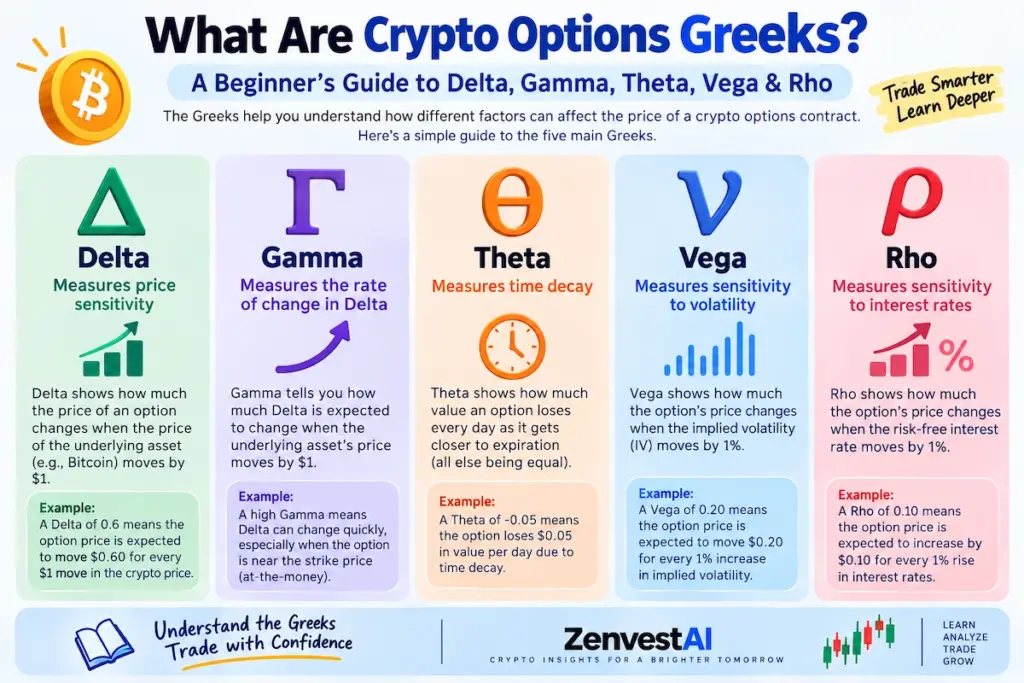
Options Greeks are mathematical indicators derived from option pricing models such as the classic Black-Scholes-Merton (BSM) formula that describe how sensitive a contract’s premium is to various market inputs.
An option contract gives the buyer the right, but not the obligation, to buy (a call) or sell (a put) a cryptocurrency at a set strike price before or on a specific date.
Because an option’s premium fluctuates based on several changing variables at once, the Greeks isolate each variable to show its individual impact.
The Greeks are sensitivity measurements, not price predictions.
They do not tell you if Bitcoin will reach $120,000 or drop to $80,000. Instead, they answer specific "what-if" questions about the contract’s current price behavior:
- Delta (Δ) answers: How much does the option price change when the underlying cryptocurrency moves by $1?
- Gamma (Γ) answers: How fast does Delta itself accelerate when the cryptocurrency price changes?
- Theta (Θ) answers: How much value does the option lose every day as expiration draws nearer?
- Vega (ν) answers: How much does the option premium gain or lose when implied volatility shifts by 1%?
- Rho (ρ) answers: How does a change in baseline interest rates influence the option’s fair value?
Understanding these five metrics gives you complete visibility into the hidden engine powering option premiums.
Once you understand what each Greek measures in isolation, the next question is clear: why do they behave so much more aggressively in cryptocurrency markets than in traditional equities?
Why Are Greeks Important in Crypto Options?
Crypto options markets operate in a fundamentally different environment than traditional stock markets. While equity markets close on weekends and observe strict weekday trading hours, digital assets trade uninterrupted 24 hours a day, 365 days a year.
This non-stop schedule removes weekend pauses and exposes options contracts to nonstop price discovery, sudden weekend liquidity drains, and continuous time decay.
Crypto asset volatility regularly dwarfs standard equity benchmarks. Traditional stock index volatility often hovers between 12% and 20%, whereas Bitcoin and Ethereum regularly register annualized implied volatility readings between 50% and 100%. Under these conditions, the Greeks do not drift gradually; they swing rapidly.
Short-dated contracts, including daily and weekly expiries, represent a substantial portion of daily volume on leading options platforms like Deribit.
For these short-dated contracts, Gamma and Theta reach extreme levels, turning small spot price moves into drastic percentage swings in contract premiums.
Monitoring the Greeks enables traders to measure their total portfolio directional bias, avoid sudden volatility crushes, and execute dynamic hedges before sharp swings cause liquidations.
With this broader crypto market context established, let us inspect the primary Greek that every trader encounters first: Delta.
Delta (Δ): Directional Exposure
What Is Delta?
Delta measures the expected change in a crypto option’s premium for every $1 USD move in the price of the underlying digital asset. If an option has a Delta of 0.50, the contract is theoretically expected to gain approximately $0.50 in value if the underlying coin rises by $1.00, assuming all other pricing variables remain identical.
How Delta Works
Delta provides a direct estimate of directional sensitivity across both calls and puts. Because an option’s value changes continuously as the underlying spot price fluctuates, Delta represents a local rate of change at that specific price point. It does not guarantee constant dollar-for-dollar gains over large price leaps, but it gives a reliable immediate gauge of directional exposure.
Beyond price sensitivity, market participants commonly use the absolute value of Delta as a rough shorthand for the market’s implied probability of that option expiring in-the-money (ITM). While not a strict mathematical probability, an option with a 0.25 Delta suggests roughly a 25% theoretical likelihood of finishing in-the-money by the expiration date.
Delta in Crypto Options
In crypto options markets, contract sizes and spot prices are substantial, making Delta vital for calculating cash-equivalent exposure. Consider a Bitcoin call option trading when Bitcoin is at $100,000 USD:
If a Bitcoin call option possesses a Delta of 0.50, a $1,000 USD upward move in Bitcoin’s spot price corresponds to a theoretical increase of roughly $500 USD in the option’s value, assuming volatility and time remain unchanged.
Conversely, if Bitcoin drops by $1,000 USD, that same call option contract loses approximately $500 USD in theoretical value. Delta helps a crypto trader instantly see that holding one 0.50 Delta contract carries the same immediate directional risk as holding 0.50 BTC in the spot market.
Positive and Negative Delta
The sign of your Delta indicates whether your position gains or loses as the underlying cryptocurrency moves upward:
- Long Call Options: Possess a positive Delta ranging from 0.0 to +1.0. As Bitcoin appreciates, the call premium rises.
- Long Put Options: Possess a negative Delta ranging from -1.0 to 0.0. As Bitcoin declines, the put premium increases. A put with a -0.40 Delta gains roughly $0.40 if Bitcoin falls by $1.00.
- Short Call Positions: Carry a negative Delta because selling a call creates a short directional bias.
- Short Put Positions: Carry a positive Delta because selling a put benefits when the asset stays flat or moves higher.
Traders track their portfolio Delta by summing the Deltas of all open positions. A trader with three contracts carrying a combined Delta of +1.50 holds an aggregate market exposure equivalent to being long 1.50 BTC.
What Does Delta Tell a Crypto Options Trader?
Delta tells a trader exactly how exposed their capital is to the next dollar move in the spot market. It answers whether a strategy is behaving like a leveraged directional bet, a conservative hedge, or a market-neutral position.
However, Delta is not static. If Bitcoin rallies $5,000 USD, your Delta will not stay at 0.50; it will climb higher. That brings us to our next logical question: what metric measures how fast Delta itself changes? That metric is Gamma.
Gamma (Γ): The Speed of Delta
What Is Gamma?
Gamma measures the rate of change in an option’s Delta for every $1 USD move in the underlying cryptocurrency’s spot price. If Delta represents the speed at which an option’s price moves relative to the asset, Gamma represents its acceleration.
Beginners often confuse Delta and Gamma. Remember this simple distinction: Delta tells you how much the option price moves, while Gamma tells you how much your Delta moves.
How Gamma Changes Delta
Gamma ensures that an option’s directional exposure expands when the trade goes in your favor and contracts when the trade goes against you. Suppose you buy a Bitcoin call option when Bitcoin is trading at $100,000 USD. The contract currently has a Delta of 0.50 and a Gamma of 0.00010:
If Bitcoin climbs by $1,000 USD to $101,000 USD, Gamma increases the option’s Delta by:
0.00010 × 1,000 = 0.10
The call option’s new Delta becomes 0.60 (0.50 + 0.10). If Bitcoin rises another $1,000 USD, the option contract will now gain value at an accelerated rate of $600 USD per $1,000 USD move rather than the initial $500 USD.
Why Gamma Matters in Crypto
Gamma matters intensely in crypto because sudden multi-thousand-dollar candle spikes can rapidly flip a conservative hedge into a high-delta directional position. When large institutional market makers sell options to retail traders, those market makers must constantly hedge their positions by buying or selling the underlying coin to maintain a neutral book.
When market makers are net short Gamma and Bitcoin breaks out violently, they are forced to buy more Bitcoin as the price rises and sell Bitcoin as the price crashes to remain hedged. This dynamic creates rapid Gamma squeezes and liquidity vacuums that exacerbate market volatility across both centralized order books and decentralized automated market makers.
Gamma Near Expiration
Gamma reaches its highest and most volatile levels for at-the-money (ATM) options right before expiration. An at-the-money contract expiring in two hours might have its Delta oscillate violently between 0.10 and 0.90 on a minor $200 USD Bitcoin flicker.
This surge in late-stage sensitivity is known as expiration Gamma risk. While high Gamma offers massive explosive upside for buyers of ultra-short-dated contracts, it introduces extreme liquidation risk for option sellers.
While Gamma gives options their explosive acceleration, holding an option comes with a constant daily holding fee. What is that daily holding cost, and how does the clock work against an options holder? That leads directly to Theta.
Theta (Θ): The Effect of Time
What Is Theta?
Theta measures the rate at which an option’s premium declines over the passage of time, assuming all other market variables stay completely flat. Because an option contract has a finite lifespan, its time value steadily erodes until expiration, when only intrinsic value remains.
Theta is expressed as a negative number for long option positions because time decay eats away at the option buyer’s premium every single day.
How Time Decay Works
Time decay is fundamentally non-linear. An option contract with 180 days remaining loses only a tiny fraction of its value each day because there is still ample time for the market to move in favorable directions.
As the contract enters its final 30 to 45 days, the pace of decay accelerates sharply. During the final week before expiration, the time decay curve plunges steeply toward zero.
Why Theta Changes Near Expiration
Theta accelerates near expiration because the window of opportunity for an out-of-the-money contract to cross into profitability is running out. For at-the-money options, daily decay reaches its maximum absolute dollar velocity in the final days of trading. Out-of-the-money options that have little chance of reaching the strike price see their remaining cents of premium evaporate rapidly to zero.
Theta for Crypto Options
In crypto options trading, Theta works continuously 24 hours a day without any weekend intermission. In traditional stock markets, options desks debate whether weekend decay is priced in on Friday afternoon or Monday morning. In crypto, there is no ambiguity: the decay occurs smoothly through Saturday and Sunday.
Institutional traders and automated vaults often sell options specifically to collect this daily Theta yield. However, collecting Theta is not free money. If you sell an option to harvest $40 USD of daily Theta decay, you are taking on the risk that a sudden $3,000 USD overnight Bitcoin swing creates a Gamma loss far exceeding your daily collected fee.
Time is one invisible force eroding an option’s value, but market sentiment and future expectations represent another equally powerful driver. What happens when the crypto market suddenly expects a massive storm? That brings us to Vega.
Vega (ν): Sensitivity to Implied Volatility
What Is Vega?
Vega measures an option’s price sensitivity to a 1% change in the implied volatility (IV) of the underlying cryptocurrency. Although represented by the Greek letter nu (ν), it is universally referred to as Vega in financial markets.
If a Bitcoin option has a Vega of $30 USD, its premium will theoretically increase by $30 USD if implied volatility rises by 1 percentage point (for instance, from 55% to 56%), assuming spot price and time to expiry remain constant.
Implied Volatility vs. Historical Volatility
Understanding Vega requires a clear grasp of the difference between historical volatility and implied volatility:
- Historical Volatility (HV): Reflects the actual, realized price fluctuations that the cryptocurrency experienced in the past over a set window (e.g., 30 days).
- Implied Volatility (IV): Represents the market’s forward-looking expectation of future price volatility, backed out directly from current traded option premiums.
Benchmark gauges like the Volmex Implied Volatility Indices track constant 30-day expected implied volatility in real time via indices such as BVIV (Bitcoin) and EVIV (Ethereum). When market uncertainty spikes, BVIV climbs, signaling that traders are willing to pay richer premiums for options insurance.
How Vega Affects Crypto Options
Vega is positive for both long call and long put options. When implied volatility expands, option premiums across the board become more expensive because the statistical likelihood of reaching extreme strike prices increases.
Conversely, when implied volatility drops, option premiums lose value even if the underlying asset does not move. This phenomenon is known as an IV crush.
For example, traders who buy call options immediately before a high-profile economic print or protocol upgrade often find that once the news is released, implied volatility collapses. Even if Bitcoin rises slightly, the loss in premium from Vega can easily overpower the gain from Delta, leaving the trade in the red.
Why Vega Matters in Bitcoin and Ethereum Options
Vega is the dominant Greek for medium- to long-dated crypto contracts (options with 60 to 180+ days to expiration). While short-dated options are ruled by Gamma and Theta, longer-dated options have substantial time value that is heavily sensitive to shifts across the crypto volatility surface.
Traders who observe market fear during sharp sell-offs often buy options when IV is relatively cheap, aiming to profit from an expansion in Vega as volatility returns to historical averages.
Beyond price, time, and volatility, options pricing models incorporate one last classic component: the cost of money over time. How does this apply to crypto?
Let us look at Rho.
Rho (ρ): Interest-Rate Sensitivity
What Is Rho?
Rho measures an option’s sensitivity to changes in the benchmark risk-free interest rate. It reflects how much an option’s theoretical value changes for every 1 percentage point (100 basis points) shift in prevailing interest rates.
When interest rates rise, call option premiums generally increase slightly, while put option premiums decrease slightly. This occurs because buying a call option allows an investor to control the asset with a small amount of capital upfront while leaving the rest of their cash deployed in risk-free yield-bearing assets.
How Interest Rates Affect Option Pricing
Higher interest rates increase the carrying cost of holding the physical underlying asset. Because purchasing a call option serves as an alternative to purchasing and financing the spot asset directly, calls become relatively more attractive as borrowing costs rise. Puts become slightly less valuable because the present value of the future strike cash received is discounted more heavily.
Why Rho Is Often Smaller in Crypto
In everyday crypto options trading, Rho is usually the least critical Greek. The vast majority of crypto options open interest is concentrated in short-dated expiries spanning days or weeks.
Over these narrow timeframes, a slight shift in macro benchmark interest rates has a negligible impact on contract values compared to multi-thousand-dollar crypto price moves or double-digit volatility swings.
Does Rho Matter Much for Crypto Options?
Rho does matter in two distinct instances: long-dated contracts (LEAPs) and periods of shifting crypto-native yields. For contracts expiring nine to twelve months out, interest rate discounting plays a noticeable role in accurate pricing.
Furthermore, advanced crypto options desks adjust standard BSM models to replace traditional government Treasury yields with crypto-native risk-free rates.
These crypto benchmarks include centralized exchange stablecoin lending yields (e.g., USDC borrow/supply rates) or decentralized staking benchmarks (such as Lido staked ETH yields).
When decentralized finance lending rates shift from 3% to 10% annualized, institutional option pricing models factor in those cost-of-capital adjustments through Rho.
Delta
Directional Risk
Measures how much the price of an option is expected to move for every $1 change in the underlying cryptocurrency’s price.
The Speedometer
- Calls (Positive): Ranges from 0 to 1. A $100 BTC rise increases a 0.50 Delta call by $50.
- Puts (Negative): Ranges from 0 to -1. A $100 BTC rise decreases a -0.50 Delta put by $50.
- Pro-Tip: Acts as a probability meter. A 0.20 Delta indicates a ~20% chance of expiring in-the-money.
Gamma
The Delta Accelerator
Measures the rate of change in Delta for every $1 move in the underlying asset. If Delta is your speed, Gamma is your acceleration.
The G-Force
- Peak Sensitivity: Highest for “at-the-money” options (when spot price equals strike price).
- The Whipsaw: High Gamma causes wild Delta swings. Explosive gains, but brutal losses if the market reverses.
- Risk Profile: Most dangerous when holding near-term, at-the-money contracts.
Theta
Time Decay
Measures how much value an option loses each day simply because time is passing. Highly relevant since crypto never sleeps.
The Ticking Clock
- 24/7 Bleed: If the market stays completely flat, the option’s premium continuously bleeds out value.
- Exponential Drop: Theta decay accelerates drastically in the final days before expiration.
- Buyer vs. Seller: Theta is the worst enemy of an options buyer, but a daily paycheck for an options seller.
Vega
Volatility Risk
Measures an option’s sensitivity to changes in “Implied Volatility” (IV). The most critical Greek for massive crypto news events.
The Fear Gauge
- The Crypto King: Because of crypto’s violent price swings, Vega dictates premium spikes during panic or euphoria.
- The News Premium: Buying low IV and experiencing sudden high IV spikes your option’s value—even before the underlying asset moves.
Rho
Interest Rate Factor
Measures how sensitive an option’s price is to changes in benchmark interest rates.
The Bank Rate
- Traditional Use: In stock markets, this directly tracks the risk-free interest rate (like Treasury yields).
- The Ghost Greek: In crypto, Rho is mostly negligible. Premiums are driven by wild price/volatility chaos, making rate impacts practically invisible.
Now that all five individual Greeks have been unpacked, let us assemble them into a clear comparative framework.
Crypto Options Greeks at a Glance
The following reference table summarizes the five primary Greeks, their core measurement functions, and their practical risk implications for cryptocurrency portfolios:
| Greek Metric | What It Measures | Plain English Meaning | Primary Risk Factor |
| Delta (Δ) | Sensitivity to underlying crypto price | How much the option gains or loses for every $1 spot move | Directional trend risk (unhedged price moves) |
| Gamma (Γ) | Rate of change in Delta | How fast directional exposure accelerates as spot price shifts | Convexity risk and violent price breakouts |
| Theta (Θ) | Sensitivity to the passage of time | How much premium bleeds away each day due to time decay | Holding cost on wasting assets (active 24/7) |
| Vega (ν) | Sensitivity to implied volatility | How much premium expands or contracts per 1% change in IV | Volatility crush after anticipated events pass |
| Rho (ρ) | Sensitivity to risk-free interest rates | How contract value shifts when baseline yields change | Long-dated discounting and funding rate shifts |
Having a clear summary is helpful, but options never trade in isolation. How do these five metrics interact when real-world crypto markets start moving?
How Crypto Options Greeks Work Together
An option’s market value never changes due to a single isolated Greek. Instead, an option’s premium changes through the simultaneous interaction of multiple Greeks responding to real-time market shifts.
Imagine you hold a Bitcoin call option. Over a 24-hour period, Bitcoin might rally $2,000 USD, market-wide implied volatility might contract by 3%, and one full day of time elapses. The net change in your option’s value is the net outcome of:
- A positive gain from Delta (Bitcoin price rose).
- An added boost from Gamma (Delta grew larger as price moved deeper in-the-money).
- A loss from Theta (one day of time value vanished).
- A loss from Vega (implied volatility fell, shrinking total premium).
- A tiny adjustment from Rho (interest rate compounding).
If the volatility collapse and time decay exceed the gains generated by Delta and Gamma, your call option can lose value despite Bitcoin moving higher. This multi-variable reality is why successful options traders evaluate all Greeks simultaneously rather than fixating on spot price direction alone.
Let us ground this dynamic in a concrete mathematical scenario.
A Simple BTC Options Example
Let us walk through a clear, realistic example using a Bitcoin call option to see how the Greeks behave in practice.
Suppose Bitcoin is trading at $100,000 USD. You purchase an at-the-money Bitcoin call option with a strike price of $100,000 USD expiring in 30 days. The pricing model displays the following Greeks for your contract:
- Current Option Premium: $4,500 USD
- Delta (Δ): 0.50
- Gamma (Γ): 0.00005
- Theta (Θ): -$40 USD per day
- Vega (ν): $35 USD per 1% IV change
- Rho (ρ): $12 USD per 1% interest rate change
Let us evaluate four separate scenarios to see how each Greek affects your contract.
Scenario 1: Bitcoin Rallies by $1,000 USD (Delta & Gamma in Action)
Assume Bitcoin immediately jumps from $100,000 USD to $101,000 USD while time and volatility remain flat.
- Delta Effect: The initial Delta of 0.50 adds approximately $500 USD (
0.50 × $1,000) to the premium. - Gamma Effect: Gamma updates your Delta. The Delta increases by
0.00005 × 1,000 = 0.05. Your new Delta is now 0.55. - Result: The option premium climbs from $4,500 USD to approximately $5,025 USD (accounting for average Delta across the move). For any subsequent price gains, your contract now behaves with 0.55 BTC worth of spot exposure.
Scenario 2: One Full Day Passes (Theta in Action)
Assume Bitcoin stays completely frozen at $100,000 USD for 24 hours, and volatility does not move.
- Theta Effect: Your contract experiences one day of time decay at -$40 USD.
- Result: The option premium falls from $4,500 USD to $4,460 USD without Bitcoin moving a single dollar.
Scenario 3: Implied Volatility Drops by 5% (Vega in Action)
Assume Bitcoin price stays unchanged at $100,000 USD, but an anticipated macro policy meeting concludes calmly, causing Bitcoin implied volatility to decline from 65% to 60% (a 5 percentage point drop).
- Vega Effect: With Vega at $35 USD per point, a 5-point decline reduces premium by:
5 × $35 = $175 USD - Result: The option premium drops from $4,500 USD to $4,325 USD solely because market fear subsided.
Scenario 4: Central Banks Cut Rates by 0.50% (Rho in Action)
Assume baseline interest rates are lowered by 50 basis points (0.50%).
- Rho Effect: With Rho at $12 USD per 100 basis points, a 0.50% cut shaves:
0.50 × $12 = $6 USD - Result: The contract value adjusts down by a negligible $6 USD, confirming why Rho plays a secondary role over a 30-day window.
Now that you can calculate these individual impacts, where do you actually find these numbers when logged into a crypto exchange?
How to Read Greeks on a Crypto Options Chain
An options chain is a structured table listing all available call and put contracts across various strike prices and expiration dates on an exchange interface. Platforms like Deribit, Bybit, OKX, and Binance provide dedicated columns displaying live Greeks alongside standard market data.
When you open a crypto options chain, you will typically see:
- Calls displayed on the left side and Puts displayed on the right side.
- Strike prices running down the center spine.
- Specific columns for Delta, Gamma, Theta, Vega, and Implied Volatility (IV).
- Standard trading data: Bid, Ask, Volume, and Open Interest (OI).
To interpret an options chain accurately, avoid reading any Greek as a raw, detached number. Always contextualize the Greek with these four checks:
- Check the Expiry Date: A 0.50 Delta contract expiring this afternoon carries enormous Gamma and Theta risk, whereas a 0.50 Delta contract expiring in six months will behave much more steadily.
- Verify the Contract Quotation Unit: Some crypto options are cash-settled in USD or USDC, while others are “inverse” contracts settled directly in BTC or ETH. Ensure your Delta reflects dollar value or coin value accordingly.
- Inspect the Implied Volatility Column: Check whether the option’s IV is trading at a premium or discount relative to recent historical volatility or index benchmarks like BVIV.
- Distinguish Long vs. Short Exposure: If you are buying the contract, you take on the Greeks as displayed. If you are selling (writing) the option, your net Greek exposure flips signs (long Theta becomes short Theta; negative put Delta becomes positive Delta).
Seeing these numbers dynamically update on a screen often leads beginners to wonder: can these calculations forecast the market?
Are Crypto Options Greeks Predictions?
No. Crypto options Greeks are not price predictions.
Greeks are sensitivity metrics derived from mathematical models under specific momentary assumptions. They calculate how an option’s theoretical value should respond to a marginal change in one independent variable, assuming all other variables remain momentarily frozen (ceteris paribus).
They do not predict:
- Whether Bitcoin will rally, dump, or consolidate.
- When a volatility breakout will occur.
- Macroeconomic announcements, regulatory news, or exchange insolvencies.
Treating Greeks as predictive crystal balls is a widespread beginner error. Instead, view the Greeks as a real-time risk assessment gauge on a vehicle’s dashboard. A speedometer tells you how fast you are traveling and how quickly you can brake; it does not predict whether you will encounter traffic around the next turn.
Understanding what Greeks cannot do helps traders avoid the most frequent missteps in live execution.
Common Mistakes When Reading Crypto Options Greeks
Navigating crypto options requires technical discipline. Below are the most common pitfalls traders encounter when interpreting options Greeks:
- Treating Delta as a Guaranteed Probability: A 0.20 Delta option does not have an exact, guaranteed 20% chance of expiring profitable. It is an approximation based on current market assumptions that can shift within minutes.
- Monitoring Delta While Ignoring Gamma: A trader might feel comfortable holding a short position with a modest -0.15 Delta. However, if Gamma is extremely high near expiration, a small spot bounce can instantly inflate that Delta to -0.60, triggering forced liquidations.
- Ignoring Theta Decay on Short-Dated Options: Buying cheap out-of-the-money options expiring in 48 hours feels like an inexpensive lottery ticket. In reality, rapid Theta decay often destroys 50% or more of that premium within a few hours if spot fails to move immediately.
- Treating Vega as a Directional Call on Volatility: Vega tells you how much value you gain if implied volatility rises; it does not tell you whether volatility is cheap or expensive. You must compare current IV to historical distributions to make an informed assessment.
- Assuming Greeks Remain Constant: Greeks are fluid and recalculate with every millisecond trade print. A Greek snapshot taken at 9:00 AM will look completely different by 2:00 PM if the market moves.
- Overlooking Position Sizing: A Delta of 0.10 seems conservative on a single contract. If you purchase 100 contracts, your position carries the directional weight of 10 whole Bitcoins. Always multiply contract Greeks by your total position size.
- Treating Model Values as Guaranteed P&L: Greeks calculate theoretical values based on models. Live profit and loss depend on real market order book liquidity, bid-ask spreads, and execution slippage.
Now that we have covered operational errors, let us address how crypto options differ from traditional equity options.
Crypto Options Greeks vs. Traditional Options Greeks
While the underlying Black-Scholes formulas are structurally identical, the physical operating environment of cryptocurrency markets introduces distinct dynamics that contrast sharply with traditional equity options:
| Feature / Factor | Traditional Equity Options | Crypto Options (BTC / ETH) |
| Trading Hours | 9:30 AM – 4:00 PM EST | 24/7/365 Continuous |
| Weekend Theta Decay | Pauses or discounts on wknd | Continuous linear bleed |
| Typical Implied Vol (IV) | 12% – 25% annualized | 50% – 100%+ annualized |
| Expiration Cycles | Monthly, weekly (some 0DTE) | High daily & weekly volume |
| Benchmark Risk-Free Rate | US Treasury Bills | Stablecoin / Staking yields |
| Settlement Currency | Fiat (USD) | USD, USDC, or Coin (Inverse) |
| Gamma Risk Profile | Contained to trading hours | Overnight weekend gapping |
Because digital assets never close, Theta decay runs uninterrupted through weekends, eliminating the ambiguity over Friday-close versus Monday-open pricing seen in equities.
Furthermore, higher baseline volatility means that crypto options premiums carry substantially larger Vega exposure, creating wider swings in option valuations during macro events.
To consolidate your practical understanding, let us address the most common specific questions asked by market participants.
Frequently Asked Questions
What are Crypto Options Greeks?
Crypto Options Greeks are a set of mathematical sensitivity measurements—primarily Delta, Gamma, Theta, Vega, and Rho—that calculate how an option contract’s price changes in response to shifts in cryptocurrency price, time to expiration, implied volatility, and interest rates.
What does Delta mean in crypto options?
Delta measures the expected dollar change in an option’s premium for every $1 USD move in the underlying cryptocurrency. It ranges from 0.0 to +1.0 for call options and -1.0 to 0.0 for put options, and also serves as a practical estimate of directional exposure.
What does Gamma mean in crypto options?
Gamma measures how fast an option’s Delta changes when the underlying crypto asset’s spot price moves by $1 USD. It reflects directional acceleration and is highest for at-the-money options approaching expiration.
What is Theta in crypto options?
Theta quantifies the daily loss in an option contract’s premium resulting strictly from the passage of time. Because options have a fixed expiration date, Theta is negative for long positions and erodes value 24/7 without weekend breaks.
What does Vega measure?
Vega measures an option’s price sensitivity to a 1 percentage point shift in the underlying cryptocurrency’s implied volatility. When implied volatility rises, Vega causes option premiums to expand; when volatility falls, Vega causes premiums to shrink.
What is Rho in crypto options?
Rho measures an option’s sensitivity to changes in the benchmark risk-free interest rate. While generally minor for short-dated contracts, it influences long-dated contracts and institutional pricing models that factor in stablecoin lending rates or decentralized staking yields.
Which Greek measures volatility?
Vega (ν) is the Greek that measures sensitivity to implied volatility. It calculates the theoretical gain or loss in an option’s premium per 1% change in expected market volatility.
Which Greek measures time decay?
Theta (Θ) is the Greek that measures time decay. It calculates how much dollar value an option’s premium loses each day as the contract nears its final expiration date.
Why does Gamma matter near expiration?
Gamma matters intensely near expiration because at-the-money options experience sharp Delta swings on minor spot price changes. This creates explosive upside potential for buyers but introduces rapid liquidation and hedging risk for option sellers.
Do Crypto Options Greeks predict price movements?
No, Crypto Options Greeks do not predict price movements. They are sensitivity measures showing how an option’s theoretical value reacts to specific input changes under current market conditions.
ZenvestAI View
At ZenvestAI, we view mastering the Greeks as the fundamental dividing line between speculative retail gambling and sustainable digital asset management. Too many participants treat crypto options as high-leverage lottery tickets, only to watch their positions decay to zero because they ignored Theta or suffered a post-announcement volatility crush via Vega.
Institutional capital now dominates over 50% of the Bitcoin derivatives market, and these players trade risk metrics, not emotional hunches. Whether you are hedging a long-term Bitcoin treasury, generating yield by writing covered calls, or protecting a decentralized portfolio, the Greeks provide the analytical clarity needed to navigate continuous, volatile crypto markets safely.
The Bottom Line on What Are Crypto Options Greeks?
Crypto options Greeks do not predict the future; they show you exactly what risks you are paying for, what market conditions will help you profit, and how fast your position will change when the market moves.
Related Intelligence
- Crypto Volatility Surface Deep Dive: How institutional market makers price the skew between calls and puts across varying expirations.
- Delta-Neutral Hedging in DeFi: Strategies for managing market-making risk across automated market makers and decentralized options vaults (DOVs).
- Understanding Gamma Exposure (GEX): How aggregate market-maker positioning drives liquidity traps and explosive spot price breakouts.
Editorial Information
- Lead Researcher: ZenvestAI Derivatives & Quantitative Research Desk
- Topic Classification: Digital Asset Derivatives, Risk Management, Quantitative Options Analysis
- Review Standard: All mathematical scenarios are verified against standard Black-Scholes-Merton continuous pricing models and live exchange specifications.
Global Regulatory & Educational Disclosure
This article is published strictly for educational and informational purposes under international publishing and digital asset frameworks, including guidelines established by the International Organization of Securities Commissions (IOSCO), the U.S. Securities and Exchange Commission (SEC), and the European Union’s Markets in Crypto-Assets (MiCA) regulation.
Nothing contained in this guide constitutes financial advice, investment recommendations, endorsement of any trading strategy, or a solicitation to buy or sell securities, derivatives, or digital assets. Cryptocurrency derivatives and options trading involve substantial risk of financial loss, including the potential loss of the entire principal invested. Readers should conduct independent due diligence and consult licensed financial, legal, and tax professionals prior to executing any options or digital asset transactions.
Sources & Data References
- Market Share & Open Interest Data: Glassnode & Bybit: The State of Crypto Derivatives Report
- Cryptocurrency Implied Volatility Benchmarks: Volmex Finance BVIV & EVIV Benchmark Methodology
- Options Greeks & Exchange Execution Specifications: Deribit Insights: Introduction to Option Greeks
- Volatility Index Analytics: Volmex Bitcoin Implied Volatility Index (BVIV) Charting