The Future of Crypto Regulations: What’s Coming in 2027?
As an experienced trader who has been navigating the markets since 2018, I have seen it all.
We started in the “Wild West” era, but that time is officially over.
Now, we are witnessing a massive shift as crypto moves from the shadows into the heart of the global financial system.
If you are wondering what this means for your portfolio, let’s dive in.
Where We Stand: The 2026 Perspective
2026 has been a year of massive implementation. We are no longer just talking about rules; we are living them.
- Global Enforcement: Major frameworks like the EU’s MiCA (Markets in Crypto-Assets) are now fully enforceable. Firms that didn’t meet the July 2026 deadline had to cease operations.
- Institutional Shift: Financial institutions are no longer just watching from the sidelines. They are embedding crypto into their core infrastructure, treating digital assets as a standard part of treasury operations.
- Compliance by Design: Successful projects are no longer “retrofitting” compliance. Instead, they are building things like real-time transaction monitoring and proof-of-reserves directly into their code.
Bottom line: The volatility we used to see from “regulatory uncertainty” is fading. As a result, the market is becoming more stable, but also more institutionalized.
Here’s what to read next
Looking Ahead: What’s Coming in 2027?
Next, we enter a phase of global synchronization. Most importantly, the focus shifts to tax reporting and cross-border oversight.
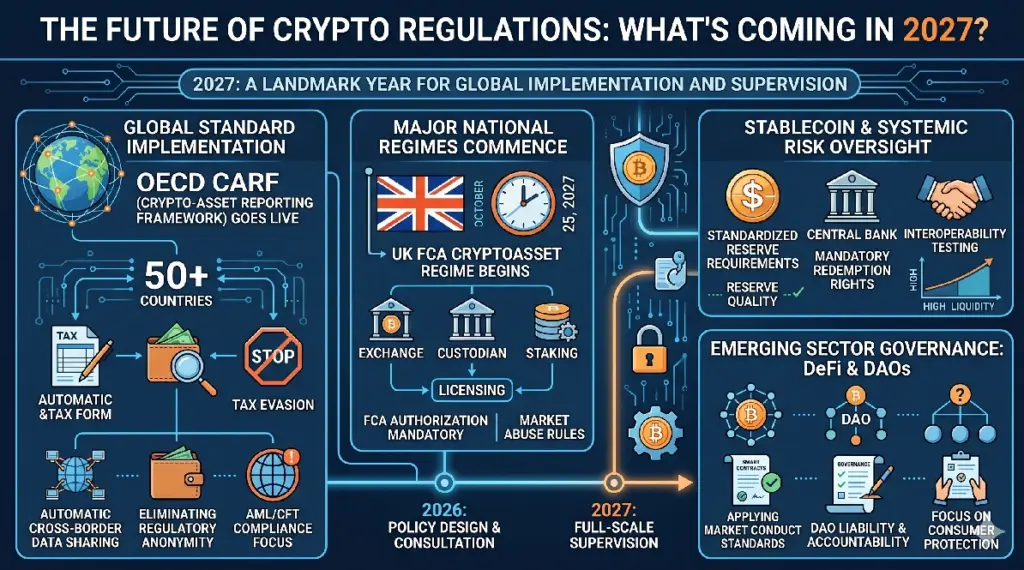
- The Big Tax Reporting Wave: In September 2027, we will see the first major information exchange under the OECD’s framework, covering all of 2026’s transactions. This means tax authorities globally will have a much clearer view of crypto activity.
- UK’s New Perimeter: By October 25, 2027, the UK will bring a wide range of crypto activities under its formal financial services regulatory regime. Firms will need formal FCA authorization to operate, making it a “must-know” date for anyone trading in or through the UK market.
- Institutional Maturity: We expect to see more “tokenized” traditional assets. Think of bonds or funds moving onto permissioned blockchains, handled by regulated players rather than just crypto-native ones.
What This Means for You
You might be wondering, “Do I need to change my strategy?” Simply put, yes. Here is a complete checklist for the modern investor:
- Prioritize Regulated Platforms: Use exchanges that are fully licensed. If they don’t have clear regulatory standing, the risk of “cease operations” notices is real.
- Understand Your Tax Obligations: With DAC8 and global reporting starting to sync up, keep clean records. Pro tip: Use portfolio tracking tools that export tax-ready reports.
- Watch the Institutional Money: As banks double down on digital assets, follow the liquidity. When institutions enter a space, they usually bring more volume and better market infrastructure.
Learn more about
Final Thought:
Don’t let the rules scare you. Actually, they are a sign of maturity. The market is growing up, and as an experienced trader, I see this as a “fast track” toward long-term sustainability.
Want to know why I’m still bullish? Because when the rules are clear, the big money finally feels safe to come in.
Disclaimer: This is for informational purposes. Always do your own research before trading.
Frequently Asked Questions (PAA)
The truth is, no. With mandatory transaction reporting and “Travel Rule” compliance for transfers, the era of total anonymity is effectively over for regulated platforms.
In short, regulation brings security. It reduces the chance of platform collapses and brings in institutional liquidity, which helps stabilize prices over the long term.
Regulators are cracking down on firms that serve local customers without local authorization. It’s essential to note that using such platforms may become increasingly difficult or legally risky by 2027.
