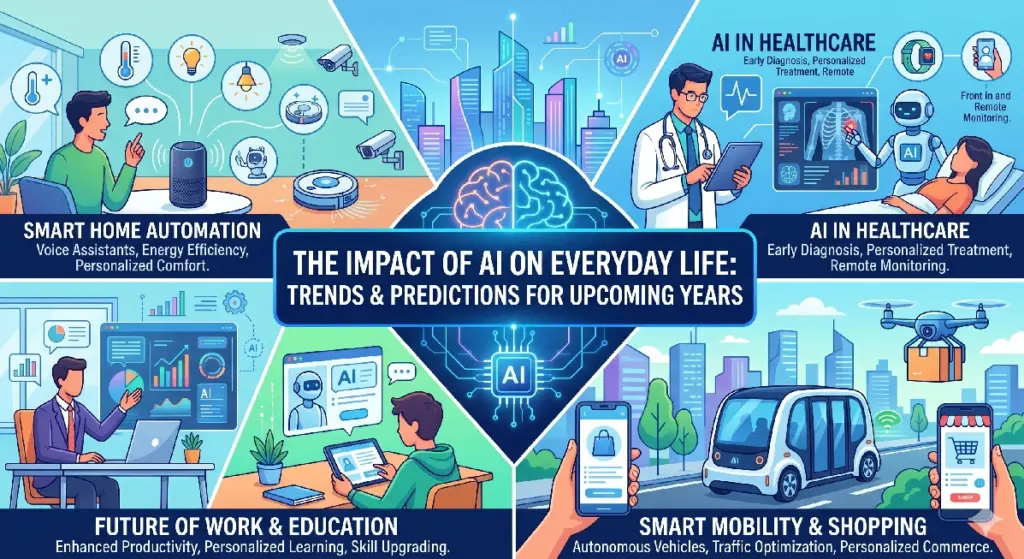
The Impact of AI on Everyday Life: Trends and Predictions for Upcoming Years
Let’s dive in. Artificial intelligence is changing the world fast.
You might be wondering how it affects your daily routine. Many people think AI is only for coding or the stock market.
The truth is, AI is already part of your life.
By 2026, AI touches 3.5 billion lives every single day.
We are moving past simple chatbots.
Now, we are entering an era of smart AI agents.
Simply, AI can act like a digital worker.
It can plan, decide, and finish tasks on its own.
What this means for you is less busywork.
You get more free time.
Let’s break it down and look at our future.
1. Healthcare: Faster Care and Better Diagnosis
First, let’s look at medicine.
AI is saving lives daily.
For example, AI tools scan X-rays and MRIs with 95% to 99% accuracy.
In comparison, this matches or beats top human doctors.
Additionally, AI handles boring paperwork.
AI medical scribes save doctors up to 15 minutes per patient.
As a result, your doctor spends more time talking to you.
Also, AI helps discover new drugs.
Due to advanced AI models, a 10-year drug research process now takes just two to three years.
In short, healthcare is getting faster and much more personal.
Explore this related post
2. Smart Devices: AI in Your Pocket
Next, expect your devices to get much smarter.
Did you know? Experts predict that 95% of new smartphones will have “on-device AI” by 2027.
To clarify, this is called a Small Language Model.
Because of this, your phone won’t always need the internet for AI to work.
Thus, it runs faster and keeps your data private.
Such as translating languages instantly or organizing your photos securely.
Bottom line, your everyday gadgets will understand you perfectly.
3. Work and Education: A Personalized Path
Furthermore, the way we learn is shifting.
For Indian students/professionals, AI is a massive game-changer.
Want to know why? AI creates custom study plans.
It learns how you learn.
Hence, it explains tough topics at your exact pace.
Moreover, AI boosts workplace output.
Real examples show early adopters getting up to 40% productivity gains.
Step by step, AI helps you turn a side hustle to full-time business.
You can automate marketing and client emails easily.
Not only that, there are many beginner-friendly and free tools available.
No credit card required to start learning today.
4. Transportation: Safer Roads and Smart Cities
Then, we have the future of travel.
AI is fixing traffic jams.
That is to say, smart traffic lights adapt to real-time car flow.
This leads to shorter commutes.
Similarly, self-driving technology is improving.
Predictive AI spots dangers before they happen.
Therefore, experts believe autonomous features will cut traffic accidents drastically.
Just like auto-pilot in planes, cars are getting a digital co-pilot.
Here’s what to read next
5. The Challenges: Privacy and Environment
We must face the risks.
It’s essential to note that AI requires massive amounts of power.
Worth noting, data centers running AI consume as much electricity as some entire countries.
Meanwhile, privacy remains a big worry.
Keep in mind, 78% of people fear AI could lead to identity theft.
However, new global rules and data laws are stepping in.
Most importantly, transparency is key.
Companies must show exactly how their AI works.
Otherwise, people will not trust it.
Your Action Plan for the Future
After that, how do you prepare?
Here’s the kicker: you don’t need to be a tech genius.
Actionable steps matter most.
Pro tip: start using AI for simple daily tasks.
Fast track your learning by using AI to draft emails or plan your meals.
Must-know: focus on building a routine that uses AI to save time, without investment.
Finally, AI is a tool. It is not a replacement for human thought.
Whereas AI handles the data, you handle the creativity. Working in 2025 and beyond means partnering with these tools.
Don’t forget to stay updated. Learn more about daily tech changes.
Frequently Asked Qusetions
AI will make our daily routines much easier. Smart homes will manage our lights, heat, and groceries.
Cars will soon drive themselves so we can relax on the road. Doctors will use AI to spot illnesses much sooner.
At work, AI will handle boring tasks so we can be more creative. Schools will use AI to help students learn at their own pace.
Some old jobs will change, but many new jobs will appear. Overall, AI will act like a smart, helpful assistant in our everyday lives.
AI is becoming a smart coworker instead of just a tool. We now use “Agentic AI” that can finish complex tasks on its own.
Smaller AI models run directly on our phones without needing the internet. AI is also teaming up with robots to help with physical work.
AI will handle boring and repetitive tasks. This means some routine jobs will disappear.
However, many new jobs will focus on managing AI systems.
Human skills like teamwork, empathy, and creativity will become much more valuable.
AI is speeding up medical research and finding new cures. Doctors use it to detect illnesses much earlier.
AI is also making roads safer with better self-driving cars. It acts like a personal tutor in schools to help students learn faster.

Leave a Reply