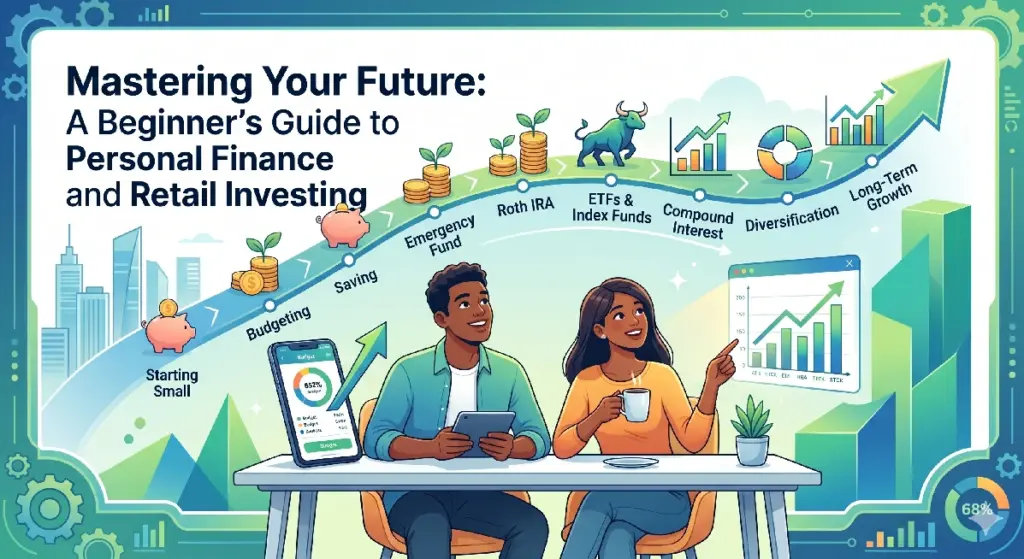
Mastering Your Future: A Beginner’s Guide to Personal Finance and Retail Investing
Managing your money can often feel like trying to solve a complex puzzle without the picture on the box.
However, it doesn’t have to be that way.
Whether you are a student or a professional, understanding the basics of Personal Finance and Retail Investing is the first step toward true financial freedom.
Simply, this guide will break down these concepts into actionable, everyday terms to help you take control of your financial journey.
Let’s dive in.
What is Personal Finance?
Think of it this way: Personal Finance is your personal roadmap. It is the practice of managing your income, expenses, and savings to reach your goals.
The truth is, it is not just about being rich; it is about having peace of mind.
You might be wondering, “How can I make my money work for me instead of just working for my money?”
Here is a complete checklist of the key pillars:
- Budgeting: This is your foundation. You must track what comes in and what goes out. By knowing where your money goes, you stop “leaking” cash. As a result, you gain control.
- Saving: Before you invest, you must save. Pro tip: Create an emergency fund equal to 3–6 months of your expenses. Because of this, if your car breaks down, you won’t need to borrow money or go into debt.
- Debt Management: Not all debt is bad. That said, high-interest debt like credit cards is a trap. Most importantly, prioritize paying off high-interest loans first so your money can actually grow.
Understanding Retail Investing
Next, once your emergency fund is ready, you are prepared for Retail Investing.
In the past, investing felt like something only people in expensive suits on Wall Street did.
Today, that has changed.
What this means for you is that you—an individual investor—can buy and sell stocks or mutual funds for your own account.
Why does this matter? It comes down to inflation. If you keep all your money in a regular savings account, it loses value because the cost of living keeps rising. Investing helps your money beat inflation.
In short, it’s the best way to grow your wealth over time.
Learn more about
Here’s how to start investing simply:
- Mutual Funds and ETFs: Alternatively, instead of picking one winning company, buy a “basket” of hundreds. This is called diversification. Simply put, if one company struggles, the others keep your investment stable.
- The Power of Compounding: Keep in mind, when you earn interest on your investment, and then earn interest on that interest, your money grows exponentially. Fast track your wealth by starting early.
- Use Technology: Working in 2026, we have apps that make investing as easy as ordering a meal. Many platforms now offer “fractional shares,” meaning you can start with very little money. No credit card required to learn on many free platforms.
The Latest Trends: Investing in 2026
Meanwhile, the world of retail investing is shifting rapidly.
- AI-Driven Financial Assistants: Most banking apps now use AI to help you budget. They analyze your spending and suggest exactly how much you can invest monthly. It’s like having a financial advisor in your pocket.
- Value-Seeking Behavior: Due to recent global economic shifts, there is a massive trend toward “smart shopping.” As a result, more people are using tech tools to track prices and move savings into index funds.
- Sustainability and Ethics: Furthermore, retail investors are choosing companies that focus on green energy. Investing is no longer just about profit; it is about supporting the world you want to live in.
Explore this related post
A beginners guide to cryptocurrency and blockchain technology
Real-Life Example: The “Latte” Effect
Let’s break it down. Suppose you spend $5 on a fancy coffee every workday. That’s $100 a month. If you take that $100 and invest it in a low-cost, diversified index fund, assuming a 10% annual return, the results are shocking.
Over 20 years, that “coffee money” grows into over $75,000. That is the magic of retail investing.
Bottom line: You don’t have to be a millionaire to build wealth; you just have to be consistent. This is a classic side hustle to full-time wealth strategy.
Your Final Takeaway
In short, personal finance is a habit, not a one-time event. You don’t need to be a math genius to succeed. You just need to:
- Spend less than you earn.
- Save for emergencies.
- Invest the rest in simple, diversified assets.
As you move forward, keep learning and stay consistent. Your future self will thank you for the small, smart decisions you make today.
Disclaimer: This post is for educational purposes only and does not constitute financial advice. Always do your own research or consult with a certified financial planner before making investment decisions.
Does this overview help clarify the difference between managing your daily money and starting your investment journey? Let us know in the comments below!

Leave a Reply