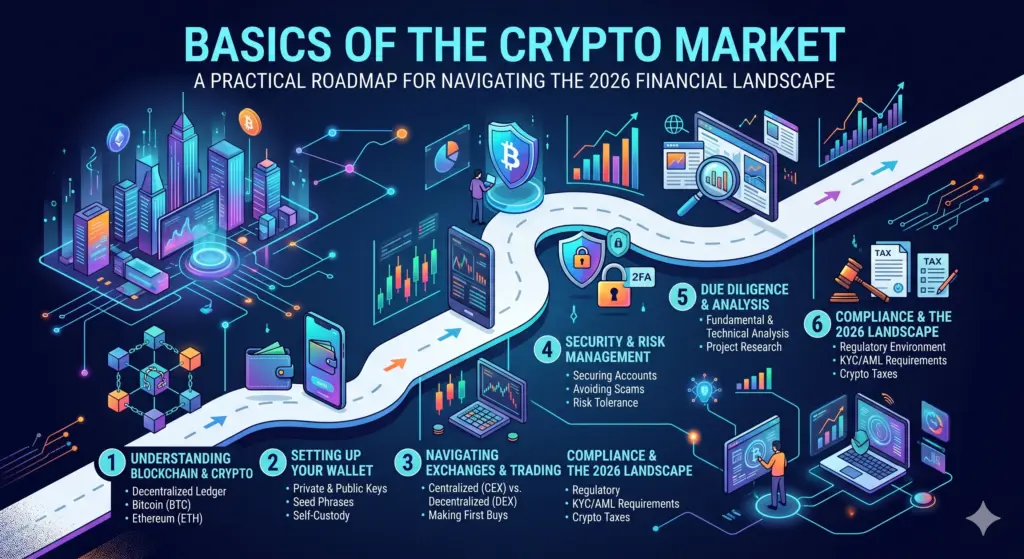
Basics of the Crypto Market: A Practical Roadmap for Navigating the 2026 Financial Landscape
Welcome to the New Era of Finance
First of all, I want to say a big thank you for coming on this post. Your time is very valuable.
Therefore, I promise to give you the best knowledge about our changing world.
Finance is evolving every single day.
Nowadays, traditional money is no longer the only option for world people.
Let us look back to see how crypto evolved over the years.
In the beginning, people did not trust digital cash.
Money was purely paper and bank entries.
However, a massive shift happened during the global financial crisis.
In the year 2008, a mysterious idea was born.
This concept came into the mind of an anonymous creator named Satoshi Nakamoto.
He wanted to build a financial system without central banks.
Consequently, he published the Bitcoin whitepaper.
By the year 2009, the very first block of cryptocurrency went live.
After that, the financial landscape changed forever.
Read It
What is the Crypto Market and Its Current Capitalization Scenario?
To begin with, let us define what the crypto market actually is.
The crypto market is a digital network.
In this network, people buy, sell, and trade decentralized digital assets.
These assets use advanced cryptography to secure transactions.
Furthermore, the market operates 24 hours a day, 7 days a week.
It never sleeps, unlike traditional stock exchanges.
Significantly, the market size has reached historic milestones in 2026.
According to recent data from global asset trackers, the total cryptocurrency market capitalization has consolidated firmly above the $3 trillion mark.
Indeed, this is a massive recovery from previous market cycles.
- Bitcoin (BTC): Dominated the landscape at over $1.46 Trillion+ baseline, acting as digital gold and a sovereign reserve asset.
- Ethereum (ETH): Ranged between $240 Billion and $400 Billion, dominating the DeFi infrastructure and smart contract space.
- Stablecoins (USDT/USDC): Maintained over $263 Billion+ combined, providing instant dollar liquidity across global exchanges.
- Altcoins (SOL, BNB, XRP, TRON): Combined for over $1.1 Trillion+, powering scalable applications and high-speed cross-border payments.
In addition, Bitcoin alone dominates the landscape with massive value.
In fact, major financial institutions like BlackRock now hold billions in digital assets through spot ETFs.
Meanwhile, stablecoins provide essential daily dollar liquidity worldwide.
How the Crypto Market Came into Existence
First, we must understand the detailed timeline of this creation.
As mentioned, the crypto market officially started from the year 2009.
At first, Bitcoin had no cash value.
People gave it away for free on internet forums.
Then, the first real-world transaction happened in 2010 when someone bought two pizzas for 10,000 Bitcoins.
Subsequently, developers realized that blockchain technology could do more than just send peer-to-peer cash.
Secondly, Ethereum was launched in 2015.
This introduction brought smart contracts to the world people.
As a result, anyone could now build automated financial applications.
Later, between 2020 and 2024, institutional investors entered the scene.
Moreover, by late 2024, the market capitalization hit a historic $3.2 trillion.
Moving into 2026, data shows that crypto has transitioned completely from a retail experiment into a permanent global financial architecture.
The Impact of the Crypto Market on Finance Worldwide
Generally speaking, the impact of crypto on global finance is profound.
Not only that, but it is also forcing traditional banks to upgrade their old systems.
For instance, the World Economic Forum notes a massive shift in global wealth.
Traditional finance and decentralized finance are now merging together.
In fact, this convergence is accelerating rapidly in 2026.
Thus, large banks are now embedding blockchain technology into their core infrastructure.
On the other hand, crypto removes expensive middlemen.
Because of this, international wire transfers that used to take days now happen in seconds.
Hence, global capital flows are becoming much more fluid and continuous.
Nevertheless, regulatory frameworks are tightening to protect users from sudden market shifts.
The World Economic Forum released its key insights for 2026.
Indeed, digital assets are no longer just a temporary experiment.
Instead, they now form the very foundation of global financial infrastructure.
Explore It
How Today’s Generation Deals with the Crypto Market
Nowadays, today’s generation interacts with money in a completely digital way.
They do not visit physical bank branches.
Instead, they manage their wealth directly through mobile applications and decentralized wallets.
To illustrate, millions of citizens across Asia, Africa, and Latin America use stablecoins like USDT to save money against local inflation.
In the same way, people are using crypto to purchase real-world products and digital services.
Besides trading tokens, today’s generation actively participates in staking and yield generation.
As a result, they are acting as their own personal central banks.
They take full control of their private keys and assets.
The Specific Effect on the Young Generation
Importantly, the young generation is experiencing the biggest psychological shift.
They have grown up with smartphones and internet connectivity.
Particularly, teenagers and young adults view crypto as a primary tool for financial inclusion.
For example, many young creators receive payments from global audiences in digital tokens instead of traditional bank wires.
- High Financial Literacy: Youth are learning complex economic concepts like liquidity, inflation, and market caps at an early age.
- Gamification Risks: However, many treat crypto trading like a video game. This habit can lead to emotional and risky decisions.
- Global Work Opportunities: They are earning internet-native income across borders without any geographical restrictions.
Although this creates massive financial independence, it also brings high risks.
Due to market volatility, young people can lose their savings quickly.
Therefore, financial experts emphasize the urgent need for structured crypto education in schools and universities.
What Will Be Its Future?
Looking ahead, the future of the crypto market is highly sophisticated.
Above all, asset tokenization will lead the way.
Real estate, corporate stocks, and gold are moving onto the blockchain.
Likewise, government bonds are being issued as on-chain tokens.
This makes expensive investments accessible to normal world people.
Eventually, the underlying blockchain networks will become invisible.
They will run quietly as the backend infrastructure for all global commerce.
Next, we will see deep integration between Artificial Intelligence and decentralized networks.
AI agents will use crypto wallets to settle autonomous machine-to-machine transactions without human delay.
How It Will Affect the Worldwide Finance World Balance
Significantly, the macroeconomic balance of the world is changing.
The World Economic Forum recently revealed critical data.
In fact, over 98% of global central banks are now taking action.
They are actively researching, piloting, or deploying Central Bank Digital Currencies (CBDCs).
Consequently, traditional fiat money is turning digital to compete directly with private cryptocurrencies.
Similarly, developing countries are utilizing crypto networks to bypass heavy economic sanctions and systemic isolation.
Just as printing presses changed literature, blockchain is rewriting the rules of global accounting.
So, the traditional dominance of old banking hubs is fading.
New digital asset capitals like Singapore and the UAE are rising quickly to lead capital flows.
Conclusion: Best Deals and Final Thoughts on the Market
In conclusion, the crypto market in 2026 is no longer a passing trend.
It is a powerful financial reality for world people.
To sum up, the best deal in this market is not about chasing short-term price spikes.
Instead, the true value lies in understanding the long-term utility of blockchain solutions, tokenized assets, and instant global payments.
Overall, we must approach this market with great discipline and continuous learning.
To wrap up, please remember that knowledge is your best asset in this digital landscape.
Thank you once again for reading this post.
Let us navigate this 2026 financial landscape safely and wisely together!

Pingback: Ultimate Guide: What Is Crypto Portfolio Margin Financing?