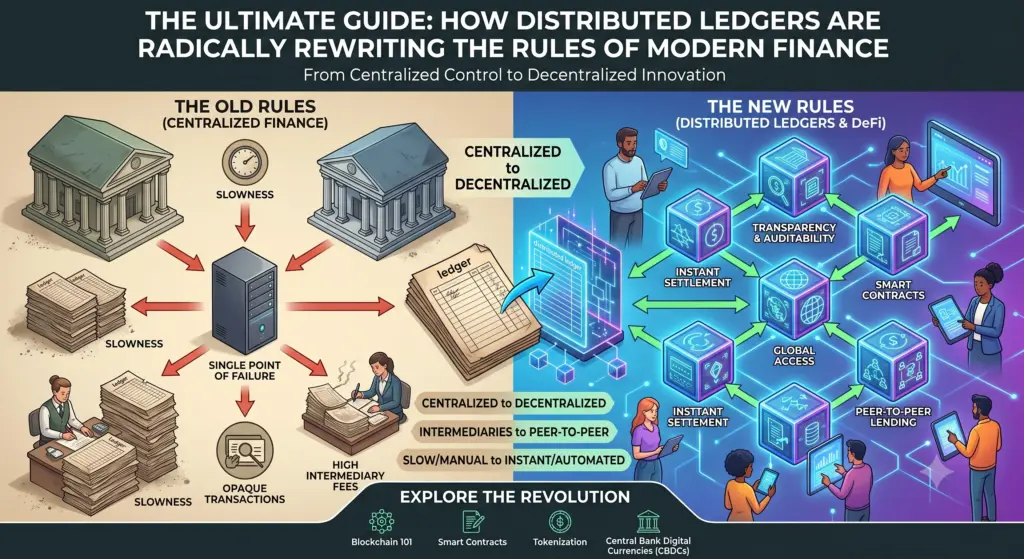
The Ultimate Guide: How Distributed Ledgers Are Radically Rewriting the Rules of Modern Finance
Have you ever tried receiving money from abroad on a Friday evening, only to find yourself waiting until Wednesday?
If you live in a Busy city or even a growing city like Muzaffarpur, Bihar, you already know this frustrating drill of high fees and endless delays.
You are not alone in this struggle, as millions face this outdated financial plumbing daily.
Therefore, understanding the technology replacing this old system is crucial for your financial future.
Distributed Ledger Technology (DLT) is a decentralized digital database shared across a global network of computers.
Regular banks use middlemen to move your money. But DLT works differently. It lets you send money directly to someone else. Furthermore, it uses special digital locks to keep your transfer completely safe.
This removes the middlemen completely. Sending money to another country now takes seconds instead of days. Also, it creates a clear digital record that no one can ever change.
As a result, DLT powers Decentralized Finance (DeFi) and smart contracts. It forever changes how we verify and send money globally.
Read It
What Exactly is a Distributed Ledger?
Imagining a highly secure digital notebook that everyone shares equally makes understanding DLT much easier.
This decentralized system ensures every participant holds an exact copy of the data.
Whenever a new transaction occurs, the entire network validates it simultaneously.
Consequently, no single entity can alter or manipulate the records.
A distributed ledger is a shared digital record that is stored on many computers instead of just one. Since every computer has the same information and strong security protects it, no one can change the records without everyone knowing. This makes transactions safe, honest, and easy to trust.
Institutional-Grade Crypto Execution
After a decade in institutional banking, my rule for digital assets is simple: capital preservation and execution speed are non-negotiable. Binance remains the industry standard for deep liquidity and the lowest trading fees. Establish your infrastructure today.
How Does Distributed Ledger Work?
🌍 1. Eliminating the Middleman for Faster, Cheaper Transfers
Traditional finance dictates that you must rely on a trusted third party to move your money.
However, DLT throws this outdated rulebook entirely out the window. By enabling secure, peer-to-peer transfers, the technology bypasses traditional banking bottlenecks.
- Direct Transactions: You send funds directly to the receiver without a clearinghouse.
- Lower Fees: Without intermediaries skimming off the top, you save your hard-earned money significantly.
- Decentralized Verification: The network uses cryptography to validate funds, ensuring absolute trust without a central bank.
🔒 2. Bulletproof Transparency and Security in Banking
Earlier, banks kept separate records of transactions. Matching these records often took time and could lead to errors.
Distributed Ledger Technology (DLT) solves this problem by using one shared digital record.
Once a transaction is recorded, it cannot be changed.
Authorized users can view the same information, making the system faster, safer, and more transparent.
Immutable means a digital record cannot be changed or deleted after it is saved.
This keeps the information safe and trustworthy. Auditors and government regulators can easily track every transaction.
As a result, fraud, money laundering, and accounting errors become much more difficult.
💡 3. Smart Contracts: When Your Money Thinks for Itself
Self-executing digital agreements, known as smart contracts, are fundamentally changing how financial deals operate.
Furthermore, these pieces of code automatically trigger actions the moment specific conditions are met.
For example, if your flight is delayed, the system instantly pays your insurance claim directly into your digital wallet.
| Feature | Traditional Finance | DLT & Smart Contracts |
| Execution | Manual review by loan officers | Automatic via self-executing code |
| Speed | Takes days or weeks to clear | Instantaneous 24/7/365 |
| Accuracy | Prone to human error | Cryptographically precise |
Explore It
Why the Binance Virtual Card is the Smartest Way to Spend Crypto in Asia (2026 Guide)
How Decentralized Finance (DeFi) Makes Financial Services Available to Everyone
DeFi helps more people use financial services with just an internet connection.
Unlike traditional banks, DeFi is open to everyone. You do not need to visit a bank or have a perfect credit score to get started.
With DeFi, people can lend money, borrow money, invest, and earn rewards from anywhere in the world.
This gives millions of people access to financial services, even if they do not have a bank account. As a result, DeFi is helping make finance more open, fair, and available to everyone.
How Will Distributed Ledgers Affect the Future of Money?
Observing central banks develop their own digital currencies proves that DLT is not just a passing trend.
In addition, real-world assets like real estate and art are rapidly becoming easily tradable digital tokens.
The network handles everything smoothly, ensuring that human error disappears from complex asset management.
💬 The Bottom Line: Your Role in the New Financial Era
Money evolves constantly, and we are currently witnessing the most significant leap forward in modern history.
Overall, distributed ledgers rewrite the foundational rules of global wealth management.
They bring speed, safety, and fairness directly to your fingertips.
You no longer have to depend on slow, expensive systems to build and protect your wealth.
Embrace this technological wave, because it is entirely rebuilding the global economy from the ground up.
What is the first thing you would do if international money transfers were completely free and instant? Let me know your thoughts in the comments below!

Pingback: The Complete Bitcoin Wealth Strategy: Foundation of Digital Wealth
Pingback: What Is Take Profit (TP)? The Ultimate Step-by-Step Guide to Locking in Crypto Trading Profits with Discipline
Pingback: What Is DEX Routing? The Ultimate to Best Crypto Swap Execution