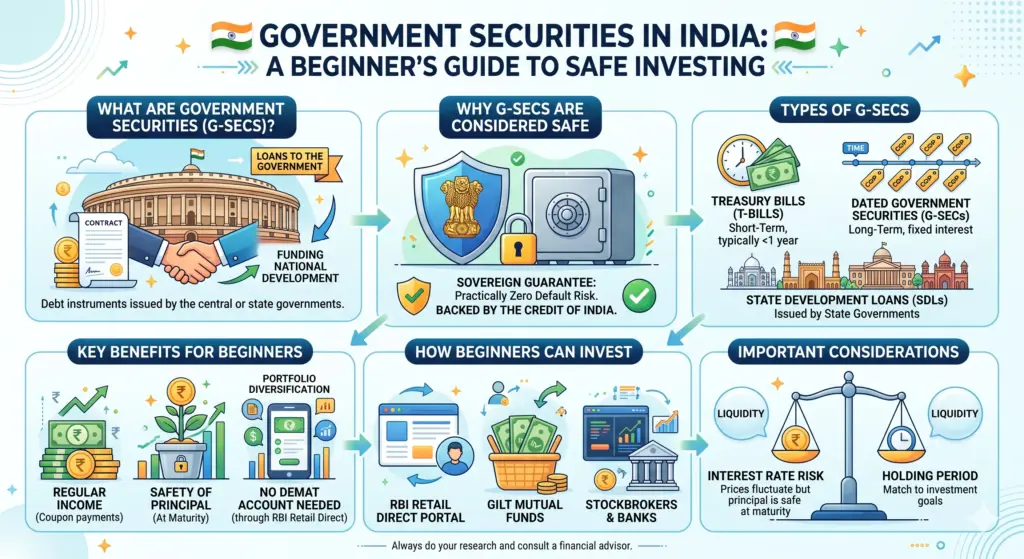
Government Securities in India: A Beginner’s Guide to Safe Investing
Hello friends, and welcome to ZenvestAI in the Post “Government Securities in India: A Beginner’s Guide to Safe Investing”.
Have you ever wondered where smart investors keep their money when the stock market becomes too risky?
Or maybe you’re looking for an investment that is safer than stocks but offers better returns than a regular savings account.
If your answer is yes, you’re in the right place.
Many people think investing always means buying shares or mutual funds. But that’s only part of the story. One of the safest ways to grow your money is by investing in Government Securities, also called Government Bonds or G-Secs.
These investments are issued by the Government of India. When you invest in them, you are lending your money to the government for a fixed period. In return, the government pays you interest and returns your money when the investment ends.
This is one of the main reasons why Government Securities are trusted by millions of investors. They are considered one of the safest investment options because they are backed by the government.
Does that mean they are perfect?
Not exactly.
Like every investment, Government Securities also have a few things you should know before investing. The good news is that they are easy to understand once someone explains them in simple language.
In this guide, I’ll explain everything step by step. We’ll cover what Government Securities are, how they work, their benefits, their risks, the different types available in India, and how you can buy them online with ease.
So, if you want to build a stronger and more balanced investment portfolio, let’s get started.
What Exactly is a Government Bond?
A government bond is a formal loan you make to the government. In exchange for your capital to fund public projects, the government promises to return your principal on a specific maturity date while paying you regular, fixed interest called a coupon.
Think of a bond as a simple, highly secure IOU. You are directly lending money to the government to help fund national infrastructure or manage the broader economy. In return, they legally promise to pay you back with interest.
To navigate this space, you need to understand a few core concepts. Here is the essential, jargon-free terminology you must know:
- Principal (Face Value): The initial amount of money you lend to the government.
- Coupon Rate: The fixed interest rate you earn on your investment annually.
- Maturity Date: The exact future date when you get your original money back.
- Yield: The effective return on your investment if you hold it or buy it on the secondary market.
Furthermore, these instruments provide a foundation of trust.
As Deepak Kumar—founder of ZenvestAI and a former institutional manager—points out, real-world financial experience proves the necessity of fixed-income assets. He notes: “Bonds aren’t just debt; they are the mathematical anchor that keeps a volatile portfolio from capsizing during market shocks.”
If you are stepping into the digital asset markets, you need a platform that offers deep liquidity, institutional-grade security, and rock-bottom fees. Binance remains my primary exchange for exactly these reasons.
Whether you are taking your first steps into spot trading or managing low-capital futures, having the right infrastructure is critical. Set up your foundation today and claim an exclusive USDC welcome reward through my official partner link below.
Are They Really “Risk-Free”? (Check Myth vs. Reality)
Government bonds are among the safest investment options because they are backed by the government sovereign guarantees.
The risk of the government failing to repay investors is very low, which is why many people choose them for stable and secure returns.
Still, no investment is perfect. If interest rates increase, older bonds may become less valuable.
Inflation can also reduce the real value of the money you earn over time. In simple words, your investment is usually safe, but the value of your returns can still be affected by changes in the economy.
Here are the hidden risks you need to monitor:
- Interest Rate Risk: If broader market rates go up, the value of your existing lower-rate bonds goes down if you try to sell them before maturity.
- Inflation Risk: If your bond pays 5% but national inflation hits 6%, your real purchasing power actually yields a negative return.
| Risk Factor | Threat Level | Mitigation Strategy |
| Credit Risk | Zero | Hold Sovereign-backed bonds to maturity. |
| Interest Rate Risk | Moderate | Avoid selling on the secondary market prematurely. |
| Inflation Risk | High | Diversify with inflation-indexed bonds or equities. |
Read It
Types of Government Securities (G-Secs)
India offers different types of government bonds for different needs. Some are made for people who want to invest for a few months, while others are better for those who want to invest for many years.
There are also bonds issued by state governments and special bonds that let you invest in gold while earning fixed interest at the same time.
The good thing is that you don’t have to choose the same option as everyone else. You can pick the investment that matches your goals, the amount of time you want to invest, and the level of returns you expect.
Once you understand the different types of government bonds, it becomes much easier to make a smart investment decision.
Here is a breakdown of the primary Government Securities (G-Secs) available to retail investors:
- Treasury Bills (T-Bills): Short-term instruments maturing in 91, 182, or 364 days. They are issued at a discount and redeemed at face value, making them great for parking emergency funds.
- Dated Government Securities: Long-term bonds ranging from 5 to 40 years that pay fixed or floating semi-annual interest. These are ideal for locking in long-term predictability.
- State Development Loans (SDLs): Debt issued by individual state governments. They typically offer a slightly higher yield than central government bonds.
- Sovereign Gold Bonds (SGBs): A unique hybrid instrument. It acts as government-backed paper tracking the market price of gold, plus an additional 2.5% fixed annual interest.
Subscribe for Updates
How to buy Government bonds In India?
OR
Where Can You Buy Government Securities in India?
Buying Government Securities (G-Secs) is much easier today than it was a few years ago. You don’t need to visit a bank or fill out lots of paperwork. In most cases, you can invest online from your home.
There are four popular ways to buy Government Securities in India. Let’s look at each one.
1. Buy Directly from the RBI (Best for Beginners)
The Reserve Bank of India (RBI) allows individual investors to buy Government Securities directly through the RBI Retail Direct Scheme. There is no middleman, and opening an account is free.
How to Buy Through RBI Retail Direct
Step 1: Visit the RBI Retail Direct website.
Step 2: Register using your PAN card, Aadhaar, bank account, mobile number, and email ID.
Step 3: Complete the online KYC process.
Step 4: Log in and choose the Government Security you want to buy.
Step 5: Enter the investment amount and make the payment through UPI or your bank account.
Step 6: After the purchase is complete, the Government Security will appear in your Retail Direct account.
Why choose this method?
- No broker is needed.
- Direct investment with RBI.
- Easy online process.
- Good for long-term investors.
2. Buy Through a Stock Broker
If you already invest in shares, this option is very convenient. Many stock brokers allow you to buy Government Securities from the same account.
Popular brokers include Zerodha, Groww, Upstox, Angel One, ICICI Direct, and HDFC Sky.
How to Buy
Step 1: Log in to your broker account.
Step 2: Go to the Bonds or Government Securities section.
Step 3: Choose the bond you want to invest in.
Step 4: Enter the amount and place your order.
Step 5: After the bond is allotted, it will be added to your Demat account.
Why choose this method?
- Easy if you already have a Demat account.
- You can see stocks and bonds in one place.
- Buying and selling is simple.
3. Invest Through Mutual Funds or ETFs
If you don’t want to choose individual Government Securities, you can invest through mutual funds or ETFs that mainly invest in government bonds.
The fund manager takes care of buying and managing the investments.
How to Invest
Step 1: Open your mutual fund app or investment platform.
Step 2: Search for a Government Bond Fund, Gilt Fund, or Target Maturity Fund.
Step 3: Invest through a lump sum or start a SIP.
Step 4: The fund manager handles the rest.
Why choose this method?
- No need to select individual bonds.
- Easy for beginners.
- SIP option is available.
- Professional management.
4. Buy Through Your Bank
Many banks also allow customers to invest in Government Securities through Internet Banking.
How to Buy
Step 1: Log in to your bank’s Internet Banking account.
Step 2: Open the Investments or Government Securities section.
Step 3: Choose the available Government Security.
Step 4: Enter the investment amount.
Step 5: Confirm the payment.
After the purchase, your investment will be added to your linked account.
Why choose this method?
- Easy for existing bank customers.
- Trusted and secure process.
- Everything is managed through your bank.
Which Option Is Best?
The best method depends on your needs.
- RBI Retail Direct: Best if you want to invest directly with the government.
- Stock Broker: Best if you already have a Demat account.
- Mutual Funds or ETFs: Best if you want a simple, hands-free investment.
- Bank: Best if you prefer investing through your existing bank.
You may like to Read It
Can You Sell Government Securities Before They Mature?
Yes, you can sell many Government Securities before their maturity date.
However, finding a buyer may sometimes take time, especially for less popular bonds. Because of this, many investors prefer to hold Government Securities until they mature.
If you think you may need your money before maturity, Government Bond Mutual Funds or ETFs can be a better choice because they are usually easier to buy and sell.
Why Smart Investors Include Government Bonds in Their Portfolio
Many people think the secret to building wealth is earning higher returns. While that is important, protecting the money you have already earned is just as important.
This is where Government Bonds can make a big difference.
Think of your investment portfolio like a cricket team. You need strong batsmen to score runs, but you also need good bowlers and fielders to win the match. In the same way, stocks help your money grow, while Government Bonds help protect your wealth when markets become uncertain.
At ZenvestAI, we believe successful investing is about finding the right balance. You don’t have to put all your money into stocks or keep everything in a savings account. A mix of growth and safety can help you invest with more confidence.
Here are three simple reasons why many smart investors include Government Bonds in their portfolio.
1. They Help Protect Your Money
The stock market does not always go up. Some years it performs very well, while other years it can fall sharply.
Government Bonds help protect a part of your investment during these difficult times. Since they are backed by the Government of India, they are considered one of the safest investment options available.
Knowing that part of your money is in a safer place can give you peace of mind.
2. They Reduce the Overall Risk of Your Portfolio
Imagine you have invested all your money in stocks. If the market falls, your entire portfolio may lose value.
But if some of your money is invested in Government Bonds, the impact of a market fall may be much smaller. Bonds often remain stable even when stock prices are moving up and down.
In simple words, Government Bonds act like a safety cushion for your investments.
3. They Give You Regular Income
Most Government Bonds pay interest at fixed intervals. This means you receive income regularly without having to sell your investment.
This can be especially helpful for retired people, anyone looking for a steady income, or investors who prefer predictable returns.
The ZenvestAI View
At ZenvestAI, we believe that investing is not only about making more money. It is also about protecting your wealth for the future.
A well-balanced portfolio usually includes both growth investments, like stocks, and safer investments, like Government Bonds. This balance can help you stay calm during market ups and downs and keep working towards your long-term financial goals.
Remember, successful investors don’t just focus on high returns. They also focus on managing risk wisely. Government Bonds can play an important role in helping you do exactly that.
Final Thoughts
Building wealth is important, but protecting your wealth is just as important.
Government Securities may not make you rich overnight, but they can help you grow your money safely over time. They offer stability when markets become uncertain and add balance to your investment portfolio.
If you are a beginner, Government Securities can be a great place to start. If you are an experienced investor, they can help reduce risk and bring more stability to your overall investments.
The key is not to invest all your money in one place. A balanced portfolio with both growth investments and safer options can help you achieve your long-term financial goals with greater confidence.
I hope this guide has made Government Securities easy to understand. If you found it helpful, share it with your friends and family who want to start investing safely.
At ZenvestAI, our goal is to make investing simple for everyone. We regularly publish easy-to-understand guides, practical investment tips, and the latest finance insights to help you make smarter financial decisions.
Thank you for reading, and I’ll see you in the next guide. Happy investing!

Leave a Reply