Key Takeaways
- You Have a Choice: A crypto option gives you the right, but not the obligation, to buy (Call) or sell (Put) crypto at a fixed price before or at a specific expiry date.
- Limited Loss for Buyers: When you buy an option, your maximum loss is generally the premium you paid.
- Two Main Uses: Options can be used to try to make a profit from price movements or to protect your crypto from a large price drop.
- Time Matters: An option can lose value as the expiry date gets closer. This is called time decay (Theta).
- Market Volatility Matters: When the market expects bigger price movements, option prices can become more expensive. This is related to implied volatility (Vega).
- How Options Usually Work: Many major crypto options platforms use European-style options, which generally means the option can only be exercised at expiry. Some platforms may instead settle the option in cash rather than transferring the actual cryptocurrency.
ZenvestAi Explains:–
Crypto options are contracts that give you the right, but not the obligation, to buy or sell a cryptocurrency such as Bitcoin (BTC) or Ethereum (ETH) at a fixed price within a specific time period.
In simple words, an option lets you make a bet on where the price of a cryptocurrency may go without having to buy or sell the cryptocurrency immediately.
When you buy an option, you pay a fee called a premium. This premium is usually the most you can lose from that option.
For example, if you buy a Bitcoin option and pay a ₹1,000 premium, your maximum loss on that option is generally ₹1,000 (excluding fees).
The price you agree to buy or sell the crypto at is called the strike price. The date when the option ends is called the expiration date.
There are two basic types of crypto options:
- Call Option: Gives you the right to buy crypto at the strike price.
- Put Option: Gives you the right to sell crypto at the strike price.
On the other side, there is the option seller, also called the writer. The seller receives the premium from the buyer. However, the seller can face much larger losses if the market moves strongly against their position.
So, the simple idea is:
Buyer → Pays a premium → Gets a right → Has limited risk
Seller → Receives a premium → Takes on more risk
If you are completely new to crypto options, think of an option like paying a small fee to reserve the right to buy or sell something later at a price agreed today.
➔ Must Read: New to digital assets? Explore What Is Cryptocurrency? The Ultimate Beginner’s Guide to build a solid foundation.
What Are Crypto Options? The Complete Beginner’s Guide
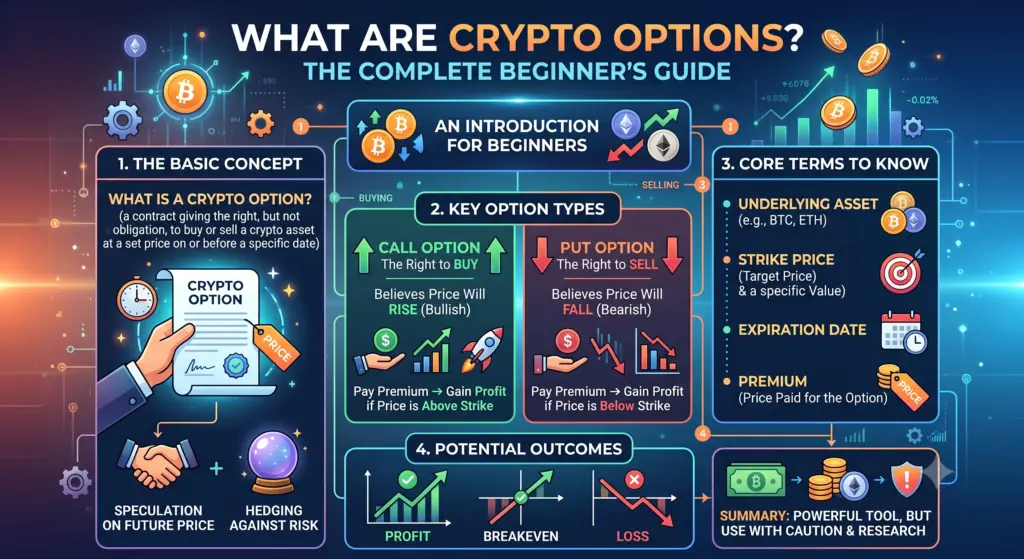
What This Post Covers
- The Core Problem: Managing Volatility Without Massive Losses
- What Are Crypto Options and How Do They Work?
- Calls vs. Puts: Breaking Down the Mechanics
- The Main Parts of an Options Contract.
- Why Crypto Options Suffer from Time Decay & Volatility Crushes
- Decoding the Options Greeks
- Crypto Options vs. Spot Trading: Real Comparison
- Practical Trading & Hedging Strategies
- Key Risks and Mistakes to Avoid
- Glossary of Essential Terms
At a Glance: Crypto Options Overview
| Metric / Parameter | Long Call Option | Long Put Option | Spot Crypto Trading |
| Market Outlook | Bullish (expects price rise) | Bearish (expects price drop) | Bullish / Long-term holding |
| Primary Goal | Leveraged upside | Portfolio insurance / Downside profit | Asset ownership |
| Maximum Potential Loss | Limited to Premium Paid | Limited to Premium Paid | 100% of asset purchase value |
| Maximum Potential Gain | Theoretically unlimited | Substantial (down to zero price) | Theoretically unlimited |
| Time Sensitivity | High (erodes via Theta) | High (erodes via Theta) | None (can hold indefinitely) |
| Settlement Type | European/Cash-Settled (mostly) | European/Cash-Settled (mostly) | Immediate asset transfer |
The Core Problem: Navigating Crypto Volatility Without Losing Your Shirt 📉
Many people who buy crypto know how stressful a sudden price drop can be. Imagine you buy Bitcoin and its price suddenly falls by 30%. If you bought Bitcoin directly, your investment would also lose about 30% in value unless you sell.
The Problem With Spot Trading
Spot trading simply means buying a cryptocurrency and holding it in your crypto wallet.
For example, if you buy Bitcoin worth ₹10,000 and its price falls by 30%, your investment could fall to around ₹7,000.
This means your money is directly affected by the price of the cryptocurrency.
The Risk of Futures Trading
Crypto futures trading allows you to trade with borrowed money, which is called leverage.
Leverage can increase your potential profit, but it can also increase your losses very quickly. If the price moves strongly against your trade, the exchange may automatically close your position. This is called liquidation, and you can lose a large part or even all of the money you used for that trade.
➔ Related Guide: How to Start Crypto Futures Trading with Low Capital in 2026
How Crypto Options Are Different
Crypto options work differently.
An option gives you the right to buy or sell a cryptocurrency at a specific price before or on a specific date. You pay a fee called a premium for this right.
One important benefit is that when you buy an option, your maximum loss is generally limited to the premium you paid.
For example, if you pay ₹500 for an option, you generally cannot lose more than that ₹500, even if the crypto price moves sharply in the opposite direction.
This makes options useful for two main purposes:
- Speculation: Trying to make money if you believe the price will rise or fall.
- Protection (Hedging): Using an option to help protect your crypto investment from a large price drop.
In simple words, spot trading exposes you directly to the crypto price, futures can create very large losses because of leverage, while buying options can give you a clearly defined maximum loss.
However, options are not risk-free. The premium can expire worthless, and understanding how options work is important before trading them.
What Are Crypto Options and How Do They Work?
A crypto option is a type of contract based on a cryptocurrency such as Bitcoin or Ethereum.
It gives you the right, but not the obligation, to buy or sell the cryptocurrency at a fixed price before or on a specific date.
In simple words, you can choose to use the option if it works in your favor. If it does not, you can choose not to use it.
Buyers (Option Holders)
Buyers pay a fee called a premium to get the option.
They get the right to buy or sell the crypto at the agreed price. If the market moves in the wrong direction, they can simply let the option expire.
For a buyer, the maximum loss is generally the premium paid.
Sellers (Option Writers)
Sellers receive the premium from the buyer.
However, they take on a responsibility. If the buyer decides to use the option, the seller must follow the terms of the contract.
So, in simple terms:
Buyer = Pays a fee for the right to trade.
Seller = Receives the fee but takes on the responsibility to complete the trade if required.
Calls vs. Puts: The Two Fundamental Contract Types ⚖️
                         ┌─────────────────────────────┐
                         │   CRYPTO OPTIONS CONTRACTS  │
                         └──────────────┬──────────────┘
                                        │
                ┌───────────────────────┴───────────────────────┐
                ▼                                               ▼
     ┌──────────────────────┐                       ┌──────────────────────┐
     │     CALL OPTION      │                       │      PUT OPTION      │
     ├──────────────────────┤                       ├──────────────────────┤
     │ • Right to BUY asset │                       │ • Right to SELL asset│
     │ • Bullish strategy   │                       │ • Bearish / Hedging  │
     │ • Gains as price ↑   │                       │ • Gains as price ↓   │
     └──────────────────────┘                       └──────────────────────┘
1. Call Options (Right to Buy)
A call option gives you the right to buy a cryptocurrency at a fixed price (called the strike price) before or on a specific date.
You would usually buy a call option when you think the price of a cryptocurrency is going to go up.
Simple Example
Suppose Bitcoin is currently trading at ₹90 lakh.
You buy a 30-day call option with a ₹95 lakh strike price. You pay ₹1 lakh for this option. This ₹1 lakh is called the premium.
If Bitcoin goes up:
Bitcoin rises to ₹1.10 crore. Your option allows you to buy Bitcoin at ₹95 lakh instead of ₹1.10 crore.
The difference is ₹15 lakh. After subtracting the ₹1 lakh premium, your profit would be ₹14 lakh (before other fees and costs).
If Bitcoin goes down:
Bitcoin falls to ₹80 lakh. You would not want to buy it for ₹95 lakh because you can buy it cheaper in the market.
So, you can simply let the option expire. Your loss would generally be limited to the ₹1 lakh premium you paid.
In Simple Words
Call option = You expect the crypto price to rise.
You pay a fee for the right to buy at a fixed price. If the price rises enough, the option can become valuable. If the price falls, you can choose not to use the option, with your loss generally limited to the premium you paid.
2. Put Options (Right to Sell)
A put option gives you the right to sell a cryptocurrency at a fixed price (called the strike price) before or on a specific date.
You would usually buy a put option when you think the crypto price may go down or when you want to protect your crypto from a big price drop.
Think of a put option like insurance for your crypto investment.
Simple Example
Suppose you own 1 Bitcoin that you bought for ₹90 lakh (as part of your Complete Bitcoin Wealth Strategy).
You are worried that Bitcoin’s price may fall sharply. So, you buy a put option with a ₹85 lakh strike price.
You pay ₹1 lakh for this option. This ₹1 lakh is called the premium.
If Bitcoin crashes:
Bitcoin falls from ₹90 lakh to ₹65 lakh.
Because you have the put option, you have the right to sell your Bitcoin at ₹85 lakh, instead of selling it at the market price of ₹65 lakh.
This helps protect you from a much larger loss. However, you must also consider the ₹1 lakh premium you paid for the option.
If Bitcoin does not fall:
If Bitcoin stays above ₹85 lakh or rises in price, you may not need to use the put option. In that case, your loss on the option is generally limited to the ₹1 lakh premium.
In Simple Words
Put option = You expect the crypto price to fall or want protection from a price drop.
You pay a fee for the right to sell at a fixed price. It can help protect your crypto holdings when the market falls sharply.
The Main Parts of an Options Contract.
A crypto options contract has a few basic parts. Understanding these parts will make options much easier to understand.
- Underlying Asset: This is the cryptocurrency connected to the option, such as Bitcoin (BTC), Ethereum (ETH), or Solana (SOL).
- Strike Price: This is the fixed price at which you can buy or sell the cryptocurrency using the option. For example, if the strike price is ₹90 lakh, the option allows you to buy or sell at ₹90 lakh, depending on whether it is a call or put option.
- Expiration Date: This is the date and time when the option ends. Options can expire daily, weekly, monthly, or quarterly. After the expiration time, the option can no longer be used.
- Option Premium: This is the price you pay to buy the option. The premium can change depending on things like the crypto’s price, market conditions, expected price movements, and how much time is left before the option expires.
In Simple Words
Think of a crypto option like a ticket with four important details:
Which crypto? → At what price? → Until when? → How much does the ticket cost?
Why Time and Market Volatility Matter
When you buy a crypto option, time and market conditions can change its value. An option does not keep the same value forever. As it gets closer to its expiry date, its value can decrease.
Time Decay (Theta)
Time decay means that an option can lose value as time passes.
For example, imagine you buy a Bitcoin call option that expires in 30 days. As each day passes, there is less time for Bitcoin to make a big price move.
Even if Bitcoin’s price does not change much, your option may become less valuable as the expiry date gets closer.
In simple words: Less time left = less chance for the option to become profitable.
Implied Volatility (IV)
Implied volatility (IV) tells us how much the market expects the price of a cryptocurrency to move in the future.
When traders expect a big price movement because of an important event, such as major economic news or a big network upgrade, IV can increase.
When IV increases, option prices (premiums) often become more expensive.
What Is an IV Crush?
An IV crush happens when expected volatility suddenly falls.
For example, suppose you buy an expensive Bitcoin option just before a major event because you expect a big price move. After the event, the uncertainty disappears and IV can fall quickly.
As a result, your option can lose value even if Bitcoin moves in the direction you expected.
In Simple Words
When trading crypto options, remember:
Time can reduce your option’s value.
Higher expected price movement can make options more expensive.
After a major event, falling volatility can cause an option’s value to drop quickly.
Understanding the Options Greeks 📊
Greeks are simple numbers that help options traders understand why the price of an option may go up or down.
There are five main Greeks:
- Delta (Δ): Shows how much the option’s price may change when the crypto price changes. For example, a Delta of 0.50 means the option may increase by about ₹0.50 for every ₹1 increase in the cryptocurrency’s price.
- Gamma (Γ): Shows how quickly Delta can change when the crypto price moves. Higher Gamma means the option’s sensitivity can change more quickly.
- Theta (Θ): Shows how much value an option may lose each day because of the passage of time. As the expiry date gets closer, time decay usually becomes more important.
- Vega (V): Shows how much the option’s price may change when expected market volatility changes. If expected price movements increase, the option may become more expensive.
- Rho (ρ): Shows how much the option’s price may change when interest rates change. For most beginner crypto traders, Rho is usually less important than Delta, Gamma, Theta, and Vega.
In Simple Words
Think of the Greeks as five tools that help you understand an option:
Delta → Crypto price changes
Gamma → Delta changes
Theta → Time passes
Vega → Market volatility changes
Rho → Interest rates change
Zenvestai Quick Insight:
If you are a beginner, focus primarily on Delta (directional movement), Theta (daily time erosion), and Vega (volatility sensitivity). These three metrics account for over 90% of day-to-day option price fluctuations.
➔ Pro Tip: Modern algorithmic traders also use automated tools to monitor volatility. Learn more in our guide on How AI Is Transforming Cryptocurrency Trading in 2026.
European vs. American Options: What’s the Difference?
┌───────────────────────────────────────┬───────────────────────────────────────┐
│        European-Style Options         │        American-Style Options         │
├───────────────────────────────────────┼───────────────────────────────────────┤
│ • Exercised ONLY at expiration date   │ • Exercised at ANY time before expiry │
│ • Standard on Deribit & crypto venues │ • Common in traditional US equities   │
│ • Typically cash-settled in crypto/USD│ • Often settled via physical shares   │
└───────────────────────────────────────┴───────────────────────────────────────┘
Basic Crypto Options Strategies: Protection, Income, and Profit
Crypto options can be used in different ways. Some traders use them to try to make a profit, some use them to protect their crypto, and others use them to earn money from option premiums.
1. Long Call — Betting on a Price Increase
A long call means buying a call option because you expect the crypto price to rise.
If the price rises sharply, the option can become more valuable. Your maximum loss is generally limited to the premium you paid for the option.
Simple idea: You expect the price to go up.
2. Protective Put — Protecting Your Crypto
A protective put is like buying insurance for your crypto.
You keep your cryptocurrency but also buy a put option. If the crypto price falls sharply, the put option can help protect you from a large loss.
Simple idea: You own crypto but want protection if the price falls.
3. Covered Call — Earning Extra Income
A covered call involves holding cryptocurrency and selling a call option against it.
You receive a premium from the person who buys the option. However, if the crypto price rises above the agreed price, you may have to sell your crypto at that price.
This strategy is often used when you believe the crypto price will stay relatively stable or rise only a little.
Simple idea: You own crypto and try to earn extra income from it.
4. Long Straddle — Preparing for a Big Price Move
A long straddle means buying both a call option and a put option with the same strike price and expiry date.
Traders may use this strategy when they expect a big price movement but do not know whether the price will go up or down.
For example, if Bitcoin is expected to move sharply after major news, a trader could buy both options. If Bitcoin moves strongly in either direction, one of the options may become much more valuable.
Simple idea: You expect a big move but don’t know which direction the price will take.
Quick Summary
Long Call → Expect the price to rise
Protective Put → Protect your crypto from a fall
Covered Call → Try to earn extra income
Long Straddle → Expect a big move in either direction
➔ Next Step Strategy: For structured profit-taking and margin efficiency, check out What Is Take Profit (TP)? Locking in Crypto Trading Profits and our Ultimate Guide to Crypto Portfolio Margin Financing.
Are Crypto Options Risky? ⚠️
Yes. Crypto options can be risky, especially if you are new to trading.
Buying an option can limit your maximum loss to the premium you paid, but that does not mean options are risk-free. Maintaining strict Risk-to-Reward Ratio management is essential for long-term survival.
1. You Can Lose the Entire Premium
If you buy an option and the crypto price does not move as expected before the expiry date, the option may become worthless.
In that case, you can lose the entire premium you paid.
For example, if you pay ₹5,000 for an option and it expires without value, you could lose that ₹5,000.
2. Selling Options Can Be Much Riskier
When you sell an option, you receive a premium from the buyer.
However, if the market moves strongly against you, your losses can become very large. Selling options without proper protection can be much riskier than buying options.
For beginners, it is important to understand the risks before trying to sell options.
3. Exchange and Platform Risk
Crypto options are traded through crypto platforms and exchanges. There is always a risk that an exchange could face technical problems, security issues, or regulatory changes.
Before using an exchange, check its reputation, security measures, and how it handles custody. (For exchange safety best practices, see How to Safely Set Up and Secure an Account on Binance and stay informed on The Future of Crypto Regulations).
In Simple Words
Buying options → Your loss can generally be limited to the premium you pay.
Selling options → Your potential losses can be much larger.
Crypto exchanges → Choose a reputable platform and understand how your funds are protected.
The most important lesson for beginners is simple: Never trade crypto options with money you cannot afford to lose.
Crypto Options Glossary
- In-The-Money (ITM): An option that possesses intrinsic value (e.g., a Call with strike below current market price).
- Out-Of-The-Money (OTM): An option with no intrinsic value, consisting entirely of time/volatility value.
- At-The-Money (ATM): An option whose strike price is identical to the current market spot price.
- Intrinsic Value: The tangible profit built into the contract if exercised immediately.
- Extrinsic Value: The portion of premium based on time remaining and market volatility.
- Cash Settlement: Settlement method where profits are credited in stablecoins or crypto without requiring physical delivery of coins.
The Bottom Line
Crypto options can give you more ways to use your money in the crypto market. You can use them to try to make a profit, earn income, or protect your crypto from a big price drop.
But options are not easy or risk-free. Before putting your money into options, first understand the basics:
- Know the strike price.
- Know the expiry date.
- Understand the premium you are paying.
- Learn the basic Greeks.
- Understand how much you can lose.
- Never risk more money than you can afford to lose.
If you are a beginner, learn how options work before trying complicated strategies.
In Simple Words
Crypto options can be useful, but knowledge should come before trading.
Start with the basics, practice with small amounts if appropriate, and always have a clear risk-management plan.
What interests you most about crypto options—trying to earn extra income or protecting your crypto from price drops? Share your thoughts or questions in the comments below!
What is a crypto option in simple words?
A crypto option is a contract that gives you the right to buy or sell a cryptocurrency at a fixed price before or on a specific date. You do not have to use the option if the trade does not work in your favor.
How can a beginner trade crypto options more safely?
If you are a beginner, first learn how options work before trading with real money. Buying a simple Call or Put option is generally easier to understand than selling options. When you buy an option, your maximum loss is generally limited to the premium you paid. However, options are still risky, so only use money you can afford to lose.
Can I lose more than I invest in crypto options?
If you buy an option, your maximum loss is generally limited to the premium you paid. For example, if you pay ₹5,000 for an option and it expires without value, you could lose the ₹5,000 premium. However, selling options can be much riskier. Depending on the type of position, losses can become very large if the crypto price moves strongly against you.
What is the difference between crypto options and crypto futures?
Crypto futures: You agree to buy or sell at a set price, so you have an obligation to follow the contract. Crypto options: The buyer has the right, but not the obligation, to buy or sell at a set price. For example, with a call option, you can choose not to buy if the market price is lower than your agreed price. Your loss as a buyer is generally limited to the premium you paid. In simple words: Futures = obligation. Options = right, but you can choose whether to use it.
