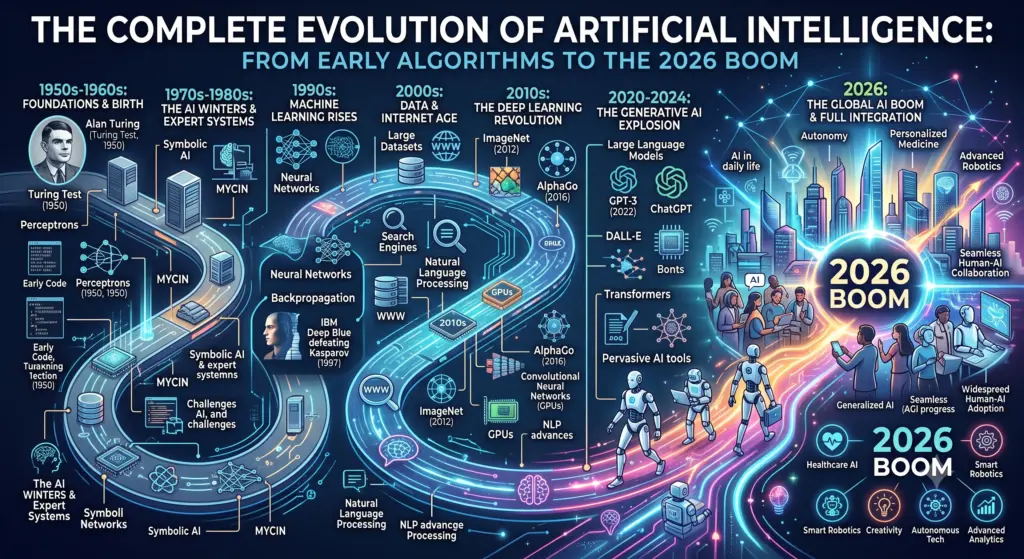
The Complete Evolution of Artificial Intelligence: From Early Algorithms to the 2026 Boom
Welcome to the ultimate guide on the evolution of AI. You are about to learn exactly how machines learned to think, step-by-step.
Let’s start with the most critical facts first.
The year 2026 represents a massive turning point in human history because AI has officially moved from a novelty to a necessity.
Today, AI systems do not just answer questions; they actively manage workflows, optimize financial portfolios, and even help students prepare for competitive government exams.
Furthermore, this technology is no longer confined to massive server farms.
Edge computing now allows powerful AI to run directly on your smartphone, entirely offline.
What is the timeline of AI development? It is a fascinating journey of massive breakthroughs, crushing winters, and ultimate triumph. 🚀
During my decade of experience managing institutional banking operations, I saw firsthand how slowly traditional systems adapted to change.
However, AI breaks all those rules. It learns, adapts, and evolves at lightning speed. To begin with, we must understand that AI is not a single technology.
It is a combination of machine learning, neural networks, and massive data processing.
Therefore, to truly understand where we are in 2026, we have to look back at how we got here.
Artificial Intelligence (AI) has evolved from simple rule-based algorithms in the 1950s to the advanced, multi-modal autonomous systems driving the 2026 tech boom.
Initially focused on logic and expert systems, AI experienced a massive shift in the 2010s with the Deep Learning revolution, heavily fueled by big data and cloud computing.
Today, Generative AI and autonomous agents seamlessly integrate into daily life, transforming industries from institutional banking to digital marketing.
The 2026 landscape is defined by highly personalized edge computing, making AI an invisible yet essential global infrastructure.
Phase 1: The Dawn of AI and Logic (1950s–1970s)
The concept of thinking machines actually began long before computers were common.
Alan Turing first proposed his famous Turing Test in 1950 to see if a machine could successfully imitate a human.
How did AI officially begin?
In 1956, scientists gathered at the Dartmouth Conference and officially coined the term “Artificial Intelligence.”
Initially, these brilliant minds believed they could solve the puzzle of human intelligence in just a few decades.
Early programming relied entirely on creating strict, rule-based systems.
These first-generation programs were essentially giant lists of “if-then” statements.
For example, if a user inputs a specific math problem, the computer follows a hard-coded rule to solve it.
Consequently, these early systems were incredibly rigid.
They could prove mathematical theorems or play simple games, but they lacked any real understanding of the world.
Neural networks, which mimic the human brain, actually have their roots in this era as well.
Scientists like Warren McCullough began theorizing about artificial neurons as early as 1944.
Later, in the 1970s, basic visual recognition systems were built.
Even so, computers of this era were simply too slow and had far too little memory to make these concepts practical for everyday use.
Read It
How to Use Free Temp Mail to Protect Your Privacy and Stop Spam (2026 Complete Guide)
Phase 2: Expert Systems and the AI Winters (1980s–Early 1990s)
To solve the limitations of early AI, researchers changed their entire strategy in the 1980s.
They introduced Expert Systems, which were designed to capture the specialized knowledge of top human professionals.
For instance, a medical expert system would be programmed with the knowledge of top doctors to help diagnose illnesses.
While this sounded great in theory, it was incredibly difficult to maintain.
The biggest problem was what experts call a “combinatorial explosion.”
As the real world is messy and unpredictable, programmers had to write an impossible number of rules to cover every single scenario.
Because of this, the systems became slow, expensive, and fragile. Subsequently, businesses lost faith in the technology.
This loss of faith led directly to the famous “AI Winter.”
Between 1987 and 1993, funding dried up, and public interest vanished.
What caused the AI Winter?
It was a classic case of overpromising and underdelivering.
Nevertheless, dedicated scientists continued their research quietly, setting the stage for the next massive leap forward.
Phase 3: Machine Learning and Big Data (Mid 1990s–2010s)
The mid-1990s brought the dawn of the internet, and with it, a monumental shift in how AI was built.
Instead of writing endless rules, scientists realized they needed to teach machines how to learn on their own.
This is the core concept of Machine Learning. By feeding a computer massive amounts of data, the system could identify patterns without human interference.
IBM’s Deep Blue provided a massive wake-up call to the world in 1997.
When this supercomputer defeated world chess champion Garry Kasparov, it proved that machine computation could rival top-tier human strategy.
Meanwhile, the internet was quietly generating the exact thing AI needed to survive: massive, digitized datasets.
Data became the fuel, and scalable algorithms became the engine.
Because storage costs plummeted and processors became faster, probabilistic learning took over.
Tech giants quickly integrated AI into everyday consumer products.
For example, Google launched AdSense, Netflix built its recommendation engine, and Apple introduced Siri. Suddenly, AI was in our pockets. 💡
Phase 4: The Deep Learning and Generative Era (2012–2024)
If machine learning was a spark, deep learning was an absolute explosion.
Deep learning uses multi-layered artificial neural networks to process information in ways that closely mirror the human brain.
How did deep learning change AI?
In 2012, a neural network named AlexNet shocked the world by dominating an image recognition contest.
It proved that Graphics Processing Units (GPUs) could train complex models faster than anyone thought possible.
The next major breakthrough occurred in 2017 with the invention of the Transformer Architecture.
Google researchers published a paper showing how AI could process entire sentences simultaneously, rather than reading them word by word.
This allowed machines to truly understand the context of human language. In addition, this single discovery laid the foundation for the massive language models we use today.
By the early 2020s, the Generative AI revolution was fully underway.
Systems transitioned from simply analyzing data to creating brand new content.
Tools like ChatGPT, Midjourney, and Stable Diffusion allowed anyone with an internet connection to write essays, generate computer code, and create stunning digital art in seconds.
Not only did this change technology, but it fundamentally altered how businesses operate.
Explore It
How AI is Changing the Game for Cybersecurity and Fraud in 2026
Phase 5: The 2026 AI Boom and Autonomous Systems
Now we arrive at the current landscape of 2026, where the novelty of chatbots has faded into highly practical, daily applications.
We are no longer just chatting with AI; we are deploying autonomous systems to do our heavy lifting.
What is an AI agent?
An agent is an advanced system that can take a broad goal, break it into steps, browse the internet, and complete the workflow without human supervision.
Multimodal cognition is the standard in 2026. Today’s systems seamlessly process text, live video, and audio all at once.
Whether I am optimizing SEO for my digital platforms like zenvestai.com or reviewing affiliate metrics, AI engines can look at a dashboard, listen to a voice command, and execute complex coding optimizations instantly.
This level of reasoning has rebuilt backend processes across major industries.
We are also seeing a massive shift toward AI-first processes in the business world.
Instead of layering a chatbot on top of an old, legacy banking system, new financial institutions are building their entire infrastructure natively around advanced algorithms.
This means faster loan approvals, perfect fraud detection, and highly personalized financial planning for rural and urban sectors alike. 📈
Understanding AI Vocabulary: Quick Reference Table
To ensure you fully grasp this topic, let’s break down the most important terms you need to know in 2026.
| AI Term | Simple Definition | 2026 Application |
| Machine Learning | Teaching computers to recognize patterns using data. | Predicting stock market trends based on history. |
| Deep Learning | Advanced ML using layered artificial neural networks. | Medical diagnostics from X-ray imaging. |
| Generative AI | AI that creates new, original content (text, images, code). | Drafting automated, SEO-optimized blog posts. |
| Edge AI | Running AI locally on your device without the cloud. | Secure, offline voice assistants on smartphones. |
| AI Agents | Autonomous systems that execute multi-step goals. | Managing complete email marketing campaigns automatically. |
How AI is Transforming Industries
It is crucial to understand that AI is not just a tool for software developers. It is completely reshaping traditional sectors.
Finance and Banking:
Financial institutions now use AI for much more than just customer service chatbots.
Algorithms instantly analyze thousands of variables to assess credit risk, allowing for immediate loan approvals even for individuals without traditional credit histories.
Furthermore, AI detects fraudulent transactions in real-time, saving billions of dollars globally.
Education and Mentorship:
The way students learn has been completely revolutionized. AI acts as a 24/7 personal tutor.
If a student is preparing for a rigorous exam like the SBI PO or a Civil Court Peon test, AI can generate custom practice papers, identify weak points in mathematics, and create highly structured, day-by-day study plans. Education is now entirely personalized.
Digital Marketing and SEO:
In the world of content creation, AI is an absolute powerhouse. Marketers use it to identify Latent Semantic Index (LSI) keywords, generate HTML/CSS code, and structure articles perfectly for search engine rankings.
Similarly, it automates affiliate link placements and analyzes which content drives the most traffic.
The Challenges and Ethical Considerations of 2026
Despite all these massive benefits, the 2026 AI boom brings serious challenges that society must address.
As AI systems become more autonomous, the potential for harm increases if they are not properly regulated.
What are the main risks of AI?
Bias, data privacy, and the displacement of traditional jobs are at the forefront of the conversation.
Data privacy is a massive concern for the average user. Because AI models require vast amounts of data to function, protecting personal information is critical.
Consequently, this is why Edge AI has become so popular in 2026. It keeps your personal data on your device rather than sending it to a corporate server.
Job transformation is another reality we have to face. While AI is automating routine, repetitive tasks, it is also creating entirely new categories of employment.
The demand for prompt engineers, AI auditors, and data curators is skyrocketing.
Therefore, the key to success in this new era is continuous learning and adaptability.
What Comes Next? The Path to AGI
As we look beyond the 2026, the ultimate goal of researchers remains the development of Artificial General Intelligence (AGI).
Unlike current systems, which are highly specialized, an AGI would possess the ability to learn, understand, and apply knowledge across any intellectual task that a human being can do. 🤖
Will AGI arrive in our lifetime?
Many experts believe it is closer than ever. The exponential growth of computing power, combined with new algorithmic discoveries, suggests that the gap between human and machine intelligence is closing rapidly.
Thus, it is essential for us to build strong ethical frameworks today to ensure this technology benefits all of humanity tomorrow.
In conclusion, the evolution of Artificial Intelligence is the most significant technological journey of our time.
From the simple rule-based programs of the 1950s to the autonomous, multimodal agents of 2026, AI has consistently pushed the boundaries of what is possible.
By understanding this history, you can better navigate the tools of today and prepare for the incredible innovations of tomorrow.
All in all, the future belongs to those who embrace these changes and learn to work alongside our new intelligent systems.

Leave a Reply