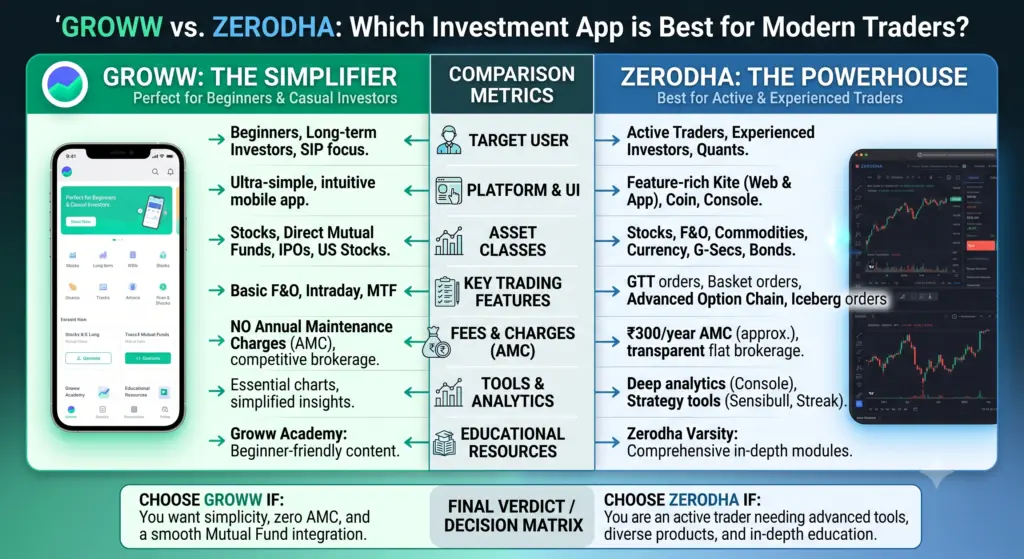
Groww vs. Zerodha: Which Investment App is Best for Modern Traders?
Are you tired of losing your hard-earned profits to confusing broker fees and clunky trading apps?
Choosing between India’s two giant discount brokers—Groww and Zerodha—can literally make or break your financial portfolio.
You might think all brokers are the same, but the hidden charges, platform features, and customer support models between these two are drastically different.
If you pick the wrong one, you could be bleeding thousands of rupees in maintenance fees and penalty charges every single year without even noticing.
Groww and Zerodha are India’s leading discount brokers, but they serve slightly different needs.
Zerodha charges
a flat ₹20 or 0.03% for intraday/F&Obut offers zero brokerage on equity delivery, making it ideal for high-volume and pro traders.However, Zerodha charges an Annual Maintenance Charge (AMC) of ₹300.
In contrast, Groww charges
zero AMC and zero account opening fees, but levies ₹20 or 0.1% on equity delivery.Ultimately, Groww is better for beginners seeking simplicity and mutual funds, while Zerodha remains the
top choice for advanced F&O tradersrequiring deep technical tools.
The Core Brokerage Showdown: Who Actually Saves Your Money? 📊
How exactly do Groww and Zerodha compare when it comes to standard trading fees?
To begin with, both platforms revolutionized the Indian stock market by abandoning the old percentage-based commission system.
First, Zerodha charges absolutely nothing for equity delivery, meaning long-term investors can buy and hold stocks for free.
On the other hand, Groww charges a small fee of ₹20 or 0.1% per executed order (whichever is lower) for equity delivery.
Therefore, if you are purely an investor looking to build a massive stock portfolio over years, Zerodha holds a distinct price advantage.
What are the intraday and F&O charges for both brokers?
Initially, both platforms look identical, but the fine print matters.
Zerodha charges 0.03% or ₹20 per executed order (whichever is lower) for equity intraday and F&O Futures, and a flat ₹20 for F&O Options.
Similarly, Groww charges ₹20 or 0.1% per executed order for equity intraday.
Because of this, heavy options traders will find both platforms exceptionally cost-effective.
However, Zerodha’s robust Kite terminal makes that ₹20 fee feel like a bargain given the advanced charting provided.
Read our full guide on
| Segment | Zerodha Brokerage | Groww Brokerage |
| Equity Delivery | ₹0 (Free) | ₹20 or 0.1% (whichever is lower) |
| Equity Intraday | 0.03% or ₹20 (lower) | ₹20 or 0.1% (lower) |
| F&O Futures | 0.03% or ₹20 (lower) | Flat ₹20 per order |
| F&O Options | Flat ₹20 per order | Flat ₹20 per order |
| Direct Mutual Funds | ₹0 (Free) | ₹0 (Free) |
Account Opening and Maintenance: The Hidden Drain
Why do Annual Maintenance Charges (AMC) matter so much to your long-term wealth?
Many beginners open accounts, trade once, and forget about them, only to find their ledger in the negative months later.
Let’s start with Zerodha, which charges ₹0 to open an individual account but mandates an AMC.
Specifically, while the first year is free for resident individuals, non-BSDA accounts are charged ₹300 per year + 18% GST (billed quarterly).
In contrast, Groww shines brilliantly here because it enforces absolutely zero account opening fees and zero AMC forever.
Who benefits most from Basic Services Demat Accounts (BSDA) on Zerodha?
If you have a small portfolio, you can escape the ₹300 AMC.
For example, holdings up to ₹4 lakh attract zero AMC on Zerodha.
Furthermore, holdings between ₹4 lakh and ₹10 lakh are charged just ₹100 per year plus GST.
Nevertheless, Groww eliminates this math entirely by keeping maintenance completely free across the board.
For a modern trader who just wants to buy a few shares without ongoing commitments, Groww’s zero-AMC policy is undeniably attractive.
Understanding Statutory and Exchange Taxes
Do you know how much the government takes from every single trade you execute?
Regardless of whether you use Groww or Zerodha, statutory taxes are inescapable.
In addition, Securities Transaction Tax (STT) is levied heavily; for equity delivery, both brokers must collect 0.1% on the buy and sell sides.
Furthermore, GST of 18% is applied to the sum of your brokerage, SEBI charges, and transaction charges.
Significantly, these taxes often amount to more than the actual brokerage fee itself.
What are the specific DP charges when selling your shares?
Depository Participant (DP) charges are hidden fees triggered every time you sell a stock from your demat account, regardless of the quantity sold.
For instance, Zerodha charges ₹15.34 per scrip sold.
Likewise, Groww charges a similar DP fee, breaking it down as ₹3.5 for the depository (male investors) and ₹16.5 for Groww itself, totaling ₹20 plus GST.
Consequently, if you sell shares of ten different companies in one day, these DP charges can quickly erode your profits.
Learn more about
Essential Statutory Charges
- STT/CTT: 0.1% on delivery; varies for intraday and F&O.
- Transaction Charges: Levied by NSE/BSE based on your total turnover.
- GST: 18% applied universally on brokerage and exchange fees.
- SEBI Charges: ₹10 per crore traded + GST.
- Stamp Duty: Varies (e.g., 0.015% on the buy side for equity delivery).
Deep Dive into Zerodha: The Pioneer’s Ecosystem 🚀
How did Zerodha become the undisputed king of Indian retail trading?
Founded on August 15, 2010, the platform pioneered the discount broking model by combining “Zero” and “Rodha” (Sanskrit for barrier).
Today, it stands as India's largest stockbroker with over 1.6 crore clients.
What’s more, it contributes to over 15% of all Indian retail trading volumes.
Above all, Zerodha’s appeal lies in its reliable technology, offering zero brokerage on direct mutual funds and equity delivery.
What happens if you make a mistake and your Zerodha account goes into debit?
The platform strictly penalizes poor margin management.
If your account has a negative balance, the brokerage fee instantly jumps to ₹40 per executed order instead of the usual ₹20.
Additionally, if an auto square-off is triggered because you failed to exit an intraday position on time, you will be charged ₹50 extra via the Call & Trade fee.
Thus, disciplined trading is mandatory when using this platform.
Deep Dive into Groww: The Millennial Champion
Why has Groww amassed over 1.4 crore active customers so rapidly?
Initially, Groww focused entirely on mutual funds before expanding into stocks, US Stocks, ETFs, IPOs, and F&Os.
Because of this, the platform features an incredibly clean, 100% paperless onboarding process that appeals to digital natives.
Another point is that Groww provides investment solutions without overwhelming the user. It objectively evaluates products but explicitly avoids offering stock recommendations or guaranteeing fixed returns.
How does Groww simplify the mutual fund experience for beginners?
To illustrate, investors can start a Systematic Investment Plan (SIP) with as little as Rs. 500.
Moreover, you can set up automated monthly investments and easily switch from regular funds to direct funds to save on expense ratios.
In fact, Groww allows you to build a curated portfolio yourself or rely on expert-designed portfolios to ensure diversification and risk reduction.
By focusing on mutual funds first, Groww built a platform where wealth generation feels accessible, not intimidating.
Check out this
Advanced Trading Features: Margin, Pledging, and Terminals
What is Margin Trading Facility and how do these brokers handle it?
Margin Trading Facility allows you to buy stocks with borrowed money, but it comes at a steep cost.
On one hand, Zerodha charges an interest rate of 0.04% per day on the funded amount.
Conversely, Groww charges an interest rate of 14.95% per annum on the funded amount, along with a 0.1% brokerage per order for Margin Trading Facility trades.
Therefore, if you plan to use leverage, you must calculate these interest rates carefully to ensure they do not consume your trading margins.
How do pledging charges compare between the two platforms?
Pledging allows you to use your existing shares as collateral to get margin for F&O trading.
First, Zerodha charges ₹30 + GST per pledge or unpledge request.
Meanwhile, Groww charges ₹20 per ISIN for a pledge/unpledge order.
Overall, both adhere to the SEBI rule effective September 1, 2020, requiring upfront margin collection and proper depository pledging.
Importantly, a 20% upfront margin of the transaction value is mandatory to trade in the cash market segment across both apps.
Platform Navigation and User Experience (UX)
Where can you find the best analytical tools for technical trading?
Zerodha’s Kite terminal is widely considered the industry gold standard for charting, offering vast indicators and seamless execution.
However, Groww is catching up fast.
In addition to its standard app, Groww offers the "Groww Terminal" and "915 Terminal" designed specifically for F&O traders.
Furthermore, Groww includes built-in Stock Screeners that allow you to filter equities based on RSI, PE ratio, and other critical financial metrics.
Are you looking for dedicated resources to calculate your potential returns?
Both platforms understand that investors need clarity before deploying capital.
For example, Groww features a comprehensive suite of calculators accessible right from its footer menu.
Namely, you can utilize their SIP calculator, SWP calculator, Brokerage calculator, and Margin calculator.
Similarly, Zerodha offers robust brokerage calculators and the immensely popular “Varsity” educational module.
Ultimately, while Groww excels in quick calculators, Zerodha provides unmatched educational depth.
Explore this related post
Safety, E-E-A-T, and Investor Awareness 🛡️
How safe is your money when investing through online discount brokers?
Both Groww and Zerodha are heavily regulated by SEBI and are members of major exchanges like NSE, BSE, and MCX.
First and foremost, investors must complete a strict KYC process through a SEBI-registered intermediary.
Once this KYC is completed, you do not need to undergo the process again with another broker.
Significantly, Groww explicitly cautions investors against unsolicited SMS or emails advising them to trade, promoting a culture of fraud prevention.
What steps should you take to prevent systemic fraud in your account?
Vigilance is your best defense in the modern stock market.
To begin with, always ensure your mobile number and email ID are updated with the depository so you receive OTPs for any pledging activity.
Later, make it a habit to verify your Securities, Mutual Funds, and Bonds in the monthly consolidated account statement issued directly by NSDL or CDSL.
Never trust third-party tips; rely only on authorized statements and official exchange portals to report any suspicious activity.
Penalties and Miscellaneous Fees
Are there hidden administrative fees that could shock you later?
While brokerage and AMC are upfront, miscellaneous fees can add up.
For instance, if you face a delayed payment situation, both brokers charge penalties.
Specifically, Groww charges a Delayed Payment Charge (DPC) of 0.05% per day (inclusive of GST), which is calculated as simple interest but compounded monthly.
Likewise, Zerodha levies an 18% per year (0.05% per day) interest rate on debit balances. Consequently, funding your account adequately is critical.
What happens if the system has to force-close your trades?
If you take an intraday position and fail to close it before the market shuts, the broker’s system will do it for you.
In this scenario, Groww charges an Auto Square-off fee of ₹50 per position.
In the same way, Zerodha charges ₹50 extra per order if placed through a dealer or triggered by auto square-off.
In short, letting the system close your trades is an expensive mistake you should avoid at all costs.
Admin & Service Charges on Groww
- Demat/Remat: ₹150 per certification + courier charges.
- Failed Demat Transactions: ₹50 per ISIN.
- Physical Statement Request: ₹10 per page.
- KYC Modification Request: ₹50 (including GST).
- UPI Mandate Balance Charges: 1% of the order value for equity brokerage.
Final Verdict: Which App Should You Choose?
Which broker ultimately aligns with your specific financial goals?
The answer lies entirely in your trading style and volume.
To sum up, if you are an aggressive day trader, an options seller, or a long-term investor who buys shares in massive quantities, Zerodha’s zero-brokerage on delivery and advanced Kite terminal make it the superior choice.
However, you must be comfortable paying the ₹300 yearly AMC.
When is Groww the undeniably better option?
In conclusion, if you are a beginner, a mutual fund enthusiast, or someone who trades stocks only occasionally, Groww is practically flawless.
Indeed, its zero AMC, zero account opening fee, and beautifully simplistic user interface remove all friction from the investing process.
Overall, both platforms demonstrate immense trustworthiness and authority in the Indian financial sector, but your choice should be dictated by whether you value advanced trading mechanics (Zerodha) or absolute simplicity (Groww).

Leave a Reply