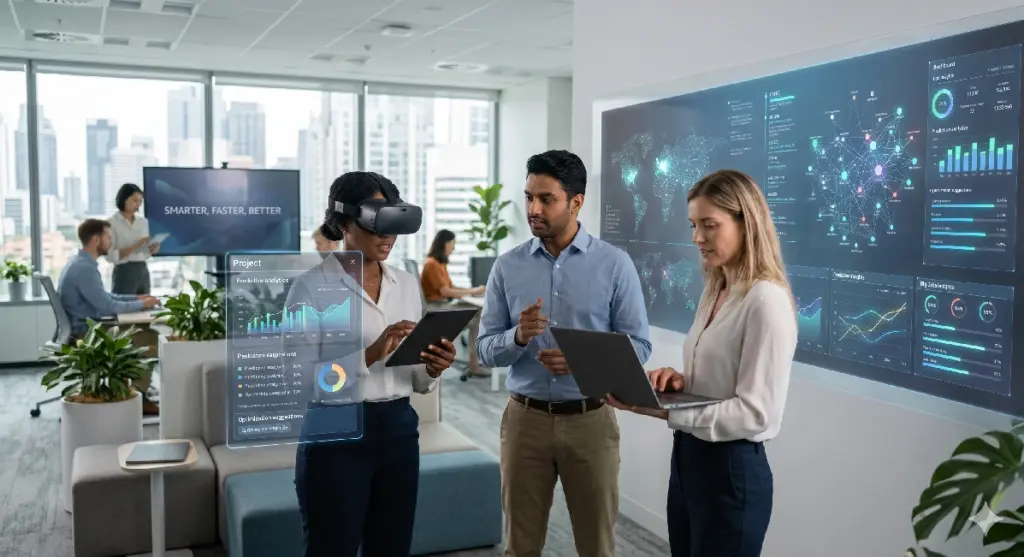
Smarter, Faster, Better: How AI and Big Data Are Redefining Work
Imagine, when you walk into your office, grab a coffee, and open your laptop.
Your inbox is already sorted.
Your weekly reports are already drafted.
And your schedule is perfectly organized.
This is not a dream.
The workplace revolution has already started.
Your digital assistant has already sorted your inbox, flagged urgent client requests, drafted replies, and updated the team sales forecast.
You do not spend hours digging for information because the exact data you need is already right in front of you.
The Workplace Revolution Has Already Started, and it is happening right on our screens.
Today, over 75% of global businesses use some form of smart technology.
Data creation is doubling every two years.
Because of this, companies are investing billions in smart software.
Work has changed deeply in just the last decade.
We went from paper files to basic software, and now to smart assistants.
In this article, you will learn how these tools work. You will also see how they change jobs and what skills you need next.
However, one major thought is on everyone’s mind. You might be asking the key question:-
Will AI replace workers or make them more productive?
AI and Big Data are rapidly transforming the modern workplace. Big Data provides massive amounts of information, while AI acts as the brain that processes it. Together, they automate repetitive tasks, boost productivity, and drive smarter business decisions. Rather than replacing humans entirely, these technologies create a new model of human-AI collaboration. Workers who learn to use AI tools will thrive. Businesses adopt these tools to reduce costs, improve customer experiences, and gain a competitive edge in a fast-paced digital economy.
1. Understanding AI and Big Data
Artificial Intelligence is simply software that mimics human thought processes to solve complex problems.
At its core, AI allows machines to learn from experience, adjust to new inputs, and perform tasks that human brains usually handle.
- Machine Learning: This is the engine behind AI where computers use statistical algorithms to find patterns in data without explicit programming.
- Generative AI: Systems like ChatGPT, Gemini, and Claude that create fresh content, including text, images, code, and audio, from simple human prompts.
- Predictive AI: This tool looks at history to guess what will happen next. For example, you use these tools daily. Netflix suggests movies. Maps find the fastest route. Your phone recognizes your face.
Every day, you likely interact with AI when you look at email spam filters, use smartphone navigation apps, or check custom recommendations on streaming services.
Big Data refers to the massive, fast-moving collections of digital information that traditional databases cannot manage.
In today’s hyper-connected economy, every click, swipe, purchase, and sensor log leaves a digital footprint.
| Data Type | Definition | Corporate Examples |
| Structured Data | Highly organized, tabular information that fits easily into standard spreadsheets. | Sales ledgers, customer phone numbers, databases, transaction timestamps. |
| Unstructured Data | Raw, unorganized information that makes up about 80% of all corporate data. | Social media videos, PDF reports, audio recordings, customer emails. |
Tech leaders often call data the "new oil" because it is incredibly valuable when refined, yet useless when left raw. Data is the raw material that powers modern business growth.
These two forces work together perfectly.
Data feeds the software.
First, the company collects facts.
Then, the smart system turns that data into clear decisions.
For instance, a store tracks what you buy.
Next, the system uses that history to send you a special discount.
Read It
2. Why Businesses Are Racing to Adopt AI and Big Data
Companies want faster results. Speed is critical in today’s market. Software allows faster decision-making. Leaders no longer wait weeks for a sales report. Instead, they get real-time insights on their screens. Consequently, they can fix problems instantly.
Cutting costs is another major goal. Automation of repetitive tasks saves money. Software can handle billing, data entry, and simple client chats. As a result, businesses see greatly reduced operational expenses. They can spend that saved money on new ideas.
Buyers want better customer experiences. People expect companies to know what they like. Smart systems offer deep personalization. For example, recommendation systems show shoppers exactly what they want to buy. Thus, customers stay happy and loyal.
Everyone seeks a competitive advantage. If you know the future, you win. Predictive analytics give companies this power. They use market forecasting to see trends before they happen. Therefore, companies that use these tools stay ahead of their rivals.
[Raw Corporate Datasets] ➔ [AI Machine Learning Engine] ➔ [Automated Systems / Human Leaders] ➔ [Instant Decisions]3. How AI and Big Data Are Transforming Everyday Work
Smart systems lead to smarter decision-making. Guesswork is gone. Leaders now rely on data-driven decisions. They use business intelligence tools to see clear charts and graphs. Above all, choices based on facts bring better results than choices based on gut feelings.
Workers enjoy increased productivity. Software handles the boring parts of the job. Automating routine tasks frees up human time. For example, AI assistants can write emails, schedule meetings, and summarize long documents. Therefore, people can focus on creative work.
Companies experience faster problem solving. Machines spot trouble early. Predictive maintenance alerts factories before a machine breaks. Similarly, risk detection tools warn banks about bad loans. In short, catching a problem early saves time and money.
Teams see better collaboration. Distance matters less now. AI-powered workplace tools connect remote teams smoothly. Intelligent project management software tracks who is doing what. Furthermore, it predicts if a project will finish on time.
Explore It
How AI is Changing the Game for Cybersecurity and Fraud in 2026
4. Industries Being Transformed Right Now
🏥 Healthcare
Healthcare is changing rapidly to save lives. Doctors use disease prediction to catch illnesses early. Medical imaging software spots tiny details in X-rays that humans might miss. Moreover, drug discovery now takes months instead of years.
💰 Finance
Finance moves faster and safer. Banks rely on fraud detection to stop stolen credit cards instantly. Algorithmic trading buys and sells stocks in milliseconds. In addition, risk management tools protect banks from losing money.
🛒 Retail & E-commerce
Retail and e-commerce focus heavily on the buyer. Stores offer personalized shopping experiences online. Inventory management software ensures popular items never run out of stock. Also, dynamic pricing changes item costs based on demand and time of day.
🏭 Manufacturing
Manufacturing relies on smart systems to build things. Smart factories use sensors on every machine. Predictive maintenance stops assembly lines from breaking down. Ultimately, this keeps factory workers safe and production steady.
📚 Education
Education offers new ways to learn. Schools use personalized learning to match each student’s pace. AI tutors help children with math or reading after school hours. Consequently, students get the exact help they need.
🚚 Transportation & Logistics
Transportation and logistics move goods faster. Delivery trucks use route optimization to avoid traffic jams. Meanwhile, autonomous vehicles are learning to drive without humans. These advances make shipping cheaper and faster.
5. AI-Powered Tools Employees Use Every Day
Workers use content creation tools to write and brainstorm.
- ChatGPT: Helps write essays, emails, and plans.
- Gemini: Assists with deep research and organizing data.
- Claude: Reads long PDF files and gives quick summaries.
Professionals rely on productivity software to stay organized.
- Microsoft Copilot: Lives inside Word and Excel to speed up work.
- Notion AI: Helps teams track goals and write project plans.
Creative teams use design tools for fast visuals.
- Canva AI: Generates pictures and slides with simple text prompts.
- Adobe Firefly: Edits photos and creates art quickly.
Developers build software faster with coding assistants.
- GitHub Copilot: Suggests lines of code as the programmer types.
- Cursor AI: Helps find bugs and fix errors in software.
Companies improve service with customer support tools.
Virtual Assistants: Route complex calls to the right human agent.
AI Chatbots: Answer basic buyer questions at any hour.
6. Jobs Being Changed by AI and Big Data
Many roles are becoming more automated. Software excels at boring, repeating steps. Data entry jobs are shrinking because software reads forms instantly. Basic customer support is handled by chatbots. Routine administrative work, like booking flights, is now done by digital assistants.
Other roles are becoming much more valuable. Companies need people to manage the machines. Data scientists are in high demand to organize massive facts. AI engineers build the actual software systems. Prompt engineers know exactly what to type to get good answers from chatbots. Business analysts translate data into company goals.
New technology creates emerging careers. We are seeing jobs that did not exist five years ago. AI Ethics Specialists make sure the software is fair. AI Trainers teach the systems to sound more human. Data Governance Managers keep private information safe. Human-AI Collaboration Experts help staff work smoothly with their digital tools.
[Declining Careers]              [Rising Careers]                 [Brand New Careers]
- Manual Data Entry Clerk        - Data Scientist                 - Prompt Engineer
- Basic Call Router              - Machine Learning Engineer      - AI Ethics Specialist
- File Administrative Assistant  - Business Intelligence Analyst  - Data Governance Manager
7. The Rise of Human + AI Collaboration
Humans are still essential to business success. Machines cannot feel or dream. Creativity belongs entirely to people. Emotional intelligence is needed to lead teams and comfort clients. Strategic thinking requires a human to see the big picture.
We must view the machine as a co-worker. This is about augmentation versus replacement. The tool adds to your skills; it does not steal your seat. For instance, real examples from companies show doctors using software to scan charts, but the doctor still talks to the patient. The machine does the heavy lifting, but the human makes the final call.
There is a new productivity formula for success. It is simple but powerful. Human Expertise + AI Intelligence = Better Results. When you combine human empathy with machine speed, the business wins.
8. Challenges and Risks Businesses Must Address 🛡️
Data privacy concerns worry many leaders. Systems need data to learn, but they must not steal secrets. Customer information protection is a top priority. A data breach can destroy a brand’s reputation overnight.
Algorithm bias is a serious problem. Software learns from old human data. If the old data was unfair, the software will be unfair. Fairness issues arise in hiring or lending if the system favors one group. Companies must test their tools often.
Cybersecurity threats are growing smarter. Hackers now use smart tools too. AI-powered attacks can guess passwords or write fake emails perfectly. Therefore, businesses must use advanced security to fight back.
Workforce displacement causes fear among workers. Some old jobs will vanish completely. Reskilling needs are massive right now. Companies must pay to retrain their staff for new roles.
Regulatory challenges change constantly. Governments are writing new rules. AI laws and compliance strictness vary by country. Businesses must follow these laws to avoid heavy fines.
[Biased Historical Data Input] ➔ [Untested AI Training] ➔ [Unfair Automated Choices] (Fix: Continuous Data Auditing)9. Skills Workers Need to Stay Relevant
Technical skills are the foundation of the future. You do not need to be a coder, but you must understand the basics. Data analysis helps you read basic charts and trends. AI literacy means you know what these tools can and cannot do. Prompt engineering is simply knowing how to ask a chatbot the right question.
Human skills are your greatest defense against automation. Machines cannot replicate your humanity. Communication is vital for explaining complex ideas. Creativity solves problems in fresh ways. Leadership guides teams through hard times. Critical thinking helps you question if the machine’s answer is actually right.
A continuous learning mindset is your best career insurance. The tools change every single month. Lifelong learning importance cannot be overstated. You must be willing to read, take courses, and try new software.
💡 Professional Success Checklist:
├── AI Literacy & Prompt Engineering (Tech)
├── Data-Driven Problem Solving (Analytical)
├── Emotional Intelligence & Empathy (Human)
└── Strategic Communication & Leadership (Human)
10. Future Trends: What Work Will Look Like by 2030
Hyper-automation will handle entire business processes. Soon, software will not just write an email; it will run an entire marketing campaign. Everything that can be automated will be automated.
AI Agents in the workplace will act freely. Today, we type prompts to get answers. By 2030, digital agents will do tasks without us asking. They will see a problem, fix it, and send you a summary.
Predictive workflows will prepare your day. Your computer will know what you need before you do. It will open files, draft replies, and fetch data based on your morning habits.
Digital employees will join your team. You might soon have a digital co-worker. This software will attend meetings, take notes, and manage the team calendar.
Personalized career development will guide your growth. Smart systems will track your skills. Then, they will suggest the exact training you need for a promotion.
AI-powered decision ecosystems will run boards of directors. Software will sit in executive meetings. It will simulate millions of business choices in seconds to advise the CEO.
The rise of autonomous businesses is coming. Some small companies might run entirely on software. A human owner will simply oversee the automated agents doing the work.
[Human Leader sets Strategic Goal] ➔ [Autonomous AI Agents execute steps] ➔ [Hyper-Automated Operations run 2030 corporate workflows]11. Success Stories: Companies Winning with AI and Big Data
- Amazon– Amazon uses data to rule retail. They master supply chain optimization. The company knows what you will buy before you click. They move products to a warehouse near you ahead of time.
- Netflix– Netflix changed how we watch television. They built a massive recommendation engine. By analyzing viewing habits, they suggest the perfect show. As a result, users stay subscribed longer.
- Tesla– Tesla is redefining travel. They collect autonomous driving data from every car they sell. Millions of miles of driving footage feed their central system. Thus, their cars get smarter every single day.
- Google– Google uses smart tools internally. They focus on AI-powered productivity for their staff. From saving energy in their servers to writing code, Google uses its own tools to stay fast.
- Microsoft– Microsoft is changing the modern office. They focus on Copilot integration. By putting smart assistants in Word and Teams, they help millions of normal workers save hours each week.
12. Practical Steps for Businesses to Get Started
Step 1: Identify Repetitive Tasks
Look at what your team does every day. Find the boring, typing-heavy jobs. These are the best places to use new software.
Step 2: Collect Quality Data
Bad information leads to bad choices. Clean up your files. Ensure your customer lists and sales reports are accurate.
Step 3: Choose the Right AI Tools
Do not buy everything at once. Pick one software that solves one problem. For instance, start with a chatbot for your website.
Step 1: Map Chores ➔ Step 2: Clean Files ➔ Step 3: Pick Software ➔ Step 4: Train Staff ➔ Step 5: Scale UpStep 4: Train Employees
A tool is useless if nobody knows how to use it. Pay for training. Show your staff how the software makes their lives easier.
Step 5: Measure Results
Track your progress carefully. Check if the tool actually saved time or money. If it did not, try a different approach.
Step 6: Scale Gradually
Once the first tool works, add another. Slowly build a smarter business. Small, steady steps are better than massive, confusing changes.
14. Final Thoughts: The Future Belongs to Human-AI Teams
The workplace revolution is here to stay. In summary, Big Data gives us the facts, and smart software helps us act on them. We have seen how these tools save money, speed up tasks, and create new careers. Moreover, we know that industries from healthcare to retail are already transformed.
It is important to remember that this software is just a tool. It is not a replacement for human potential. Your creativity, empathy, and leadership are irreplaceable. The machine handles the data, but you handle the direction.
Therefore, I encourage you to learn these skills now. Do not wait for the future to happen to you. Try a new chatbot. Read a data report. Ask your boss for training.
Finally, the future of work looks incredibly bright. When we combine human passion with machine speed, the possibilities are endless. We are building a world where work is less about grinding and more about growing. Smarter, faster, and better work is within our reach.
Frequently Asked Questions (FAQs) 💡
Will AI replace all jobs?
No, it will not replace all jobs. It will automate specific tasks within jobs. People who use smart tools will likely replace people who refuse to learn them.
How does Big Data improve workplace productivity?
It removes the guesswork from daily tasks. Big data shows exactly where time and money are wasted. Therefore, teams can fix delays and work much faster.
What industries benefit most from AI?
Healthcare, finance, and logistics see massive benefits. These fields have huge amounts of data. Smart tools process this data to save lives, stop fraud, and speed up shipping.
Is AI safe for businesses?
It is safe if managed correctly. Businesses must protect private data and check for software bias. Good human oversight is the key to safety.
What skills should employees learn for the AI era?
Employees need critical thinking, creativity, and tech literacy. Learning how to write good prompts for chatbots is also highly valuable right now.
How can small businesses use AI?
Small businesses can start easily. They can use cheap tools to write marketing emails, schedule social media, or answer basic customer chats.
What is the future of AI in the workplace?
The future points to deep human-machine teamwork. Software will act as a digital assistant. This will allow humans to focus on strategy, relationships, and creative growth.

Leave a Reply