The Future is Already Written: 5 Ways Predictive AI is Shaping Our World
In today’s world, the future is no longer a mystery we are waiting to see.
Indeed, it is actively being written right now.
Artificial Intelligence has reached a massive turning point, because it is no longer just reacting to what we do.
Instead, it is predicting what we will do next.
In fact, global spending on AI technologies has shattered records, rocketing past $2 trillion.
Driven by this surge, predictive AI has become one of the absolute fastest-growing sectors in tech.
Consequently, every major institution is shifting from a defensive posture to an offensive one.
For instance, businesses use it to anticipate customer demands, while governments deploy it to plan infrastructure.
Similarly, healthcare providers use it to catch diseases early, and financial institutions rely on it to secure global wealth.
Therefore, science fiction has officially crossed over into daily reality.
Nowadays, every click you make, every route you drive, as well as every medical checkup you schedule, is being shaped by systems that see one step ahead.
Read It
How AI is Changing the Game for Cybersecurity and Fraud in 2026
What is Predictive AI?
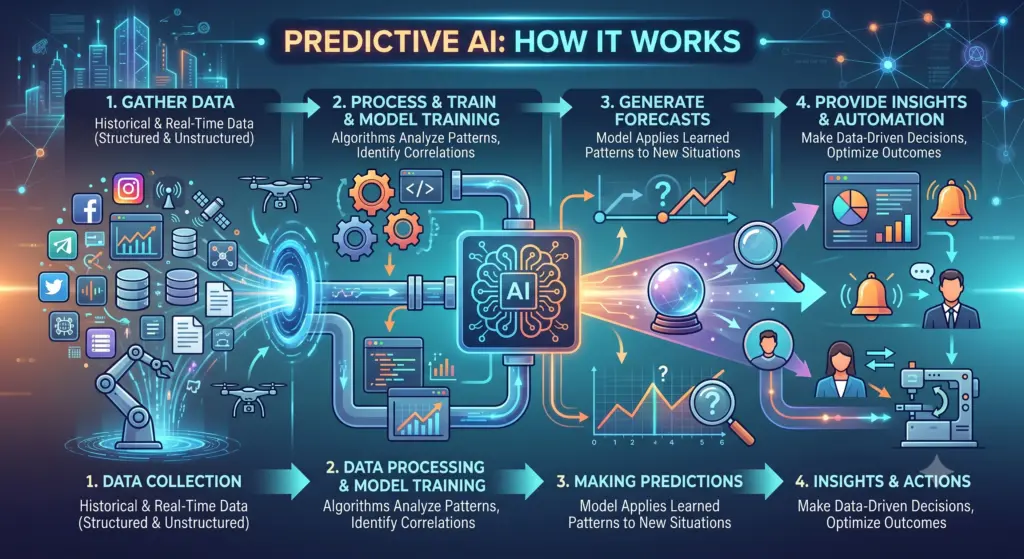
To begin with, predictive AI is a technology that uses historical data, machine learning, and real-time information to forecast future outcomes with incredible accuracy.
How It Works
- First, Data Collection: The system gathers massive amounts of information, such as past trends, live user actions, and environmental factors.
- Second, Pattern Recognition: Advanced mathematical models scan the data. Subsequently, they find hidden relationships and connections that humans cannot see.
- Then, Machine Learning Models: The AI tests these patterns, and thus it builds a digital blueprint of how behaviors and events typically unfold.
- Next, Future Predictions: The system applies this blueprint to new, live data. As a result, it calculates the exact probability of what will happen next.
- Finally, Continuous Improvement: The AI never stops learning because it checks its predictions against real outcomes, instantly tuning itself to become smarter.
5 Ways Predictive AI is Shaping Our World
1. Predictive Healthcare: Preventing Diseases Before They Happen
Generally speaking, healthcare is shifting away from reactive treatments, as doctors are moving entirely toward active prevention.
Patient Data Inputs ──> [ Predictive AI Engine ] ──> Custom Prevention Blueprint
(Genetics + Wearables)
To illustrate, AI engines constantly analyze electronic medical records, genetic profiles, lifestyle choices, and live data from wearable smartbands.
Particularly in clinical settings, these models predict heart disease risks years before symptoms appear.
Moreover, they identify early-stage cancer markers on scans that human eyes might miss.
In addition, hospitals use this data to forecast patient admission rates.
Consequently, this allows them to balance staff and resources perfectly before the waiting room fills up.
Ultimately, preventive medicine is drastically driving down healthcare costs, while also expanding human life expectancy.
2. Smarter Financial Markets and Investments
Likewise, Wall Street and global banking look completely different today.
This is because predictive AI systems absorb market sentiment, live breaking news, economic indicators, and decades of historical data simultaneously.
For example, algorithmic trading platforms use these data streams to execute highly profitable trades in fractions of a second.
Furthermore, banks use predictive analytics to run automated risk assessments on loans.
Not only that, but they also instantly flag fraudulent credit card patterns, hence reducing global fraud losses by up to 18% year-over-year.
As a result, these tools take the chaotic emotion out of the market for regular everyday investors.
Instead, they optimize portfolios automatically, serving indeed as a personal, high-end financial advisor for millions.
3. The Rise of Hyper-Personalized Shopping
In the same way, the modern retail experience is built entirely around your future desires.
Specifically, retail giants track your exact browsing behavior, purchase history, as well as your search patterns.
Then, this feeds the recommendation engines of platforms like Amazon.
Consequently, it allows them to offer hyper-targeted discounts on items you haven’t even realized you want yet.
Meanwhile, behind the scenes, this predictive power helps brands forecast their exact inventory needs down to individual item levels.
Due to this optimization, businesses achieve higher sales, eliminate stock shortages, and cut corporate product waste to an absolute minimum.
In short, shopping has become entirely personalized in real time.
4. Smart Cities and Intelligent Transportation
Furthermore, our cities are quickly transforming into self-optimizing ecosystems.
To achieve this, modern urban grids use AI to analyze real-time traffic congestion, municipal energy demands, and public transit schedules.
For instance, smart traffic lights adjust their countdown timers dynamically based on actual vehicle flow.
Thus, they dramatically slash commuter times and lower idling emissions.
Meanwhile, predictive maintenance algorithms monitor bridges, water pipes, and subways.
They alert crews to repair infrastructure before a structural failure can occur.
Therefore, the result is a highly efficient, cleaner, and much safer urban environment.
Explore It
5. Predicting Climate Risks and Environmental Changes
Above all, predictive AI has become humanity’s strongest shield against environmental disasters.
For example, meteorologists feed advanced AI models global satellite imagery, ocean temperatures, and atmospheric data.
Significantly, these models accurately forecast extreme weather events, flood risks, drought patterns, and wildfire trajectories days in advance.
Because of this, local authorities gain critical time for disaster preparedness and evacuations.
Similarly, farmers use these exact insights for advanced agricultural planning to secure crop yields.
At the same time, renewable energy grids use them to predict wind and solar patterns, ensuring green power is routed exactly where it is needed most.
The Dark Side: Challenges and Ethical Concerns
However, no technology this powerful comes without deep risks.
In fact, the widespread adoption of predictive systems raises massive red flags regarding personal privacy, data security, and algorithmic bias.
Although the technology is objective, if historical data contains human prejudices, the AI will simply fast-forward those biases into the future.
Besides, there is also the scary reality of overreliance.
Should an automated system influence life-altering decisions—such as criminal sentencing, medical diagnoses, or mortgage approvals—without human oversight?
Expert Insight: Importantly, the future must belong to Human + AI collaboration, not AI alone. True progress happens when human empathy and ethics guide machine precision, yet complete control should never be handed over to an algorithm.
What This Means for You
- For Students: Prioritize AI literacy, statistics, and data management skills, since understanding data is the new universal language.
- For Professionals: Learn the predictive analytics tools native to your industry, because the professionals who thrive will be the ones who know how to interpret AI forecasts.
- For Investors: Focus your capital on companies building or scaling core AI infrastructure, namely predictive software and automated workflows.
- For Businesses: Adopt predictive technologies early into your supply chains and customer systems. Otherwise, waiting any longer means risking total irrelevance.
Future Predictions: What Happens Next?
Looking ahead, over the next few years, expect to see deeply integrated predictive AI assistants that manage your daily schedule, finances, and health before you ask them to.
Meanwhile, continuous healthcare monitoring via smart implants will become normal, while fully autonomous transportation networks will safely manage city traffic.
In addition, predictive cybersecurity systems will neutralize digital threats before hackers even launch them.
Ultimately, within the next decade, predictive AI will be woven so deeply into our lives that living without it will feel just as impossible as living without the internet today.
Final Thoughts: The Balance Sheet of Tomorrow
In summary, predictive AI brings an incredible set of advantages, but it demands careful management.
| Benefits | Disadvantages |
| Eradicates operational inefficiencies and human errors | Severe threats to personal privacy and data safety |
| Shifts medicine from treating illness to saving lives | Risk of multiplying human biases on a massive scale |
| Erases financial and environmental uncertainty | Danger of algorithmic overreliance without human empathy |
To wrap up, the future is no longer a blank page that we simply wait to read.
On the contrary, it is an active script that machines are helping us draft.
By turning deep uncertainty into calculated opportunity, predictive AI gives us the ultimate tool to solve our hardest problems.
Therefore, the question is no longer whether predictive AI will rule tomorrow.
Instead, the real question is how prepared you are to use its predictions to build a wiser world.

Leave a Reply