The Ultimate Guide to Crypto Wallets: How to Choose & Stay Secure
Let’s start a digital revolution that is changing our world. In today’s world, money is no longer just paper inside a leather pocket.
Instead, it has transformed into digital code flowing across a global network.
Nowadays, the cryptocurrency market is booming like never before.
In fact, the total global crypto market capitalization has climbed to an incredible $2.46 trillion.
Bitcoin alone leads this massive financial wave with a market cap of around $1.45 trillion, while Ethereum holds strong at over $257 billion.
Millions of people worldwide are buying, selling, and trading these digital assets every single day.
However, as this massive market grows, a critical question arises for every investor: How do you keep your digital wealth safe?
This is exactly where the concept of a crypto wallet becomes your most important shield.
Read It
What is Cryptocurrency?
To begin with, we must look at some advanced facts and figures to truly understand what a cryptocurrency is.
It is important to note that a cryptocurrency is not a physical coin, nor is it managed by any central bank.
On the contrary, it is a decentralized digital asset built on blockchain technology, which acts as a secure, shared ledger.
Significantly, Bitcoin operates with a strict hard cap of 21 million coins, creating built-in scarcity that earns it the title of "digital gold."
Furthermore, the modern crypto landscape has evolved far beyond simple payments.
For example, Ethereum currently hosts roughly 75% of all decentralized finance (DeFi) activity.
Moreover, the recent approval of spot Bitcoin and Ethereum ETFs has allowed institutional capital, pension funds, and major corporations to enter the space.
Stablecoins have also grown rapidly, with around $300 billion in circulation, providing a steady digital bridge to traditional fiat currencies.

What is a Crypto Wallet and Why is it Necessary?
So, what exactly is a crypto wallet, and why is it necessary?
At first, the name might make you think it stores actual digital coins inside your phone or computer.
However, this is a common misconception.
In reality, your crypto assets always live on the blockchain network.
A crypto wallet is simply a software program or a physical device that stores your private keys and public keys.
Your public key acts like an email address or a bank account number that you can safely share with others to receive funds.
On the other hand, your private key is like a secret password or digital signature that gives you the right to spend those funds.
Therefore, a crypto wallet is absolutely necessary because, without it, you cannot interact with the blockchain, view your balance, or move your funds.
If you lose your private keys, you lose access to your money forever.
Explore It
A Brief History
Let’s look back in time to see why the crypto wallet was invented, by whom, and when.
In the beginning, the very first crypto wallet was created by the mysterious founder of Bitcoin, Satoshi Nakamoto, in 2009.
This original software was known as the Bitcoin Qt wallet, which later became Bitcoin Core.
Initially, it was invented because users needed a tool to generate private keys, create addresses, and send coins to one another on the brand-new Bitcoin network.
Subsequently, as the ecosystem expanded, developers realized that writing down long strings of random numbers for private keys was too difficult for regular people.
Consequently, in 2012, a major upgrade introduced BIP39, which allowed wallets to use a simple list of 12 to 24 random words known as a “seed phrase.”
This brilliant invention made backing up and restoring a wallet incredibly easy for everyone worldwide.
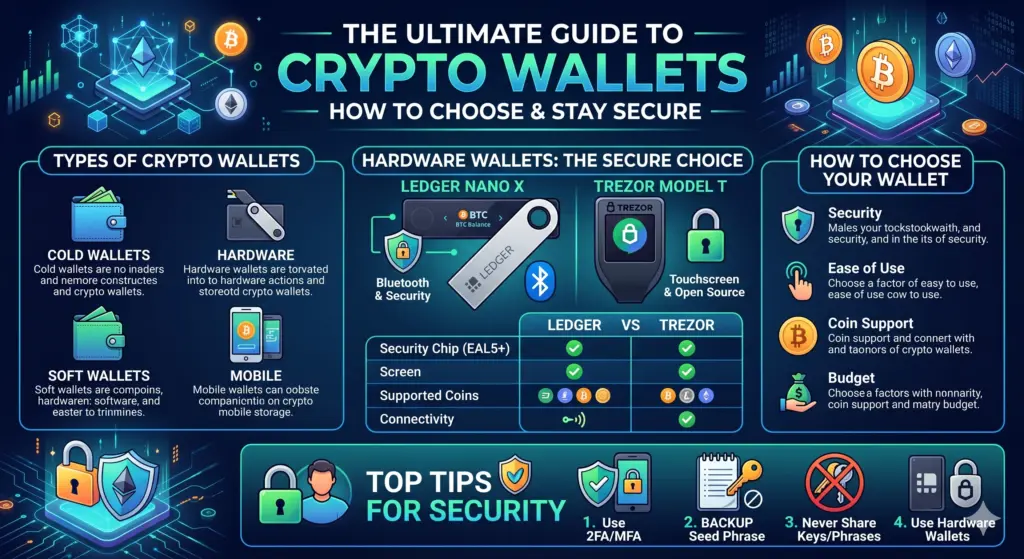
Types of Crypto Wallets
Generally speaking, there are two main categories of wallets:
- Hot Wallets: These are connected to the internet. They are very convenient for frequent trading. Examples include mobile apps and browser extensions. However, because they are always online, they are slightly more vulnerable to cyber threats.
- Cold Wallets: These operate offline. They are often physical devices, such as hardware wallets. Because they stay disconnected from the internet, they are significantly more secure for long-term storage of large amounts of crypto.
Additionally, we can look at wallets through the lens of custody.
Custodial wallets are managed by a third party, such as a major exchange like Binance or Coinbase.
This means the exchange holds your private keys for you.
Conversely, non-custodial wallets give you 100% control over your keys.
This means you bear full responsibility for your own security.
Read This:-
How AI is Changing the Game for Cybersecurity and Fraud in 2026
Choosing and Staying Secure: The Ultimate Guide
To keep your assets safe, follow these essential steps:
- Prioritize Cold Storage: If you have significant holdings, invest in a hardware wallet.
- Protect Your Seed Phrase: Your recovery phrase (usually 12–24 words) is the master key to your funds. Never store it digitally. Instead, write it on paper or stamp it on metal and keep it in a fireproof safe.
- Use 2FA: Always enable two-factor authentication on your accounts.
- Practice Transaction Hygiene: Always double-check wallet addresses before sending funds. Furthermore, be wary of suspicious links or messages from strangers.
- Use Separate Wallets: For instance, use a “hot” wallet for daily spending and a “cold” wallet for your main savings.
Benefits of Crypto Wallets
- Full Control: You are your own bank. You don’t have to rely on third-party institutions.
- Global Access: You can send money anywhere in the world, 24/7, without traditional banking delays.
- Enhanced Privacy: You can interact with the blockchain without needing to provide personal details for every transaction.
Best Crypto Wallets in 2026
While the “best” wallet depends on your needs, popular choices for 2026 include:

- Software Wallets: MetaMask and Trust Wallet are widely used for their ease of use and support for various decentralized applications.
If you are looking for the best crypto wallets in the current market, here are the top choices trusted by millions globally.
To begin with, Ledger and Trezor remain the absolute gold standards for hardware cold wallets.
They offer incredible offline security and support thousands of different tokens.
If you prefer the convenience of hot wallets, MetaMask is the most popular software wallet for interacting with Ethereum and decentralized finance apps.
Meanwhile, Phantom has become the go-to favorite for the ultra-fast Solana ecosystem.
For beginners who want a simple, beautiful interface on their smartphones, Trust Wallet and Exodus are excellent, highly reliable choices.
The Future and the Young Generation
What does the future hold for crypto wallets?
Significantly, the next generation of wallets is moving toward a technology called Account Abstraction and Smart Contract Wallets.
At present, losing a seed phrase means losing your funds forever.
However, future wallets will eliminate seed phrases entirely.
Instead, they will use “Social Recovery,” allowing you to regain access to your wallet through trusted friends, family, or biometric data like face ID.
Furthermore, as traditional finance blends with blockchain, we will see regular banking apps integrate secure crypto wallet features.
Thus, managing digital assets will soon become as natural and simple as sending a standard text message.
It is fascinating to observe how the young generation has liked and adopted this technology.
Young people, especially Gen Z and Millennials, have grown up in a fully digital world.
As a result, they do not trust traditional, slow-moving financial systems the same way older generations do.
In fact, young adults love crypto wallets because they fit perfectly into their mobile-first lifestyles.
To illustrate, they can buy digital art (NFTs), invest in meme coins, and access global financial markets directly from their smartphones while sitting at a coffee shop.
This instant accessibility makes them feel empowered and fully in control of their financial destinies.
Conclusion
To sum up, crypto wallets are no longer just optional tools for tech enthusiasts.
Overall, they are the essential gateways to the future of global finance.
Choosing the right wallet requires a clear balance between daily convenience and long-term safety.
While hot wallets are fantastic for quick activities, cold hardware wallets remain the safest vault for your life savings.
Ultimately, the golden rule of cryptocurrency will always remain: “Not your keys, not your coins.”
By taking full responsibility for your private keys and following basic security steps, you can confidently explore this exciting digital frontier while keeping your hard-earned wealth perfectly safe.
In summary, crypto wallets are the bridge between you and the future of finance.
While the digital world can seem complex, taking small, proactive steps—such as choosing the right wallet and keeping your keys offline—will keep you safe.
Ultimately, education is your best tool.
Stay curious, stay cautious, and enjoy exploring this new financial frontier!
Are you currently using a hardware wallet, or are you just getting started with a mobile app?

Pingback: The Ultimate Risk-to-Reward Ratio Guide: Master Crypto Risk and Protect Your Capital
Pingback: How to Safely Set Up and Secure an Account on Binance