A stablecoin is a type of crypto asset designed to keep its value relatively stable against another asset, most often the U.S. dollar.
That sounds simple. But one important question comes next:
If stablecoins are crypto, how can they stay close to $1 when Bitcoin and other cryptocurrencies can move sharply in price?
The answer is the way stablecoins are designed.
Depending on the stablecoin, its value may be supported by reserves, other crypto assets, collateral, market incentives, or an algorithm-based system. Some stablecoins can also be created, or minted, and later removed from circulation, or burned, when users buy or redeem them.
For example, a dollar-pegged stablecoin may aim for:
1 stablecoin ≈ $1
The word “stable” is important, but it does not mean the price can never move. A stablecoin can trade above or below its target. In stressful market conditions, some stablecoins can lose their peg for a period of time.
So, to really understand stablecoins, you need to understand three things:
what they are, what supports them, and how the system tries to keep their value stable.
What Is a Stablecoin?
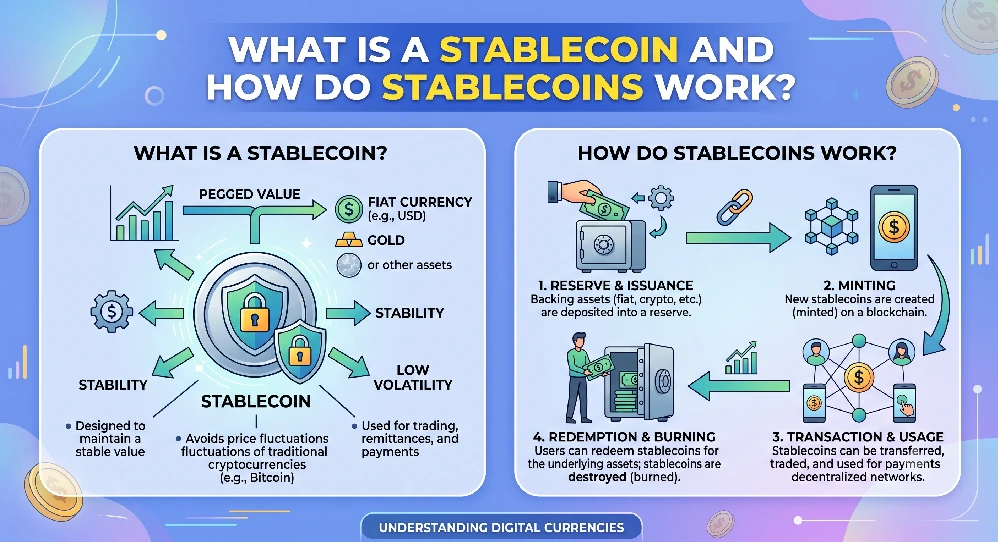
A stablecoin is a crypto asset created to maintain a relatively stable value compared with a reference asset.
The reference asset is often a national currency, such as the U.S. dollar. It can also be another asset, such as the euro or gold.
A simple example is a dollar-pegged stablecoin.
If the target is:
1 stablecoin = $1
the stablecoin system is designed to keep its market price close to that level.
This is different from Bitcoin.
Bitcoin does not have a fixed price target. Its market price changes according to buying and selling activity.
A stablecoin, by contrast, is designed around a stability mechanism.
The International Monetary Fund describes stablecoins as crypto assets that aim to maintain a stable value relative to a specified asset or group of assets.
Why Is It Called a “Stablecoin”?
The name comes from its main purpose.
Bitcoin can move from $60,000 to $65,000 or $55,000 as the market changes.
A dollar-pegged stablecoin is designed to stay much closer to $1.
This makes stablecoins useful when people want to move value on a blockchain without taking the same level of price risk that comes with holding a highly volatile crypto asset.
However, stable does not mean guaranteed.
A stablecoin can lose value if confidence falls, reserves are questioned, liquidity becomes difficult, or its stabilization system fails.
What Is a Stablecoin Peg?
A peg is the target relationship between a stablecoin and its reference asset.
For example:
1 USD-pegged stablecoin → target value of $1
If the stablecoin trades at:
$1.01
it is trading above its target.
If it trades at:
$0.99
it is trading below its target.
Small movements around the target can happen because stablecoins are traded in open markets.
The important point is that the system is designed to bring the price back toward the target.
The Federal Reserve explains that stablecoins use different stabilization mechanisms to maintain their intended value.
How Do Stablecoins Work?
The easiest way to understand a stablecoin is to follow the money and the token.
A basic stablecoin system can be viewed like this:
Backing → Minting → Circulation → Trading → Redemption → Burning
Not every stablecoin follows exactly this process. But this model helps explain how many reserve-backed stablecoins work.
Step 1: A Reference Asset Is Chosen
First, the stablecoin needs a value target.
For example:
U.S. dollar
The stablecoin is then designed to track that reference value.
Other stablecoins may track:
- The euro
- Gold
- Other currencies
- A basket of assets
- Another reference value
The U.S. dollar is especially important in the stablecoin market because many of the largest stablecoins are dollar-linked.
Step 2: Something Supports the Stablecoin
The next question is:
What gives the stablecoin its value?
This depends on its design.
A stablecoin may be supported by:
- Cash or cash-like assets
- Government securities
- Other traditional financial assets
- Crypto collateral
- Overcollateralized crypto assets
- Commodities
- Market mechanisms
- Algorithms
- A combination of mechanisms
This is one of the most important differences between stablecoins.
USDT, USDC, a crypto-backed stablecoin, and an algorithmic stablecoin should not be assumed to work in exactly the same way.
The IMF notes that fiat-backed stablecoins make up most of the stablecoin market and are generally backed by reserve assets.
Step 3: Stablecoins Are Minted
Minting means creating new stablecoin tokens.
Imagine a simple system where an eligible participant provides the required backing.
The system may then issue new stablecoins.
For a simplified example:
$1 of qualifying backing → 1 stablecoin minted
The actual process can be more complex, and the amount and type of backing depend on the stablecoin.
The new tokens can then enter circulation.
Step 4: Stablecoins Enter the Market
Once issued, stablecoins can be transferred between blockchain addresses.
People can use them for:
The tokens can move quickly from one blockchain address to another, depending on the network being used.
Step 5: Stablecoins Can Be Redeemed
Some stablecoin systems allow eligible holders or market participants to redeem tokens according to the issuer’s rules.
In a simplified example:
1 stablecoin → approximately $1 of backing
The exact process depends on the stablecoin, who is allowed to redeem directly, minimum amounts, fees, timing, and other rules.
Step 6: Tokens Can Be Burned
When stablecoins are redeemed, the corresponding tokens may be removed from circulation.
This is called burning.
So the basic cycle can look like:
Backing enters the system → stablecoins are minted
Then:
Stablecoins are redeemed → tokens are burned
This helps explain how supply can change as demand changes.
How Do Stablecoins Stay at $1?
This is the question at the heart of stablecoins.
A stablecoin does not stay near $1 simply because its name says “stable.”
Its design creates economic and technical mechanisms that can help keep its market price close to the target.
Four ideas are especially important:
reserves, redemption, arbitrage, and supply and demand.
How Reserves Help Maintain a Stablecoin’s Value
For a reserve-backed stablecoin, the backing assets are an important part of the system.
Imagine a simplified example.
A stablecoin has a target of:
1 token = $1
If the system has suitable assets supporting the tokens, users and market participants may have greater confidence that the stablecoin can maintain its target value.
But the quality of the backing matters.
It is not enough to simply say:
“The stablecoin is backed.”
You also need to ask:
- What assets are held?
- Who holds them?
- How liquid are they?
- Can they be sold when needed?
- How often are reserves reported?
- Who has the legal claim?
- Can holders redeem the stablecoin?
- Under what conditions?
These questions become especially important during periods of market stress.
How Redemption Helps Maintain the Peg
Redemption can create a link between the stablecoin and its reference asset.
Suppose a stablecoin is trading below its target.
For example:
Target = $1
Market price = $0.98
If market participants can buy the stablecoin for $0.98 and have a reliable way to redeem it for approximately $1, there may be an opportunity to make a small gain.
That can create buying demand.
As demand increases, the market price may move closer to $1.
However, this mechanism only works effectively when the redemption system, liquidity, access and backing support it.
How Arbitrage Helps Stablecoins Stay Near Their Peg
Arbitrage means trying to benefit from a price difference between markets or related assets.
Suppose a stablecoin is trading at:
$0.98
while its redeemable value is approximately:
$1
A market participant may buy the token at $0.98 and redeem it according to the stablecoin’s rules.
The potential difference creates an incentive to buy.
Now imagine the opposite.
The stablecoin trades at:
$1.02
Depending on the system, market participants may have an incentive to sell it or create new tokens and sell them.
This additional supply can put downward pressure on the market price.
These market forces can help pull the price toward the target.
But arbitrage is not magic.
If redemption becomes difficult or confidence disappears, the normal price-support process can weaken.
Supply and Demand Also Matter
Stablecoins are traded in markets.
Therefore, they still face supply and demand.
If many people suddenly want a stablecoin, its market price can move above its target.
If many people suddenly want to sell, its price can move below its target.
The stability mechanism is designed to reduce these movements and bring the price closer to its reference value.
That is why it is better to say:
A stablecoin is designed to maintain a stable value.
rather than:
A stablecoin always equals exactly $1.
What Are the Different Types of Stablecoins?
Stablecoins can be grouped according to how they try to maintain their value.
The main categories are:
- Fiat-backed stablecoins
- Crypto-backed stablecoins
- Commodity-backed stablecoins
- Algorithmic or uncollateralized stablecoins
These categories can sometimes overlap in practice, and individual projects can use different designs.
Fiat-Backed Stablecoins
Fiat-backed stablecoins are designed to maintain their value using reserves connected to traditional financial assets.
For a dollar-linked stablecoin, the backing may include assets such as cash, bank deposits, short-term government securities or other qualifying reserve assets, depending on the issuer and its structure.
The basic idea is:
Traditional financial assets → stablecoin backing → digital token
This is one of the most common stablecoin models.
The Bank of England explains that stablecoins can be backed by assets held by an issuer and highlights the importance of how those backing assets support the stablecoin’s value.
Crypto-Backed Stablecoins
Crypto-backed stablecoins use cryptocurrency as collateral.
This creates a different problem.
Crypto prices can move quickly.
If someone deposits $100 worth of crypto, that crypto might later be worth only $80.
Because of this risk, some crypto-backed systems require more collateral than the value of the stablecoins issued.
This is called overcollateralization.
A simplified example:
$150 of crypto collateral → $100 stablecoins
The extra collateral provides a buffer if the crypto market falls.
Smart contracts can monitor collateral and take action if the collateral level becomes too low.
Commodity-Backed Stablecoins
Some stablecoins are linked to commodities.
Gold is a common example.
The basic idea is:
Commodity → backing → digital token
The token may be designed to represent a claim linked to a certain amount of the commodity.
However, the details matter.
You should always check what the token actually represents, where the asset is held, who controls it, and what redemption rights exist.
Algorithmic Stablecoins
Algorithmic stablecoins attempt to maintain their target value through rules, supply changes, incentives or other automated mechanisms.
Some systems try to increase or reduce token supply when the market price moves away from its target.
The basic idea may look like:
Price too high → increase supply
Price too low → reduce supply or create incentives to buy
But algorithmic systems can be complex.
They can also be vulnerable when market confidence falls quickly.
A system that works during normal market conditions may behave very differently during a major market shock.
For that reason, algorithmic stablecoins should not automatically be treated as equivalent to reserve-backed stablecoins.
Stablecoin Example: How Does a Stablecoin Work in Real Life?
Let’s use a fictional example.
Imagine a stablecoin called USDX.
Its target is:
1 USDX = $1
Suppose an eligible participant provides $1 of qualifying backing.
The system creates:
1 USDX
That USDX can then move across the blockchain.
A user could use it to trade another crypto asset.
Another user could receive it as payment.
Someone else could deposit it into a DeFi application, depending on whether the application supports it.
Now suppose the holder wants to redeem it.
The simplified process becomes:
1 USDX → redemption → backing returned
The USDX is then removed from circulation.
Now imagine that USDX trades at $0.98.
If the redemption system is working and accessible, the difference between the market price and the redemption value may attract buyers.
That is one of the ways market forces can help restore the peg.
The important lesson is that the token’s stability comes from the entire system, not simply from the token itself.
What Is Stablecoin Minting?
Minting means creating new stablecoin tokens.
It increases the supply of the stablecoin.
A simple model is:
Backing added → new tokens created
For some stablecoins, only certain participants can mint tokens directly.
For others, smart contracts can handle the process automatically.
The exact rules depend on the stablecoin.
What Is Stablecoin Burning?
Burning means permanently removing tokens from circulation.
A simple example is:
Stablecoin redeemed → token burned
This can reduce the circulating supply.
Minting and burning are therefore important parts of many stablecoin systems.
They allow the supply of tokens to change as users enter or leave the system.
What Happens When a Stablecoin Loses Its Peg?
A stablecoin depeg happens when its market price moves away from its intended reference value.
For a dollar-pegged stablecoin:
Target = $1
A price of:
$0.995
is a small deviation.
A price of:
$0.90
would represent a much larger deviation.
A serious depeg can become a major problem if it continues or confidence in the system falls sharply.
Why Do Stablecoins Depeg?
There is no single reason.
A stablecoin can move away from its target because of:
- Sudden selling
- Market panic
- Liquidity problems
- Questions about reserves
- Problems with redemption
- Problems with collateral
- Smart contract failures
- Issuer problems
- Counterparty risk
- Banking or custody problems
- Extreme market conditions
The Federal Reserve has highlighted how concerns about a stablecoin’s backing or ability to meet redemptions can contribute to rapid selling and stress.
Can a Stablecoin Recover Its Peg?
Sometimes a stablecoin can return toward its target.
But recovery is not guaranteed.
It depends on several factors:
- Quality of the backing
- Liquidity
- Redemption access
- Market confidence
- The design of the stablecoin
- The size of the selling pressure
- The condition of the broader crypto market
This is why investors should never assume that a stablecoin will automatically return to $1.
What Are Stablecoins Used For?
Stablecoins have become an important part of the crypto market because they provide a digital asset that is designed to have lower price volatility than many other cryptocurrencies.
Stablecoins for Crypto Trading
Stablecoins are widely used in crypto trading.
A trader can move between:
BTC → stablecoin
instead of immediately converting the position into traditional bank money.
Stablecoin trading pairs are common across crypto markets.
Stablecoins for Payments
Stablecoins can be transferred using blockchain networks.
This makes them potentially useful for digital payments, depending on the network, fees, local rules and acceptance.
Stablecoins for Cross-Border Transfers
Stablecoins can also be used to transfer value across countries.
This is one reason governments, banks and financial institutions are paying more attention to them.
But actual use depends on regulation, liquidity, banking access and local financial systems.
Stablecoins in DeFi
Stablecoins are also widely used in decentralized finance, commonly called DeFi.
They can be used for:
- Lending
- Borrowing
- Liquidity pools
- Trading
- Yield strategies
- Collateral
Because their target value is more stable than many crypto assets, they can serve as an important building block inside DeFi applications.
Why Are Stablecoins Important?
Stablecoins connect traditional money concepts with blockchain technology.
A stablecoin can offer some features associated with blockchain:
- Digital transfer
- Programmable transactions
- Global reach
- 24/7 network availability
- Integration with smart contracts
while attempting to maintain a value linked to a more stable reference asset.
This combination is one reason stablecoins have become important in crypto.
The debate is also expanding beyond crypto trading. Policymakers and financial institutions are increasingly looking at stablecoins as possible payment tools and at the risks they could create for the wider financial system.
Are Stablecoins Safe?
The short answer is:
Stablecoins can be useful, but they are not risk-free.
The word “stable” describes the goal of the asset. It does not remove every financial, technical or operational risk.
Before using a stablecoin, it is useful to understand several different risks.
Reserve Risk
If a stablecoin depends on reserves, the quality of those reserves matters.
Important questions include:
- What assets are held?
- How liquid are they?
- Who controls them?
- How are they reported?
- Can they be accessed during market stress?
A reserve-backed stablecoin is only as strong as the system supporting those reserves.
Issuer Risk
Some stablecoins depend on a company or other organization.
This creates issuer risk.
Users may need to consider:
- Who issues the token?
- What legal rights do holders have?
- How does redemption work?
- Where are assets held?
- What happens if the issuer faces financial problems?
Redemption Risk
A stablecoin may trade close to $1 in normal conditions.
But during a crisis, the important question becomes:
Can holders actually redeem it under the stated rules?
Redemption terms can vary significantly between stablecoins.
Depeg Risk
A stablecoin can move away from its target.
This is one of the most obvious risks.
A token intended to track $1 could trade at:
$0.98
$0.95
or even lower during severe stress.
The size and duration of the deviation matter.
Smart Contract Risk
Crypto-backed and DeFi-based stablecoins may rely heavily on smart contracts.
A coding error, exploit or unexpected market condition can affect the system.
This is why technical design matters.
Regulatory Risk
Stablecoin rules differ across countries.
Governments and regulators are increasingly focusing on stablecoin supervision and compliance under global crypto regulations.
- Reserve requirements
- Issuer rules
- Redemption rights
- Consumer protection
- Financial stability
- Payments
- Anti-money-laundering controls
Therefore, the legal treatment of a stablecoin can depend on where you live and how the stablecoin is used.
Counterparty and Custody Risk
A stablecoin can depend on banks, custodians, reserve managers, blockchain infrastructure or other external parties.
Problems with one part of this chain can affect the wider system.
This is especially important for users who assume that “on-chain” automatically means that every part of the stablecoin system is decentralized.
It may not be.
Stablecoin vs Bitcoin
The easiest way to understand the difference is to look at their goals.
| Feature | Stablecoin | Bitcoin |
|---|---|---|
| Main goal | Maintain a relatively stable value | Digital scarcity and decentralized money |
| Price target | Usually linked to another asset | No fixed target |
| Volatility | Designed to be lower | Can be high |
| Backing | Depends on the stablecoin | No traditional reserve backing |
| Blockchain | Yes | Yes |
| Common uses | Trading, payments, DeFi, transfers | Investment, payments and holding |
| Peg | Usually has one | No |
The biggest difference is simple:
Bitcoin is not designed to stay at $1. A dollar stablecoin is.
Stablecoin vs Fiat Money
A stablecoin may represent a value linked to a national currency, but it is not automatically the same thing as holding that currency in a bank account.
For example:
$1 in a bank account
and
1 dollar-pegged stablecoin
can have very different legal and financial structures.
A bank deposit is generally a claim against a bank.
A stablecoin may represent a claim connected to its issuer or its underlying system.
The exact rights depend on the stablecoin and its legal structure.
The Sveriges Riksbank notes that stablecoin holders can have a claim on the issuer and stresses the importance of sufficient liquid assets for redemption.
Why “Stable” Does Not Mean Risk-Free
This is one of the most important lessons for a beginner.
There are four different ideas that should not be mixed together:
Price stability
means the token is designed to keep its market value close to a target.
Issuer solvency
means the organization behind the stablecoin can meet its obligations.
Reserve quality
means the backing assets are suitable and available as intended.
Redemption certainty
means users can actually redeem their tokens according to the applicable rules.
A stablecoin can be designed to be stable while still carrying risks in one or more of these areas.
That is why researching the mechanism is more useful than simply looking at the word “stable.”
Why Stablecoins Matter in 2026
Stablecoins are no longer discussed only as a tool for crypto traders.
Their possible role in payments and financial infrastructure is receiving growing attention around the world.
In September 2026, Reuters reported that a group of major banks, including Goldman Sachs, Bank of America, Citi and Deutsche Bank, planned to create a company to issue a U.S.-dollar stablecoin, showing how traditional financial institutions are increasingly exploring the area.
At the same time, central banks and international financial institutions continue to examine the risks and benefits of stablecoins.
This creates a broader question:
Can stablecoins become part of mainstream payment and financial systems?
That question is still being debated.
For a beginner, however, the most important point remains the same:
A stablecoin is a crypto asset designed around a stability mechanism.
Understanding that mechanism is more important than simply memorizing the names of different stablecoins.
How to Understand Any Stablecoin Before Using It
When you come across a new stablecoin, do not start with its price alone.
Ask these questions:
What Is It Pegged To?
Is it linked to:
- USD?
- EUR?
- Gold?
- Another asset?
What Backs It?
Find out whether it uses:
- Fiat reserves
- Government securities
- Crypto collateral
- Commodities
- Algorithms
- Other assets
How Is It Minted?
Understand who can create new tokens and what is required.
How Is It Redeemed?
Find out how holders can exchange the token for its reference value or backing.
What Happens During a Depeg?
Look at the system’s response when the market price moves away from its target.
Who Controls the System?
Determine whether it is controlled by:
- A company
- A decentralized protocol
- Smart contracts
- A combination of these
What Are the Main Risks?
Look beyond the price chart.
Check:
- Reserve risk
- Issuer risk
- Liquidity risk
- Redemption risk
- Smart contract risk
- Depeg risk
- Regulatory risk
This simple checklist can help a beginner understand a stablecoin before using it.
The Stablecoin System in One Simple Picture
The entire concept can be reduced to a simple flow:
Reference asset
↓
Backing or stabilization mechanism
↓
Stablecoin is created
↓
Token enters circulation
↓
Users trade, transfer or use it
↓
Market price moves around the target
↓
Stabilization mechanisms attempt to bring it back
↓
Users may redeem
↓
Tokens are burned or removed from circulation
This is the basic idea behind many stablecoin systems.
The details can be much more complex, but the basic concept does not need to be.
Stablecoins in Simple Words
If you remember only one thing from this guide, remember this:
A stablecoin is a crypto asset designed to keep its value relatively stable against another asset.
Most commonly, that reference is the U.S. dollar.
The way it tries to stay stable depends on its design.
Some use traditional reserves.
Some use crypto collateral.
Some use commodities.
Some use algorithms and market incentives.
The system can involve minting, burning, redemption, reserves, collateral and arbitrage.
And despite the word “stable,” stablecoins can still lose their peg and carry financial, technical, operational and regulatory risks.
So the right question is not simply:
“Is this a stablecoin?”
The better question is:
“How does this stablecoin create and maintain stability?”
Once you understand that question, stablecoins become much easier to understand.
Bottom Line: What You Need to Know About Stablecoins
A stablecoin is a crypto asset designed to maintain a stable value, usually against the U.S. dollar. But stablecoins do not all work in the same way.
Some stablecoins use fiat reserves, while others use crypto collateral, commodities, algorithms, or market-based mechanisms. Their systems may use minting, burning, redemption, reserves, and arbitrage to keep the price close to its target.
The key point is simple: a stablecoin is designed to be stable, but it is not risk-free. Stablecoins can lose their peg because of liquidity problems, reserve concerns, market panic, issuer issues, smart contract failures, or other risks.
Before using any stablecoin, ask five basic questions:
What is it pegged to? What backs it? How does it maintain its value? How does redemption work? What could make it depeg?
Once you understand these five points, you can better understand how stablecoins work, why stablecoins are important, and what risks stablecoins carry.
In crypto, “stable” is the goal—not a guarantee.