The Hidden Threat: How AI is Changing the Game for Cybersecurity and Fraud in 2026
Welcome to zenvestai.com! In today’s world, technology moves at lightning speed.
It brings amazing tools into our daily lives. However, it also creates new, hidden risks.
This article explores how artificial intelligence is changing the game for cybersecurity and fraud in 2026.
What is AI and What Can It Do in Cybersecurity?
To begin with, Artificial Intelligence (AI) is the ability of computer systems to mimic human intelligence.
It allows machines to learn, reason, and solve complex problems.
Nowadays, advanced AI models like GPT-5, Gemini 2.0 Ultra, and Claude 4 can process massive amounts of data in seconds.
In cybersecurity, these models act as a tireless, 24/7 automated shield.
- Instant Threat Detection: AI scans entire corporate networks constantly.
- Pattern Recognition: It looks for unusual system behaviors.
- Automated Response: For example, it can isolate a virus before a human engineer even notices the breach.
Consequently, AI makes digital defense faster and more efficient than ever before.
Ready It
What is Cybersecurity and How It Affects Our Daily Life
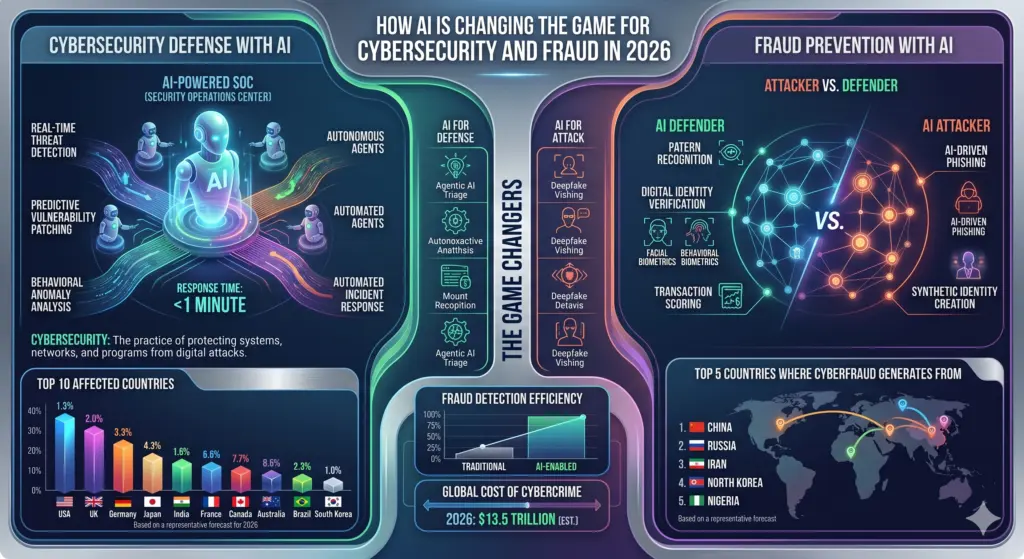
Cybersecurity is the practice of protecting systems, networks, and programs from digital attacks.
It deeply affects our daily lives because almost everything is connected to the internet.
In today’s world, we rely on digital banking, online medical portals, and smart home devices.
If these systems are hacked, daily life stops.
For instance, a single data breach can leak your private identity or crash a city’s power grid.
Therefore, cybersecurity is no longer just an IT problem.
It is a daily necessity for global safety.
What is Cyberfraud and the Top 10 Affected Countries
Cyberfraud is any dishonest scheme that uses the internet to steal money, data, or identity.
In 2026, global cyberfraud losses have reached a shocking $450 billion.
Some countries suffer much more than others due to high digital adoption rates.
Below is the latest data showing the top 10 countries most affected by cyberfraud:
| Rank | Country | Primary Area of Impact |
| 1 | United States | Ransomware & Corporate Identity Theft |
| 2 | United Kingdom | Personal Phishing & Bank Scams |
| 3 | India | Mobile Payment & UPI Fraud |
| 4 | Brazil | Mobile Banking Malware |
| 5 | Canada | Fake Investment & Crypto Scams |
| 6 | Germany | Industrial Espionage & Data Theft |
| 7 | Australia | Social Engineering & Phishing |
| 8 | France | E-commerce & Shopping Fraud |
| 9 | South Africa | Business Email Compromise (BEC) |
| 10 | Japan | Tech Support & Elderly Scams |
Explore It
How AI is Changing the Game for Cybersecurity and Fraud
In 2026, AI is a double-edged sword.
It is completely changing the game for both hackers and security teams.
The Hacker’s Side
Criminals now use AI to automate their scams.
In the past, hackers spent hours writing a single fake email.
They often made spelling mistakes.
Today, AI helps them write perfect, highly personalized phishing messages in seconds.
What’s more, they use polymorphic malware. This is a type of virus that changes its digital code every time it attacks to bypass traditional firewalls.
The Defender’s Side
On the other hand, security systems use AI to predict attacks.
In coming years, we will see fully autonomous networks.
These systems will find their own weaknesses and patch them before hackers can exploit them.
How Humans Have Failed in Preventing This Fraud
Initially, human eyes were enough to spot fraud.
Today, however, human defenses are failing against AI threats.
First, the speed of AI attacks is too fast for humans to handle.
Second, security workers suffer from alert fatigue. They have to review thousands of digital alerts every day, and as a result, they miss critical threats.
Finally, humans are naturally trusting.
AI creates perfect deepfake voices and videos that trick our emotions.
Because of this psychological manipulation, human judgment alone is no longer enough to stop modern fraud.
Top 5 Countries Where Cyberfraud Generates From
Cyberfraud is a global industry, but certain regions host the majority of these operations.
Significantly, the latest 2026 data shows the top 5 countries where most cyberfraud originates:
- Russia: The global hub for advanced ransomware syndicates and state-sponsored hacking groups.
- China: Deeply involved in large-scale corporate data theft and intellectual property espionage.
- Nigeria: Highly active in complex Business Email Compromise (BEC) and romance fraud.
- North Korea: Focuses heavily on cryptocurrency exchange hacks to fund state operations.
- Brazil: A rapidly growing source for banking trojans and automated financial malware.
More On
Main Types of Cyberfraud in 2026
- Deepfake Voice Impersonation: Scammers clone the voice of a boss or a family member using a short audio clip. They then call you and demand an urgent money transfer.
- Synthetic Identity Fraud: AI mixes real and fake data to create completely new, fake profiles. Fraudsters use these to open bank accounts and take out loans.
- AI-Powered Phishing: Automated systems send millions of error-free emails tailored specifically to your hobbies and job.
- Ransomware-as-a-Service (RaaS): Criminal networks lease out AI hacking tools to amateur scammers for a share of the profit.
How AI is Handling This Fraud and What the Future Holds
Indeed, defensive AI is stepping up to fight back.
Security platforms now use behavioral analytics to monitor accounts.
For example, if you log into your bank from India, and five minutes later a login attempt occurs from Canada, the AI blocks it instantly. It does not wait for a human to check.
In the future, security will be completely predictive.
AI will simulate millions of hacking scenarios every minute.
It will secure systems before a criminal even writes the malicious code.
How We Can Be Aware to Stop Cyberfraud
Above all, awareness is your best shield against digital crime.
You can protect yourself by building a few simple habits:
- Be Skeptical of Urgency: Scammers want you to panic. If a message demands urgent money, stop and think.
- Verify via a Second Source: Did your boss text you to buy gift cards? Call them directly on their known phone number to verify.
- Use Strong Multi-Factor Authentication (MFA): Always enable MFA on your accounts. Use authenticator apps instead of SMS codes, as SMS can be intercepted.
- Keep Software Updated: Turn on automatic updates. These updates contain critical security patches that block the latest AI malware.
Conclusion
In conclusion, AI is shaping a complex digital landscape in 2026.
It gives bad actors scary new tools, but it also gives defenders unmatched power.
To wrap up, staying safe requires both smart technology and personal caution.
“Technology is a useful servant but a dangerous master. In the age of AI, your skepticism is your ultimate shield.”

Leave a Reply