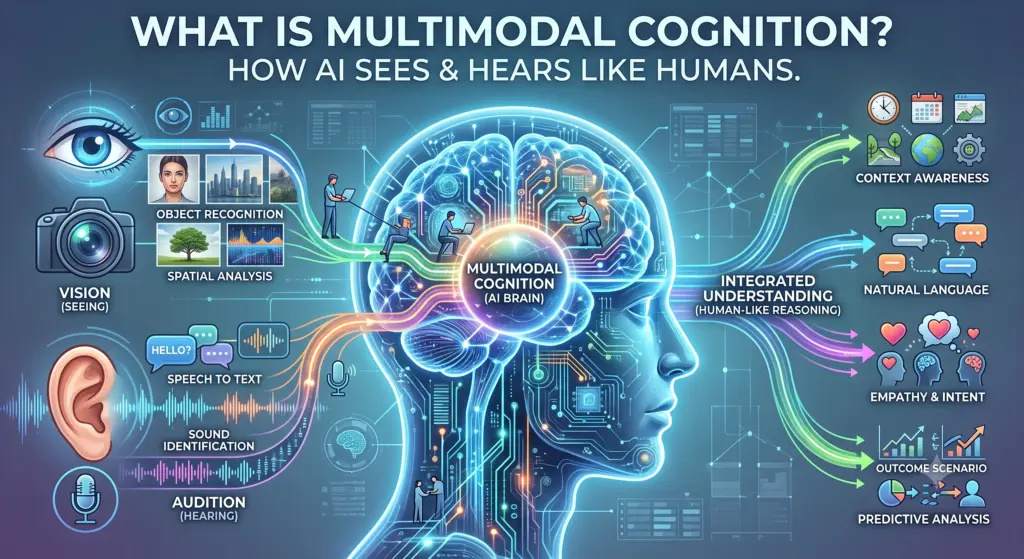
What is Multimodal Cognition? How AI Sees & Hears Like Humans
Back when I was managing a rural bank branch, deciphering faded, handwritten deposit slips and endless stacks of paperwork was a daily challenge.
We relied entirely on our own eyes and experience to make sense of the mess.
Not long ago, I decided to put a new AI tool to the test by uploading a photo of a similarly chaotic, handwritten financial calculation from my own desk.
I fully expected the machine to output pure gibberish.
To my absolute amazement, the AI didn’t just transcribe the scribbled numbers—it analyzed the entire context, recognized it as a budget projection, and even caught a minor addition mistake I had made!
That was the exact moment it clicked for me: artificial intelligence had evolved far beyond simple text. It was truly beginning to ‘see’ and ‘reason’ just like we do.
How exactly does a computer learn to experience the world like a real person?
Welcome to our guide on What is Multimodal Cognition? How AI Sees & Hears Like Humans, where we break down the magic behind machines that can read, look, and listen all at once. 🧠
Today, we are exploring a breakthrough concept that is changing technology forever.
Let’s dive into how machines are moving beyond simple text to understand our complex, messy world.
In this post, we will cover the core definition of this technology, the gap between human and machine reasoning, everyday challenges, real-world applications, and how to optimize for voice search.
Multimodal cognition in artificial intelligence is the ability of a machine learning system to simultaneously process, integrate, and analyze multiple data types—such as text, audio, images, and video.
By combining these diverse inputs, advanced neural networks can achieve a deeper, more contextual understanding of complex environments.
This bridges the gap between natural language processing and computer vision.
While models excel at basic sensory fusion, they still struggle with intuitive physics and human psychology.
Ultimately, this technology aims to replicate human-like perception and interaction.
Read It
What is Multimodal Cognition?
What does multimodal cognition mean in AI?
To begin with, it is the ability of a system to understand different types of data at the same time.
Humans naturally use sight, sound, and touch to make sense of their environment.
Similarly, advanced neural networks try to copy this exact process to build a complete picture.
Data integration allows machines to mix text, images, and auditory inputs together seamlessly.
In fact, this blending of data is what makes modern computer vision and semantic processing so powerful.
Think of data fusion like a master chef perfecting a complex dish.
A great chef doesn’t just stare at a written recipe to know if a curry is ready.
They read the recipe instructions (text), look at the color of the simmering gravy (visual), and taste the spices (sensory) all at the exact same time.
If the dish looks too thin but tastes perfectly salted, the chef instantly combines those different senses to know exactly what to do next.
Multimodal AI does the exact same thing.
Instead of just reading data or looking at an image in isolation, it blends multiple inputs together to truly ‘understand’ the whole recipe.
Key Features of Multimodal Systems
Why do these systems need to blend different senses to work properly?
The core features of these advanced cognitive engines revolve around sensor fusion and human-like processing. 👁️
Machines use deep learning architecture to connect the dots between a visual picture and a written sentence.
For instance, if you show an algorithm a picture of a dog and ask a question about it, it uses cross-modal reasoning to give you the right answer.
True machine comprehension requires seamless integration of visual and textual data.
| Feature | Description | Benefit |
| Data Fusion | Combining text, audio, and images. | Gives a complete context of a situation. |
| Cross-modal Reasoning | Using one data type to explain another. | Helps the system answer questions about pictures. |
| Human-Like Emulation | Copying human thought patterns. | Makes interactions feel natural and intuitive. |
Consider how we evaluate the health of a local business.
You don’t just stare at a spreadsheet of raw numbers to make a final judgment.
You listen to the owner’s tone of voice during a meeting (audio), read their financial reports (text), and physically look at how busy their storefront is (visual).
Your brain naturally fuses all these different inputs to get the true picture of the business.
For decades, computers could only look at the spreadsheet. Today, multimodal cognition allows AI to ‘visit the storefront’ and ‘listen to the owner’ at the exact same time.
The Gap in Human-Like Reasoning
Why do AI models struggle with complex visual reasoning despite their immense computational power?
Even though a system can identify a ball in a picture, it does not truly understand gravity.
Because of this, it fails at tasks requiring intuitive physics and common sense.
Current neural models lack an intuitive understanding of physics and human psychology.
On the other hand, a human toddler easily knows that a glass will break if dropped.
Yet, a machine might struggle to predict that outcome from a simple photo.
Furthermore, understanding human emotions remains a massive hurdle.
Therefore, researchers are working hard to close this gap.
Explore It
What is Artificial General Intelligence (AGI)? A Simple Guide
Challenges Facing the Industry Today
What are the biggest roadblocks in developing perfect cognitive computing?
Firstly, training these massive networks requires huge amounts of raw data and computing energy.
Secondly, teaching a computer “common sense” is incredibly difficult.
While they can handle basic pattern recognition, they get confused by optical illusions or complex social situations.
Another point is the difficulty of processing real-time video perfectly.
Sometimes, the spoken words do not match the transcript, or the image is blurry.
Consequently, the program makes a wrong guess.
Overcoming these processing errors is essential for the future of safe technology development.
Nevertheless, scientists are making slow but steady progress every single day.
Real-World Applications
“In the end, artificial intelligence is about enabling machines to adapt and understand the world as we do.” — Demis Hassabis, CEO of Google DeepMind
How is multimodal AI used in real life to solve everyday problems?
For example, in the education sector, these tools create enhanced learning environments.
By mixing interactive videos, spoken words, and written text, students can learn much faster.
Integrating different modes of representation improves comprehension and memory retention.
In today’s world, healthcare is also benefiting from this sensor fusion.
Doctors use programs that can scan patient notes and look at X-rays at the same time.
As a result, the tool can suggest better treatment plans.
Additionally, smart chatbots can now look at a screenshot you upload and read your complaint to fix your software issue instantly.
How do smart speakers use blended data to answer our spoken questions?
Voice search optimization is an area where this technology truly shines. 🗣️ When you ask your digital assistant a query, it uses contextual understanding to find the best response. People speak much differently than they type. Because of this, algorithms must understand casual speech, slang, and even voice tone to work correctly. True voice search optimization requires AI to interpret human intent, not just raw text.
- User Question: “Hey, what is multimodal AI?”
- Voice Search Answer: “Multimodal AI is a type of artificial intelligence that can understand and combine different types of information, like text, images, and sounds, just like a human brain does.”
Why does content structure matter for these digital assistants? By formatting facts clearly, search engines can easily parse your definitions. Thus, when someone scans the internet for a quick answer, the algorithm can pull the most accurate information immediately. For instance, using short paragraphs and bullet points helps Large Language Models (LLMs) read your site better. Consequently, your website becomes the top source for smart speaker answers. Structuring data perfectly ensures your content is chosen by voice assistants every single time.quick answer, the platform can pull the most accurate information immediately.
Conclusion
“Our intelligence is what makes us human, and AI is an extension of that quality.” — Yann LeCun, Chief AI Scientist at Meta
What does the future hold for machines that can see, hear, and read? In conclusion, the journey toward true machine understanding is just beginning. 🚀
We have explored how sensor fusion combines visual recognition, language parsing, and deep learning. Above all, it aims to make technology more helpful and human-like.
Overall, while there are still challenges in teaching machines intuitive physics and common sense, the progress is undeniable.
Finally, as these tools grow smarter, they will continue to transform education, healthcare, and our daily lives.
To sum up, the future of this field is not just about reading text; it is about experiencing the world just like we do.

Leave a Reply