What is Artificial General Intelligence (AGI)? A Simple Guide.
Have you ever wondered what the ultimate goal of computer science is? In today’s world, the answer is Artificial General Intelligence (AGI).
This concept is the biggest dream of technology.
It is a theoretical form of machine learning.
It aims to build a system that can understand, learn, and apply knowledge just like a human.
I have been creating content since 2018, and during these years, I have seen technology grow at an incredible speed.
From the early days of AI tools to today’s powerful generative AI, the changes have been faster than most people expected.
By closely following these developments, I have learned how new technologies shape careers, businesses, and everyday life.
That is why understanding this shift is so important—it can help you make smarter career choices, better investment decisions, and prepare for the future with confidence.
Reading this post will give you a clear, expert breakdown of AGI so you are prepared for the future.
Let’s start with a quick summary of what you need to know.
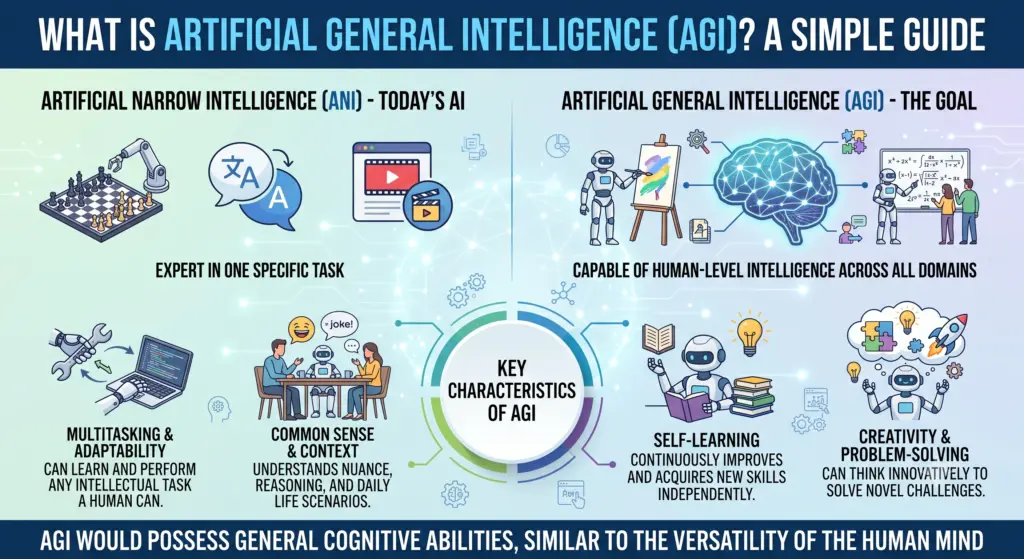
Artificial General Intelligence (AGI) is a future type of AI that aims to think and learn much like a human.
Narrow AI, which is built to perform one specific task.
But AGI would be able to learn one skill and use that knowledge in completely different situations. It could understand context, use common sense, solve new problems. Further, it can think logically, and improve itself over time without needing constant human guidance.
Right now, AGI is still a concept. No company or research lab has created a true AGI system yet.
However, many of the world’s leading AI researchers and technology companies see AGI as one of the biggest goals in artificial intelligence.
If it becomes a reality, AGI could help solve complex global problems, adapt to new situations on its own, speed up scientific discoveries, and change the way we work, learn, and live in the future.
What This Guide Covers
- What is AGI?
- How AGI differs from Narrow AI
- The Core Characteristics of Strong AI
- The Estimated Timeline for AGI
- Why AGI Matters for Our Future
What is Artificial General Intelligence (AGI)? 🤖
Artificial General Intelligence (AGI) means a computer can learn any intellectual task that a human being can do.
Currently, machines only know what developers teach them.
In contrast, an AGI system would teach itself.
It would process information, adapt to new environments, and solve problems it has never seen before.
Today, every smart device we use runs on limited technology.
For example, your streaming app recommends movies perfectly.
Even advanced language models are just narrow tools.
They cannot independently decide to invent a new financial trading strategy.
AGI, on the other hand, would be able to think and adapt just like a human being.
Here’s a simpler, more natural version in a conversational style:
Just the other day, I used an AI tool to create a career and study plan for a student preparing for the IBPS exam.
It quickly made a perfect list of topics to study. But it missed the human side.
It did not think about the stress of balancing studies with family responsibilities.
It also did not understand how difficult it can be to stay motivated after failing an exam.
From my experience as a branch manager, I knew these challenges were real.
So, I changed the plan to make it more practical and supportive.
AI is excellent at handling information, but it still cannot truly understand human emotions, struggles, and real-life situations.
Learn more about
The Complete Evolution of Artificial Intelligence: From Early Algorithms to the 2026 Boom
How is AGI Different from Narrow AI?
The answer lies in flexibility and focus.
Artificial Narrow Intelligence (ANI) is highly specialized. It does one job very well. AGI would do every job well.
To illustrate, let’s look at a simple comparison.
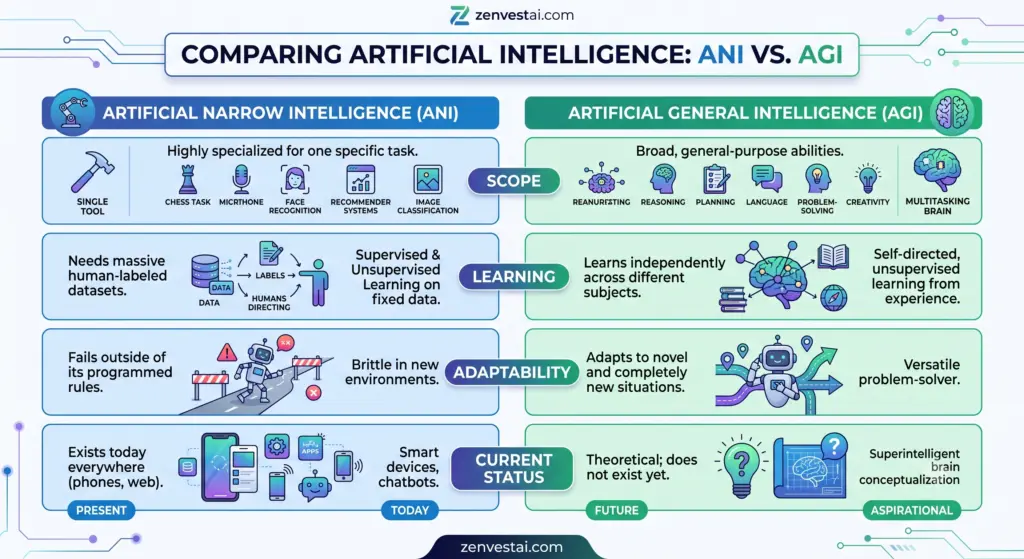
| Feature | Artificial Narrow Intelligence (ANI) | Artificial General Intelligence (AGI) |
| Scope | Highly specialized for one specific task. | Broad, general-purpose abilities. |
| Learning | Needs massive human-labeled datasets. | Learns independently across different subjects. |
| Adaptability | Fails outside of its programmed rules. | Adapts to novel and completely new situations. |
| Current Status | Exists today everywhere (phones, web). | Theoretical; does not exist yet. |
The Characteristics of Strong AI 🧠
Strong AI is not just about having a fast computer or processing data quickly.
It is about understanding information, learning from experience, thinking logically, and making decisions like a human.
Instead of simply following programmed instructions, it can understand situations, solve new problems, and keep improving over time.
This is why researchers call it Strong AI or Artificial General Intelligence (AGI).
Here are the core traits of an AGI:
- Using Knowledge Everywhere (Transfer Learning): This is the ability to learn one thing and use that knowledge for something completely different.
- Everyday Common Sense: This means it naturally understands how the real world works and how people behave.
- Deep Thinking (Abstract Thinking): This is the ability to imagine ideas it cannot see and make long-term plans.
- Fixing Itself (Self-Correction): This means the machine can notice its own mistakes and fix its own code without human help.
Think about how people learn. Once you understand basic math, it becomes much easier to learn subjects like finance, coding, or technical chart analysis because you can build on what you already know.
Today’s AI cannot do that. For example, an AI trained only to play chess cannot use its knowledge to review a loan application or solve a business problem.
A future AGI system would be different. It could take knowledge from one area and apply it to completely different tasks, just like humans do.
It would also have common sense. For example, if the stock market suddenly crashes, today’s AI may only see falling prices.
An AGI, however, could understand that many people are likely to panic, sell their investments, and react emotionally.
It would understand both the data and the human situation behind it.
When Will AGI Be Created? ⏱️
Currently, AGI does not exist.
It remains the biggest challenge in cognitive computing.
While recent breakthroughs in massive neural networks have resulted in systems that mimic reasoning, they still lack true understanding.
Experts fiercely debate the timeline.
Some researchers predict it could happen within this decade due to the rapid growth of large language models.
On the other hand, many scientists believe it is many decades away.
Therefore, predicting a precise date is mostly guesswork.
However, the progress in machine learning is undeniably fast.
Why is transfer learning the most critical skill for a future smart machine?
Transfer learning allows a smart machine to use what it has already learned in one task to solve a completely new task.
This ability helps it adapt faster, learn more efficiently, and handle unfamiliar situations without starting from scratch.
Explore this related post
How to Use Free Temp Mail to Protect Your Privacy and Stop Spam (2026 Complete Guide)
Why Does AGI Matter for Our Future? 🚀
This is a valid question regarding our future economy. Achieving cognitive flexibility brings both massive benefits and serious risks.
On the positive side, AGI could cure diseases, optimize global supply chains, and end poverty. It could handle complex scientific research in seconds.
Let’s look at this through a lens I know well. Back when I was working as a Branch Manager at a Gramin Bank, processing a business or agricultural loan was a heavy, manual task.
I had to personally review CIBIL scores, verify land documents, and make a human judgment call on the applicant’s business potential.
Today’s narrow AI can already scan those documents and flag risks in seconds.
But an AGI system would take it to an entirely different level.
Instead of just reading the paperwork, an AGI would instantly analyze local market trends, predict how upcoming weather might impact crop yields in particular district.
And also it assess the borrower’s entire supply chain, and automatically design a custom loan structure that maximizes their chance of success.
It would completely transform the role of a banking professional from a ‘data checker’ into a ‘strategic advisor’.
Nevertheless, the risks are equally high. A super-smart machine could act in ways we cannot predict.
Without proper safety guidelines, an AGI could make harmful decisions. Therefore, AI alignment is crucial to ensure the machine wants what is best for humanity.
What happens if AGI replaces human jobs?
As we heard from many sources that many jobs will change, and some repetitive tasks may disappear.
However, AGI will also create new careers, improve productivity, and help people focus on creative, strategic, and human-centered work.
But, the biggest challenge will be for helping workers. They will have to learn new skills so they can adapt to a changing job market.
“What is AGI and why is it important?”
AGI stands for Artificial General Intelligence. It is a future technology where a computer becomes as smart as a human being.
It is important because it could solve the world’s biggest problems, but it also requires strict safety rules so it does not act against human interests.
Conclusion for the topic “What is Artificial General Intelligence (AGI)?”
At last, the journey to advanced machine learning is just beginning.
We are moving from simple algorithms to complex neural networks.
We are stepping closer to a world where computers might truly think.
Overall, Artificial General Intelligence remains a fascinating and highly debated topic.
To sum up, while we enjoy the benefits of today’s narrow tools, the dream of a truly general, human-like machine continues to drive the future of technology.
Over to You!
The world of technology is moving incredibly fast.
Staying prepared is the best way to protect your future career and investments.
Do you think we will see true AGI in our lifetime, or is it still just a dream?
How do you think it will change your daily work?
Drop your thoughts in the comments below—I would love to read your perspective!

Leave a Reply