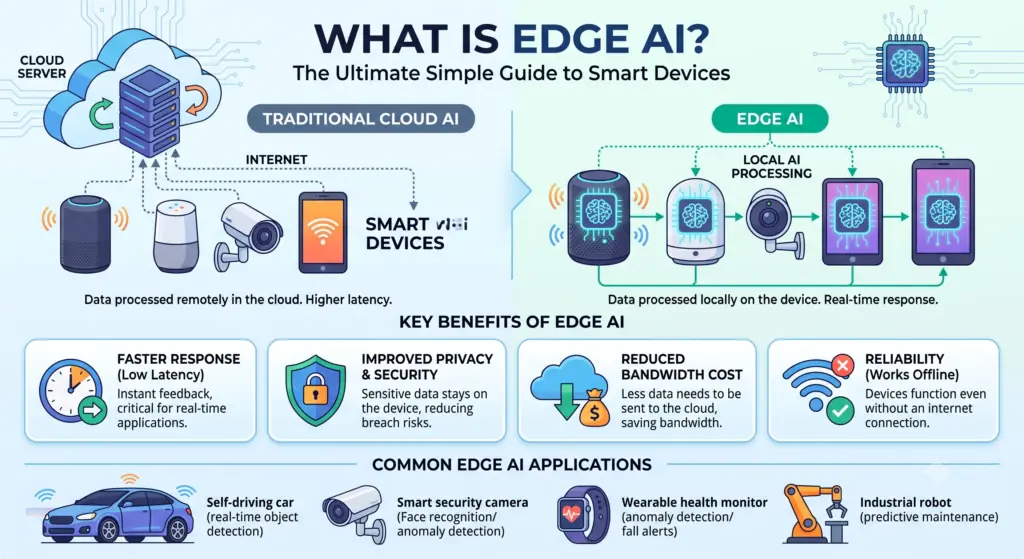
What Is Edge AI? The Ultimate Simple Guide to Smart Devices
Welcome to What Is Edge AI? The Ultimate Simple Guide to Smart Devices. Are you tired of smart devices lagging because of slow internet connections?
In today’s world, sending your private data to a faraway data center is becoming obsolete and risky.
Instead, Edge AI is a breakthrough technology that lets your gadgets think instantly on their own.
You should read this entire post to understand how this shift protects your sensitive financial data.
It also boosts business operations, and fundamentally changes the hardware we use daily.
So, let’s dive in…
What is Edge AI and how does it work?
Edge AI means AI works directly on your device, instead of sending your data to a distant internet server (called the cloud) for processing.
For example, your smartphone, smartwatch, security camera, or factory sensor can make decisions on their own using a special AI chip built inside the device.
These AI chips, often called Neural Processing Units (NPUs), are designed to run AI tasks very quickly while using less battery power.
Because everything happens on the device, you get results almost instantly. Even if there is no internet connection, many AI features continue to work.
Another big advantage is privacy. Since your photos, voice recordings, and other personal data do not need to be sent to the cloud, your information stays more secure. It also reduces internet data usage because less information needs to travel over the network.
In simple words, Edge AI puts the power of artificial intelligence directly into your hands, making devices faster, smarter, more private, and capable of working even when they are offline.
What This Post Covers
- The core differences between Cloud AI and decentralized intelligence.
- How on-device machine learning works securely.
- Why local processing is crucial for modern businesses.
- Real-world applications from regional manufacturing to banking.
- The specific silicon chips powering these advancements.
Understanding the Shift from Cloud to Local
Let’s understand this with a simple example.
Imagine you have a question. With Cloud AI, it’s like sending your question in a letter to someone living far away.
You have to wait for them to receive it, find the answer, and send it back.
This takes time, and you also need an internet connection.
Now think about Edge AI. It’s like having a smart teacher sitting right beside you.
You ask a question, and you get the answer almost instantly.
There is no need to send your data to a distant server.
So, what is the biggest difference?
The difference is where the data is processed.
- Cloud AI processes data on remote servers over the internet.
- Edge AI processes data directly on your device or on a nearby device.
Because Edge AI works locally, it gives faster results, works even without the internet in many cases, and keeps your personal data more private.
What exactly separates traditional cloud computing from this new edge technology?
The biggest difference is where the work happens.
With cloud computing, your device sends data over the internet to a remote server. The server processes the data and sends the result back.
With edge computing, the processing happens right on your device or a nearby local device. This means you get faster results, use less internet, and your data stays more private.
In simple words, cloud computing depends on distant servers, while edge computing brings the computing power closer to you.
Learn more about
What is Artificial General Intelligence (AGI)? A Simple Guide
| Feature | Cloud AI | Edge AI |
| Where it Thinks | Faraway Data Centers | Inside the Local Device |
| Speed (Latency) | Slow (Depends on Internet) | Instant (Near-Zero Delay) |
| Internet Needed? | Yes, Always | No, Works Offline |
| Data Privacy | Travels Over the Internet | Stays Safe on the Device |
| Cost Structure | Pay-as-you-go Token Fees | Fixed Hardware Cost |
The Smart Technology Inside Your Device 🧠
Now you may be wondering, how does a small device run AI so quickly?
The answer is a special chip called a Neural Processing Unit (NPU).
A normal processor can run AI, but it uses more power and can drain the battery faster. An NPU is specially built for AI tasks. It can perform millions of calculations very quickly while using much less electricity.
Let’s look at a simple example.
When you unlock your phone or open a banking app using Face Unlock, your phone scans your face right on the device. It does not need to send your face to a server on the internet.
This means you get faster results, your battery lasts longer, and your personal information stays on your phone. As a result, your data is more private and better protected from hackers.
How do small gadgets run heavy software without draining the battery instantly?
At first, it may sound surprising. How can a small phone, smartwatch, or smart camera run powerful AI software without the battery dying quickly?
The answer is special AI chips.
Modern devices come with chips that are specially designed to handle AI tasks. These chips do the work much faster while using much less power than a normal processor.
Instead of making the main processor do all the work, the AI chip takes care of the heavy tasks. This saves battery, improves speed, and helps the device run smoothly.
That is why today’s smart devices can use powerful AI features for a long time without draining the battery very quickly.
Why Is Edge AI Becoming So Important?
You might be wondering, why is everyone talking about Edge AI today?
The answer is simple. Some tasks cannot afford to wait.
For example, think about a self-driving car. It must react immediately if someone suddenly crosses the road. Even a one-second delay could cause an accident.
The same is true in areas like financial trading or factory automation. These systems need to make decisions in real time. Waiting for data to travel to a cloud server and back can be too slow.
There is another big reason.
Using cloud services all the time can become expensive because businesses often pay monthly fees based on how much they use them.
With Edge AI, most of the processing happens on the device itself. After buying the hardware, businesses can reduce many of these ongoing cloud costs.
As a result, Edge AI gives faster responses, lowers operating costs, and keeps important data on local devices, making it more private and secure.
Read our full guide on
The Complete Evolution of Artificial Intelligence: From Early Algorithms to the 2026 Boom
Real-World Uses of Edge AI
Now let’s see where Edge AI is being used in everyday life.
A few years ago, powerful AI systems mostly worked in large data centers or big technology companies. Today, things have changed. Edge AI is now used in factories, banks, hospitals, farms, and even the smartwatch on your wrist.
Let’s look at some simple examples.
Smart Factories and Farming 🏭
Have you ever wondered how factories avoid machine failures?
Today, many factories use smart cameras and sensors that can think and make decisions on the spot. They do not always need an internet connection.
For example, imagine a makhana processing factory. Smart cameras watch the production line all the time. If a worker gets too close to a moving machine, the system can stop the machine immediately to prevent an accident.
At the same time, smart sensors listen to the sound and vibration of machines. If they notice something unusual, they warn the workers before the machine breaks down. This saves both time and money.
Safe and Secure Banking 🏦
Now let’s talk about banks.
Many rural bank branches do not always have a stable internet connection. Even then, they still need to keep customer information safe.
With Edge AI, tasks like face recognition or fingerprint verification can happen directly on the local computer or device. This means customers can be verified quickly, even if the internet is slow or unavailable.
Because the data stays inside the branch, it is also better protected from unauthorized access.
Smart Health Watches ⌚
Edge AI is also making smartwatches much more useful.
Earlier, smartwatches mainly counted your steps and tracked your daily exercise.
Today, they can check your heart rate, blood oxygen level, and other health information right on your wrist.
If your heart rate becomes abnormal or your blood oxygen level suddenly drops, the watch can warn you immediately—even if there is no internet connection.
This quick response can help people get medical attention faster and, in some cases, even save lives.
The Smart Chips Behind Edge AI 💻
Now you might be thinking, what makes Edge AI work so fast?
The answer is special computer chips.
Different devices use different chips depending on the type of work they need to do. Some chips are designed to save battery, while others are built to handle bigger and more complex tasks.
Let’s look at the most common ones.
NPU (Neural Processing Unit)
An NPU is a special chip made for AI tasks. It can process AI very quickly while using very little power.
That is why smartphones, smart cameras, and smartwatches use NPUs for features like face recognition, voice commands, and image processing.
GPU (Graphics Processing Unit)
A GPU is built to handle many calculations at the same time.
It is often used for heavy AI tasks such as image editing, video processing, gaming, and even offline language translation.
TPU (Tensor Processing Unit)
A TPU is another special AI chip designed for machine learning.
It can process AI models very quickly, making it useful for advanced AI applications that need high performance.
In simple words, the right chip helps a device work faster, use less battery, and run AI more efficiently.
Final Thoughts 🚀
Edge AI is changing the way we use technology.
Instead of sending data to a cloud server, many smart devices can now process information right where it is created. This makes them faster, more private, and more reliable.
As Edge AI continues to improve, we will see smarter phones, safer cars, better healthcare devices, more efficient factories, and stronger security systems.
In simple words, Edge AI is bringing powerful AI closer to us, making our daily lives faster, safer, and more convenient.
Frequently Asked Questions
How does Edge AI keep my personal data safe?
Edge AI processes your data directly on your device instead of sending it to a cloud server. Because your information stays on the device, there is less risk of data leaks, hacking, or unauthorized access, making your personal data more private and secure.
Where is Edge AI used in everyday life?
Edge AI is used in smartphones, smartwatches, security cameras, self-driving cars, factories, hospitals, and smart home devices. It helps these devices make quick decisions, even without an internet connection.
What is the difference between an NPU and a GPU?
An NPU is specially designed to run AI tasks quickly while using very little power. A GPU is built to handle large and complex calculations, making it ideal for graphics, gaming, and heavy AI workloads.
Can Edge AI work without an internet connection?
Yes. Edge AI can process data directly on your device, so many AI features continue to work even when there is no internet connection. This makes it faster, more reliable, and useful in remote areas.

Leave a Reply