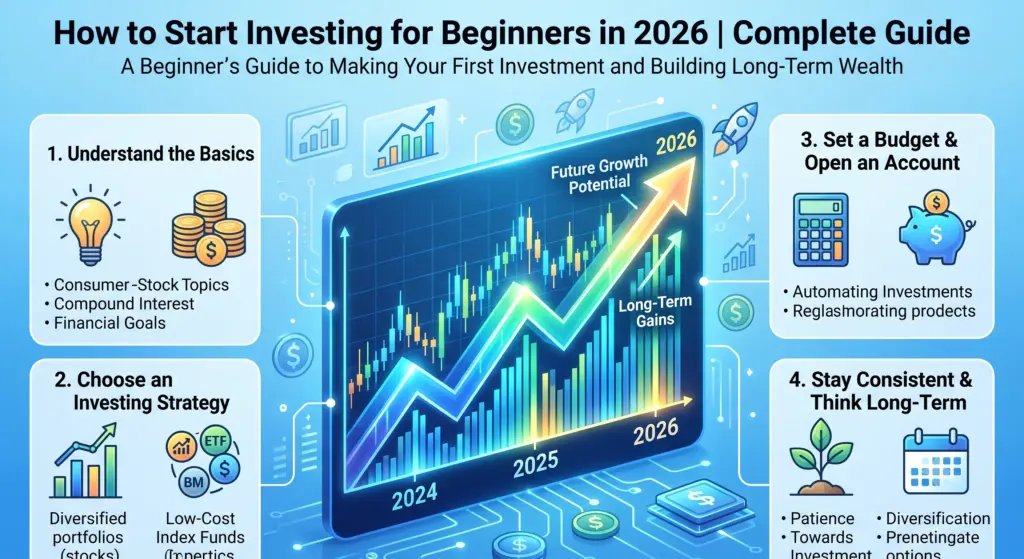
A Beginner’s Guide to Making Your First Investment and Building Long-Term Wealth 📈
How can you start investing in 2026 and build long-term wealth from scratch?
Today’s Generation Z faces unique financial challenges, making wealth creation more critical than ever.
In this post, I will share my own life journey to show you exactly why putting your money to work is essential.
We belong to the middle class, where every single rupee is earned by working day and night.
Therefore, our hard-earned capital must go to a safe place while still growing over time.
Let’s start with the absolute basics to help you build a secure, prosperous future.
Concise summary of this beginner’s investment guide…
To start investing in 2026, beginners must first clearly understand the difference between saving (preserving cash) and investing (growing wealth).
A safe and profitable approach requires diversifying your capital across multiple asset classes.
Beginners should allocate funds into a balanced mix of the share market, Life Insurance Corporation (LIC) policies, Kisan Vikas Patra (KVP), government bonds, and Fixed Deposits (FDs).
Always research companies thoroughly before buying equity.
This balanced strategy protects hard-earned middle-class income while ensuring long-term financial stability and wealth generation against rising inflation.
What This Post Covers
- The core difference between saving and investing.
- Why diversification is the secret to wealth protection.
- My personal journey with small-price shares.
- Top investment vehicles for 2026.
- Voice search FAQs for beginner investors.
Understanding the Basics: Saving vs. Investing
What is the primary difference between saving and investing?
Saving means keeping your money safe for immediate emergencies, whereas investing means making your money work to generate more wealth.
For instance, keeping cash in a standard bank savings account loses purchasing power over time due to inflation.
In fact, during my time as a Branch Manager, I saw a harsh reality.
Many customers kept their life savings in basic bank accounts.
Their money stayed safe, but inflation slowly reduced its value every year.
Meanwhile, customers who invested in fixed deposits (FDs) and government bonds steadily grew their wealth.
However, investing puts that capital into financial vehicles that grow faster than inflation.
It is crucial to understand that saving preserves your capital, but investing multiplies it.
Thus, young earners must shift their mindset from simply hoarding cash to actively building long-term assets.
Read It
25 High-Profit, Low-Investment Business Ideas for Aspiring Entrepreneurs (2026 Global Guide)
The Real Purpose: Securing Your Family’s Future
Why do we actually take the risk of investing our hard-earned money?
Beyond just growing numbers in a bank account, investing is fundamentally about protecting the people we love.
As a husband and a father to two young son, every financial decision I make is focused on my family’s ultimate peace of mind.
When my wife and I sit down to plan our budget, our biggest priority is ensuring our child’s future higher education is fully funded without the burden of heavy education loans later.
Furthermore, unexpected emergencies can strike any middle-class family at any time.
Therefore, building a diversified investment portfolio acts as a strong financial shield for the whole household.
When you invest thoughtfully today, you are directly buying a secure, stress-free tomorrow for your loved ones.
Ultimately, whether you are planning for a child’s degree, a sister’s marriage, or a comfortable retirement, proper financial planning brings absolute peace of mind to your entire family.
Where Should Investment Be Done?
Where should a beginner invest their capital for maximum safety and growth?
You must spread your capital across different financial instruments because every investment has its own distinct benefits.
During my years managing bank branches, I saw firsthand that you should never put all your eggs in one basket.
Some of your money should be in Fixed Deposits (FDs) for absolute guaranteed returns.
Meanwhile, another portion should go into government-backed schemes like Kisan Vikas Patra (KVP) or reliable Life Insurance Corporation (LIC) policies.
Furthermore, adding government bonds provides steady interest with sovereign backing.
Finally, a calculated portion should enter the share market for higher growth potential.
| Asset Class | Risk Level | Primary Benefit |
| Fixed Deposit (FD) | Low | Guaranteed capital protection |
| KVP / LIC | Low | Sovereign backing and life cover 🏦 |
| Government Bonds | Low to Medium | Steady, predictable interest payouts |
| Share Market | High | Significant long-term wealth generation |
My Personal Journey with the Share Market
How can a middle-class beginner approach the share market safely?
If you are investing in shares, you must completely know about the company’s fundamentals before buying.
In my early trading days around 2016, I focused heavily on small-price shares.
I believed that by investing a lesser amount, I could buy a massive quantity of shares, and in the future, it would give me huge returns.
However, my journey taught me that the underlying quality of the business matters significantly more than a cheap share price.
Always prioritize fundamentally strong companies over cheap penny stocks to protect your capital.
Because we work tirelessly for our income, our stock selections must be backed by solid research rather than market hype.
A Real-Life Lesson: Surviving a Market Crash
What happens when the stock market suddenly crashes right after you invest?
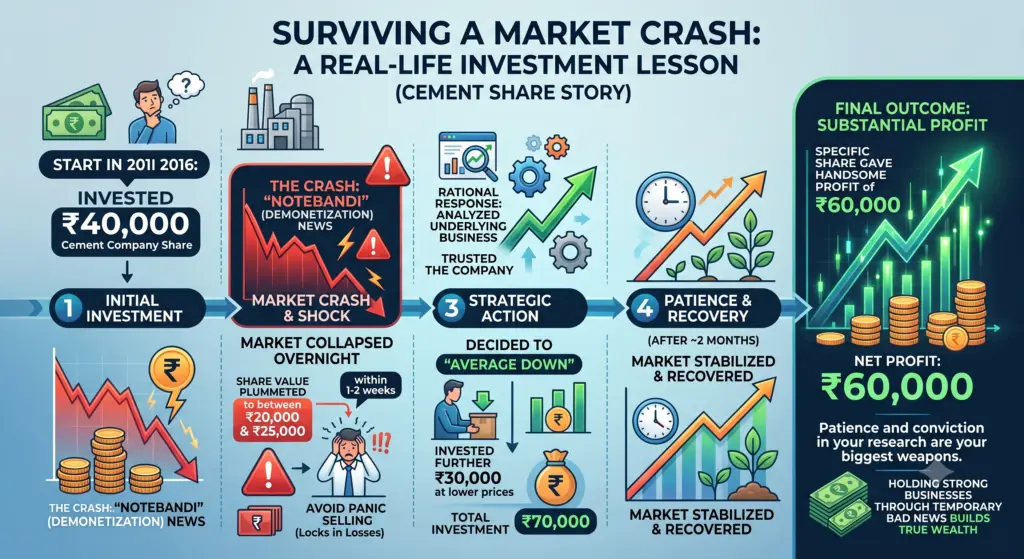
When I started my personal investment journey back in 2016, I learned a massive lesson about market volatility.
Initially, I invested around ₹40,000 in a particular cement company share.
However, shortly after my purchase, the “Notebandi” (demonetization) news broke, and the entire market collapsed almost overnight.
Consequently, within just one or two weeks, the value of my shares plummeted to between ₹20,000 and ₹25,000.
During my years as a bank manager, I saw many people panic in situations exactly like this, pulling their money out and permanently locking in their losses.
How should an investor react when their portfolio drops by half?
Instead of panicking and selling at a heavy loss, I analyzed the situation and trusted the underlying business.
Therefore, I decided to average down and invested a further ₹30,000 into that exact same cement share at the much lower price.
Patience and conviction in your research are your biggest weapons in the stock market.
Eventually, after just two months, the market recovered, and that specific share gave me a handsome profit of ₹60,000.
Ultimately, this is exactly what happens in investing; markets will test your nerves, but holding strong businesses through temporary bad news is how true wealth is built.
Explore It
Groww vs. Zerodha: Which Investment App is Best for Modern Traders?
The Reality of Crypto: My Journey and Deep Facts You Need to Know
The cryptocurrency market is not just a place to park your funds; it is a highly volatile but potentially rewarding digital asset space.
In fact, if you’ve been in the crypto market as long as I have, you quickly learn this reality.
I have been actively trading and investing in this sector since 2018.
Back then, I watched Bitcoin hover between $7,000 and $9,000.
Subsequently, within just a few years, I saw it blast past the $100,000 mark.
That kind of exponential growth is real, and it will continue to offer incredible opportunities if you invest wisely in long-term, fundamentally strong projects.
However, you cannot put your investment money in blindly.
I have seen massive ups and downs in the market because it is a highly fluctuating environment.
While the crypto market can sometimes give 50% to 100% gains in a single day, it can wipe you out just as fast if you don’t know the facts.
Here are some deep, data-backed realities about crypto investing that every beginner needs to understand right now:
1. The Historical Cycle of Crashes and Peaks The crypto market operates in distinct, multi-year cycles.
For example, if we look at the data, Bitcoin hit a massive all-time high of over $126,000 in late 2025.
But right now, in mid-2026, it is trading at roughly half that price — around $62,000 to $64,000.
To a beginner, a 50% drop looks terrifying, yet to a veteran, this is normal.
Historically, Bitcoin has seen massive drawdowns during its “reset” years:
- 2018: Dropped about 83%.
- 2022: Dropped about 77%.
- 2026: We are currently seeing a ~50% drop.
Every single time it has crashed historically, it has eventually recovered to set a new all-time high. Patience is your best strategy in volatile markets.
2. The Power of Absolute Scarcity Unlike fiat currencies which governments can print infinitely, Bitcoin has a strict mathematical hard limit.
There will only ever be 21 million Bitcoins in existence.
Significantly, this absolute scarcity is the core reason why its value has grown so aggressively over the last decade.
As a result, as demand increases over time, the fixed supply naturally pushes the price upward.
3. The “Whale” Phenomenon You are not just trading against other regular retail investors; you are swimming with “whales” — individuals or institutions holding massive amounts of digital assets.
For instance, in July 2026, a wallet that had been dormant for 8.5 years suddenly moved over $380 million worth of Bitcoin.
Consequently, when players of this size buy or sell, they can single-handedly cause the massive daily price swings we see in the market.
My Golden Rule for Crypto Beginners Because this market is highly volatile, your portfolio strategy must be defensive.
Never invest money you might need next month for daily living expenses.
Therefore, do your research, understand the blockchain technology behind the coin, and focus only on long-term projects with real utility.
If you hold strong assets through temporary panic, the market historically rewards that discipline.
Conclusion
How can you take your first step toward financial freedom today?
To sum up, building wealth is a marathon, not a sprint. Start by opening a reliable Demat account and organizing your savings.
Allocate your funds wisely across shares, LIC, KVP, bonds, and FDs based on your risk tolerance.
Consistency and patience are the ultimate keys to unlocking long-term wealth.
Finally, keep educating yourself, stay disciplined, and watch your hard-earned money grow over time. 💡
Frequently Asked Questions
What is the difference between saving and investing?
Saving is for short-term safety, while investing is for long-term wealth building.
Where should a beginner invest in India?
A mix of FDs, LIC, KVP, Bonds, and thoroughly researched stocks is best.
Is it safe to invest in low-price shares?
It carries very high risk, so detailed company analysis is absolutely mandatory before investing. 💰

Leave a Reply